KEPLER MISSION WILL TAKE A GALACTIC CENSUS OF EARTH-LIKE WORLDS
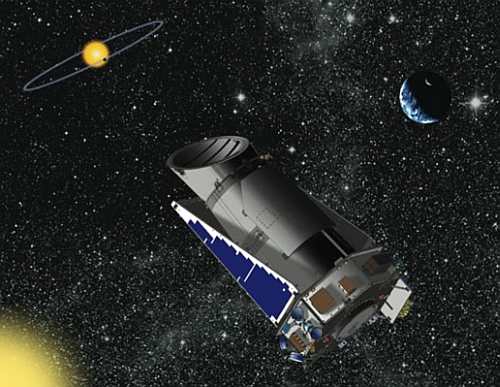
The Kepler mission will be the first serious search for habitable planets in our galaxy.
Taking a break from politics this weekend (at least on this blog) because I’ve had a hankerin’ to do some gee-whiz, wowie-zowie, omigod, eye-popping, knock you out of your sox, space blogging.
There’s a lot going on at NASA besides trying to keep the dinosaur Shuttle fleet in one piece. (I pray every time they launch that Edsel that humans will not pay with their lives for the bureaucratic bungling that has us using this antique rather than modernizing years ago.) It is a consequence of a lazy media and their even lazier audience that the truly stunning scientific accomplishments that NASA is generally responsible for (in partnership with the EU, the Russians, and others on occasion) are barely reported and commented on.
NASA may be an agency in search of a grand vision but when it comes to cutting edge science, they do alright. The Mars rovers, orbiters, and the most recent laboratory lander, the Phoenix, that discovered what almost certainly is water ice at the north pole, are radically changing our view of the “dead” red planet (recent discoveries of plumes of methane suggest the possibility of life).
The agency’s New Horizon’s mission to Pluto and the Kuyper Belt is chugging along about a third of the way to crossing the orbit of Uranus. Launched 3 years ago, the spacecraft is the fastest man made object in the solar system traveling at more than 43,000 MPH. Even at that speed, it won’t reach Pluto until July of 2015.
The Hubbell Space Telescope is still amazing scientists with its discoveries. And for pure, geeky, kewlness, the pictures that are beamed to earth from Hubbell can’t be beat. Hubbell’s successor - The James Webb Space Telescope - will, if it works properly, probably have the capability to see earth-like planets in enough detail that we will be able to discern whether any intelligent life exists there.
But the launch of Webb is four years off. In the meantime, the most sophisticated effort in history to find earth like planets will be undertaken on March 6 of this year when NASA launches the Kepler Spacecraft into orbit.
A different kind of telescope, Kepler will be equipped with a gigantic photometer and will peer at one, small section of the sky continuously, comprising about 100,000 stars. It’s job will be to catch earth-like planets crossing in front of its star - “transiting” is the scientific term - and then determining the shape of its orbit.
The goal is to discover those planets in the “Goldilocks Zone” or habital zone, where water can exist in liquid form and planetary temperatures would at least give life a chance to arise. It’s called the “Goldilocks Zone” because the orbit would place the planet in a zone not too cold and not too hot but “just right.” This is a narrow zone indeed if you think about it. Of our two closest planetary neighbors, Venus is probably too close to the sun for life to have arisen (other factors like a runaway greenhouse effect also doomed life there) and Mars may be at the outer edge of the habital zone, having seen liquid water early in its formation as well as the possibility mentioned previously that some form of microbial life still exists there.
Here’s a brief overview of the mission from the Kepler website:
The scientific objective of the Kepler Mission is to explore the structure and diversity of planetary systems. This is achieved by surveying a large sample of stars to:
- Determine the percentage of terrestrial and larger planets there are in or near the habitable zone of a wide variety of stars;
- Determine the distribution of sizes and shapes of the orbits of these planets;
- Estimate how many planets there are in multiple-star systems;
- Determine the variety of orbit sizes and planet reflectivities, sizes, masses and densities of short-period giant planets;
- Identify additional members of each discovered planetary system using other techniques; and
- Determine the properties of those stars that harbor planetary systems.
Using supercooled charge coupled devices (CCD’s), the sensitive photometer will be able to determine a small body transiting a distant star by measuring light before and during the transit. It is described as akin to measuring the light blocked by a moth as it transits a searchlight. The telescope will have its eye fixed on one, relatively small section of the sky and study such transits for 100,000 stars over a 5 year period.
There are a couple of drawbacks to this method of detecting earth-like planets. First, Kepler will only be able to see planets orbiting within the plane of the star. In our solar system, Neptune orbits outide of the plane of the sun which means its transits are very, very rare. An earth like planet orbiting closer to the star but not in its plane would have more transits but probably not enough to be detected during the 5 year life span of Kepler. (Scientists believe they have to see at least 3 or 4 transits in that period that will show the exact same drop off in starlight due to the object’s transit in order to be able to have a “robust” confidence in the data.)
Secondly, there is a possibility (some astronomers believe a probability) that Kepler won’t discover many of these earth like planets at all, that there are just too few of them. NASA says that this will also be valuable knowledge and I agree. But with cost overruns pushing Kepler’s price tag toward $500 million, the Republican in me questions whether earth-based observations could eventually achieve the same results for about 1/10 the cost.
At any rate, here are NASA’s expectations for Kepler:
Expected Results:
Based on the mission described above, including conservative assumptions about detection criteria, stellar variability, taking into account only orbits with 4 transits in 3.5 years, etc., and assuming that planets are common around other stars like our Sun, then we expect to detect:
From transits of terrestrial planets in one year orbits:
- About 50 planets if most are the same size as Earth (R~1.0 Re) and none larger,
- About 185 planets if most have a size of R~1.3 Re,
- About 640 planets if most have a size of R~2.2 Re,
- About 12% with two or more planets per system.
These numbers come out substantially higher, when one takes into consideration all orbits from a few days to more than one year.
From modulation of the reflected light from giant inner planets:
- About 870 planets with periods less than one week.
From transits of giant planets:
- About 135 inner-orbit planet detections,
- Densities for 35 inner-orbit planets, and
- About 30 outer-orbit planet detections.
Detection of the short-period giant planets should occur within the first several months of the mission.
The sample size of stars for this mission is large enough to capture the richness of the unexpected. Should no detection be made, a null result would still be very significant.
As you can see, there would still be valuable data gleaned from the mission even if they only discovered a handful of earth like planets. To date, extra-solar planets have overwhelmingly been of the “hot giant” class due to the methods employed to discover extra-solar planets using earth based observations. The debate over why this is so is fascinating. Are these Hot Giants failed stars? Since about half of the stars in our galaxy are binary star systems with two suns in close proximity to one another, that explanation makes sense. Or are our theories on how planets form wrong? The “accretion disc” theory has been with us for several decades but suppose there are alternate means by which the dust and gas surrounding a new star resolves itself?
The big question is can both short period Hot Giants and earth like planets exist in the same solar system? Kepler may help answer that.
Kepler is the next step in NASA’s efforts to discover extra-solar life and perhaps, intelligent neighbors who might also be searching the heavens for signs they are not alone. More likely, those planets Kepler will find, if they harbor intelligent life, feature civilizations far more advanced or far less advanced than ours. But the discovery that there are perhaps thousands of earth like planets in the habital zones of stars in our galaxy alone would almost certainly change the way we look at our universe. Even many skeptics would be forced to rethink their notions of life in the universe if Kepler meets expectations.
Enjoy these discoveries while you can. With trillion dollar deficits staring Congress in the face, the probability that NASA funds will be cut to the bone are about 95%. Congressmen find it easy to cut programs that don’t enrich cronies or buy them votes back home. Most of the pure scientific exploration represented by Kepler, New Horizons, the Mars probes, and the Webb telescope are easy pickings for the budget cutters.
The paltry amounts that will be saved pale in comparison to what we will be losing.