Right Wing Nut House

10/10/2005

IN GEORGE WE TRUST?

Filed under: Supreme Court — Rick Moran @ 9:00 am

This article originally appears in The American Thinker

Watching the conservative coalition slowly unravel over the Miers nomination these past two weeks has been an extraordinarily painful experience. Despite all of the hard slogging work done by activists of various stripes over the past quarter century, the winning coalition that encompasses movement conservatives, main street Republicans, foreign policy hawks, and religious fundamentalists under one overarching banner is showing some wear and tear. Five long years of bitter partisan warfare, shocking tragedy, economic bust and boom, and a shooting war in Iraq, where the terrorists test our resolve to prevail every single day, produce a certain amount of stress.

This isn’t the first crisis for the conservative movement since it initially tasted electoral success in the 1980 elections. The world seemed young and full of possibilities then, as the landslide victory of Ronald Reagan, along with the Republican capture of the Senate for the first time since 1948, seemed to augur bigger and better things to come.

Then in the late 1980’s, conservatives fell victim to their own success, as the Cold War ended with astounding speed and the iron curtain fell. Politically speaking, these events started untying the part of the Reagan coalition that included what author Theodore H. White referred to as “urban ethnics.” These were white, middle class, blue collar, second and third generation immigrants, many with deep emotional and family ties to Eastern Europe, who were disgusted with the appeasement and unilateral disarmament policies of the McGovern-Carter wing of the Democratic party.

Economically liberal but socially conservative, they were bunched in an arc in what used to be referred to as “The Rust Belt” along the Great Lakes. Their support allowed Reagan to cut into Democratic strengths in the battleground states of the Midwest. Although considered “natural” Democrats due to their union affiliations, the political brain trust of the Reagan campaign successfully targeted them by appealing both to their patriotism and their unease with liberal values.

Then, in 1992, they went home. With the Cold war over, the Clintonites successfully appealed to the economic interests of this group, portraying George Bush 41 as out of touch with “regular” Americans and thus not able to “feel their pain.” Clinton pandered to their values by rushing home in the middle of his first presidential campaign to preside over the execution of an Arkansas death row inmate, and taking issue with rap singer Sister Souljah.

Many of these white ethnics have since made their way back to the Republican Party, as the Democrats have careened further and further to the left. They have become “values voters” whose allegiance to the party can be traced to its stand on issues like abortion, gay marriage, and the family values espoused so eloquently by President Bush. There is ample evidence that these values voters were the difference in Ohio during the election campaign of 2004.

The crisis over Harriet Miers, however, is much different. It reflects a schism not over ideology, but over perceptions of the President himself. While many activists are extremely unhappy with the choice of Miers and some conservative intellectuals have expressed opposition over her supposed lack of credentials, the question of supporting or opposing the nominee comes down to one, simple question.

How much do you trust George W. Bush?

Even before the Miers nomination, many conservatives have had to take deep breath in order to continue supporting a man whose veto pen seems to have been misplaced in the face of numerous budget-busting, pork-laden spending bills from a supposed conservative Congress. And the President’s support for the McCain-Feingold First Amendment-shattering campaign finance monstrosity has enraged web activists whose support has been so vital both to the Administration’s legislative successes and electoral victories.

But it is on the question of judges that many conservatives have nearly lost patience with the President. They have been frustrated by Bush’s seeming acquiescence in the face of Democratic tactics that seek to impede his most conservative choices. He has been given the benefit of the doubt thanks only to the hyperbole of the left with regard to the unconscionable filibuster tactics of Congressional Democrats.

But now the right is faced with a nominee whose name was put forward as someone who would be acceptable to many of these same Democrats. For some, that is reason enough to oppose Miers. For others, it is proof that the President has “caved in” to certain political realities and has arrogantly ignored the advice of his allies, just to avoid a bruising partisan debate. There has even been talk that Miers should be opposed to teach the President a lesson or to purge her supporters who come from the more moderate wing of the party.

This is idiocy. Prominent conservatives such as The American Thinker’s own Thomas Lifson have pointed out the utter and complete folly of such opposition:

I think these conservatives have unwittingly adopted the Democrats’ playbook, seeing bombast and ‘gotcha’ verbal games as the essence of political combat. Victory for them is seeing the enemy bloodied and humiliated. They mistake the momentary thrill of triumph in combat, however evanescent, for lasting victory where it counts: a Supreme Court comprised of Justices who will assemble majorities for decisions reflecting the original intent of the Founders.

All too often, conservatives have followed a “feel good” course of action and ignored what was possible or even necessary. This has resulted in Republicans devouring their own when it comes to Presidential governance. Only an iconic figure like Ronald Reagan could escape the fate of other Republican Presidents like Richard Nixon and George Bush 41, whose administrations were nearly torn apart by internecine battles between conservatives and pragmatists.

Reagan’s stature was so Olympian in the conservative movement that any visible moves toward the center were blamed on the moderates around him. “Let Reagan be Reagan” was a plaintive, even juvenile cry, first uttered by Interior Secretary James Watt, but which became a battle hymn for movement conservatives who thought they saw apostasy in what was actually Reagan’s deftness and agility in pushing his programs through a heavily Democratic Congress.

Both Lifson and blogger/radio host Hugh Hewitt make the same argument: Trust George. When it comes right down to it, pragmatic conservatives have very little choice. It’s not like they’re going to abandon Republicans and vote Democratic. And it is probable that, with a little coaxing, they can be made to come out and support Republicans in 2006. Indeed, as Democratic prospects have improved over the summer, it will become vital come election time that these same conservatives not sit on their hands and refuse to take part – not with the possible takeover of the Senate, or the House, or both by Democrats in the offing.

For the conservative “true believers” however, this is the crisis of the Bush presidency. No amount of stroking by Bush aides is going to assuage their disappointment. In this respect, it remains to be seen if these disappointed activists will fall on their swords once again in a futile gesture of defiance by staying home on Election Day, 2006. If they do so, and if they hand the election to the Democrats, there could be a real bloodletting among conservatives that could split Republicans for a generation and perhaps even give impetus to the creation of a third party.

Any way you look at it, the President has his work cut out for him. And if Harriet Miers falters or comes up short in any way, the coalition that has elected 3 out of the last 4 Presidents could finally collapse in flurry of recrimination and anger.
10/8/2005

INSIDE “INSIDE BASEBALL”

Filed under: WORLD SERIES — Rick Moran @ 2:53 pm


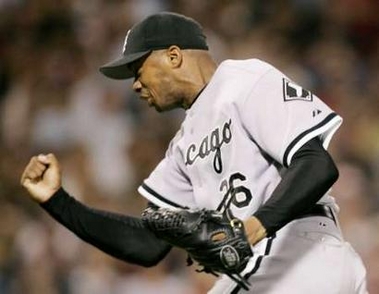
WHITE SOX PITCHER ORLANDO HERNANDEZ, AKA “EL DUQUE,” PUMPS HIS FIST IN TRIUMPH AFTER STRIKING OUT JOHNNY DAMON TO END THE 6TH INNING IN THE CHISOX 5-3 SERIES CLINCHING VICTORY OVER BOSTON

The box score and even most news reports that tell what happened in the bottom of the 6th inning of the Chicago White Sox series clinching 5-3 win against Boston give only the barest of bones about the gorgeous one-on-one struggles between White Sox pitcher Orlando Hernandez and the Bosox hitters. To flesh out what really happened and why, one must look deeper into the very soul of the game of baseball itself to discover the secret by-plays and timeless strategies of both hitters and pitchers to recognize why that sequence was so special both to baseball purists and the history of the game.

First, a little background. The White Sox had gone up 4-2 in the top of the inning thanks to a towering home run by slugger Paul Konerko, one of the few Chisox players not bewitched by Boston pitcher Tim Wakefield’s fluttering, sinking, diving and dancing knuckleball.

At times, Wakefield was damn near unhittable. The knuckleball is thrown in such a way as to negate any rotation on the ball thus not allowing the seams to cut through the air so that the ball flies straight and true toward its target. Instead, because the 60 feet six inches between the pitcher’s mound and home plate is full of currents and eddies of air, the knuckler floats like a paper airplane, diving and rising, swerving and dipping, even appearing to “flutter” up and down and back and forth until it finally arrives at home plate. The pitcher “controls” the pitch in only the grossest sense. And the poor catcher has a devil of a time trying to corral the ball.

But it’s the hitter you should be feeling sorry for. To be effective, the knuckler is usually thrown under 70 miles an hour. Given that most major league fastballs are in the 90 MPH range, the hitter is flummoxed not only by a baseball that changes direction three or four times before getting to him, but it also arrives at the plate traveling not much faster than a good little leaguers fastball. To the batter, what appears to be a slow ball coming at him as big as a pumpkin will, in the end, usually fall out of the strike zone making the batsman look silly as he swings at nothing but air.

This was Wakefield for most of the game. With the exception of a rough spot in the top of the third where the White Sox were able to string together two doubles and a single with two out for two runs, Wakefield had the Chicago hitters hogtied.

Then in the 6th, Jermaine Dye waited out Wakefield and wangled a walk. Konerko followed with his blast and that was it for the Boston pitcher. The White Sox managed to put a couple runners on, but 3 Red Sox pitchers finally got out of the inning.

That half inning lasted nearly 35 minutes which meant that White Sox pitcher Freddie Garcia had been sitting and stiffening up while his teammates were batting. The first hitter he faced in the bottom of the sixth was Manny Ramirez who promptly sent one of Freddie’s slider’s in the general direction of New Hampshire. The ball, in fact, may still be airborne as I write this. It was Ramirez second homer of the game, a titanic blast that proved why he is so much fun to watch hit even if he is on the other team. Almost as much fun to watch bat is David Ortiz who was responsible for the other Red Sox tally also via the homer.

That was it for Garcia who pitched adequately but walked 4 batters and gave up the aforementioned 3 home runs. He gave way to Damaso Marte who promptly got in trouble by giving up a single to Trot Nixon and then two successive walks to load the bases with no one out. One wonders if that is the first and only time Marte will make an appearance in the playoffs as the once unhittable pitcher has become a league punching bag.

Enter Orlando Hernandez. Last winter when the White Sox were looking for a 5th starting pitcher, General Manager Ken Williams wanted to get someone with extensive playoff experience. The fact that he got Hernandez was a stroke of genius as most baseball experts believed El Duque’s best days were behind him. The Cuban defector had a great record in the playoffs however and after a mediocre year as a starter, manager Ozzie Guillen decided to add the aging hurler to the playoff roster to give some seasoning to the young, inexperienced arms in his bullpen.

El Duque came out of the pen with his usual swagger. As St. Louis Cardinal Hall of Fame pitcher Dizzie Dean once said “It ain’t braggin’ if you can do it,” and El Duque was going to need all of his guile, his talent, and a great deal of pluck to get out of this game altering situation.

After throwing his 8 warm-up tosses, into the batter’s box steps one of the great clutch hitters of the game, Red Sox Captain Jason Varitek. Varitek hadn’t shaved for about three days and he looked like the true throwback player that he his; a scowling, menacing, hulking presence at the plate. El Duque stared at him while Varitek went through his “routine” or the rigmarole that all batters have before they get set to hit. Varitek got ready, bat poised off his shoulder, his eyes intent on Hernandez. But El Duque just kept looking at him. Varitek, not wanting to give in to El Duque’s little stratagem of trying to freeze him, kept his eye on Hernandez, his bat very still while time itself slowed and the crowd grew a little quieter. But El Duque just continued to stare at Varitek intently. Finally, the scowling slugger gave in and called for time, stepping out of the batter’s box.

Round one to El Duque.

Immediately upon his return into the hitters area, Varitek needed to get ready because Hernandez was going into his stretch. This is a veteran pitcher’s trick to keep the hitter from getting too comfortable, too familiar at the plate - especially in game situations. El Duque then reared back and fired…his “ephus” pitch. Also called a “parachute” pitch, the ball actually travels in an arc to home plate like a slow-pitch softball delivery. Hernandez pitch wasn’t a true ephus pitch but it had the desired effect. Even though it fell over the plate several inches inside, Varitek’s eyes went wide and he started talking to himself.

Round Two to the pitcher.

Varitek never had much success in his career against Hernandez, getting only 3 hits in 29 at bats. Now that El Duque had him off balance, he quickly worked the count to 1 ball and two strikes. Hernandez then delivered the perfect pitch; a high fastball, slightly inside. It was too close for Varitek to take, hoping it would be a ball and he was forced to swing at it. The result was a weak pop-up in foul ground caught by White Sox first baseman Paul Konerko for the first big out of the inning.

Round three TKO to Hernandez.

Next up was the excellent clutch hitting Tony Graffanino who had the extra incentive to redeem himself following his unforced error at second base in Game 2. Graffanino is the consummate pro and took the first two offerings by Hernandez for balls. Being up 2 balls no strikes with the bases loaded and one out is almost an automatic “hit away” situation. The pitcher absolutely has to throw a strike. Hernandez delivered and Graffanino was right “on” the pitch - his timing was right - but he only got a piece of the ball and it went back to the screen for strike one.

The next pitch was a little trickier. It was one of El Duque’s specialties - a sweeping, swerving slider that Graffanino topped into the ground in foul territory for strike two. And then, the battle was really joined as Graffinino fouled off two Hernandez rising fastballs and then watched a slider dip low and away for ball three.

This put Graffinino in the drivers seat. El Duque just had to come to him with a strike. A walk would force in a run. No one knew this better than El Duque. But over the next four pitches - all fouled off by the tenacious Graffanino - Hernandez proved that it mattered where you throw a strike. His pitches were all barely off the plate - not a true strike among them. But Graffinino didn’t want to strike out either, so with a brilliant piece of hitting and plate coverage, he got a piece of each of El Duque’s offerings, hoping that Hernandez would make a slight error and he could get the meaty part of the bat on the ball and drive it to the outfield for at the very least a sacrifice fly that would tie the score.

Finally, after 10 nerve wracking pitches, Chisox catcher A.J. Pierzynski called time and went out to discuss the matter with Hernandez. After the game, El Duque said that he told A.J. he wanted to throw a slow curve to throw Graffanino off stride. From the looks of the conversation on the mound, A.J. was probably trying to talk Hernandez out of it. In the end, Hernandez ended up throwing a slow, spinning, get-me-over curve ball that badly fooled Graffanino who was still looking for the heat. Tony G swung and popped the ball weakly to shortstop Uribe.

Second set to El Duque.

That confrontation with Graffinino was almost too beautiful to watch. It was beyond classic. It reached down and grabbed the very essence of what baseball is - a team game that is almost totally dependent on a mano a mano confrontation between a pitcher and a hitter. High salaried, spoiled players can’t ruin it. Greedy owners can’t ruin it. Even inane announcers couldn’t ruin that moment.

And it wasn’t over yet.

Up steps one of the top five hitters in the game, Red Sox center fielder Johnny Damon. Damon of the 197 regular season hits. Damon of the 75 RBI’s - an astronomical total for a leadoff hitter. Damon of the grimly determined bunch of Red Sox fatalists who never gave up and was one the heroes of the Red Sox magical run to the Championship in 2004.

More El Duque gamesmanship as he does a little mound cleaning just as Damon steps into the batters box. With his spikes, he carefully digs a little trench on the third base side of the pitcher’s rubber. His concentration on his mound maintenance is apparently total. A closeup of the pitcher however, shows a grim little smile playing at the corners of his mouth.

Following the game, Paul Konerko was asked what he thought of Hernandez. Konerko averred that El Duque had more heart than any player he had ever been around. Ozzie Guillen called Hernandez “cold blooded.” Either way, Hernandez would need all of his wits and wisdom to get past Johnny Damon and get out of the inning unscathed.

El Duque began to fire; Strike one fastball. Ball one fastball outside. Strike two on a fastball Damon couldn’t catch up to and fouled off to the left. Ball two on another fastball. Another foul on a slider. And a curve ball that broke off the plate inside took the count the 3 balls and 2 strikes once again. A rising fastball was fouled off again by Damon.

The crowd, a screaming, swaying, living , breathing thing was on its feet begging, imploring, trying to will the miracle all by themselves. The Red Sox nation never gives up. And if you didn’t get a chill listening to that crowd and watching the action and the by-play of that inning, you must be drinking formaldehyde ’cause you’re not livin’ the way the rest of us are.

Another 3 and 2 pitch was in the offing and El Duque had a choice. Damon had been timing his fastball and was more than likely to hit it hard if he threw it over the plate. So he chose to throw is breaking ball. The pitch started over the middle of the plate but then, as Damon started his swing, the ball broke viciously downward, diving into the dirt. Too late, Damon had started his swing and couldn’t stop it before the bat had crossed home plate. No appeal to the third base ump was even necessary. Damon had struck out and he knew it.

Game, Set, Match El Duque.

The rest of the game was nerve wracking but mostly anti-climactic. Hernandez had the Red Sox eating out of his hand in the 7th and 8th inning, allowing only a Texas League single to John Olerude. And after the White Sox literally squeezed a run across in the top of the ninth giving them a two run lead, all that remained was for baby-faced Bobby Jenks to blow the Red Sox away in the ninth inning, a task that he accomplished with an alacrity that was almost like a merciful coup de grace to the Red Sox. Their gallant run was over.

For the celebrating White Sox, it was a trip back home to await the outcome of the Angels-Yankees series. And if those games have half the drama of the last two, I would suggest you get your heart medication refilled quickly. And while you’re at it, keep the Prozac handy because White Sox fans can anticipate even more nerve wracking chills and thrills during this next, longer, 7 game series.

UPDATE

The Crank ignores my Chisox clincher and gives a short, sweet, and spot-on analysis of the Yanks-Angels marathon that brought the Bronxies to the brink of elimination. While he rightly touts Torre as a great playoff manager, I questioned his use of Small in that relief situation in the fourth. While I recognize that he needed a pitcher that could have given him at least three innings, couldn’t Sturtz have filled the bill? As a former starter, Tanyon may have been more effective, being used to coming out of the pen. As it was, Sturtz came out of the bullpen to face only one batter.

10/7/2005

CARNIVAL OF THE CLUELESS #16

Filed under: CARNIVAL OF THE CLUELESS — Rick Moran @ 10:59 am

Regular visitors to this site will have perhaps been chagrined to discover that the last week or so, there has been a dearth of political blogging at the House. Instead, I have written extensively on the titanic struggle between two different socks - er, Sox that is - and a children’s game that most modern Americans look upon with a haughty disdain as a passion more suited for wheezing old-timers and clueless kids who are unaware that football in fact, is now king in America.

I’m speaking of my 45 year love affair with the game of baseball.

The Miers nomination, Bill Bennett’s comments about race and crime, the DeLay indictment(s), and other more worthy subjects have taken a backseat to what my good friend The Maryhunter has called while he’s guesting on TJ’s excellent NIF Blog, my “obsession” with baseball. I plead guilty as charged. While I generally have many other passions - history, space, reading, writing, cats, and coffee - it is sports and in particular baseball that takes up much of my free time and engages my interest.

I know it is silly. I realize for a grown man to memorize a baseball batter’s average with runners in scoring position (RISP) or a pitcher’s strikeouts to walks ratio borders on the irrational. And this obsession recently has not been helping either my links or my traffic for this blog.

But I don’t care. And for this obsession with my Chicago White Sox - my beloveds - I am forced to name myself, Rick Moran, as Cluebat of the Week.

To the overwhelming majority of you who despise baseball, I know this comes as very good news. Even though some prominent conservatives are huge baseball fans - George Will and George Bush come immediately to mind - I realize that the right wing in America has abandoned this one tradition that, as James Earl Jones playing the Salingeresque Terry Mann in the baseball fable Field of Dreams points out, is “the one constant” through all the years of struggle and upheaval which has kept America together:

And they’ll watch the game and it’ll be as if they dipped themselves in magic waters. The memories will be so thick they’ll have to brush them away from their faces. People will come Ray. The one constant through all the years, Ray, has been baseball. America has rolled by like an army of steamrollers. It has been erased like a blackboard, rebuilt and erased again. But baseball has marked the time. This field, this game: it’s a part of our past, Ray. It reminds of us of all that once was good and it could be again.

It should go without saying that a game that has insisted on maintaining an anti-trust exemption and fights fiercely to keep control of both the number and location of franchises is anti-competitive and anti-free market, attributes that make baseball a very un-conservative pastime. And the morally reprehensible behavior by athletes that at times has been winked at or even condoned by the league does not recommend the game as a good example of American morality.

Nevertheless, my cluelessness about the importance of baseball as compared to some of the stories and individuals covered in this week’s Carnival should be seen in the context of my love for a truly remarkable American game where “the mystic chords of memory” bind us in inexplicable and mysterious ways to our fathers, our grandfathers, and their grandfathers before them. Baseball is memory. And despite all, it will remain for me a touchstone to my youth and a source of pleasure for as long as I endure on this earth.

” When you come to a fork in the road….Take it “
(Yogi Berra)

“Hey Yogi! You’ve analyzed the Democratic Party platform perfectly!”
(Me)
**********************************************************************
Don Surber leads off this “diamond” edition of the Carnival with some rational and cogent thoughts on how conservatives should be opposing Robert Byrd in his re-election bid for the Senate. Don’t play the race card says Don. Agreed, but you gotta admit Jeff Goldstein’s “brief conversations with Senator Robert Byrd’s (D-WV) Grand Kleagle hood” is one of the funniest bits on the net.

Wonder Woman does a great job fisking an anti-American flash presentation on the history of our relationship with Saddam Hussein. How the left always ends up on the wrong side of history is a source of continuing fascination with me.

Josh Cohen skewers the MSM for celebrity obsession at the expense of reporting real news. Given the vapidity of thought and cluelessness of most celebrities when it comes to politics, I heartily agree.

Two Dogs has some…ahem, interesting thoughts on Bill Bennett’s comments regarding race and crime as well as a message for the moonbats: Meany: “I know that you have a masters degree in 15th Century poetry, Moonbeam, but that doesn’t mean that you are smart, that means that you are a dumbass.” Hee.

An arts center in Atlanta named for the late Gangsta Rapper Tupac Shakur? Mensa Barbie has the skinny and a thought on where the arts may have diverged from the dominant culture.

Pat Curley has an interesting article on why many Americans still believe that Saddam was responsible for 9/11 which gives the lie to Al Gore’s oft repeated claims of the Bush Administration promoting the idea.

Jay at Stop the ACLU has a question for the “rights” group about why it’s bad to print pictures of a prostitutes Johns in the newspaper but alright to print pictures of terrorists being abused by Americans.

Omigod…Beth has a live one. A commenter actually believed that her post for White Trash Wednesday featuring the sometimes catty, usually trashy, and always clueless Beulah Mae was written by a real person! And you won’t believe the IP address either.

Ferdy the Cat says we should be cautious when reading stories on the internet. First, see if the story comes from an accredited journalist. Ferdy: “If it doesn’t, then it may be distorted or fabricated. If it does, then it may be distorted or fabricated.” One smart cat, that Ferdy…

Carnival Superhero, the lovely Pamela of Atlas Shrugs gives us the horrifying news that the UN’s Nuclear “watchdog” Mohamed ElBaradei (some watchdog!) is up for the Nobel Peace Prize. Maybe while they’re at it they could give a humanitarian award to Saddam Hussein.

Rachel at the excellent blog Tinkerty Tonk has some thoughts on the panting moonbats who see ABC’s Drama Commander in Chief as paving the way for Hillary in ‘08. Are we “smart enough” to elect a woman President? Rachel: “Geez, if it weren’t for Geena Davis, I’d never have considered such a new-fangled notion. What’ll they think of next?” Yup.

Here’s your weekly dose of excellent satire from two of our Carnival regulars. First, The Nose on your Face has the mystery of the arresting officer’s missing hand at the Cindy Sheehan media circus during the anti-war demonstration. This one as well as Mr. Satire’s take on some Garrison Keillor hypocrisy are both laugh out loud funny as well as being unsafe for work.

AJ at The Strata-Sphere has some truly shocking revelations about a probable source for global warming that shoots holes in the luddite arguments about climate change.

Van Helsing is tracking moonbat Donald Sutherland and his recent breakdown in public over how America is doomed! Doomed I tell you. Says the slayer: “The same to you Donald, and to the rest of the infantile group-thinking zillionaire traitors who make up the Hollywood Left.” Uh-huh.

More on Sutherland from Duncan Avatar who reminds us all of what actors actually do as opposed to who they really are: “Remember folks, Donald only plays intelligent human beings on television, doesn’t mean he himself is intelligent.” As I former actor, I can attest to the truthfullness of that statement.

Matt Barr has some fascinating thoughts on an ad campaign in Florida regarding new laws about guns and victims rights that are designed to keep clueless criminals from making a mockery of the law.

Cao (pronounced “key”) has everything you want to know about the University of Oklahoma cluebat who could very well have been America’s very first suicide bomber. We can only hope that any imitators are equally clueless about high explosives. Great post, Blogmama.

Not to be outdone, The Maryhunter reminds us all why Cindy Sheehan is a c**t. While Maryhunter doesn’t use that perjorative, I’ve come to the conclusion that it is a most apt description of this clueless slimeball. Great job, TMH.

Mike Huckabee for President has more on Al Gore’s rant of a speech given in moonbat heaven, San Francisco, about how America is in D-A-N-G-E-R. After quoting how Dan Rather was “forced out by the White House (????)” clueless Al quotes Dandy Dan by saying that “V news has been “dumbed down and tarted up.” As Blue State Republican says “DAN RATHER? He quotes Dan Rather?”

Orac is mad at Bill O’Reilly and for good reason. O’Reilly evidently needs some remedial work in history not to mention some common sense and a decent sense of when to keep his mouth shut. Other than that, I can’t think of a thing wrong with him.

Dan Melson at Searchlight Crusade brings us the story of an air traffic controller in Las Vegas that made a huge, potentially catastrophic mistake.

The Prowling Pachyderms from Elephants in Academia have fleshed out a story about a Kansas State “Cultural Conference” where one of the topics will be “The Secret Lives of Conservatives.” One of the subtopics is “sexual dysfunction in conservatives.” Hey moonbats! Speak for yourselves!

Jimmie K has some truly clueless news about the CIA’s Porter Goss not convening a special committee to look into the abject failures of our intelligence service with regard to 9/11, WMD, etc. etc. etc… Goss evidently gave into pressure from the agency about how it would “lower morale.” Better to get rid of incompetents rather than hurt the spooks feelings, I should think.

Finally, I criticize the stupidity of the Boston Red Sox in Game 1 of the Division Series against my beloved White Sox.

10/6/2005

THE THUNDER ROLLS

Filed under: WORLD SERIES — Rick Moran @ 6:40 am


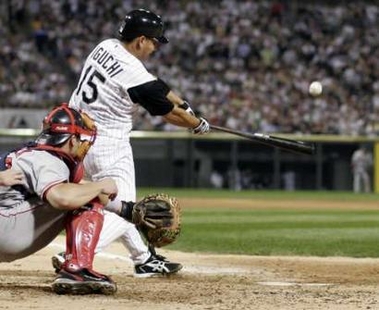
Chicago White Sox batter Tadahito Iguchi (15) of Japan hits a three-run home run off of Boston Red Sox starting pitcher David Wells

The origin of the curve ball is shrouded in mystery. Some believe the claims of one William “Candy” Cummings who says he invented the pitch in the 1870’s. More likely, it was a host of pitchers who figured out early on that if the ball was gripped a certain way and released with a snap of the wrist, it would move precipitously away from or toward the batter, depending on which side of the plate the hitter is standing.

There has even been something of an ongoing controversy as to whether or not the ball curves at all. As late as 1941 Life Magazine published a series of pictures which purported to show that the curve ball is actually an optical illusion, that the ball doesn’t move.

This is silly of course, as any slow-motion camera will clearly show. But even knowing the physics of the curve ball doesn’t help Major League hitters much. All they know is that when thrown by a master, they’re in deep trouble at the plate.

For a period of time, the curve ball fell out of favor with Major League pitchers. During the 1980’s and 90’s, not only did pitchers become more enamored of the split fingered delivery as an “out” pitch but umpires were refusing to call the pitch for a strike - death to curve ballers whose pitch relied on umps not giving up too soon on the diving, slanting ball that in the hands of a master would cross the plate at both a downward and sideways angle.

Then, the wheel turned again as it is apt to do in a game that has had such longevity and the curve was back in style. It says a lot about this particular pitch that the curve ball has achieved iconic status among both hitters and pitchers to the point where it actually has numerous nicknames. It is “Uncle Charlie” or “The Yellowhammer” or “Captain Hook.” And its modern masters include some of the best pitchers in the game such as Oakland’s Barry Zito, the White Sox own Freddie Garcia, and the ageless playoff warrior for Boston, David Wells.

Wells was on the hill for Boston last night enjoying a 4-0 lead in the fifth inning thanks largely to his control of a devastating curve ball. When released, Wells’ curve starts off head high and out of the strike zone. By the time it crosses the plate, it has dropped to the knees and traveled a good 18 inches or more which usually causes the hapless batter to freeze like a side of beef in cold storage.

The pitch had puzzled White Sox hitters for 4 full innings. Then Carl Everett singled sharply to right center on a low outside fastball and Aaron Rowand got a lucky break and made contact with Wells’ “Uncle Charlie.” Rowand was fooled on the pitch and swung way too early, the ball hitting off the very end of the bat and was softly popped directly down the left field line. Bosox left fielder Manny Ramirez had been shading Rowand slightly toward center field so was out of position to field the ball and could only watch helplessly as the ball dropped inches fair for a freak double. Everett, running hard and intelligently, guessed that Ramirez wouldn’t be able to catch up to the ball and scored standing up. That made the score 4-1 and the White Sox were in business.

The next batter was catcher A.J. Pierzynski, hitting hero of game one but badly over matched by the lefty slants of Wells. The first pitch Wells threw was a real yakker of a curve, so devastating that A.J. actually flinched thinking the ball was going to hit him. Instead, it dropped gently over the outside corner of the plate for a strike. Nevertheless, A.J. battled hard, fouling off a few good pitches, until he was finally able to ground the ball softly to the right side of the diamond allowing Rowand to take third. Joe Crede then stepped up big and with the Boston infield playing back conceding the run, the White Sox third sacker lashed a ground ball “seeing eye” single to center scoring Rowand making it a 4-2 ball game. If the infield had been playing in to cut off the run at the plate, the ball may have been fielded by second baseman Bill Mueller. As it is, we’ll never know.

What followed next was painful for Red Sox fans to watch as it happened and also for White Sox fans in retrospect. Juan Uribe, badly fooled on another brilliant Wells curve ball, hit the ball off the end of the bat and sent a wildly spinning masse shot of a ground ball slowly toward second baseman Tony Graffanino. Tony “G” was a fan favorite and beloved teammate for the 3 plus years he played for the Chisox and had been a reliable second baseman for the Carmines, making only three errors since being picked up in a trade with Kansas City in July. But the angels who sat on the shoulders of the Red Sox last year during their championship run must have been on a coffee break because as Uribe’s grounder reached Graffanino, the ball scooted under his glove and into short right field. What was at least one sure out became an error that allowed Crede to take third.

Still, the Bosox were ahead 4-2 and Wells had proven himself a battler in his 28 previous playoff starts. Sure enough, he induced left handed hitting Scott Podsednik to pop up weakly to third which took the sacrifice fly off the table for the White Sox. If they were going to inch closer and get Crede home from third, it would be up to second baseman Tadahito Iguchi to hit safely.

“Da Gooch” had proven himself an unbelievable clutch hitter all year long. Not only were 11 of his 15 home runs hit to either tie or win ballgames but his batting average from the 7th inning on was a white-hot .340. Clearly, the Japanese import liked to bat with the game on the line.

Wells’ first offering was off the plate. Then he snapped off his best curve ball of the game, a real jelly roll of a pitch that started in the left hand hitter’s batters box and dropped like a brick over the inside corner of the plate for a called strike.

What happened next was not exactly “The Shot Heard ‘Round the World” that Bobby Thompson’s legendary 1951 home run became known as but the noise made at U.S. Cellular field could at least be heard in Rockford.

Iguchi watched as Wells threw another great curve, not quite as good as the previous pitch but still a real biter, burrowing toward the inside part of the plate like a scared mole when Iguchi stepped slightly “in the bucket,” moving his left foot backward just enough so that his hips flew open and allowed the bat to move through the hitting zone with lightening speed. Ball met bat and Iguchi met history. The ball sailed on a line drive over the fence for a shocking three run homer and the White Sox had surged ahead 5-4.

After the game, Wells allowed that he had “hung” the ball. This is clearly not the case as replays show that it was a good pitch, well located and that Iguchi simply won the battle. Pitchers hate hitters (and vice versa) and usually refuse to give them any credit for winning the most lovely of one-on-one competitions in sport - the eternal struggle between the hurler and the hitter.

The game was far from over at that point what with White Sox pitcher Mark Buehrle getting slapped around by the top of the Red Sox lineup with alarming regularity. The dangerous duo of David Ortiz and Manny Ramirez had come through in the first and third innings accounting for 3 of the 4 runs scored by the Bosox and Jason Veritek owned the Sox hurler going 2 for 2 and an RBI.

But Buehrle hung on grimly for two more innings as Red Sox hitters hit cannon shot after cannon shot only to have their efforts thwarted when the ball ended up being hit almost directly at White Sox fielders. Buehrle left at the end of the seventh to be replaced by the Chisox newly minted closer, Bobby Jenks.

I profiled Jenks here, saying that he had “the heart of a lion and the soul of a serial killer.” Bobby didn’t disappoint as he mowed down the Red Sox allowing only an 8th inning walk to Trot Nixon and a solid double by Tony Graffanino in the 9th. Tony G’s hit with one out could have redeemed him in the eyes of history and Boston fans but alas, Jenks threw a perfect cut fastball that Johnny Damon popped up weakly to Pierzynski in foul territory for the second out and then induced shortstop Edgar Renteria to ground out to his counterpart Uribe to end the game and send the White Sox to Boston with a 2-0 series lead.

Boston has been a magical franchise through the years and has proven that it can come back from the brink of disaster time and time again. In the last two years, they are a spectacular 8-1 in elimination games. And they’ve come back twice since 1999 when down 2-0 in the Division Series. Clearly, with the Red Sox nation behind them, the Carmines feel capable of any miracle.

But this time, it may be different. The Red Sox are putting knuckleballer Tim Wakefield out on the mound for game 3, a pitcher the White Sox have hit well. And with Freddie Garcia going for the Chisox - a proven big game pitcher who has been throwing the ball well recently - the White Sox have an excellent chance to sweep the World Champs.

All depends on Wakefield and the vagaries of the knuckleball - a pitch that even the pitcher doesn’t know exactly what route it will take to the plate. If the wind is wrong or if Wakefield’s release is just a bit off, it could be a very short stint for the veteran hurler.

One thing is certain; all the White Sox have to do to advance to the League Championship Series is win one of the next three games. Given the depth and talent on the Chisox pitching staff, it seems inevitable that the current champs will go down to defeat while thinking bitterly about both the Graffanino error and the thunder that shook northern Illinois as Iguchi’s blast disappeared into the night.

UPDATE

Laurence Simon has locked up his kitties for a while to blog about bloggers rooting for their respective teams in the Division Series.

Go here and sign up to be recognized. And if you’re a White Sox fan, please go as we are horribly outnumbered by both Bosox blogs and Bronx Scum Bag fans.

10/5/2005

BIG BOPPERS BLAST BOSOX

Filed under: WORLD SERIES — Rick Moran @ 7:34 am


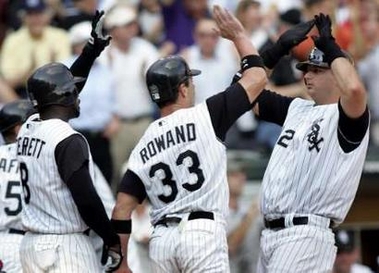
Chicago White Sox A.J. Pierzynski is congratulated at home plate by Carl Everett (L) and Aaron Rowand after hitting a three-run home run against the Boston Red Sox in the first inning of their American League Divisional Series

Forty six years is a very long time to go without a home playoff win for most baseball franchises. But given the fact that no Chicago team has won a World Series since 1917, the concept of time for White Sox fans has become a relative thing. We here in the Windy City do not measure our sports disappointments using such archaic and unenlightening concepts like linear time. Rather, the bio-rhythms of the cicada - who return every 7 years - is a more appropriate notion. Hence, when viewing the dearth of playoff successes for the Pale Hose, it sounds much better and is actually more accurate to state that it has been approximately 6 1/2 cicadian life cycles since the White Sox managed a home playoff triumph.

Doesn’t sound quite so bad when put that way, huh?

That said, it is hard to overestimate how sweet the White Sox 14-2 victory over the Boston Red Sox was for Chicagoans. We are so used to seeing our players tie themselves into Gordian knots of apprehension, giving into the pressure at playoff time that to see how loosey-goosey the Chisox were from the get go has allowed a small measure of hope to creep into our settled and fatalistic approach to gaging our chances of ultimate success during baseball’s mean season.

It was the World Champion Boston club who looked like bushers. Red Sox starting pitcher Matt Clement (an ex-cub…’nuff said) had a perplexed look frozen on his face for the entire time he was on the mound. It was almost as if he didn’t quite know where the ball was going to end up once it left his hand. Come to think of it, that’s pretty much the case. Clement plunked two of the first three batters he faced and then watched helplessly as White Sox scored two runs by getting only two hits - a liner to right by Carl Everett, and centerfielder Aaron Rowand’s soft single over the head of shortstop Edgar Renteria, a ball not hit hard enough to dent a Rosatti’s Chicago style pizza box.

Still, Clement could have gotten out of that first inning with only the minimal damage of two runs but for Chisox catcher A.J. Pierzynski. Now A.J. has been in a power slump, having last hit a home run about the time that the aforementioned cicadas were emerging from their 7 year slumber. Well…perhaps not quite that long. At any rate, the White Sox backstop sent one of Clement’s perplexed deliveries on a line to the opposite field and into the seats for a three run homer. The crowd went wild, the home team dugout erupted, and Clement? Clement cast his eyes skyward apparently seeking help from some of the same baseball gods that intervened last year to give the Bosox a World Series title.

But those whom the gods destroy they first drive mad and then laugh uproariously at the looks on their victim’s faces. The whiskers that grace Clement’s chin seemed to turn several shades grayer and by the time Red Sox manager Terry Francona pulled the hapless hurler in the 4th inning following a two-run blast by White Sox shortstop Juan Uribe, Clement looked like Odysseus after being pummeled by Poseidon’s wrathful storms - a broken shell of a man, tattered and torn by the South Sider’s onslaught.

The slaughter was on and there was nothing the Chowderheads could do to stop it. Before he exited the game, Clements gifted White Sox slugger Paul Konerko with a solo homer before giving up Uribe’s towering drive into the left field seats. He was replaced by former White Sox reliever Chad Bradford whose underhanded delivery turned the tables and perplexed the Chisox hitters for an inning. Alas, for Red Sox fans, their relief was shortlived. Bradford is a set-up man out of the bullpen and not intended to pitch to more than a few batters.

The submariner then gave way to Jeremi Gonzalez who came in and promptly threw a home run ball to a man who had 507 at bats during the regular season without a single round tripper. To say that Scott Podsednik’s 3-run tater was unexpected is like saying Federal prosecutors found no corruption in Mayor Daley’s city hall; it’s something you just can’t believe unless you see it with your own eyes. No one looked more suprised than Podsednik who didn’t quite know how to behave when circling the bases. Instead of the stately, majestic home run trot of your typical power hitter, Scotty scooted around the bases so fast it appeared he believed someone was playing a huge practical joke on him and he better get a move on before they changed their minds.

Topping off the day was a second homer by Pierzynski, this time off Bronson Arroyo, another Boston lamb led to the slaughter. The tally for the Red Sox bullpen was 6 runs on 4 hits over 4 2/3 innings for an Earned Run Average of about 12 runs per 9 innings. Not an auspicious beginning for a crew that is being counted on to relieve Boston’s aging and inconsistent starters.

On the other side of the coin, White Sox pitcher Jose Contreras pitched well, if not spectacularly. All the early runs simplified Mr. Contreras task immensely. All he had to do was throw strikes and allow the over-anxious Red Sox hitters to get themselves out. The vaunted Bosox offense could manage only two runs against the slants of 3 White Sox pitchers with the dynamic duo of Ortiz and Ramirez going a combined 2 for 8 - Ortiz getting both hits - and both men leaving a combined 5 players in scoring position. Best not to gloat where those two are concerned as they are just as likely to knock the ball all over the yard for the rest of the series. But for this game, they were as quiet as mice in Boston’s North Church.

Most baseball people expect the Red Sox to rebound following this humiliating defeat and I see no reason why this should not be so. They are professionals who realize that this game was a fluke and probably not indicative of the way the rest of the series will play out. The one intangible is that a great weight has been lifted from the White Sox shoulders which will allow them to relax a little. It has also given the club some confidence, two elements that can translate into winning baseball for the duration of the series.

We’ll see. In the meantime, playoff warrior David Wells takes the mound for the Red Sox tonight. He’ll be opposed by playoff rookie Mark Buehrle, a pitcher who threw well the last few weeks of the season. Will the canny veteran Wells be able to stifle the Chicagoans and give his potent offense a chance to get it into gear?

My guess is that it will be a high scoring game decided in the late innings. And in a bullpen vs. bullpen match-up, I like the chances of my White Sox.

UPDATE

The Baseball Crank predicts my beloveds to win the Bosox series but then inexplicably gives the hated Yankees the nod in his expected ALCS - in a sweep no less.

The ridiculousness of that notion is so profound as to call into question Mr. Crank’s sanity. With their aging, injured, patchwork pitching staff, it’s problematic whether the Bronx Bums will be able to get by the Angels much less sweep a team with a pitching staff as deep and talented as the White Sox. Methinks I detect a whiff of Yankee Kool aid on the breath of the Crank…best mix it with a few grains of salt.

And Pauli at The Commons bemoans Clements ineffectiveness in the second half of the season. This is all part of the “Ex-Cub Factor” that I will write about tomorrow.

10/4/2005

ON THE CUSP OF IRRELEVANCY

Filed under: History, Politics, Supreme Court — Rick Moran @ 9:06 am

The Presidency of the United States has been called both the strongest and the weakest elected office in democratic government. This is because the President has no real constitutional authority to enact laws, consent to treaties, (theoretically) declare war, or even choose his own cabinet. All of these Presidential actions are dependent on the suffrage of the elected representatives in the Congress. The President can only “propose” not “dispose” and thus in a very real sense is at the mercy of both the partisan opposition and the vagaries of electoral politics in his own party when it comes to enacting his policies.

But the President is not a helpless giant. His ability to get what he wants from the Congress is usually directly related to his standing with the American people. Before opinion polls, Congressmen relied on a keen political ear in their own districts and states to tell them whether or not supporting the President would lead them into trouble. Even today, legislators can get a good sense of where their own constituents stand on the subject of the President’s popularity simply by reading their mail. True, there are organized attempts to influence the Congressman’s position by flooding he email or deluging his office with telegrams. These interest-group driven campaigns are also helpful although are not given as much weight as the letter from the 80 year old grandma who is worried about having her social security check cut.

What this adds up to is one of the truly remarkable aspects of our republic; the power of the President to get things done being dependent on how well ordinary people think he’s doing his job. This is not some pie-in-the-sky, starry eyed first year poli-sci nonsense but rather the cold calculation of power used by both parties, honed to a fine point via the science of polling, and then sliced and diced by experts to determine what kind of influence the President can wield.

Lately, the process has become even more sophisticated as “talking points” for the party faithful are promulgated based on this polling data and surrogates pan out to hit the various cable news shows where no matter what question is asked by the host, the talking points are driven home at least twice in the segment. Then more polls are taken and the process repeats itself. Both parties do it as does the Administration. In this way, the public is cajoled, pulled, pushed, and even manipulated in a dizzying, head snapping, confusing and often contradictory manner.

Surprisingly, people tend to resist a change in their feelings toward a President. This is because most Americans feel that they have a personal relationship with the man in the White House. Even before television and mass media, this was so. If anything, the ubiquitousness of the media has intensified the relationship.

I don’t have a clue what the internal polls of both the White House and the Democrats are really telling them about the attitudes of the American people toward George Bush. I suspect that the numbers are slightly better than the published polls that have come out recently showing the President’s “approval” (Do you like him?) ratings in the low 40’s. As has been pointed out many times by people like D.J. Drummond, much depends on the way a question is asked and who is being asked in the first place. Most public polls are taken to prove a point. The private, internal polling done by the White House and the Democratic National Committee are done to find out what people really think.

And that brings me to George Bush’s choice of Harriet Miers for Supreme Court Justice.

This has been a summer of discontent for Americans as gas prices have skyrocketed, progress in Iraq has slowed, a hurricane has virtually destroyed a major American city, consumer confidence in the future of the economy is down, and there is an overall feeling of unease in the electorate. Anyone who doubts this need only look at the political smoke signals just this past week as two high profile Republicans have declined to run for high office.

Outgoing North Dakota Governor John Hoeven has declined to run for the Senate seat currently held by vulnerable Democrat Ken Conrad while former Illinois Governor Jim Edgar tearfully turned down the opportunity to run against another vulnerable Democrat, Rod R. Blagojevich, for the statehouse in Springfield. This may be an indication that those two experienced and able politicians see 2006 as the year of the Democrat. And in an uphill battle against an incumbent office holder - even against a vulnerable incumbent - it should be apparent that the calculations made by both men included how the President was viewed in their respective states.

Bush’s nomination of Miers for the Supreme Court must be seen in this political context; the President may not have the strength to engage in a bruising partisan fight for someone more experienced and perhaps even more conservative. Not so much with the Democrats but with members of his own party who are running for re-election next year. When members of your own party start to sidle away from you, chances are your Presidency is nearing the point where your influence is waning and the crew feels less compunction is supporting the Captain as the ship is tossed on ever stormier seas.

The Bush Presidency is far from dead. But the President may have to make more decisions like the Miers choice in the future as his Administration teeters on the cusp of irrelevancy. Perhaps an easy confirmation will help him regain some momentum. That, along with the probable passage of an Iraqi Constitution next week could help the Administration regain some of the luster it has lost off its election victory less than a year ago.

THE COUNCIL HAS SPOKEN

Filed under: WATCHER'S COUNCIL — Rick Moran @ 7:47 am

The votes are in for this week’s Watchers Council and the winner in the Council category for best post goes to Dymphna at Gates of Vienna for “Witches Brew at the UN.” Finishing second was New World Man’s “Being Normal.”

The winner in the non-Council category was Villainous Company for “You say you want a Revolution.”

If you’d like to participate in this week’s Watchers Vote, go here and follow instructions.

10/3/2005

AN ARROGANT CHOICE

Filed under: Supreme Court — Rick Moran @ 11:56 am

There has always been a fine line in the President’s personality between confidence and arrogance. I’ve pointed this out on more than one occasion, especially when it has come to the way the Administration has conducted some aspects the war as well as the President’s penchant for keeping advisor’s who have either proven themselves inept (Michael Brown) or outlived their usefulness (Rumsfeld).

To me, the most attractive aspect of the President’s personality has always been a confidence in his own judgment and innate abilities. It has allowed him to make tough decisions both domestically and in the foreign policy arena that I admire him for and continue to support. It places him on a level far above the craven Clinton and even his wishy-washy father whose backbone of jelly doomed conservatives to having to put up with two terms of a serial liar and pompous ass as well as possibly saddle us with his addle brained wife as President.

But the President’s choice of Harriet Miers to replace Sandra Day O’Connor as a Justice of the United States Supreme Court just strikes me as out and out hubris.

Miers is someone with no experience as a judge, which will anger some legal experts whose good opinion the President will need to get her confirmed. The choice has angered many conservatives because she has no track record on abortion or other conservative issues near and dear to the right’s heart. It will anger main stream Republicans because until recently, the woman has apparently been a supporter of Democrats. And it opens up a line of attack by the President’s enemies who are already charging “cronyism” in the selection.

In short, if the President wanted to piss off the most number of people in the shortest period of time, he should be congratulated.

But of course, that was not the President’s intent. Instead, it appears the President has rejected the advice of Republicans, Democrats, conservatives, liberals, pundits, and professionals and chosen a non-entity to fill the important position of Supreme Court Justice.

It is now an open question as to whether or not the President has become so cut off from real world exigencies that he is unable to gauge the reaction of both his opponents and supporters. This is not unusual in second term Presidents as both Reagan and Clinton showed at times that they had lost the sure political touch of their first terms. It comes from the inevitable staff shake-ups that occur in any administration. It could also signal that the President, a man who did not take criticism well in the best of times, has completely closed himself off to opposing viewpoints. And while I would hesitate to say that the President’s advisers have turned into a bunch of gonad-less “yes men,” it stands to reason that you’re not much use if the boss never listens to you. And by the way, those the boss doesn’t listen to tend to disappear from the circle of power and cease having any influence.

Perhaps there is something else at work here that we are unaware of but I think not. The President apparently decided that his judgment in the matter was so superior to others that it wasn’t necessary for him to listen to anyone else. If there is a better definition of arrogance, I’m listening.

The nomination announcement is less than 3 hours old and already Miers is in trouble. Perhaps the President can crack the whip and pull 51 Senate votes out of a hat but I’m doubting it. It’s also too late to pull back - unless something of a disqualifying nature can be found. Given how carefully the President’s team vetted her for her position of White House Counsel, that’s not likely.

Does this prove the President is a lame duck? Not hardly. Even though the left will spin the potential defeat of Miers as an indication of the President’s diminished ability to lead, the defeat of an unqualified, unwanted candidate for the Supreme Court would not be an indication of anything except the Senate showing good judgment in not having this nominee rammed down their throats.

Maybe we’ll get lucky and Miers will see the storm of controversy surrounding her nomination and gracefully withdraw. Anyone remember Alan Ginsburg? (10/3: Actually, as Erisamann points out in the comments, it’s Douglas Ginsburg not Alan, the Beat poet and author of one of my favorites, the epic poem “Howl.”)

UPDATE

I’m glad I wrote the above post without reading a single thing from any other source because I probably would have been even more negative in my assessment.

About the only positive note is being sung by the unflappable Hugh Hewitt who gives the selection a “B+.”

Elsewhere, not so good.

Captain Ed is “mystified.”

The Powerline crew is “disappointed.”

Lori Byrd wishes she was younger but is willing to trust the President.

Michelle Malkin is “underwhelmed” and does her usual spectacular job of rounding up reax.

Wizbang is not thrilled and links to Red State who has the skinny on Miers rather interesting camapaign contribution history.

Junkyard Blog makes many of the same political points I do.

Could the Prez run to the East Room and yell “Gotchya” at the press and then announce someone else? Not if he wants to be taken seriously.

ON PAPER IT’S NO CONTEST

Filed under: WORLD SERIES — Rick Moran @ 8:45 am


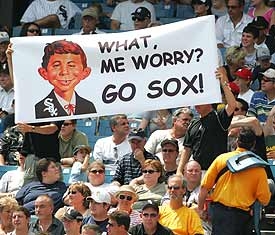
A NEW WHITE SOX MASCOT?

One of the traditions of post-season sports reporting - any sport - is the so-called “Match-up” column where sportswriters pretend that it matters if a player for one team at a particular position is better than his counterpart playing for the other team.

This is sheer sophistry. It is idiocy personified. It’s a useless exercise carried out by self-important writing hacks who don’t have the talent or the brains to write for the “legitimate” sections of the paper like news, politics, or culture…

Which, of course, is why I’m going to take a stab at it myself.

Actually, it is kind of silly. After all, what possible relevance is there except in the most tangentially nebulous way if one first baseman is better than the other? What matters is how they perform on the field not some statistical comparison that you can throw out the window once the postseason begins anyway.

That said, the reason to do it is because it’s fun! Here then, are some mostly honest position by position comparisons between my beloved Pale Hose and the World Champion Boston Red Sox. The White Sox player will always be listed first.

CATCHER

A.J. Pierzynski vs. Jason Veritek

A.J. has been rightly credited with superior handling of the talented White Sox pitching staff all year. In baseball parlance he “calls a good game.” Only an adequate throwing arm, if the Red Sox are smart, they’ll try to run early and often. Offensively, A. J. hasn’t hit a homer in a month and is only average in the clutch.

Veritek on the other hand is a field general. A true throwback, he’s tough, smart, and a take charge player on the field. Better than average arm which may put a crimp in the White Sox running game Only the 3rd Captain in the entire history of the franchise, he’s a clutch hitter with a killer instinct at the plate. If the White Sox try to pitch around Ramirez and Ortiz, Veritek is perfectly capable of doing enough damage to make them wish they didn’t.

Big Edge to Boston.

FIRST BASE

Paul Konerko vs. John Olerud

Very quietly, Paul Konerko has become one of the most reliable sluggers in the American League. With 40 homers and 100 RBI’s, Konerko’s value on a team that lost slugger Frank Thomas to injury and last year’s heavy hitters Magglio Ordonez and Carlos Lee to off-season trades cannot be overstated. In short, for the White Sox to win, Konerko must produce. The Bosox know this which is why they’d be smart to pitch around Konerko and make one of the other Sox players beat them. An average glove but steady and reliable in the field.

John Olerud is a veteran with a smooth glove and excellent hitting skills. Seeing him as a Cincinnati rookie, Ted Williams thought that he reminded him of himself when it came to hitting - high praise coming from the self-absorbed Hall of Famer. Indeed, Olerud has a sweet swing that rarely breaks down under pressure. What he lacks in power, he makes up for in clutch hitting ability. And he’s a veteran of the playoff wars, an intangible that most of the White Sox players don’t have.

Slight edge to Chicago

SECOND BASE

Tadahito Iguchi vs. Tony Graffanino

“Da Gooch” was a Rookie of the Year candidate and for good reason; a .278 average with 15 homers and 71 RBI’s, Iguchi’s offensive numbers were more than impressive for a second baseman. However, his value to the team could never be measured in stats. Iguchi functioned as the proto-typical #2 hitter, a true “push-along” player who moved lead-off hitter Scott Posednik over to second (or more usually third base given Posednik’s base stealing binge in the first half of the season) on a consistent basis. And he proved himself more than capable in the late innings to deliver big hits. In the field, he’s weak going to his right, much stronger to his left, he hesitates to take charge and possesses only an adequate arm. He makes an excellent pivot on double plays, however, and like all Japanese players is sound fundamentally.

Tony “G” was a fan favorite when he was a utility infielder here in Chicago. Graffinino is solid if unspectacular defensively with good range both left and right, an adequate throwing arm, and makes the pivot well. A decent hitter with some power and is good in the clutch, Tony is a good Major League second baseman who is probably playing out of position in that he might be a better shortstop. But the Bosox needed a second baseman when Mark Belhorn went down and Graffinino hasn’t disappointed.

Slight Edge to White Sox

THIRD BASE

Joe Crede is the most maddeningly frustrating player to watch on the White Sox. A promising rookie two years ago, Crede has yet to live up to his true potential. His defense has improved immensely however and he can now be placed in the top tier of defensive third basemen in the league. He possesses a cannon for an arm and moves well both left and right - especially important given the weakness of shortstop Juan Uribe going to his right. Crede fills the hole better than just about any third baseman in the league and guards the line as if it were his own personal property. At the plate, he is streaky. Currently he’s on fire and it should be interesting to see if he can maintain the nearly .400 average he hit for in September.

Bill Mueller is a canny veteran with cat-like reflexes and possesses a strong arm. But he’s weak going to his left and his glove has been shaky at times. A switch hitter, he possesses power from both sides (left side dominant) and gives the Bosox some RBI punch at the bottom of their line-up.

No Advantage

SHORTSTOP

Juan Uribe has been a slight disappointment for the White Sox. After a 25 home run output last year, Uribe’s production fell to just 16, although he hit 7 long ones the last month of the season. His average also was on the rise at season’s end. Defensively he’s more than adequate with a strong arm and good going toward the middle. Excellent in combination with Iguchi on twin killings, he has demonstrated a weakness going to his left and his arm can be scattershot at times.

Edgar Renteria has been a defensive disappointment with the Bosox. Something must have happened between his stint with the Cardinals where he was known for his defensive ability and his current status as something of a liability. No one can doubt his bat, however, and he has proven himself a dangerous hitter.

Slight Edge to White Sox

LEFT FIELD

Not much of a comparison here. While Scott Posednik has been the major impetus during the Sox drive to the Division title with his ability as a lead-off hitter to get on and steal bases, he’s in a horrible base stealing slump since he came off the disabled list earlier in September which leads one to believe he still is not quite right. An adequate outfielder with an average arm, he possesses the speed to chase down fly balls anywhere from left center to foul territory.

Manny Ramirez is perhaps the best hitter in the game today and worth every penny the Red Sox are paying him. Who cares about his defense when the guy can hit like that?

Big Edge to Boston

CENTER FIELD

Aaron Rowand vs. Johnny Damon

Rowand is another Sox player having an off year. After hitting over .300 and 24 home runs last season, Rowand has slumped to .270 with only 13 homers this year. Defensively, he has played outstanding, gold glove type ball at times. At other times, he has played indifferently. Still, he gives the White Sox some pop at the bottom of the lineup and if he gets hot, watch out.

Damon is a tremendous talent, a great leadoff hitter who walks rarely but garnered nearly 200 hits. A smart, tough player, he patrols center field like it’s his own private preserve and can run down just about anything. A great asset to his team and a true spark plug. If he gets on base with consistency, the White Sox lose.

Edge to Boston

RIGHT FIELD

Jermaine Dye is a solid pro who had an above average season. His 31 homers were second on the team and it should be interesting to see where Ozzie Guillen places him in the lineup. For most of the year, Dye batted 5th or 6th. But with Carl Everett in a pronounced slump for the last two months, Dye was hitting 3rd in front of Konerko. Not known as a real clutch hitter, he probably would be better off batting 5th. An excellent defensive outfielder with a rifle for an arm.

Trot Nixon is another solid pro although somewhat less spectacular at the plate. He is, however, an excellent clutch hitter and plays a solid defensive right field with good range and a strong arm. It remains to be seen if Nixon can regain some of the pop in his bat that he’s had in the past although injuries may have hurt him there.

Slight Edge to White Sox

DESIGNATED HITTER

Problem child Carl Everett kept his mouth shut most of the year. Then, when he hit a slump and Guillen dropped him to 6th in the order, Everett made it clear that it didn’t sit well with him. It was a big thing for about a week and has since dissipated as a result of the team clinching the Division. However, any residual bad feelings in the clubhouse are not good this time of year. Otherwise, Everett appears to be snapping out of it and playing against his old team should give him some extra incentive to do well.

David Ortiz is one of the greatest DH’s ever to play the game. The Ortiz-Ramirez show will be the story of the series. If White Sox pitching can limit their damage, they win. If not, look for a short series.

Big Edge to Boston

STARTING PITCHING

The White Sox quadrimvirate of Contreras, Garland, Buerhle, and Garcia were lights out for the first half of the season. They slid precipitously in August and the first part of September which allowed Cleveland to get back in the race. However - very bad news for Boston fans - it appears the starters have regained their early season form. In their last 8 starts, they have a combined ERA of 1.57. Contreras was Pitcher of the Month in September and both Garcia and Buerhle are excellent big game pitchers. Garland is a question mark although his last three starts have been above average.

Boston’s group of Clement, Wakefield, Schilling, and Wells is a good, proven group of playoff performers but far less reliable. This could be the Bosox Achilles heel against the White Sox - especially Clement (who the White Sox have knocked around a couple of times already this year) and Schilling who is just a shadow of his former spectacular self.

Big Edge to White Sox

BULLPEN

The White Sox have the best bullpen in the American League bar none, hands down. Guillen has used them intelligently which has given the group of Cotts, Politte, Vizcaino, and Marte a ton of confidence. Closer Bobby Jenks is young - but old enough to throw a fastball 100 mph. If the White Sox have the lead after the 6th inning, it’s almost an automatic “W.”

The Bosox have some good arms but much less reliable. Timlin always gives White Sox players fits as does former White Sox submariner Chad Bradford. But with Keith Foulkes well known troubles - one reason the White Sox gave up on him - the bullpen is hardly as solid as the Chisox group.

Big Edge to White Sox

BENCH

Ozzie Guillen has been giving players like Pablo Ozuna and Timo Perez game time all year long and both are primed for pinch hitting and perhaps even a starting role if things go south. And catcher Keith Widger has proven himself an adequate back up.

The leading Red Sox pinch hitter is Jay Payton with three hits - and he was traded to Oakland in July.

Edge to White Sox

MANAGER

While Ozzie Guillen is a strong candidate for Manager of the Year, the regular season means butkus this time of year. And Terry Francona has been there, done that. Can a manager freeze? Yes, but don’t look for that to happen to the happy-go-lucky Guillen. However, you’ve still got to give the nod to Francona.

Slight Edge to Boston

PREDICTION

Will the old baseball adage “Good pitching beats good hitting” prove out? The answer is yes. But the question isn’t whether pitching or hitting is more important, the question is performance. If the White Sox pitchers pitch like they are capable of doing, the Red Sox lose in 4. If not, it could be the Bosox in 3.

More likely, it will come down to game 5 in Chicago - with my White Sox winning a low scoring game in a low scoring series.

UPDATE

A couple of notes:

First, if you’re a baseball fan. be sure to bookmark Baseball Musings for the duration of the playoffs. Most fans are statistics nuts (like me) and former ESPN researcher David Pinto has the goods on everybody and everything.

SITE NOTE: AN EXPLANATION

Filed under: Blogging — Rick Moran @ 6:26 am

Regular readers of this site may have noticed that there have been several posts recently on my beloveds, the Chicago White Sox, and their quest to break the 88-year record of championship futility for Chicago baseball teams.

While I will continue to post on other, less important subjects like war and peace, the Supreme Court nomination, the media, and liberal lunacy, until my White Sox are eliminated from World Series competition, I will be doing regular updates on the games, the players, and maybe a few thoughts on how all this relates to our society and culture. Playing a pastoral game in an urban setting has always been the great dichotomy of baseball and one of its big attractions. Of course, it doesn’t matter as much now and it has become fashionable to bash the sport for all of its many faults as well as the documented and sordid foibles of its players.

You may bash to your heart’s content. My love for the game on the field when played with the skill of Major League players will not be diminished. If you enjoyed baseball in your youth, I invite you to take this journey with me. If nothing else, it’ll be a nice change of pace from documenting the faults and foibles of the fools and knaves in Washington.

« Older PostsNewer Posts »

Powered by WordPress