Right Wing Nut House

10/2/2005

A REAL HEAD SCRATCHER FROM THE TIMES

Filed under: Media — Rick Moran @ 11:12 am

The headline from this New York Times article that analyzes how many prisoners sentenced to life in prison are never paroled had me scratching my head trying to figure out what the point was:

To More Inmates, Life Term Means Dying Behind Bars

I guess I’m just not sophisticated enough to follow the Time’s reasoning here. If a “life term” doesn’t mean “life term,” why give one out in the first place.

The Times explains:

But now, driven by tougher laws and political pressure on governors and parole boards, thousands of lifers are going into prisons each year, and in many states only a few are ever coming out, even in cases where judges and prosecutors did not intend to put them away forever.

Well, that explain everything! When judges and prosecutors want to pull the wool over our eyes and give some violent criminal a wink and a nod about his incarceration, they sentence him to what should be called a “not really for life” life sentence.

My jaw dropped a little lower after I read this:

Indeed, in just the last 30 years, the United States has created something never before seen in its history and unheard of around the globe: a booming population of prisoners whose only way out of prison is likely to be inside a coffin.

I hate to seem like an idiot but when someone convicted of a particularly heinous crime - one where a life sentence is either mandated by law or given by a judge in lieu of the death penalty - where is the societal interest in letting these people out of jail so that they can potentially prey upon other people? The New York Times is certainly being free and easy with other people’s lives and well being.

Is it the Times contention that most of these people are innocent? Not at all. What the Times is saying is that habitual offenders just aren’t being released to prey upon the rest of us like they used to in the good old days of liberal ideas regarding our penal system.

Fewer than two-thirds of the 70,000 people sentenced to life from 1988 to 2001 are in for murder, the Times analysis found. Other lifers - more than 25,000 of them - were convicted of crimes like rape, kidnapping, armed robbery, assault, extortion, burglary and arson. People convicted of drug trafficking account for 16 percent of all lifers.

Here are a few facts and figures that the Times evidently missed in it’s research for this article:

FEDERAL BUREAU OF JUSTICE STATISTICS

Rates of Recidivism of State Prisoners - Rearrest Rates by Most Serious Offense for Which Released

Homicide: 40.7%
Kidnapping: 59.4%
Rape: 46.0%
Other Sexual Assault: 41.4%
Robbery: 70.2%
Assault: 65.1%
Other Violent Crimes: 51.7%

In summary, 67.5% of violent criminals were rearrested within 3 years of being released for a new crime. This is a point made by the Times article, albeit with the caveat that those who spend a long time in prison tend to be less enamored of criminal behavior. And of course, it just doesn’t look good when compared to our betters over in Europe. In fact, it must be downright embarrassing for the Times editors when they attend those cocktail parties with their European counterparts:

Marc Mauer, executive director of the Sentencing Project, a research and advocacy group that issued a report on life sentences last year, said that about a fifth of released lifers were arrested again, compared with two-thirds of all released prisoners.

“Many lifers,” Mr. Mauer said, “are kept in prison long after they represent a public safety threat.”

In much of the rest of the world, sentences of natural life are all but unknown.

“Western Europeans regard 10 or 12 years as an extremely long term, even for offenders sentenced in theory to life,” said James Q. Whitman, a law professor at Yale and the author of “Harsh Justice,” which compares criminal punishment in the United States and Europe.

Don’t you feel a lot better knowing that there’s “only” a 20% chance that a violent criminal will either kill again or rape again, or commit some unspeakable act against you or a loved one?

For you see, the Times likes those odds. Sounds about right…2 out of 10 ex lifers who, despite spending a couple of decades behind bars, are willing to recommit crimes for which they were sent up in the first place.

What do you suppose the chances of any New York Times editors being affected by those 20% of criminals who end up killing or raping or assaulting you or your loved ones? Which is the point, of course. Better to look good in the eyes of the rest of the world than keep us safe.

There’s a reason people are sentenced to life in prison. And while there may be a few exceptions to the so-called “Three strike” rule in sentencing (and these should be dealt with on a case by case basis) the fact is that sentencing guidelines are in place because too many judges and prosecutors think like the editors of the New York Times; that criminals are in jail not because they’re horrendously violent sociopathic thugs but because they are misunderstood by society or that they’re the wrong color or that they’ve spent time in jail and have actually “reformed” and gone straight.

This kind of thinking caused crime to skyrocket in the 1960’s - 1980’s. It wasn’t until legislatures and the Congress passed mandatory sentencing laws that crime finally began to drop. Yes judges complain they have little leeway in sentencing anymore. But that decision wasn’t taken in a vacuum. It was because judges routinely abused their positions to foist their ideas about crime and society on the rest of us that those laws were passed in the first place.

I have no doubt some lifers, if released, would make solid citizens. But until we come up with a way to positively identify those people - an almost certain impossibility given that it would require both a working crystal ball and the ability to read minds - I recommend we keep people who have been sentenced to life in prison right where they are thank you.

Knowing they are in there and I am out here helps most of us sleep more soundly at night.

UPDATE:

John Cole had a similar thought when he saw the Times headline.

Also, go Inside Larry’s Head and read Larry Bernard’s thoughts on this.

Cole just IM’d me to say when he read the headline he spit milk through his nose. For me, it was hot coffee - not a pleasant experience.
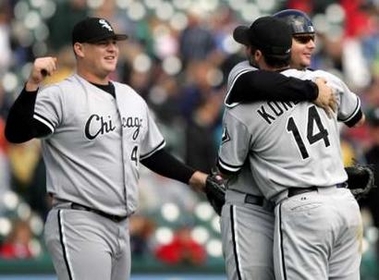
COULD THIS BE THE YEAR?

Filed under: WORLD SERIES — Rick Moran @ 7:25 am


‘THE KID WITH THE GOLDEN ARM,” BOBBY JENKS, CHEERS ON TEAMMATES PAUL KONERKO AND A.J. PIERZYNSKI FOLLOWING THE SOX CLINCHER ON THURSDAY

He can throw a baseball more than 100 miles per hour. At that speed, the ball screams toward the hitter appearing to be a tiny, jet propelled pellet of white-hot molten plasma, a blur to the eye of even the best of Major League hitters and forcing them to begin their swing almost before the pitch leaves his hand. And his 12 to 6 curve ball thrown almost 20 miles per hour slower has made more than one Major League hitter look like a busher with cataracts.

He also has the pudgy, cherubic face of a 15 year old choir boy.

But what Bobby Jenks has that makes him a potential star closer for the White Sox during the upcoming post season is the heart of a lion and the soul of a serial killer - two attributes that a successful baseball fireman must have in order to succeed when the game is on the line and the pressure so intense that equally gifted pitchers have buckled and broken.

Being a closer has more to do with possessing a mindset rather than any specific set of baseball gifts. Some of the greatest closers in the relatively short history of the position did not possess the overwhelming fastball of a Bobby Jenks or a Rob Dibble, the former Cincinnati great from the early 1990’s. The St. Louis Cardinal’s closer in the early 1980’s, Bruce Sutter, relied on the relatively new pitch - the “split fingered” fastball - to rack up his Hall of Fame numbers. And Dennis Eckersley, another Hall of Fame closer for the Oakland A’s, relied on pin point control and a devastating slider to confound hitters.

But what both of those men had and what Sox youngster Jenks seems to possess is an absolute killer instinct, a “take no prisoners” approach to the task of closing out a ballgame. It is an attitude that apparently cannot be taught but rather is part of the psychological make-up of a pitcher from the start of their careers. Jenks began his professional career in the Anaheim Angels organization. He was a raw, callow youth, so enamored of baseball during high school that he was declared academically ineligible to play 3 out of the 4 years he attended school in the small, Idaho town of Spirit Lake.

However, Jenks played American Legion ball and dazzled the competition both as a pitcher and a hitter, leading the league in homers and RBI’s as well as victories. Invited to a showcase camp for potential major leaguers, Anaheim (now Los Angeles) Angels scout Jack Uhey recognized the potential in the raw youth and signed him up.

The Angels figured they had a potential 20 game winner in the youngster and they tried to make him into a starting pitcher. As a 19 year old rookie in the “Low A” affiliate in Butte, Montana, Jenks struck out 42 batters in 52 innings but also walked 44 hitters. Not an auspicious beginning but the Angels stuck with him. The following year he struck out 96 hitters in 98 innings for Cedar Rapids and was temporarily promoted to the club’s double A affiliate in Arkansas for that teams playoffs. He did well enough there that during the next two years, he was tapped to play in the prestigious Arizona winter league where 2/3 of prospects end up on major league rosters. But the hard throwing kid with the golden arm was suffering the fate of most young pitchers - the injury bug had bit and bit hard.

Apparently, young Bobby throws so hard that the stress on the elbow causes what’s known in the business as “reaction fractures” - small cracks that cause intense pain. All professional pitchers have learned to pitch with pain as the unnatural act of flinging a baseball with velocities approaching 100 miles per hour every four or five days causes the muscles and tendons of the arm and shoulder to stretch and contract in an abnormal manner. Most pitchers learn to deal with the pain and pitch through it.

But the kind of pain caused by a fracture of the bone in the elbow can only be fixed by surgery. So, in 2004, Jenks went under the knife and had a screw placed in his elbow to keep the fractures from spreading. Fearing his career was over, the Angels released him. Taking a chance, the White Sox picked up his contract in less than 24 hours and immediately sent him to their instructional league in Florida. It was there that the Sox decided to make the 24 year old fireballer into a short reliever. Within a few weeks, they sent Jenks to their Triple A affiliate in Birmingham where he dominated the hitters, striking out 52 in just 41 innings. That, coupled with a decent spring training stint with the main club made his elevation to the majors simply a matter of time.

The call came July 5th. Manager Ozzie Guillen had become concerned over back problems being experienced by his closer at that time, veteran Dustin Hermanson, and thought that Jenks would be a good back-up for the ailing pitcher. The move proved to be a stroke of genius when Hermanson took the young fireballer under his wing and began to train Jenks in some of the finer points of closing a baseball game. Apparently, Hermanson’s tutelage had more to do with teaching the youngster how to prepare mentally for his appearances rather than any tips on how to throw a baseball.

The results have been remarkable to see. Guillen eased Jenks into the role of closer over the last few months of the season so that now, with the playoffs looming and Hermanson’s bad back a real question mark, Guillen feels no compunction about putting Jenks on the firing line during the most important games of the year.

At times, Jenks has been unhittable, striking out 50 batters in barely 39 innings. But the real test of a closer is in their ability to overcome mistakes. And Jenks has proven himself adept at getting out sticky situations created by his occasional wildness. This ability will stand him in good stead during the playoffs when every pitch in the late innings usually has the potential to turn the game around.

The ascendancy of Jenks over Hermanson, who until his probable career ending injury was one of the dominant closers in the American League, has given Sox fans hope that this in fact could be the year that frustration turns into triumph. The last time a Chicago baseball team won a World Championship was in 1917, a record of futility and heartache unmatched by any other Major League club in existence today. And with a flamethrower like Jenks in the wings, if the Sox have a lead going into the last inning, their chances of success and vindication have been increased substantially.

UPDATE

In addition to his outstanding work on the Plame Game, Tom McGuire is now evidently rooting for the White Sox to beat Cleveland since his Red Sox are now in trouble of missing the playoffs.

I would say to Mr. McGuire, no need to fret as my Sox literally own the Tribe’s backsides at The Jake this year, winning 8 while losing only 1. The snakebit Tribe will fall like a ripe huckleberry and allow his Sox to face my Sox in the Division Series beginning October 4 at US Cellular Field.

Needless to say, given the huge advantage my Sox enjoy in starting pitching and defense, his Carmines will feel the sting of defeat at the hands of my beloveds quicker than one can say “Bucky Dent” - who McGuire may not be aware began his career with none other than my White Sox.

UPDATE II

Color my face red but McGuire is a fan of the most hated, despised, and loathed franchise in all of professional sports, the New York Y**kees.

From here on out, since the name of the team is actually an obscenity and this is a family-friendly blog, we will x-out part of the Y**kees name in the interest of not corrupting children. Also, Y**kees is actually quite descriptive if one were to substitute a “uck.”

« Older Posts

Powered by WordPress