Right Wing Nut House

5/30/2009

JOHN LOGAN AND MEMORIAL DAY

Filed under: History — Rick Moran @ 11:46 am


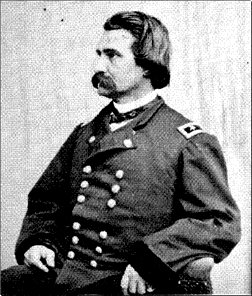
GENERAL JOHN A. LOGAN

May 30th was, at one time, the day designated as “Decoration Day” which later morphed into Memorial Day.

Before federal workers were able to pressure Congress to grant them several three day weekends a year by tossing aside tradition and making holidays like Memorial Day (May 30), Washington’s Birthday (February 22), Lincoln’s Birthday (February 12), and Columbus Day (October 12) moot by designating the closest Monday as the “observed” holiday (while kicking Lincoln under the bus altogether), Americans marked the passage of time by celebrating our heritage on these specific days every year.

I like three day weekends as much as the next guy but something went out of our holidays when we switched to the current system. If they fell midweek, we school kids would look forward to a nice little break from our studies so that they become true “holidays.” February used to be my favorite month of the year. Not only could we look forward to two holidays from school but Spring Training traditionally started between them, thus bring us closer to that most holy of all holy days; Opening Day at the ballyard.

Yes, we lost something when we no longer observed Memorial Day on May 30. But to keep a tiny bit of that tradition alive, allow me to repost something I wrote back in 2005 on John Logan and the origins of Memorial Day.

******************************************
This post originally appeared on May 30, 2005

Congressman John Logan was angry. His party, the Democrats, had just lost the election of 1860 to Abe Lincoln and the Republicans. But his opposition to the fire eaters of the South who were agitating for secession had incurred the wrath of men who just recently had called him a “son of the South.” In a speech on the floor of the House, Logan warned his Southern colleagues that if they persisted in their folly, the union would crush them. He returned to his district and gave a speech at Marion, Illinois that today is widely seen as helping keep that vital part of Illinois - “little Egypt” - loyal to the Union.

Resigning from Congress, he was one of a handful of Democratic lawmakers that fought on the Union side during the war. Most of these political officers were a disaster. Benjamin Butler, for instance, was a Massachusetts Democrat whose ineptitude as a soldier was surpassed only by his incompetence as an administrator. While overseeing the military occupation of New Orleans, Butler issued the infamous “General Order #28″ that stipulated that “any female shall, by word, gesture, or movement, insult or show contempt for any officer or soldier of the United States, she shall be regarded and held liable to be treated as a woman of the town plying her avocation.”

Other political generals were equally unfit for command and ended up costing thousands of lives because of their incompetent leadership. But not so John Logan.

Logan organized a regiment of volunteers and was named a Colonel. Immediately distinguishing himself on the field of battle, Logan made it his business to study the art of war. Attached to the Army of the Tennessee, General Grant recognized Logan’s leadership ability and promoted him to General. He played a key role in the victory at Raymond, Mississippi that cleared the way for Grant’s march to Vicksburg and eventual capture of that vital city.

When Grant moved North to take command of the Union armies, Sherman, who had nothing but disdain for political generals, took over the Army of the Tennessee. But after seeing Logan in action during the Battle of Atlanta, Sherman was impressed enough to give Logan command of the entire left wing of his army on its march to the sea. Again, Logan distinguished himself as he fought off whatever resistance the South could throw at Sherman as he devastated the countryside.

Popular with the men under his command, Logan was a rarity - a commander the men could trust. They sensed his concern for their welfare as Logan made it a habit of visiting the company mess to taste the food himself. If he found it inadequate, he’d dress down the company commander and order him to fix the situation. Usually it was something simple like changing cooks or cleaning the cooking pots once and a while. In addition, Logan made sure the men under his command were properly supplied with shoes, blankets, and other necessities that kept the men comfortable during winter months.

Logan’s concern for his men was evident after the war as well. Elected to Congress again in 1866, Logan took part in the first memorial day observance in Illinois. It’s thought that Logan became especially interested in the issue of a decoration day for the nation following a gesture by the women of Columbia, Mississippi who, during a remembrance for the dead, placed flowers on the graves of both Union and Southern soldiers. Logan had fought with Grant at the battle of Columbia and remembered well the hatred of civilians toward the Union Army. Horace Greeley wrote a famous editorial about the Columbian women and Francis Miles Finch wrote a beautiful poem for the Atlantic Monthly entitled “The Blue and the Grey.”

Logan’s popularity with the men paid off when he was named Commander in Chief of the Grand Army of the Republic (GAR). In 1868 he issued his famous general order that designated May 30th as Decoration Day “for the purpose of strewing with flowers or otherwise decorating the graves of comrades who died in defense of their country during the late rebellion, and whose bodies now lie in almost every city, village, and hamlet churchyard in the land.”

Because of Logan’s leadership, the GAR grew into the most influential voting bloc in the Republican party. For more than 30 years, no Republican could get the Presidential nomination without the support of the GAR. At it’s peak, more than 400,000 veterans of the civil war were members. Their presence during parades and remembrances of that war became a source of inspiration to an entire generation of American historians and writers.

Logan would go on and be elected Senator and even be nominated on the 1884 Democratic ticket for Vice President. He was a strong advocate of public education and served on the Committee for Military Affairs. When he died in 1886, he lay in state in the Rotunda of the Capitol. Thousands of tearful veterans filed past his coffin to pay their last respects to the man they nicknamed “Blackjack.”

Some historians have taken a less than charitable view of Logan’s motivations for initiating Decoration Day. They point out that Logan probably used the holiday to promote his own political career. His bid for the Senate in 1871 played up his role in boosting the holiday and he never failed to remind audiences of his service in that regard.

However, Logan also wrote a loving tribute to his men in a book that came out after his death entitled The Volunteer Soldier in America which was written partly in response to U.S. Grant’s autobiography that criticized the performance of volunteers during the war.

John Logan didn’t come up with the idea of Memorial Day. But his generous inclusion of Southern dead in his General Order authorizing Decoration Day was a magnanimous gesture that helped heal the wounds of that conflict and bring us together as a nation.

It might not be a bad idea this Memorial Day to take a page from our forefathers and recognize that those on the other side of the debate of the War in Iraq mourn our losses as well. For this one day, let us be united in recognition of the service these brave men performed and the fact that no matter what you believe, they have given that “last full measure of devotion” to a grateful nation.

5/25/2009

SMALL TOWN HEROES FROM THE HEARTLAND

Filed under: History, PJ Media — Rick Moran @ 9:39 am

1-11

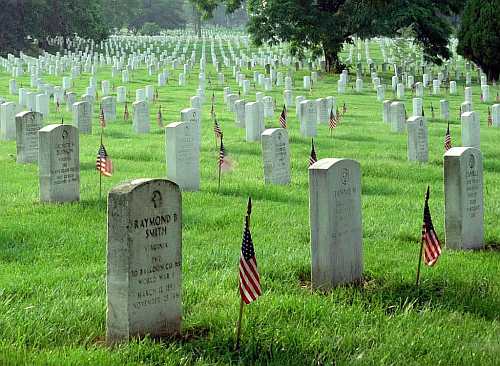
Arlington Cemetary

My latest piece is up at Pajamas Media. It is a Memorial Day tribute to small town heroes and, more importantly, the small town values that animated their patriotism.

I also take to task elites who look down their noses at these values and citizens.

As sample:

Perhaps it is no accident then that so many of America’s fallen hailed from towns with place names that are familiar only to those who live but a stone’s throw from where these heroes grew up.

Who has ever heard of Clairsville, Ohio, birthplace of Medal of Honor winner Sylvester Antolak? Among the heroic deeds mentioned in his citation were:

With one shoulder deeply gashed and his right arm shattered, he continued to rush directly into the enemy fire concentration with his submachinegun wedged under his uninjured arm until within 15 yards of the enemy strong point, where he opened fire at deadly close range, killing 2 Germans and forcing the remaining 10 to surrender. He reorganized his men and, refusing to seek medical attention so badly needed, chose to lead the way toward another strong point 100 yards distant. Utterly disregarding the hail of bullets concentrated upon him, he had stormed ahead nearly three-fourths of the space between strong points when he was instantly killed by hostile enemy fire. Inspired by his example, his squad went on to overwhelm the enemy troops. By his supreme sacrifice, superb fighting courage, and heroic devotion to the attack, Sgt. Antolak was directly responsible for eliminating 20 Germans, capturing an enemy machinegun, and clearing the path for his company to advance.

Hundreds of other Medal of Honor winners can lay claim to a similar background, growing up in rural villages and hamlets that, in many cases, time has forgotten and the world has passed by. America’s small-town culture has been ridiculed, criticized, and dismissed - especially over the last few decades - by an elite that cannot fathom why anyone would wish to live more than a couple of miles from a world class opera house or art museum. Nor can they understand why someone would choose country quiet over the babble and cacophony of the big city.

So they disparage these simple citizens - the ones who do most of the living, loving, fighting, and dying for America - because at bottom, they are what they accuse small town folk of being: narrow-minded and bigoted.

If these elites were to open their eyes, they may discover that people who live in small towns have exactly the same values as those who live in larger cities and suburbs. American values are the same regardless of where you live. The difference is they are perhaps taken to heart in a more fundamental way in small towns than in places that boast large populations and cultural diversity. Patriotism seems more heartfelt and genuine in rural parts of the country, more a regular part of life than in urban or suburban America.

Perhaps because showing one’s patriotism has been equated with having an “unsophisticated” attitude - a lack of world weariness and cynicism that the smart set personifies - the elites accuse those of us in flyover country of possessing a dullard’s sense of how the world really works. In this context, patriotic feelings and gestures are worse than futile, they are dangerous. Outward manifestations of patriotism come perilously close to upsetting the cosmopolitan self-image held by Americans not vouchsafed the blessing of living in a more pastoral setting. Such rash displays of emotion where America is concerned are contrasted with the blasé, more refined attitudes of our betters, who appreciate the splendid opportunity to feel smugly superior to the rubes who show reverence to the flag rather than dream of burning it.

Read the whole thing.

5/12/2009

The Posner Challenge

Filed under: Blogging, History, Politics, conservative reform — Rick Moran @ 11:48 am

Judge Richard Posner has written something of a vanilla essay, trying to answer the question “Is the Conservative Movement Losing Steam?”

I appreciate the fact hizzoner may have been a little busy since the November election and may have missed the 5,000 blog posts, articles, tweets, and books that not only noticed that very fact but have actually tried to find a cure for what ails the movement.

Nevertheless, any time someone of Judge Posner’s eminence and brilliance turns his attention to diagnosing the illness afflicting the right, we should pay attention if only to glean nuggets of truth from someone a whole helluva lot smarter than anyone reading this (or writing it for that matter).

No, we shouldn’t automatically accept as gospel what brainy people have to say. But given that Posner will no doubt be labled an “elitist” by the base for being cursed with the ability to view the world in an unemotional, analytic manner, I thought highlighting his views on the problems of conservatism would give them the exposure they deserve.

In essence, Posner makes the same point made by most pundits - conservatism is a victim of its own success:

By the end of the Clinton administration, I was content to celebrate the triumph of conservatism as I understood it, and had no desire for other than incremental changes in the economic and social structure of the United States. I saw no need for the estate tax to be abolished, marginal personal-income tax rates further reduced, the government shrunk, pragmatism in constitutional law jettisoned in favor of “originalism,” the rights of gun owners enlarged, our military posture strengthened, the rise of homosexual rights resisted, or the role of religion in the public sphere expanded. All these became causes embraced by the new conservatism that crested with the reelection of Bush in 2004.

My theme is the intellectual decline of conservatism, and it is notable that the policies of the new conservatism are powered largely by emotion and religion and have for the most part weak intellectual groundings. That the policies are weak in conception, have largely failed in execution, and are political flops is therefore unsurprising. The major blows to conservatism, culminating in the election and programs of Obama, have been fourfold: the failure of military force to achieve U.S. foreign policy objectives; the inanity of trying to substitute will for intellect, as in the denial of global warming, the use of religious criteria in the selection of public officials, the neglect of management and expertise in government; a continued preoccupation with abortion; and fiscal incontinence in the form of massive budget deficits, the Medicare drug plan, excessive foreign borrowing, and asset-price inflation.

Yes, that just about covers it. I would niggle a bit with the good Judge in his example of global warming as evidence that will has been substituted for intellect. While there is something of a knee jerk reaction to the idea of man made climate change among many conservatives, there is also a solid, growing body of scientific evidence that skepticism with regards to global warming is well founded - even more so when one considers the “solutions” being offered.

That said, Posner has a couple of very interesting, and original causes for conservatism’s decline as an intellectual force.

The realization that, for all our expensive military hardware, not very much of it is useful on the modern battlefield, may be the most lasting and best lesson learned from our troubles in Iraq. Only a fool like Saddam will challenge us in the future to a stand up battle which makes a lot of the equipment we designed and built to fight the Soviet Union obsolete - and a waste of defense resources at that. Given the unholy deficits we will be running in the future, a massive contraction of defense spending is in the offing. National defense is one of the only budgetary items where savings in the hundreds of billions can be achieved and given the trillions of red ink Obama will be running, you can bet he will cut there before he goes after entitlements.

But have we learned the lesson that military force has its limits - again? One would have thought that after losing 55,000 men in Viet Nam, the lesson would not have needed repeating. Alas, we may be condemned to repeat this exercise in wasting blood and treasure as long as we seek to maintain superpower status.

Another interesting point made by Posner was “the neglect of management and expertise in government.” For a variety of reasons - some good, some horrible - George Bush insisted on staffing his government with cronies.

If you are going to make appointments of cronies, the least you can do is appoint competent ones. While many of Bush friends and supporters were people he could trust, a legitimate question could be asked as to how competent were many of them?

The evidence suggests that Bush appointed people who were not up to the tasks assigned to them. By sticking industry hacks into regulatory positions (a long and shameful list), the president put the foxes in charge of watching the very henhouses they were supposed to be regulating. There was cronyism and partisan appointments everywhere in government during the Bush years and efficiency suffered as a result.

But Posner’s real gripe - and the gripe of many less ideological conservatives - is that “the new conservatism [is] powered largely by emotion and religion and [has]for the most part weak intellectual groundings.”

Amen and Hallelujah. What Posner refers to as “new” conservatism (a term I will be shamelessly stealing from now on), calls on such intellectual luminaries as Hannity, Limbaugh, Coulter, and Beck, for sustenance. In this, the leading lights of the new conservatism dole out philosophy and rationale the way a Baskin Robbins ice cream server spoons whipped creme on to his concoctions. The result are that ideas and concepts with the heft of cotton candy, but extremely palatable to the narrow minded, are passed off as conservative dogma.

Religion has been confused with “traditional values” in order to justify the infallibility of many positions on social issues. Posner points specifically to abortion but might have also included gay marriage, embryonic stem cell research, and the teaching of creationism in schools. And the slice of conservatism that also identifies itself as “evangelical” - influential beyond their numbers - makes these “values” the centerpiece of their political universe.

Judge Posner has correctly diagnosed most of what’s wrong with conservatism today. He makes mention in his article that the intellectual giants of the past or gone and few recognized public thinkers have stood up to take their place. That’s not to say they aren’t out there The question of when and how they will step forward to define a kind of “post-conservatism” that builds on the past while laying the groundwork for the future will be hard to answer as long as the right continues to wander aimlessly in the wilderness.

4/28/2009

THE MORAL PARAMETERS OF TORTURE

Filed under: Blogging, Ethics, Government, History, Middle East, Politics, Torture — Rick Moran @ 10:51 am

There are few of us who haven’t made up their minds about whether torture is immoral, illegal, or both/neither. But wherever you come down on this issue, good arguments and thoughtful writing should never be ignored or dismissed out of hand simply because you disagree with it. In fact, I find that reading opposing viewpoints - when they are argued rationally and with a minimum of bombast - help clarify my own thinking and sometimes, even alter my position on an issue.

Not this time. But Commentary’s Peter Wehner has a great piece that tries to set some moral parameters for torture that are well argued and well written. Such clear thinking - even though I believe him wrong - should be commended given all the crap that has been sloughed off as “commentary” on both sides of this issue.

I can appreciate Wehner’s struggle to understand the moral universe he inhabits and seek exceptions and clarifications to the idea of using torture. The problem as I see it is he has adopted the “ticking bomb” scenario that has been thoroughly debunked by people much more knowledgeable than I about terrorism. And there is a troubling detachment on Peter’s part that disconnects what many of us consider the absolute moral wrong of torture as he seeks wiggle room in a kind of moral relativism that I don’t think he would ordinarily embrace.

Wehner’s attempts to “define down” what is torture and what isn’t misses the point that what was done was illegal. Can a moral good (or morally neutral) action be found in breaking the law? It can if, as Wehner attempts to do, you twist the ends/means argument into a pretzel. He also brings up the straw man argument about some of our military going through the SERE program (that I dealt with here) as well as the fact that others have endured it so, he reasons, it can’t be all that bad.

Finally, Wehner employs the argument that because torture “worked,” this should be taken into account when judging the morality of its use during the Bush administration.

To begin, allow me to quote extensively from a Daniel Larison post as he responds to a piece by Jim Manzi who asks, “[W]hy is the belief that the torture of captured combatants is wrong compatible with anything other than some form of pacifism? I mean this an actual question, not as a passive-aggressive assertion.”

Larison swallows hard and lets him have it:

One of the things that has kept me from saying much over the last week or so is my sheer amazement that there are people who seriously pose such questions and expect to be answered with something other than expressions of bafflement and moral horror. Something else that has kept me from writing much on this recently is the profoundly dispiriting realization (really, it is just a reminder) that it is torture and aggressive war that today’s mainstream right will go to the wall to defend, while any and every other view can be negotiated, debated, compromised or abandoned. I have started doubting whether people who are openly pro-torture or engaged in the sophistry of Manzi’s post are part of the same moral universe as I am, and I have wondered whether there is even a point in contesting such torture apologia as if they were reasonable arguments deserving of real consideration. Such fundamental assumptions at the core of our civilization should not have to be re-stated or justified anew, and the fact that they have to be is evidence of how deeply corrupted our political life has become, but if such basic norms are not reinforced it seems clear that they will be leeched away over time.

[snip]

mplicit in Manzi’s entire post is the rejection of any distinction between combatant and non-combatant, which tells me that he either doesn’t understand or doesn’t accept the concept of limited war. For him, unless one is a pacifist, one must endorse total war. In such a view, there would be nothing immoral about the summary execution or cruel and inhumane treatment of POWs, since the latter would have been targeted for death while they were still combatants. After all, if torturing such prisoners is not immoral, as Manzi seems to say it is not, what could possibly be wrong with killing them? That is where one must ultimately end up once the distinctions between combatant and non-combatant are erased or blurred, and it is the barbaric conclusion one will eventually reach if one does not start from the assumption that war itself is a sometimes-necessary evil and that it is morally justifiable only under specific circumstances and within certain limits. One of those limits is that captured combatants are to be treated humanely, and when we go down the road towards easing those restrictions we taint not only the institutions responsible for national security with crimes but we also abandon any real claim to moral integrity.

Larison’s argument might be viewed as the absolutist view of torture. I might disagree with the extent he worries about the corrupting nature of torture but there is no dismissing the line in the sand he has drawn - a line I accept for practical, rational, and moral reasons as well.

Wehner? Not so much:

Critics of enhanced interrogation techniques have taken to saying that Americans don’t torture, period – meaning in this instance that we do not engage in coercive interrogation techniques ranging from sleep deprivation to prolonged loud noise and/or bright lights to waterboarding. Anyone who holds the opposite view is a moral cretin and guilty of “arrant inhumanity.” Or so the argument goes.

Methinks Peter listens too much to liberal bomb throwers and besides, this is a gross oversimplification and something of a straw man. But to continue:

But this posture begins to come apart under examination. For one thing, the issue of “torture” itself needs to be put in a moral context and on a moral continuum. Waterboarding is a very nasty technique for sure – but it is considerably different (particularly in the manner administered by the CIA) than, say, mutilation with electric drills, rape, splitting knees, or forcing a terrorist to watch his children suffer and die in order to try to elicit information from him.

The question Peter leaves unanswered is whether it is legal or illegal? How can you make a moral judgment about torture — and defining down what is torture is irrelevant to whether it meets the definition under the law — without taking into consideration the moral imperative to obey the law? Wehner is pouring quicksand and doesn’t realize the ground is shifting beneath his feet.

I certainly wouldn’t want to undergo waterboarding – but while a very harsh technique, it is one that was applied in part because it would do far less damage to a person than other techniques. It is also surely relevant that waterboarding was not used randomly and promiscuously, but rather on three known terrorists. And of the thousands of unlawful combatants captured by the U.S., fewer than 100 were detained and questioned in the CIA program, according to Michael Hayden, President Bush’s last CIA director, and former Attorney General Michael Mukasey – and of those, fewer than one-third were subjected to any of the techniques discussed in the memos on enhanced interrogation.

“Far less damage” as opposed to electrodes and thumbscrews but again, it avoids what Wehner apparently doesn’t want to face; the fact that the civilized world has proscribed the practice in words of unmistakable clarity — unless you are seeking a moral “out” and wish to begin to parse pain and suffering.

US law, the Geneva Accords, and the UN Convention Against Torture all use language that clearly makes the physical and psychological pain of waterboarding a form of torture. The fact that our servicemen are not being held as prisoners and therefore not subject to the law’s protections as well as being volunteers who fully realize the nature of the exercise makes Wehner’s use of the SERE argument nothing more than a strawman set up to excuse torture.

Wehner’s thesis really goes off the rails when he tries to imply that moral relativeness, when evaluating torture, should be employed to blur the ends/means distinction. He dubiously invokes Senator Charles Schumer’s thoughts during a Congressional hearing on torture back in 2004 where the New York lawmaker invokes the “ticking bomb” scenario as one exception to torture. Here’s Schumer:

Take the hypothetical: if we knew that there was a nuclear bomb hidden in an American city and we believe that some kind of torture, fairly severe maybe, would give us a chance of finding that bomb before it went off, my guess is most Americans and most Senators, maybe all, would do what you have to do. So it’s easy to sit back in the armchair and say that torture can never be used. But when you’re in the fox hole, it’s a very different deal.

Wehner eagerly embraces the hypothetical and runs with it:

Apropos of Schumer’s comments, critics of enhanced interrogation techniques need to wrestle with a set of questions they like to avoid: if you knew using waterboarding against a known terrorist may well elicit information that would stop a massive attack on an American city, would you still insist it never be used? Do you oppose the use of waterboarding if it would save a thousand innocent lives? Ten thousand? A hundred thousand? What exactly is the point, if any, at which you believe waterboarding might be justified? I simply don’t accept that those who answer “never” are taking a morally superior stand to those who answer “sometimes, in extremely rare circumstances and in very limited cases.”

First, it is an absolute impossibility to know that “using waterboarding against a known terrorist may well elicit information” that could prevent an attack. That is sophistry on a stick. We might also “know” that pulling his fingernails out might get him to talk if waterboarding doesn’t work. And we wouldn’t know, for instance, whether this particular terrorist had been specifically trained to resist waterboarding or other forms of torture - at least long enough to fail in our efforts to stop a “ticking bomb” attack.

The whole ticking bomb scenario needs to be dumped by torture defenders. It does their argument no good to posit a hypothetical that is more the product of fantasy than possibility.

A good debunking of the ticking bomb myth can be found in an article published in Public Affairs Quarterly last year by Jamie Mayerfield, associate professor of political science at the University of Washington:

Among the many unrealistic elements of the ticking bomb hypothetical, I give
particular attention to the exaggerated degree of certainty attributed to our belief in the prisoner’s guilt. In the scenario we are fully certain that the individual in our custody has launched an attack on civilians and is now withholding the information needed to save the civilians’ lives. Such certainty is unrealistic. Any realistic approximation of the ticking bomb scenario creates too high a risk that an innocent person will be tortured.

The made-to-order features of the ticking bomb scenario blind us to torture’s
reality. In the real world, torture “yields poor information, sweeps up many innocents, degrades organizational capabilities, and destroys interrogators.”7 Consider the problem of false information, which not only causes delays, swallows man hours, and leads down blind alleys, but can also encourage disastrous choices.

Below I discuss how the Bush administration used false information extracted
under torture to help justify the Iraq war. In this case, torture did not save lives, but helped bring about a great many deaths. Torture also inflames enemies, alienates friends, and scares away informants. And it spreads.

These dangers, purged from the ticking bomb hypothetical, are inseparable from actual torture. Yet public attention is consumed by the hypothetical. Obsession with the better-than-best case scenario warps our thinking about torture. We overlook torture’s dangers and exaggerate its effectiveness. By now, the ticking bomb narrative has acquired its own momentum, but fear and anger do much to keep it aloft.

Mayerfield’s point is well taken; because the ticking bomb scenario has not only permeated our culture through fictional variations found in TV, novels, and films, but also because it has been eagerly embraced by many torture apologists, it has become a rote defense even though there has never in history been a situation that remotely resembles it. Mayerfield, like Larison above, may exaggerate the dangers of torture to America’s soul but that doesn’t obviate his point that justifying torture in one, limited case can open the door to its use in other scenarios as well.

So the answer to Peter’s question regarding whether torture condemners would use waterboarding if it could save “a thousand innocent lives? Ten thousand? A hundred thousand?” is irrelevant because its impossible to answer a hypothetical that doesn’t exist except on TV and in film.

And Mayerfield’s point about torture being hugely unreliable is spot on as well. I don’t buy the flat statement that torture doesn’t work, or never works. It wouldn’t have been in use for thousands of years unless it did. The problem with it is its unreliability as a means to accurate information. Those thousands of lives Peter wishes to save by waterboarding a terrorist wouldn’t be worth spit if the bomber lied under torture about everything.

The fact that we simply couldn’t be sure means but would have to act as if the terrorist was telling the truth. Suppose while the authorities were off on a wild goose chase the bomb went off and killed those thousands of innocents? That nice moral house of cards torture defenders have built up would collapse in a heap. Is bad information better than no information at all — or good information that might have been extracted using interrogation techniques other than torture?

Wehner answers this argument by trying to make the case that the good information we extracted via torture saved lives and therefore, the ends justifies the means because saving so many innocents is an absolute moral good in and of itself. It is a strange argument considering Peter’s moral waffling earlier in his piece.

On the substantive level, there is the question of the efficacy of enhanced interrogation techniques. There is an intense debate surrounding this matter, but we can certainly say that respected members of the intelligence world insist that innocent Americans are today alive because we employed a set of coercive interrogation techniques. According to Hayden and Mukasey, “As late as 2006, fully half of the government’s knowledge about the structure and activities of Al Qaeda came from those interrogations.” Former CIA Director George Tenet said, “I know that this program has saved lives. I know we’ve disrupted plots. I know this program alone is worth more than [what] the FBI, the [CIA], and the National Security Agency put together have been able to tell us.” And former National Intelligence Director Mike McConnell has said, “We have people walking around in this country that are alive today because this process happened.”

I will ignore the dubious employment of authority by Peter of people who may go on trial for crimes related to what they are defending and only point out what Peter himself admits later:

It seems unlikely that asking a jihadist his surname, first name and rank, date of birth, army, regimental, personal or serial number, or failing this, equivalent information – which is what the Geneva Conventions say ought to apply to prisoners of war but not, historically, to unlawful enemy combatants – would elicit as much information as coercive interrogation techniques. Dennis Blair, Obama’s national intelligence director, admitted to his staff that “high value information came from interrogations in which those methods were used and provided a deeper understanding” of al Qaeda. (Once Blair’s memo was revealed, he added this caveat: “There is no way of knowing whether the same information could have been obtained through other means.”

Why does Wehner concoct this strawman of “name, rank, and serial number?” Professional interrogators are masters of putting psychological pressure on a subject without coercive or “enhanced” interrogation techniques. It is a gross simplification to make it appear that the “either/or” options open to an interrogator would be polite banter about al-Qaeda or waterboarding.

But the key here is Blair’s statement that there was “no way of knowing” whether the exact same information could have been obtained through legal interrogation methods. The reason is because they weren’t tried or, more likely, the interrogation regime that involves non-torture wasn’t given much of a chance to work. (See this Heather McDonald piece in City Journal from 2004 where she details the initial, successful efforts of army interrogators who used psychological pressures on prisoners, walking up to the line but never crossing it.)

Thus, the interrogators who used torture became victims of their own success, leaping for the opportunity to employ torture as a short cut when such methods were unnecessary or, at the very least, non-coercive interrogations were given short shrift.

Finally, Wehner tries to excuse and justify torture because we’re at war and moral choices are hard:

There are of course serious-minded critics of enhanced interrogation techniques. But to pretend, as some critics do, that the morality of this issue is self-evident and that waterboarding and other coercive interrogation techniques are obviously unacceptable and something for which our nation should be ashamed is, in my judgment, not only wrong but irresponsible. When a nation is engaged in war, you hope to find in government sober people who are able to weigh competing moral goods and who take seriously their obligation to protect our nation. They may not get everything right at the time – hardly anyone does in the heat of the moment – but they should not have to face a lynch mob years after the fact (especially those in the lynch mob who blessed the activities at the time they were being used). The American public, one hopes, can see through all this. And as Nancy Pelosi might well discover, playing a role in inciting a mob can come at a cost.

“Competing moral goods?” That’s a new one when discussing torture. But here is where Peter and I agree - at least I am moving toward his position that the law is not a concrete edifice with only form and substance. What of justice? What of mitigating circumstances? Unlike the revenge seekers and out and out Bush haters, I grant the administration the benefit of their good intentions in a very difficult and morally ambiguous universe. I think they made the wrong choices - horribly wrong - but recognize that some allowance must be made when the awesome responsibilities under which those men and women were working is thrown into the mix.

It doesn’t excuse their actions. It won’t “lessen their time in purgatory” as we used to half-jokingly use as a catch-all for arguments about ethics and morals with our Viatorian teachers back in the day.

But perhaps, it should keep them out of the dock. And out of jail.
4/25/2009

WATERBOARDING: THE S.E.R.E. STRAWMAN

Filed under: Government, History, Politics, The Law, Torture — Rick Moran @ 8:57 am

I suppose it is suicidal to pick a fight with a lawyer over the legality of waterboarding but I think John Hinderaker is just plain off base here:

But if waterboarding is “torture,” then it’s illegal. So why is the U.S. military still using it as a training device, last we knew? If we’re going to start prosecuting people, don’t we have to prosecute the many civilian and military leaders who have for decades inflicted waterboarding, or condoned the use of waterboarding, on our servicemen? Just a thought. Actually, of course, no one has any interest in such prosecutions (which would be absurd in any event) since there is no political advantage to be gained.

John is referring to the use of waterboarding in the military’s SERE program - “Survival, Evasion, Resistance, Escape.” Some of the program is apparently classified but enough details have leaked out to confirm that the trainees who volunteer for the program go through some pretty horrendous treatment. In fact, according to this Slate piece by William Saletan, there are some who wish to alter some of the program’s training methods, believing them too harsh. Many others disagree.

Hinderaker’s argument has some merit - if one were to forget that the trainees are not being held by the US government as prisoners and therefore, not offered protections under international agreements we have signed that clearly make waterboarding a form of “torture” under the letter and spirit of the definition as outlined in those treaties.

This is the strawman that many who are defending torture are throwing up to distract from a fundamental truth; that regardless of whether waterboarding was experienced by American military personnel, and regardless of whether it was legal or illegal under US law at the time, the fact remains that prisoners being held by our government and who were waterboarded, were illegally tortured according to, at the very least, the United Nations Convention Against Torture and, some would argue, the Geneva Conventions.

The UN Convention Against Torture has a very straightforward definition:

For the purposes of this Convention, torture means any act by which severe pain or suffering, whether physical or mental, is intentionally inflicted on a person for such purposes as obtaining from him or a third person information or a confession, punishing him for an act he or a third person has committed or is suspected of having committed, or intimidating or coercing him or a third person, or for any reason based on discrimination of any kind, when such pain or suffering is inflicted by or at the instigation of or with the consent or acquiescence of a public official or other person acting in an official capacity. It does not include pain or suffering arising only from, inherent in or incidental to lawful sanctions.

Was waterboarding “intentionally inflicted” in order to obtain “information or a confession?” Of course it was. A better question is was that the intent of waterboarding SERE volunteers? Of course not.

The catch most often used by defenders of the practice is that waterboarding does not constitute “severe pain or suffering, whether physical or mental” because our own guys go through it and come out of the experience no worse for wear.

Slate’s William Saletan destroys that argument against waterboarding and also punches holes in other arguments that use SERE as a crutch:

The first difference, Ogrisseg noted, is that SERE trains soldiers to defeat interrogation, whereas “the real world interrogator wants to win.” This is a moral difference, as Hitchens observed. But it’s also a practical difference: An interrogator whose job is to extract information will behave more harshly than an interrogator who’s teaching resistance.

Second, SERE pits American interrogators against American trainees. “When dealing with non-country personnel, as in the case of detainee handling, there is greater risk of dehumanization of these personnel, and thus a greater likelihood of worse treatment,” Ogrisseg warned.

Third, SERE offers interventions that relieve stress and reinforce the unreality of the exercise. Instructors and psychologists are available “to watch the students for indications that they are not coping well with training tasks, provide corrective interventions with them long before they become overwhelmed, and if need be, remotivate students who have become overwhelmed to enable them to succeed,” Ogrisseg noted.

Fourth, SERE has “defined starting and ending points. … [T]rainees arrive on a certain date and know that they will depart on a specified date.”

Fifth and most important, SERE is voluntary. “Students can withdraw from training,” Ogrisseg noted. In a report issued four months ago, the Armed Services Committee added that in SERE, “students are even given a special phrase they can use to immediately stop” any ordeal.

Also, the UN treaty doesn’t even try and define who might or might not be protected under its strictures. It simply refers to persons in the custody of the state that is party to the agreement, anywhere the authority of the state is exercised:

Each State Party shall take such measures as may be necessary to establish its jurisdiction over the offences referred to in article 4 in the following cases:

1. When the offences are committed in any territory under its jurisdiction or on board a ship or aircraft registered in that State;
2. When the alleged offender is a national of that State;
3. When the victim was a national of that State if that State considers it appropriate.

Each State Party shall likewise take such measures as may be necessary to establish its jurisdiction over such offences in cases where the alleged offender is present in any territory under its jurisdiction and it does not extradite him pursuant to article 8 to any of the States mentioned in Paragraph 1 of this article.

This Convention does not exclude any criminal jurisdiction exercised in accordance with internal law.

Clearly, this covers Guantanamo, Bagram, and anywhere in Iraq where we were in charge of detainees. And then there’s this stricture against rendition:

1. No State Party shall expel, return (”refouler”) or extradite a person to another State where there are substantial grounds for believing that he would be in danger of being subjected to torture.
2. For the purpose of determining whether there are such grounds, the competent authorities shall take into account all relevant considerations including, where applicable, the existence in the State concerned of a consistent pattern of gross, flagrant or mass violations of human rights.

Did we have “substantial grounds for believing” that Egypt, Yemen, and a few other venues where we transferred custody of prisoners were havens for torture and mistreatment? I would say that’s a “yes” wouldn’t you?

And what about American law? The notion being advanced by torture apologists is that waterboarding wasn’t against American law at the time flies in the face of the definition of torture under Title 18, Part I, Chapter 113C, S. 2340 passed in 1994 (minor amendments in 2007) to fulfill our treaty obligations under the UN Convention Against Torture:

As used in this chapter—

(1) “torture” means an act committed by a person acting under the color of law specifically intended to inflict severe physical or mental pain or suffering (other than pain or suffering incidental to lawful sanctions) upon another person within his custody or physical control;
(2) “severe mental pain or suffering” means the prolonged mental harm caused by or resulting from—
(A) the intentional infliction or threatened infliction of severe physical pain or suffering;
(B) the administration or application, or threatened administration or application, of mind-altering substances or other procedures calculated to disrupt profoundly the senses or the personality;
(C) the threat of imminent death; or
(D) the threat that another person will imminently be subjected to death, severe physical pain or suffering, or the administration or application of mind-altering substances or other procedures calculated to disrupt profoundly the senses or personality; and

(3) “United States” means the several States of the United States, the District of Columbia, and the commonwealths, territories, and possessions of the United States.

I am no lawyer but my reading of this statute is pretty simple; waterboarding easily meets the definition of torture in that it intentionally inflicted “severe mental pain or suffering,” that it carried with it the “threat of imminent death,” and that it occurred in the defined jurisdiction - which holds true for most of the other enhanced interrogation techniques.

I will repeat something I’ve written previously; the law is not a straitjacket and liberals who want to throw the book at everyone but the cook at Guantanamo are perfectly willing to rip this country apart in search of vengance. Torture was not carried out to satisfy the sadistic cravings of Bush, Cheney, the CIA interrogators, or anyone else involved. The fact is, I fully grant these officials and intelligence experts the benefit of their beliefs that what they were doing was protecting the country. That has to be a mitigating factor when determining what to do with the perpetrators.

But trying to keep us safe is not an excuse or justification for torture as the UN Convention makes clear:

Article 2

1. Each State Party shall take effective legislative, administrative, judicial or other measures to prevent acts of torture in any territory under its jurisdiction.
2. No exceptional circumstances whatsoever, whether a state of war or a threat or war, internal political instability or any other public emergency, may be invoked as a justification of torture.
3. An order from a superior officer or a public authority may not be invoked as a justification of torture.

Guilty, yes. But I am not at all certain that torture trials of the kind envisioned by many on the left would accomplish anything. Would it “prove” that we are a nation of laws? If that is the goal then one might ask whether there is not also justice under the law and whether throwing the book at those who were trying to act in good faith is really the route to redemption. I think not. Some reckoning must take place but must it involve criminal proceedings? I envy they who possess certainty in this matter.

4/20/2009

INDEFENSIBLE: OBAMA FAILS HIS FIRST BIG TEST

Filed under: Blogging, Government, History, Politics — Rick Moran @ 7:15 am

Our founders were very suspicious of the presidency. There were many who believed - Thomas Jefferson among them - that all that was needed to govern a free country was a Congress elected by the people at suitably short intervals so that if a representative proved untrustworthy or unresponsive, the people could put someone else in his stead. Many of Jefferson’s ilk saw the presidency as an invitation to monarchy. And the very idea of a Supreme Court who might be able to overturn laws passed by Congress gave the Jeffersonians the vapors.

Thankfully for history’s sake, a more realistic and hard-headed approach to designing a system of government for the United States prevailed in Philadelphia during that God-awful hot summer of 1787. As the delegates sweated through the debates over big state-small state issues, it became clear that there should be some kind of federal office charged with making sure the laws were “faithfully executed.” Not a king or emperor supreme to Congress but an executive who would enforce the laws passed by the legislature as well as act as a representative of American sovereignty as Head of State and Commander in Chief of the military.

Several plans regarding the executive were presented and tossed aside including an idea to make the president little more than errand boy for Congress. Clearly, there were grave misgivings about granting a single individual so much power in a republic.

What turned the tide toward a strong executive branch was the certainty that George Washington would be our first president. While debating the limits and scope of the presidency, delegates would glance at Washington and be reassured that the office would start out in good hands at least. They knew that Washington would defend the United States with honor - something he did several times during his two terms when he responded to various calumnies advanced by the French who accused the US of favoring Great Britain in their war against Napoleon.

The Founders imbued the office of President with a dignity that few presidents have besmirched in our history. We have endured fools, knaves, stumblebums, party hacks, and political generals. But each of them tried honestly to defend the United States when she was attacked.

The president is ultimately responsible for the maintenance of American honor. And defending that honor is perhaps the greatest privilege - and challenge - of the office.

President Barack Obama either doesn’t understand this aspect of the presidency or, just as likely, doesn’t believe that safeguarding American honor is his job. Or even that it is worth his time.This became apparent as a result of what happened at the Summit of the Americas that the president is attending along with the heads of state from most of Latin America.

Daniel Ortega, the Sandinista Marxist thug who is currently President of Nicaragua, used his opening remarks at the summit to skewer the United States in a rant that lasted more than 50 minutes. The dripping irony of this communist lout decrying the actions of America over the last century (and longer) is a titanic joke. Ortega’s actions in support of the Communist guerrillas in El Salvador as well as his attempts to undermine governments elsewhere in Latin America during his first term as “president” back in the 1980’s makes anything he says regarding American interference ring hollow.

Ortega and the Sandinistas, along with a coalition of middle class and small businessmen deposed Nicaraguan dictator Anastasio Somoza in 1979. The first thing the Sandinistas did - as any good little Communist would do - was to kick out the more moderate political partners who played a big role in the largely bloodless revolution, jailing some, and establishing a Marxist dictatorship. No other political parties were allowed to operate freely. Their rallies were broken up by black shirted thugs. They were denied air time on government controlled TV. Opposition leaders were routinely arrested, harassed, and beaten.

Almost immediately, he was opposed by former National Guard members who began an armed revolution that eventually - with the help of the US - forced Ortega to hold elections in 1990. Every lefty in America worth their salt traveled to Nicaragua to help Danny Ortega defeat the evil designs of the Americans. Ortega did his part by trying even harder to suppress the opposition, using his bully boys to intimidate and beat down - literally and figuratively - his opponents, led by Violetta Chamorro, publisher of La Prensa and leader of the National Opposition Union.

In the end, when given the choice between freedom and Communist tyranny, the people chose Chamorro. But before Ortega left office, he had his Sandanista legislature pass a law granting he and several of his cronies deeds to vast estates that were confiscated during his presidency. The theft made him fabulously wealthy.

In the intervening years he ran for the presidency twice and lost badly. Then, in 1998, his daughter shocked the world when she accused her father of sexually abusing her from the time she was 11 until 1990. Denied the opportunity to prove her case in Nicaragua, she took it to the Inter American Human Rights Commission which ruled the charges admissible. A settlement was reached with the government but Ortega’s daughter has never recanted the charges.

This is the man who stood in front of our president and railed against American interference in Latin America. Fond of pointing out American hypocrisy, our friends on the left are silent about both the Ortega diatribe and Obama’s “Grip and Grin” with that other paragon of democratic virtue and non-interference, Hugo Chavez. Instead, they have chosen to attack conservatives who are criticizing Obama for his being a bump on a log while Ortega skewers the country he supposedly leads and Chavez presents him with a book that is such a laughably, over the top, exaggerated, Marxist critique of American policy in the region that one wonders what planet it fell from. The author himself, Eduardo Galeano, admits he is not an historian nor does he write history but rather a combination of “fiction, journalism, political analysis, and history.”

I will be the first to admit that the United States has behaved very badly in Latin America over the years; there has been resource grabbing, commercial exploitation, support for thugs like Somoza, and CIA shenanigans in countries too numerous to count. Most of our military interventions were to keep pro-American governments in power or help stamp out leftist guerrillas. Some of our interventions were to prevent the expropriation of American companies so that commercial monopolies could be maintained. There’s worse and it’s all true.

What is also true is that for the last few decades, no nation has done more for Latin American democracy than the United States - and that includes leftists in Latin America who prove that when they get a chance to lead are as brutal and thuggish as any right wing dictator who ever ruled in the region. Galeano apparently has the honesty at least to point out that Latin America’s problems are largely the result of their own making - their own view of themselves.

Of course, he also makes it clear that Euro-American “colonialism” is the major cause of this but there is something more fundamental at work. Very few Latin American countries have established the rule of law as a basis for governance. This is not the fault of colonialism, or America, or the CIA but rather the fault of the people themselves. It is not blaming the victim to point out the numerous opportunities that Latin American nations have had to rectify this situation and have chosen instead the path of corruption, oppression, and tyranny. The ruling class in most Latin American countries is besotted with crony capitalists, confiscatory leftists, and ambitious generals. And it’s time to stop blaming America, colonialism, the CIA, United Fruit, and all the other scapegoats presented to their long suffering citizens as excuses for their poverty and hopelessness and place the blame where it belongs; in the face looking back at them in the mirror.

Ortega presented the classic Latin American leftist case for why when they get in power, they muck things up so badly and continue the cycle of extreme poverty; it’s America’s fault:

Ortega, meanwhile, droned on about the offenses of the past, dredging up U.S. support of the Somoza regime and the “illegal” war against the Sandinista regime he once led by U.S.-backed Contra rebels in the 1980s. Ortega was a member of the revolutionary junta that drove Anastasio Somoza from power in 1979 and was elected president in 1985. He was defeated in 1990 by Violeta Chamorro and ran unsuccessfully twice for the presidency before winning in 2006.

Of the 19th and 20th centuries, Ortega said: “Nicaragua central America, we haven’t been shaken since the past century by what have been the expansionist policies, war policies, that even led us in the 1850s, 1855, 1856 to bring Central American people together. We united, with Costa Ricans, with people from Honduras, the people from Guatemala, El Salvador. We all got together, united so we could defeat the expansionist policy of the United States. And after that, after interventions that extended since 1912, all the way up to 1932 and that left, as a result the imposition of that tyranny of the Samoas. Armed, funded, defended by the American leaders.”

Ortega denounced the U.S.-backed attempt to overthrow Fidel Castro’s new Communist government in Cuba in 1961, a history of US racism and what he called suffocating U.S. economic policies in the region.

Ortega droned on for the better part of an hour and what was our president doing while a tin pot thug was running down his country, spreading exaggerated claims and outright lies?

Obama sat mostly unmoved during the speech but at times jotted notes.

He could have gotten up and walked out. That would have been the headline for the day as well as being the right thing to do. There should be a limit in the international arena of how much calumny can be heaped upon your country before honor requires a president to remove himself in protest. We can take a little intelligent criticism. But when the United States is savagely attacked, its honor impugned by a lying, child molesting, thieving, hypocritical Marxist gangster, I question the president’s judgment in sitting there and calmly “taking notes.”

Later, the president failed again to defend the United States when he gave a milquetoast response:

“To move forward, we cannot let ourselves be prisoners of past disagreements. I’m grateful that President Ortega did not blame me for things that happened when I was three months old. Too often, an opportunity to build a fresh partnership of the Americas has been undermined by stale debates. We’ve all heard these arguments before.”

Has a president ever tried to distance themselves from the history of their own country in such a shocking and narcissistic way? Obama makes absolutely no attempt to answer Ortega or call him the liar that he is. Instead, he shows incredible weakness by, in effect, validating Ortega’s critique while attempting to wash his hands of the history of his own country.

But this is patriotic, of course as I have written about before. Recognizing the faults of America, trying to outdo our foreign critics in trashing one’s own country is leftist dogma. I don’t doubt the president’s patriotism (according to his lights) nor do I mind Obama going around the world apologizing for what he perceives are our mistakes. I expect no better from a liberal. But this is different. The honor of the United States demanded a ringing defense of the many good things we have done and are doing for Latin America. The scales may not balance but to quit the ring without throwing a punch smacks of either cowardice or ignorance.

Obama is no longer a leftist senator projecting his ideological slant and accepting criticism of the US from foreigners as just and necessary. He is now head of state and thus charged with defending the US from attacks like Ortega’s. Someone has to stand up for the United States in forums like the summit. In this, the president has failed his first big test as chief executive. The State Department can’t be counted on to defend America from such attacks (Secretary Clinton wouldn’t even talk about the Ortega rant.) Only one person is charged by history and tradition to call out the lying thugs who besmirch the name of the US and thus, deliver a slap in the face not just to the government but the people of America as well.

The president’s meek acceptance of Ortega’s largely unjustified criticism may play well among his ideological soul mates but for the rest of us, it causes one to wonder if there is any calumny, any lie, any exaggerated falsehood that Obama would balk at accepting.

Judging by what happened at the summit, I wouldn’t get my hopes up if I were you.

UPDATE

Most of my critics so far think it childish or just not a good idea for Obama to have walked out on Ortega when he was railing against America.

Here are some folks who walked out on Ahmadinejad at Durban II in Geneva when he went into his anti-Israeli speil.

And it wasn’t even their country the Evil Elf was ranting against.

4/17/2009

THE TRUTH WILL SET YOU FREE

Filed under: Ethics, Government, History, Politics — Rick Moran @ 7:04 am

I was a johnny-come-lately to the idea that the severe interrogation techniques being employed against some prisoners held by the US crossed the line of legality and constituted illegal torture. Chalk it up to excessive partisanship. Or ignorance. Or perhaps fear of going against the grain of conservative opinion in the blogosphere.

The fact is, for more than a year after I began blogging, I either excused or ignored evidence that proved the Bush Administration was guilty of sacrificing our most cherished values in order to protect us. It wasn’t until early November of 2005 that I offered a somewhat rambling discourse on why torturing prisoners besmirched our nation’s good name and made the Bush Administration complicit in violations of American and international law. Despite being troubled by the evidence previous to that, I said nothing, wrote nothing, except the usual talking points still found, it pains me to say, in most conservative and Republican internet salons today.

What changed my mind? I tried to reconstruct my thought process by going through my archives and it turns out that there were two people whose writing finally opened my eyes to the illegalities being practiced by the Bush Administration - two writers who I rarely read today for reasons not related to the torture issues but who I must give credit for forcing me to look at the horror and reach the same conclusion they had; John Cole and Andrew Sullivan.

To those who are now nodding their heads with a knowing smirk on their face I will only say this; outright dismissal of views based solely on a writer’s ideological or even political leanings is the mark of the incurious and the ignorant. A grain of salt or two is helpful to be sure. Skepticism, the philosopher/educator Thomas Dewey remarked, is “the mark and even the pose of the educated mind.” And I am no doubt as guilty as the next blogger of being too quick with the snark when it comes to evaluating the case being made by an ideological opponent rather than using reason and logic to demolish an odious point of view.

Be that as it may, those two gentlemen’s writings were seminal in changing my opinion about what the Bush Administration was doing in our name. The fact that they believed sincerely they were doing it to protect us is not a valid excuse or justification. The idea that American military trainees also are forced to endure some of the “enahanced interrogation techniques” is the reasoning of a sophist. The trainees are not in United States custody and therefore, the officers responsible for these exercises are not subject to the same laws that military and intelligence professionals were required to follow with detainees - as were all officals in the Bush Administration. And whether you believe the Geneva Convention applied in the case of “enemy combatants” is also beside the point; no one repealed American law under which the Bush Administration was required to operate. As the Bybee memo proves beyond any reasonable doubt, the Administration was seeking a legal fig leaf in order to skirt that law as well as international treaties of which we are a signatory that clearly defines torture.

Tom MaGuire:

IN OUR NAME: The newly released torture memos are cold-blooded and clearly client-driven - the lawyers knew the answers they wanted and reasoned backwards.

The same could be said of the Yoo memos when the Bush Administration was seeking legal justification for their torture. Yoo knew full well what the Administration wanted - a sort of “Get out of jail free” card that would cover their behinds if anyone ever found out what they were doing. While this is true, there is another dynamic at work that seems to get short shrift by Bush Administration critics -a dynamic that, in some ways, makes the lawbreaking even more chilling.

Sure, they wished above all else to protect America from another attack. The sincerity of their beliefs must be granted them else one wanders off into territory reserved for kooks who believe Bush was a sadist and enjoyed torturing people. That they displayed enormous hubris in giving the middle finger to the law and proceeding marks them as cynics of the highest order.

Again, Maguire:

The US concern about actually harming someone comes through on every page. In fact, at one point (p. 36 of .pdf) the legal team wonders whether it would be illegal for the interrogators to threaten or imply that conditions for the prisoner could get even worse unless they cooperate. I suppose these memos will provide welcome reassurance of our underlying civility to both the world community and the terrorists in it.

The same holds true when discussing the “insect war” being fought on the internet today. The news that the Administration considered using one detainee’s fear of insects to extract information by locking him in a small box and telling him a stinging bug was in there with him is being derided on the right and used as proof that Bush was inhuman on the left. Both sides are wrong on this one. Using the threat of a stinging insect on someone with a phobia knowing it will terrorize him is clearly psychological torture and violates both US law and the Geneva Convention. But please, let’s not exaggerate or use wild hyperbole to make this any more than it is; one more example of the law being tossed aside - and not a particularly egregious example at that. The technique was never used.

Andrew Sullivan, who ridiculously complained yesterday when, a couple of hours after the memos had been released, some conservative writers had not commented on them, nevertheless reaches into the past to get to the heart of what the airing of this chapter in American history means:

Perhaps you are reading these documents alongside me. I’ve only read the Bybee memo, as chilling an artefact as you are ever likely to read in a democratic society, the work clearly not of a lawyer assessing torture techniques in good faith, but of an administration official tasked with finding how torture techniques already decided upon can be parsed in exquisitely disingenuous ways to fit the law, even when they clearly do not. This is what Hannah Arendt wrote of when she talked of the banality of evil. To read a bureaucrat finding ways to describe and parse away the clear infliction of torture on a terror suspect well outside any “ticking time bomb” scenario is to realize what so many of us feared and sensed from the shards of information we have been piecing together for years. It is all true.

Sullivan and many on the left have raised the specter of the Gestapo and Nazi Germany when discussing the techniques used on detainees but I think that misses the point. As Maguire points out, the Administration seemed torn about actually injuring even the worst of the terrorists they wished to single out for this treatment. Rather, it is the chilling, cold blooded legalese used by Bybee and the others that Andrew correctly judges as “the banality of evil.” It is reminiscent of the minutes that were found after World War II from the Wannsee Conference - the meeting of high level SS officers and Nazi party officials that developed “The Final Solution to the Jewish Problem.” The bureaucratic language of murder far surpasses in evil what the Bybee memo reveals. But the tone is the same - a detatched, unemotional accounting of various torture regimes, whether they would hurt too much, whether the subject would be in any danger, how much psychological damage would be done by employing these techniques, and what kind of legal exposure interrogators would have. (Another, less apropos parallel but still relevant, would be some of the memos from I.G. Farban to the extermination camp commandants where the mass gassing of human beings using Zyklon-B was touted in language that must be read to be believed.)

No, Bush is not like Hitler nor is his Administration or Bybee fascist or Nazi. But when reading the Bybee memo (I have read only one of the Bradbury memos), you feel unclean - as if you were reading something that might be contagious. What in God’s name got into these people? You wonder what the hell the gentleman was thinking when he wrote it. Did he grasp the fact that he was in the process of justifying the deliberate infliction of pain on another human being? I suppose lawyers can do just about anything - defending Bin Laden in an American court if it comes to that - but Bybee, like a good little bureaucrat, followed orders issued by his superiors and what emerged from his mind and pen puts a terrible coda on Bush era policies that broke American and international law.

President Obama, required by law, released these memos and then appropriately gave a pass to the men and women who operated under their legal guidelines. Overall, he is showing a sensitivity to the issues that most of us on the right are not giving him much credit for. He has not recommended prosection of Bush, Cheney, Rumsfeld, and other high level Administration officials - yet. It could be he is waiting to see which way the political wind blows. It could be he is reluctant to distract the country from what he considers more important business. It could even be that he may wish to employ some of the same techniques against high value targets in the future and doesn’t want to close down any of his options. I believe, like myself, he really doesn’t know how to proceed. Will there be war crimes trials? A special prosecutor? A blue ribbon, “non-partisan” truth commission? I doubt whether he even wants to make that decision which means he will leave it to the Democratic Congress. If so, I have little hope that anything useful will emerge from anything the rabid Bush haters, who spent 8 years undermining the policies of a Republican president, can come up with.

I am done writing trying to convince conservatives that I am right by arguing nits. I came to the conclusion that despite what I see as clear evidence of lawbreaking, others on the right sincerely believe otherwise. But if there are any conservatives out there reading this who are continuing to defend these actions by President Bush and his people but nevertheless feel troubled and unsure, I urge you to take a fresh look at the issues - if only to buttress your own defense. There is no shame in changing your opinion if you expose yourself to new facts, new insights and look at the issue from a new perspective.

4/13/2009

OBAMA PULLS THE TRIGGER: NOW HOW ABOUT SOME FOLLOW THROUGH?

Filed under: History, Media, Pirates, WORLD POLITICS — Rick Moran @ 7:01 am

So Captain Phillips is free and unharmed and the pirates are killed or captured. Good news all around, although I think Michael Shear of WaPo gave new meaning to the phrase “gushing coverage:”

It was one of the earliest tests of the new American president — a small military operation off the coast of a Third World nation. But as President Bill Clinton found out in October 1993, even minor failures can have long-lasting consequences.

Clinton’s efforts to land a small contingent of troops in Haiti were rebuffed, for the world to see, by a few hundred gun-toting Haitians. As the USS Harlan County retreated, so did the president’s reputation.

For President Obama, last week’s confrontation with Somali pirates posed similar political risks to a young commander in chief who had yet to prove himself to his generals or his public.

But the result — a dramatic and successful rescue operation by U.S. Special Operations forces — left Obama with an early victory that could help build confidence in his ability to direct military actions abroad.

Some victory. The US Navy against 4 pirates in 15 foot launch. And by all accounts, the Navy SEAL’s acted in response to the Captain trying to escape - brave felow, him. He no doubt realized once he was clear that the pirates would be toast.

The significance here is not a “victory” but rather that the president proved he can pull the trigger. By authorizing the use of force not once, but twice, the president showed that when American lives are threatened, he will act. That should bolster his reputation somewhat with a suspicious military:

The operation pales in scope and complexity to the wars underway in Iraq and Afghanistan. And Obama’s adversaries are unlikely to be mollified by his performance in a four-day hostage drama.

Nonetheless, it may help to quell criticism leveled at Obama that he came to office as a Democratic antiwar candidate who could prove unwilling or unable to harness military might when necessary.

And as Obama’s Democratic predecessors can attest, a victory — no matter how small — is better than a failure.

Obama’s two Democratic predecessors were notorious for their seeming inability to pull the trigger on military action at times. The question of whether Clinton could have killed Bin Laden will haunt this country for many years while his Haiti operation, where US troops were prevented from landing by a couple of hundred armed irregulars, was seen at the time as an embarrassment. The Kosovo operation suffered from a lack of will to commit ground troops and end the conflict swiftly. For Clinton, a man who headed an administration that Buzz Patterson found first hand to have nothing but contempt for soldiers in uniform (Patterson and other military personnel assigned to the White House were ordered not to wear their uniforms), the inability to give the “go” signal was the result of a Viet Nam era distrust and disgust of the mlitary.

Carter was just plain inept - a dithering, hand wringing Commander in Chief who surrounded himself with pacifists - and his inability to come to a decision about the hostage rescue (it was an on again, off again operation) while previously assisting anti-regime forces in Iran and Nicaraugua to overthrow American allies, emboldened the Soviets at the time to expand their influence dramatically around the world, not to mention invade Afghanistan. The Communists figured correctly they had nothing to fear from Carter.

So our friends on the left will excuse us if we have our doubts about Mr. Obama’s ability to act decisively when the chips are down and American lives are at stake. The manner in which he handled the hostage situation is a good start toward allaying those fears.

Now, however, comes the hard part. It is time for the United States to take the lead and mount a military operation that will wipe out the scourge of piracy. If no one will help, we should do it ourselves although I think it likely that most nations are ready for such a move. And such an operation cannot be simply a raid; from what I’ve read from experts, it must be a sustained campaign that involves not only the navies of the world but also special forces to infliltrate the towns and villages along the coast where the pirates live and destroy their ability to cause trouble. This means destroying their boats, the docks, the gasoline dumps, interdict and confiscate weapons, and take other actions against targets that allow the pirates to operate.

But this situation is not as easy as simply going after terrorists or high seas criminals. Alas, our president will no doubt see the other side of the coin as well; that the pirates are simply acting in “self defense” or responding to unbearable provocations from western fishing trawlers:

This from Crooks and Liars:

I wonder which principled member of our corporate media will point out that, in the big picture, the Somali pirates are acting in self-defense?

Yes - a VERY big picture, fer sure. Meanwhile, the author quotes from a story in The Independent that gives a pass to the pirates due to (wait for it) western imperialism:

In 1991, the government of Somalia collapsed. Its nine million people have been teetering on starvation ever since – and the ugliest forces in the Western world have seen this as a great opportunity to steal the country’s food supply and dump our nuclear waste in their seas.

Yes: nuclear waste. As soon as the government was gone, mysterious European ships started appearing off the coast of Somalia, dumping vast barrels into the ocean. The coastal population began to sicken. At first they suffered strange rashes, nausea and malformed babies. Then, after the 2005 tsunami, hundreds of the dumped and leaking barrels washed up on shore. People began to suffer from radiation sickness, and more than 300 died.

Coud this be true? Der Spiegel tells it a little differently:

Somali fishermen have another problem: toxic waste. Initially dumped on land, toxic waste was increasingly dumped at sea after the collapse of the regime of former President Siad Barre in 1991. Because the country has no coast guard, for the past 20 years the Somali coastline has had no protection against European ships dumping waste at sea. Although hard evidence was rare, there have been periodic and mysterious incidents. In early 2002, tens of thousands of dead fish washed ashore at Merca, south of Mogadishu. The causes remain unclear.

In the spring of 2004, fishermen spotted two large containers floating in the water near Bosaso. Whether they were deliberately tossed overboard or accidentally fell of a container ship in rough seas is unclear. The Indian Ocean tsunami in December 2004, which also reached the African coast, unearthed dozens of containers of toxic waste and deposited the waste along the Somali coast. According to a United Nations report, many coastal residents suffered “acute respiratory infections, heavy coughing, bleeding gums and mouth, abdominal haemorrhages, unusual skin rashes, and even death.”

Experts and environmentalists have long been aware of the problem. In 2006, a team of specialists sent to the region to investigate discovered nine toxic waste sites along 700 kilometers (435 miles) of coastline in southern Somalia.

The UN envoy to Somalia, Ahmedou Ould-Abdallah, said last October that the UN has “reliable information that European and Asian companies are dumping toxic waste, including nuclear waste, off the Somali coastline.”

Clearly, there’s problem here and it’s not western imperialism or even grasping capitalism; Somalia has no government. The jackals of the world take advantage of that. And the UN - even though they are aware of the problem - do nothing. And when something newsworthy comes out of all of that, wake me up.

Rapacious businessmen are taking advantage of the chaos in Somalia by bullying the few Somalis who try and make a living as fishermen and dumping toxic waste - including some low level nuclear waste - along the shore where there was already a problem thanks to the Somalis themselves dumping waste on land. There is some evidence that the Mafia are making a killing by contracting with firms to dump their waste off the Somali coast.

Now just to set the record straight, there is absolutely no evidence that 300 Somalis have died of exposure to nuclear waste nor has their been a clear link established between the dumping of any toxic waste and the death of any Somali.

Here’s a Greenpeace scientist:

A senior scientist with Greenpeace Research Laboratories in Great Britain, David Santillo, says while it would be difficult to prove that exposure to industrial waste is the sole cause of such health problems, he believes there is a link.

“It could well be that some of those health effects are a result of exposure to radioactive material and in that case, for some people, regrettably, the prognosis could be very devastating,” he explained. “There could be people who simply would not recover.”

Obviously, the key to ending piracy and the illegal dumping is for Somalia to form some kind of government - a task that has been beyond their capabilities for going on two decades. The UN is in its usual throwing-its-hands-in-the-air- mode of doing nothing and spending a lot of money showing it. If ever there was evidence needed that the UN is not only a useless organization but one that actually makes matters worse, the situation in Somalia is it.

Meanwhile, our intrepid Somali pirates know they have western liberals on their side as long as they can show that the reason they board ships, terrorize people, take crew members hostage, kill with impunity, and barter for ransom is because they are only acting in “self defense” against rancid capitalists and western governments who allow the practice of dumping and illegal fishing with a wink and a nod. This appeals to many on the left who will now see the problem as a question of “fairness” and will agitate that the president forgoe knocking the stuffing out of pirate infrastructure in favor of a “negotiated” solution. Piracy will continue, hostages will still be taken, governments and businesses will still be forced to pay ransom - but liberals will feel better about the whole thing.

Sure, let’s negotiate; just as soon as their isn’t a ship, a dock, or a boathouse left standing in those villages and towns that assist the pirates in their lawlessness. And capturing and hanging a few pirates wouldn’t hurt either.

Does the president have the judgement to pull the trigger on this, a much more problematic operation where civilians are likely to be killed and the loss of American life is probable? That will be Obama’s first real “test” and not some quick thinking by a brave captain and the dead eye marksmanship of our SEAL’s.

UPDATE

Once again, the fusion of great minds is evident as Ed Morrissey agrees with me:

This should actually be the next mission for the US Navy after freeing Phillips. We don’t need a quarantine and inspection to identify some of the boats and ports in question; I’d bet dollars to donuts we’ve already identified most of them. Our next step after killing the pirates on the lifeboat is torpedoing their ships in their home ports without inspections or even warnings. Somalia’s failed state can’t impose order on these areas, but if the pirates become a liability rather than an asset to these facilities, they’ll get the heave-ho soon enough.

In the future, we don’t need the lawyers and the FBI negotiators, and we especially don’t need to legitimize Somali “elders”, either. Iklé has that right; piracy is not a bank robbery. The entire point of piracy is to capture ships in territory where no nation can claim sovereignty and therefore work outside the civil law. The proper response to that is military, not some notion of cops and robbers. When pirates find out we’re serious, and when enough of them wind up at the bottom of the ocean, they’ll think twice about seizing American or Western shipping.

I’m not so sure the townsfolk have the strength to give the pirates the “heave ho” which is why I recommend taking Ed’s idea and expanding it by sinking all boats, destroying every dock, every business that caters to the pirates. Yes, it is horrible that we would be destroying very poor people’s ability to make a living. Spreading some green as compensation for legitimate boat and business owners would help there. But it has to hit home to everyone in those towns and villages that the pirates are more than a liability.

4/6/2009

OBAMA’S FORIEGN TRIP ABOUT WHAT YOU’D EXPECT FROM A LIBERAL ROOKIE

Filed under: History, Politics, WORLD POLITICS — Rick Moran @ 6:40 am

Here we are in April with Opening Day upon us (for the uninitiated, this used to be a holy day of obligation for followers of what used to be called our National Pastime) and Barack Obama has been president for 10 weeks. It has been an eventful epoch in American history with the president taking unprecedented steps to head off a depression, save our financial system, and remake America into a liberal paradise.

He has made plenty of errors, befitting his rookie status in the major leagues of public policy and national politics. So far, none of these miscues have cost us the game, as it were. (Forgive the baseball analogies but I am rounding into shape for the coming season.) The national government is in a rebuilding mode as veteran players and old policies are either traded away or unceremoniously let go while we give the youngsters a chance to prove themselves.

Some of these policies may indeed pan out and make the cut. The president’s new Af-Pak strategy has its drawbacks but, I believe, holds real promise for progress. And if Europe wants to embrace our new president and if that leads to better cooperation, I applaud it. We need Europe and NATO more now that the president is going to unilaterally and drastically reduce defense spending. The outline of an agreement with Russia on further reducing nukes appears to be pragmatic and not based on looking into Putin’s “soul” to discern what kind of a partner he might be. Trouble is brewing in Asia but that would have happened if John McCain had become president instead of Obama. The North Korean missile launch has scrambled our alliances with Japan and South Korea while making even the Chinese a little antsy. This presents an opportunity rather than a set back - as long as the Administration sees it that way and not as another excuse to placate Kim Il Jung by continuiing talks as if nothing has happened.

Domestically, the recession seems to be bottoming out (not surprisingly, no thanks to the Stimulus Bill) and Washington and the financial community appear to be coming to grips with the banking crisis. Whether the Geithner plan will work is a big unknown but just addressing the problem is a good first step. Other policy initiatives from stem cells to Guantanamo are matters of extreme disagreement with the opposition. Not that it matters. The voting public rejected the Republicans and conservatives and elected an almost supermajority of Democrats. They are in the drivers seat and for the first time since 1964, one party is going to get a chance to implement its agenda without needing to bother with what the political opposition has to say about it. In 1980 and 1994, the GOP had to deal with either a large, powerful, entrenched opposition or a president of the other party. Ronald Reagan worked some miracles to get most of his tax and spending policies made into law while the 1994 Republican takeover in the House saw many agenda items adopted, others not. Today’s political landscape is a Democratic one. All the Republicans can do is howl.

But it is Obama’s current foreign trip that is revealing of what kind of person we have elected as president. No one on the right should be surprised if Obama behaves like a liberal. He made no secret of his plan to exchange the “unilateralism” of the Bush Administration that always put American interests first with the unilateralism of the left that grants concessions without reciprocity (Iran) while subsuming American interests in the name of “cooperation” and “unity.”

Obama is making all the right noises and taken the right attitude - if one supports a liberal foreign policy. He has been apologetic, humble, cognizant of what the Europeans consider our “past mistakes,” solicitous of the sensibilities of our allies who, after all, think they should be running the world and not us (despite making a royal botch of things for 500 years), and respectful of leaders who have shone little but disdain for the US.

He has had a few gaffes but this is to be expected for his first at bat on his first road trip. What I find curious is the lack of coverage of many of these faux pas and liberal websites dismissing them as “distractions” or with the euphemistic “Bush did it too, only worse” meme. What’s interesting is that when Bush was president, they didn’t believe these gaffes to be a distraction but rather huge international incidents. One would have thought the world ended when Bush got too familiar with German Chancellor Merkel or he was overheard saying “sh*t” at a state dinner.

Somehow, now that Obama is president, these kinds of miscues that at one time were incidents that threatened the foundations of international order and indicative of the relative competence and smarts of President Bush have suddenly become “distractions.”

Glad we got that cleared up.

Beyond that, it was nice to see an American president lecture Europe about the “casual” anti-Americanism that occassionally morphs into a kind of nutty, conspiratorial idiocy and contributes to attitudes like believing America is a bigger threat to their country than Iran. That kind of stupidity can only be explained by an unreasoning, illogical, hatred of America. And for Obama - as popular as he is with the Euro-young - to lay it out in such stark terms was refreshing indeed.

Did he have to preface that lecture in Strasborg by referring to the US as “arrogant?” I note the overreaction to this statement on the right and while I understand the emotional response, Obama was doing more than simply playing to his audience as the Dixie Chicks and other high profile Americans have done while overseas. The president saw himself in the role of repairman in Europe. The alliance has been strained over our invasion and occupation of Iraq and the news - both true and false - about our government’s support for torture. Before you can fix anything, you must first identify what is wrong. This is what Obama was attempting to do when he said that past American policy had “shown arrogance and been dismissive, even derisive.” All of those perjoratives have nothing to do with “America” and everything to do with “Bush.” Nations aren’t arrogant. National leaders are. Nor are nations “dismissive and derisive.”

(Tis a pity our president didn’t give any examples of our “dismissiveness” and “derisiveness.” I can’t recall a single incident the previous 8 years where the US government was “derisive” of anything said by anyone save perhaps the North Koreans and the Iranians. Was he apologizing to them? I hope not.)

I guess the words were meant to convey an attitude recognizing the fact that America isn’t perfect rather than apologizing for specific instances of American derisiveness. Obama as supplicant went over very well with those who want to see America brought down a peg or two. These people hold the same attitude toward America as those who reduced our former Ambassador to Great Britain Phillip Lader to tears on the BBC program Question Time a few days after 9/11 by applauding audience members who said the attack was our fault and mocking Lader when he tried to defend American policy. The myth of European solidarity with the US after 9/11 is a powerful one despite mountains of evidence to the contrary. Oh sure, they were shocked and horrified by the nature of the attack and the loss of life. And they certainly felt a sympathy for the American people. But it is laughable to believe that on some level, they weren’t extremely pleased to see American power take a hit.

It worries me that Obama might believe in this legend and will seek to further subsume American interests in hopes that this mythical “solidarity” can be found again - a return to a time that never existed and a relationship that has been romanticized by the left. The fact is, Obama may be popular but America is not - not now and will not likely be in the future - unless Obama completely goes native and hands the keys to American foreign policy to the EU. This won’t happen which means European attitudes toward America will remain basically unchanged - as they have remained the same since the end of the cold war. The EU has been looking for a “counterweight” to American power for a long time and the thought that President Obama can do anything except improve our image and meliorate other atmospherics in our relationship is wishful thinking.

So Obama’s European test rates about a “B-” in my opinion. There is plenty of room for improvement but he accomplished much in the time he was there that I believe will end up being a net good for America. As a rule, I think it unimportant whether an American president is liked or disliked by the Europeans. But considerng the worldwide financial mess, the crumbling situation in Afghanistan, our continuing fight with Islamic extremists, and other issues of vital mutual concern with the EU, it certainly can’t hurt that Obama is well liked and apparently got off on the right foot with our allies and their citizens.

4/2/2009

FIRST, THEY CAME FOR THE SMOKERS

Filed under: History, Politics — Rick Moran @ 10:29 am

President Obama sorta fibbed a little when he promised that no one who made less than $250,000 a year would have their taxes raised. But that’s OK because the people he decided to raise taxes on are the minority that almost everyone - liberals, conservatives, Nazis, Communists, Greens, and your local Community Improvement Association - loves to gang up on.

I am talking about smokers, of course.

The largest increase in tobacco taxes took effect despite Obama’s promise not to raise taxes of any kind on families earning under $250,000 or individuals under $200,000.

This is one tax that disproportionately affects the poor, who are more likely to smoke than the rich.

To be sure, Obama’s tax promises in last year’s campaign were most often made in the context of income taxes. Not always

“I can make a firm pledge,” he said in Dover, N.H., on Sept. 12. “Under my plan, no family making less than $250,000 a year will see any form of tax increase. Not your income tax, not your payroll tax, not your capital gains taxes, not any of your taxes.”

He repeatedly vowed “you will not see any of your taxes increase one single dime.”

Now in office, Obama, who stopped smoking but has admitted he slips now and then, signed a law raising the tobacco tax nearly 62 cents on a pack of cigarettes, to $1.01. Other tobacco products saw similarly steep increases.

The extra money will be used to finance a major expansion of health insurance for children. That represents a step toward achieving another promise, to make sure all kids are covered.

That federal tax increase is added on to the three state tax increases over the last 14 months that have been enacted here in Illinois. The price of a carton for my brand has gone up nearly $13 during that time and has doubled in the last 5 years. Some of that price increase is the result of cigarette manufacturers being under attack in the courts as they pass along those costs of doing business to the consumer. But taxes make up around 75% of the cost of a carton of cigarettes - more in some states. It is by far and away the most popular tax at all levels of government because it affects a relatively small percentage of the population. Around 20% of the US population smokes, down from half in 1960 which was right before the first Surgeon General’s report linking smoking and lung cancer.

Trashing smokers is so easy, so empowering on so many levels that mental health professionals should be concerned about the day that there are literally no more smokers - at least none who will puff in public.The resulting loss in self esteem for busy bodies who feel compelled to demonstrate their moral superiority by criticizing total strangers for their personal life choices might cause an epidemic of clinical depression cases.

There is no human activity save smoking (except perhaps having sex in public) that empowers people to tell a total stranger how he should live his life. Not many would walk up to the morbidly obese and tell them to quit eating so much. Few would stand at the door of a McDonald’s and rail against people walking in for eating unhealthy food. And I have never had the experience of someone standing in the snack aisle at the grocery store and telling me to save myself and stop eating Fritos.

Smoking truly brings out the nanny in most non-smokers. Worst of all are former smokers who are not only imbued with a nauseating self-righteousness that manifests itself in the way these former addicts chastise the smoker for their “weakness” (thus intimating the quitter has superior strength of character) but are near hysterical in their zealotry if you come within 10 feet of their person and start to puff away - even if you’re outside.

Thanks to the very questionable science that has been used to justify limiting exposure to any secondhand smoke, the fear and paranoia that has been drummed up by the government and health advocates has resulted in the most extraordinary personal restrictions placed upon smokers, turning them into modern day lepers.

No doubt that for many people, second hand smoke is bothersome and even unhealthful which is reason enough to ban smoking in the workplace, and most indoor businesses. But it is demonstrably untrue that exposure to secondhand smoke outdoors is dangerous nor can most of the studies showing that any exposure to secondhand smoke can lead to cancer or heart disease be trusted.

Most people would be surprised to learn that almost as many government funded studies on the effects of second hand smoke show no correlation with diease as posit a connection:

The WHO’s World No-Tobacco day web site lists, “Comprehensive Reports on Passive Smoking by Authoritative Scientific Bodies.” The listed reports include the 1986 reports from the Surgeon General and National Research Council, the 1993 report from the U.S. Environmental Protection Agency, and two late-1990s reports from the California EPA.

For those unfamiliar with the reports, the list appears formidable. Otherwise, it’s just disingenuous.

The 1986 reports by the NRC and Surgeon General concluded secondhand smoke was a risk factor for lung cancer. But of the 13 studies reviewed, 7 reported no link between secondhand smoke and lung cancer. Given the statistical nature of these studies, this split in results is precisely what one would expect if no true link existed.

Neither report produced much progress for anti-smoking activists. So they convinced the EPA to pick up the gauntlet.

Thirty-three studies on secondhand smoke had been completed by 1993. More than 80 percent of the studies reported no association between secondhand smoke and lung cancer, including the largest of the studies. The EPA reviewed 31 studies - inexplicably omitting two studies reporting no association between secondhand smoke and lung cancer - and estimated secondhand smoke caused 3,000 lung cancer deaths annually.

Under the stewardship of the anti-tobacco Clinton administration, secondhand smoke hysteria caught fire.

Repeat: These were studies funded by various federal and state agencies and not the tobacco industry. And most found no link between cancer and second hand smoke. But, since the Clinton Administration decided to politicize the results, we ended up with this mad rush to trample the rights of smokers.

So what of those studies that did indeed, posit a link to cancer from secondhand smoke? Here’s a take on the “methodology” used:

Lung cancer and cardiovascular diseases develop at advancing ages. Estimating the risk of those diseases posed by secondhand smoke requires knowing the sum of momentary secondhand smoke doses that nonsmokers have internalized over their lifetimes. Such lifetime summations of instant doses are obviously impossible, because concentrations of secondhand smoke in the air, individual rates of inhalation, and metabolic transformations vary from moment to moment, year after year, location to location.

In an effort to circumvent this capital obstacle, all secondhand smoke studies have estimated risk using a misleading marker of “lifetime exposure.” Yet, instant exposures also vary uncontrollably over time, so lifetime summations of exposure could not be, and were not, measured.

Typically, the studies asked 60–70 year-old self-declared nonsmokers to recall how many cigarettes, cigars or pipes might have been smoked in their presence during their lifetimes, how thick the smoke might have been in the rooms, whether the windows were open, and similar vagaries. Obtained mostly during brief phone interviews, answers were then recorded as precise measures of lifetime individual exposures.

You could have gotten the same “scientific” results if you had used a Ouija board.

Again, let me stress that I believe smokers and non-smokers should generally be kept apart. I have no trouble at all honoring the request of people that I not smoke in their homes when I am a guest, not light up at a party, or even refrain from smoking in the presence of other people’s children. But the idea that the City of Chicago can ban me from smoking outdoors at a beach (in a designated area away from the crowds) or, as some municipalities want to do, ban smoking on your own property, or in your car, or in your own apartment, is so outrageously illiberal and undemocratic that it is time for smokers to wake up and begin to oppose these fascists and expose the real reason for their fanatical campaign against individuals who have made a choice they disagree with.

It’s not about health. It’s about control.

The various temperance movements in the 19th and early 20th centuries had little to do with the dangerous health and societal effects of drinking and everything to do with controlling the lives of recent immigrants. Not only did the city fathers who backed most of the temperance efforts in their towns want the immigrant workers showing up on the job clean and sober, but the taverns and neighborhood bars where recent arrivals did their drinking were social centers as well. Here, the immigrants were exposed to dangerous ideas like unions, democracy, voting rights, tenant rights, and other notions that did not fit in with the upstanding protestant “work ethic” community leaders were seeking to imbue in recent arrivals. In this way, banning the sale of alcohol was a way to control their workforce - in ways that seem most unamerican today.

For the anti-smoking lobby, it is much simpler; the very human desire to dictate to another how to run their lives. All the rest is smoke and mirrors. For instance, smokers actually use fewer health resources over their lifetime than non smokers because they die earlier - much earlier. Smoking is not a “gateway drug” that leads the way to pot or heroin. The list of falsehoods, bad science, myths, and urban legends about smoking is about what you’d expect from a society that is seeking to alter the behavior of a small minority that, for various reasons, they wish to control. Similar campaigns dot our history from the hysteria surrounding the Salem witches (which was at least partly about a religious dispute in the town where there was a schism between believers) through the wild exaggerations about the dangers of pot claimed by government in the early 20th century (a result of it being seen as a “black” drug). The urge for control of another by dictating what amounts to personal choices has been a common theme in our history.

Why should the non-smoker care? Unless you believe the anti-smoking nannies will cease and desist their efforts at control once they have triumphed over smokers, then you should be concerned what target their eyes fall upon next. It may be something that you wouldn’t want to see stratospherically taxed or regulated beyond any reason. At that point, you very well may preach to me about the dangers of a government in the hands of people who are an anathema to personal liberty. And my question to you will be a pointed “Where were you when my rights were being gouged by these philistines?”

There is no doubt cigarettes are a dangerous product and should be kept out of the hands of children. But adults should be able to make their own decisions in this regard - and accept the consequences of that decision. It is no one’s business why I smoke, why I don’t quit, or even how much I spend on them or how many cigarettes I smoke every day. Those are personal questions that people who would never ask a non-smoker about a behavior they find troubling ask me all the time. I suspect that most smokers are getting sick of it too.

Just as we are sick and tired of being the first place politicians look to grab some extra loot from the taxpayer to fund their pet schemes. Given our status as less than citizens, any protest we make falls on deaf ears. There will be no tea parties put on by smokers (or non-smokers in solidarity with our plight) nor will there be any big name conservatives who will fight on our behalf. So be it. Driving smoking underground will only enrich criminals while making the world a more dangerous place because instead of Al Capone selling beer and liquor you may find yourself responsible for an Osama wannabe who funds his terrorist operations through the sale of illegal cigarettes.

Stick that in your pipe and smoke it.

« Older PostsNewer Posts »

Powered by WordPress