Right Wing Nut House

12/25/2009

MERRY CHRISTMAS FROM AN ATHEIST TO ALL YOU BELIEVERS

Filed under: Ethics, History — Rick Moran @ 10:40 am

Atheism is usually its own worst enemy. By that, I mean there is a large number of unbelievers who make great sport of those who worship a divinity, mocking them, referring to them as “superstitious” and generally lording their supposed superior intellect and perception of the “real world” over those who see things differently.

Yes, there are times when Christians especially deserve this treatment. It becomes impossible to respect the beliefs of people who think that the AIDS virus or 9/11 were punishments from God. And forget the loony Muslims who believe it efficacious to live in the 8th century rather than embracing modernity. These believers have demonstrated that they are a clear and present danger to the west and everything we have built up over a thousand years of bloody wars over placing religion in its proper place in our society.

But true atheism takes the best thinking from religions and incorporates some of the more universal moral tenets into everyday life. For example, if you can get by the story of how they came into being, most of the Ten Commandments are an excellent starting point if you seek to live a moral life. At bottom, they are nothing more than common sense rules in how to organize a society around basic moral precepts. Don’t kill the fellow walking towards you even if he’s a stranger and not of your tribe. Don’t steal from your neighbor. Take care of your parents. Don’t play around with your neighbor’s wife. Workers deserve one day off a week. Don’t lie.

These commandments whether they are from God or man, are the basis for any moral community. Other religions such as Islam and Hinduism offer similar, if less well known strictures on behavior that has allowed their societies to flourish. The point being; recognizing inherent contradictions in these principles as they relate to one another does not obviate their value as moral guideposts for secular society. The Ur Christian teaching to “love thy neighbor” finds an echo in all great religions, as does Jesus’s related call to treat others as you yourself would be treated.

As far as Christmas is concerned, we have an apparent dichotomy between the biblical Jesus Christ, son of God, and the historical Jesus - son of Galilee, oppressed Jew living in Roman occupied Palestine, and someone who, probably not until near the end of his life, believed in his own messianic mission.

The historical Jesus has always been more attractive to me than the mostly sweet, syrupy, nice-guy Christ of the bible - even when I was still a believer. The real Jesus was a rabble rouser, a trouble maker, a guy who deliberately tried to get a rise out of the powers that be by challenging the nature of their authority. Not the Romans, mind you. But rather the priests and pharisees who ran Judea for the occupiers and who profited monetarily by this relationship. This Jesus was one tough cookie - at least he appears to have been tough minded, and his life in poverty inured him to physical hardship as well.

Whether he was out to “reform” Judaism as some scholars believe or whether he really had in mind an entirely new philosophy that would appeal to both Jews and gentiles is not clear from his teachings. His partial rejection of Jewish dietary requirements as well as some rituals places him in either camp.

He was almost certainly not born in Bethlehem. This seems to have been a construct of the early church who invented the idea of a Roman census (and Joseph’s ancestry?) in order to fulfill biblical prophecy about the origin of the messiah. There is some tantalizing evidence that he hooked up with caravans traveling to India and spent several years there, although most historians view this claim as apocryphal.

Regardless of the historical figure, we know a lot more in a general sense about how Jews lived in 1st century Palestine under Roman rule and specifically, how people in Jesus’s part of Galilee lived. For example, Nazareth was about 6 miles from the city of Sepphoris that scholars note rebelled against Roman rule either shortly before or shortly after Jesus was born. The Romans being Romans, and eminently practical about such matters, slaughtered the inhabitants and razed the city to the ground. This act would no doubt have caused an immense backlash against Roman rule in the area, especially when the Romans rebuilt the city with baths, theaters, and other Roman touches.

Now Nazareth was a poverty stricken place with life pretty much of a hand to mouth existence. The reform minded young Jesus would no doubt have absorbed not only the hatred for Romans but also have developed a burning desire to right what he saw as the evil of the huge gap between rich and poor. Poor people died at a frightful rate, barely living beyond their 20’s before some disease of poverty - leprosy, scurvy, and other disease of malnutrition - claimed them. Death would have been all around the young Jesus. His friends and neighbors, perhaps even family members, succumbing to the ravages brought about by their lot in life.

What has always attracted me to Jesus the man was that he apparently wanted to do something about this. His chastisement of the rich while taking to task the priests and pharisees who accumulated wealth at the expense of the poor was a large part of his teaching while also comforting the poor with the promise of eternal life in heaven. It was the former, of course, that led eventually to his death on the cross - a fate it can be inferred that he accepted as a price to pay for fulfilling his mission.

For in truth, this was a driven man, as most reformers are. Scholars have argued when and even if Jesus actually began to believe himself to be the messiah. The biblical references, written decades after Jesus lived, are suspect because the new Christians would have found it advantageous to have the central figure of their religion proclaim his divinity at some point. And it is generally accepted that Jesus had already come to the attention of both the Romans and the Jewish hierarchy prior to his arrival in Jerusalem - not necessarily because he proclaimed himself divine but because of his association with John the Baptist (executed state criminal) and his many healings that some in the leadership viewed as suspect because he claimed God had performed the miracle through his intercession - a notion perilously close to heresy.

But knowing all this, Jesus chose to go to Jerusalem where he faced the very real prospect of his death. This is the kind of courage shown by the best reformers in history - or the most fanatical. Whatever the reason, the incident in the temple - almost certainly planned in advance - sealed his fate. That attack on the money changers was a direct challenge to Caiaphas and his fellow collaborators. And the Romans no doubt took a very dim view of the incident also, given it was Passover - a time when the population of Jerusalem skyrocketed and Jewish sensibilities about the Romans were a tinderbox of resentment and hate.

This was a man that anyone, believer or non-believer can admire. And honoring him and his simple message on Christmas by exchanging gifts, and getting into the spirit of the season by trying to be a little nicer to people is perfectly in keeping with holding a secular outlook on the world, and preferring to live one’s life by following moral precepts that rise above any particular religion to reside in the tangled beauty of our imperfect, but rational minds.

Even though I don’t see this tough, driven, intelligent, yet gentle, and compassionate man as a God figure, I can celebrate his life by honoring traditions begun by those who, in fact, believe in Jesus as the Son of God. The “Spirit of Christmas” knows no religion. It has, as its basis, the enduring belief that that one can revere the spiritual without acknowledging the sacred.

So Merry Christmas to all my Christian friends. And to my fellow atheists, it wouldn’t hurt if you acknowledged the secular nature of the season while embracing those universal moral tenets taught by the Man from Galilee.
12/20/2009

UNITED STATES OUT OF THE UN — NOW

Filed under: Blogging, Environment, General, History, Politics, UNITED NATIONS — Rick Moran @ 12:33 pm

I used to laugh at some of my fellow conservatives who believed that the United States should withdraw its membership in the United Nations. The notion belonged in the Robert Taft era when visions of Bilderbergs and Trilateral Commission conspiracies haunted the dreams of the paranoid right. (They still do but not half as bad as it used to be.)

Sure, it’s full of anti-American brutes and thugs, but you can’t go anywhere in the world without tripping over people who hate us. You have to be daffy to like the US in a lot of places on this planet — something that was true even after our Lightwalking Messiah became president.

Corruption? There was a time that I believed simple bureaucratic inefficiency at the United Nations was the price we paid to participate in a forum where at least we had the veto in the Security Council. And even with all its drawbacks, there was a time I believed that the United Nations mattered as a place where the superpowers could talk about problems in a neutral forum that contributed to stability and peace.

Yes, I was young and stupid once. Perhaps the UN was never any of those things, that it was a mirage, a convenient fantasy that was designed to cover up the world body’s fatal flaws.

Whatever the UN was, it is no longer. I wrote this a few years ago when I wondered whether it was time to withdraw from the organization:

The United Nations is not a serious place. It is a place where people pretend. It is a place where people pretend to address the serious issues of the day when they have no desire to do so nor seriously engage any process that would begin to solve them. It is a place where people pretend that what they do or say matters one whit to the gimlet eyed thugs whose murderous designs on the rest of humanity are downplayed and even rationalized. And it is a place where people pretend that all of this is so despite knowing full well that it is not.

Adults do not pretend. Adults deal with the world as it is not as they would like it to be. In this, the UN then has become a playground, a fantasyland for childish notions of “peace” and “stability.” It has become the number one enabler of genocidal maniacs, brutish aggressors, and fanatics with an eye on Armageddon. And since the consequences of facing down the evil is too painful, they pretend the evil doesn’t exist.

Add to this a breathtaking cynicism that has now made the UN not only fatally flawed, but dangerous to human liberty as well. Is it my imagination or has the United Nations gotten infinitely worse over the last two decades? Maybe it’s that I’m paying attention more but it seems to me that there have been some massive examples of personal and institutional corruption publicized in the last few years relating to the UN which prove that this is an organization that does not deserve US taxpayer monies, nor is it any longer in the interest of the United States to belong.

Oil for Food - possibly the biggest bribery case in the history of human civilization with up to $20 billion in bribes and kickbacks, also ensnaring former SG Kofi Annan and his son; the UN “peacekeeper” scandals involving selling underage girls for sex - these are just the more egregious examples of the shocking corruption that passes as business as usual for the world body.

The day to day waste is incredible. Nobody knows how much the UN Secretariat spends because it doesn’t have a budget in the real sense of the word. It is estimated at around $5 billion a year - just for the secretariat. That doesn’t include all the funding for WHO, peacekeepers, and other UN functions.

And now, the clincher.

The Chairman of the Intergovernmental Panel on Climate Change (IPCC) - the UN office that is ramrodding the entire planet-wide effort to cut emissions, do the science, and transfer massive amounts of cash from rich countries to poor countries, has a conflict of interest so profoundly corrupting as to be beyond belief.

Dr. Rajendra Pachauri is involved in dozens of companies who benefit directly from his panel’s decisions on climate change:

Although Dr Pachauri is often presented as a scientist (he was even once described by the BBC as “the world’s top climate scientist”), as a former railway engineer with a PhD in economics he has no qualifications in climate science at all.

What has also almost entirely escaped attention, however, is how Dr Pachauri has established an astonishing worldwide portfolio of business interests with bodies which have been investing billions of dollars in organisations dependent on the IPCC’s policy recommendations.

These outfits include banks, oil and energy companies and investment funds heavily involved in ‘carbon trading’ and ‘sustainable technologies’, which together make up the fastest-growing commodity market in the world, estimated soon to be worth trillions of dollars a year.

Today, in addition to his role as chairman of the IPCC, Dr Pachauri occupies more than a score of such posts, acting as director or adviser to many of the bodies which play a leading role in what has become known as the international ‘climate industry’.

A guy who has the fate of the western world’s economies pretty much in his hands has a direct, personal, financial interest to portray climate change as gruesome, terrifying, and inevitable a reality as possible?

Should it surprise us that this is, indeed, how the IPCC views climate change when the man responsible for leading the world toward a responsible future is involved with “more than a score” (20) of companies who are set to become fabulously wealthy because of his say so?

A guy who doesn’t know his ass from a climate model is overseeing the biggest cooperative international effort in history. The only thing comparable that comes to mind was the nearly successful effort by the WHO to eradicate smallpox. But the world was much smaller back in the 1970’s and no one had to gin up fear about the effects of that disease.

Are we to believe our government is unaware of these connections? Of course not. You can bet they are also fully aware of the consequences now that these connections are out in the open.

Here’s just a couple of those pies in which Dr Pachauri has dipped his fingers:

The original power base from which Dr Pachauri has built up his worldwide network of influence over the past decade is the Delhi-based Tata Energy Research Institute, of which he became director in 1981 and director-general in 2001. Now renamed The Energy Research Institute, TERI was set up in 1974 by India’s largest privately-owned business empire, the Tata Group, with interests ranging from steel, cars and energy to chemicals, telecommunications and insurance (and now best-known in the UK as the owner of Jaguar, Land Rover, Tetley Tea and Corus, Britain’s largest steel company).

Although TERI has extended its sponsorship since the name change, the two concerns are still closely linked.

In India, Tata exercises enormous political power, shown not least in the way it has managed to displace hundreds of thousands of poor tribal villagers in the eastern states of Orissa and Jarkhand to make way for large-scale iron mining and steelmaking projects.

[...]

TERI-NA is funded by a galaxy of official and corporate sponsors, including four branches of the UN bureaucracy; four US government agencies; oil giants such as Amoco; two of the leading US defence contractors; Monsanto, the world’s largest GM producer; the WWF (the environmentalist campaigning group which derives much of its own funding from the EU) and two world leaders in the international ‘carbon market’, between them managing more than $1 trillion (£620 billion) worth of assets.

All of this is doubtless useful to the interests of Tata back in India, which is heavily involved not just in bio-energy, renewables and insurance but also in ‘carbon trading’, the worldwide market in buying and selling the right to emit CO2. Much of this is administered at a profit by the UN under the Clean Development Mechanism (CDM) set up under the Kyoto Protocol, which the Copenhagen treaty was designed to replace with an even more lucrative successor.

Under the CDM, firms and consumers in the developed world pay for the right to exceed their ‘carbon limits’ by buying certificates from those firms in countries such as India and China which rack up ‘carbon credits’ for every renewable energy source they develop – or by showing that they have in some way reduced their own ‘carbon emissions’.

How can anyone take anything the IPCC says about climate change seriously? What kind of cynical, corrupt, power hungry organization would place this man in charge in the first place?

Look, I am not a warming denier. But Holy Mother of God people - we’re about to spend trillions of our own money and many trillions more from other industrialized countries based on this crook’s say so. And don’t bother to tell me that the IPCC isn’t affected by what Pachauri wants. It is he who shaped the IPCC statements in 2003 and 2007 that sounded such a shrill alarm about global warming. Would the warnings have been so dire without him as chairman? Don’t you think we should find that out before committing economic sepaku?

If Climategate didn’t convince reasonable people to take a second look at the science upon which global warming is based, perhaps these revelations will force even some believers to be a little more skeptical.

And this should also be the last straw as far as our participation in the United Nations. Sure, keep giving money to WHO, to the refugee commission, maybe even to the peacekeeping operations.

But our contributions to keep the United Nations secretariat functioning should be stopped and we should clear out our offices and let the kleptocrats have it. When having sex, I like to know who’s screwing me - something you can’t say about the UN.

12/17/2009

THE ALL-AMERICAN BARACK OBAMA TRAVELING DISASTER SHOW

Filed under: Decision '08, General, History, Media, Politics, The Rick Moran Show — Rick Moran @ 11:28 am

We’re a month short of a year since Barack Obama took office with sky-high approval ratings and the people prepared to give him the benefit of the doubt on a range of issues from the economy, to health care reform, to the environment.

I think in order to be fair, we should acknowledge that unlike George Bush, Barack Obama has tackled head on some very difficult, and divisive problems at the outset of his presidency. In contrast, looking at Bush’s situation prosaically, he got some popular legislation passed prior to 9/11 (tax cuts and No Child Left Behind) after which point his popularity rose to spectacular levels as a result of the attacks on America.

It’s easy for a president’s approval ratings to remain high if he doesn’t do anything controversial or is in office during a national security crisis. But president Obama did not have that luxury. He made a deliberate, calculated decision to tackle an economic crisis with a massive expenditure of funds, address global warming by getting the House to pass a carbon trading scheme, and tried to ram a gargantuan health care reform bill through the Congress.

We can argue the merits or demerits of what the president was attempting to do, but what is not at issue is that by addressing these controversial matters, Obama’s approval ratings were bound to drop.

But drop this far?

In December’s survey, for the first time, less than half of Americans approved of the job President Barack Obama was doing, marking a steeper first-year fall for this president than his recent predecessors.

Also for the first time this year, the electorate was split when asked which party it wanted to see in charge after the 2010 elections. For months, a clear plurality favored Democratic control.

The survey suggests that public discontent with Mr. Obama and his party is being driven by an unusually grim view of the country’s status and future prospects.

A majority of Americans believe the U.S. is in decline. And a plurality now say the U.S. will be surpassed by China in 20 years as the top power.

The president’s approval stands at 47% in this WSJ/NBC poll. That’s probably higher than it should be from the standpoint that the president is failing on a number of levels:

* The “stimulus bill,” the writing of which was outsourced to Congress, has not had the anticipated results and a majority of Americans now see it as something of a boondoggle.

* Cap and Trade/Global Warming was in trouble before Climategate with the public becoming increasingly skeptical of both the problem and the solution. Again, the president depended on his congressional lieutenants to carry the load to the point now where any action on the bill is on life support in the senate.

* Health care reform is currently in meltdown. Everybody agrees there is a problem. No one - except the president himself - likes what the process has done to the legislation. It is rare that something could get so screwed up that liberals, moderates, and conservatives can mostly agree - for different reasons - that the bill is a turkey.

It would be false to say the president hasn’t done anything right. Parts of the stim bill, like the monies for alternative energy research and development, were good and necessary expenditures of the public purse, and even parts of the health care bill address critical problems in a reasonable manner. And the president’s foreign policy record, while spotted with jaw dropping naivete in some respects, nevertheless has its good points as well.

But overall, the president simply isn’t delivering. Disaster seems to be overtaking his administration and for whatever reason, he seems powerless to halt the slide.

It could be that the issues are just too divisive, too complex to address. This would be a reflection on the current state of our politics where nuance and complexity are abandoned for sound bites and excessive partisanship. If this be the case, we are in deeper trouble than even that poll might suggest.

But I believe the president’s troubles go beyond the issues or the nasty backbiting that passes for political discourse today. I think a case can be made that the president simply isn’t demonstrating leadership. He is not convincing anyone. He is not inspiring a lot of people. His dealings with Congress are strangely docile and subdued, as if he is holding back, allowing them to take the lead.

He doesn’t appear able to use the full power of his office to get his way. And when he tries hardball - threatening Senator Nelson with the loss of Offut AFB, a key jobs generator in Nebraska for example - he overplays his hand. While he seems adequately engaged on the issues, his prescription for everything appears to be more speeches and town halls or transparent gimmicks like the “Jobs Summit.” Last weekend, he journeyed to the Hill and gave a pro-forma speech to senators - a gimmcky, useless exercise. Later in the week, he dramatically called senators to the White House only to let Rhambo read them the riot act, while the president sat by, all but disengaged from the fray.

Is this a fatal flaw in the president’s personality? We knew so little about the man before he became president that we simply couldn’t judge how his obvious leadership qualities would translate into concrete skills. Perhaps he abhors confrontation. Maybe he is getting bad advice. Whatever the cause, he better figure out a way to right the ship quickly.

With health care, the process has taken on a life of its own. Getting something, anything passed has now become the priority, and with that comes confusion and compromises. Shouldn’t the president be stepping in and drawing a line in the sand “this far and no farther?” This is what the Democratic base wants Obama to do and it is sound advice.

The process is out of control and the senate Democratic caucus is coming unglued because of it. Whether any kind of reform can get through either chamber is now up in the air with liberals taking the lead in opposing the senate bill. And with the president’s base now on the warpath, who is going to support what is clearly a flawed piece of legislation? It appears an impossible task for the president to be able to cobble together a coalition of Democrats that could make reform a reality at this point.

As the president jets off to Copenhagen - another disappointment, although the lack of any significant agreement is not his fault - he leaves behind an administration that is on the precipice of failure. Sure he has three more years to go, and he could no doubt recover enough to beat any Republican challenger in 2012.

But the high hopes and high expectations that he rode into office are fading fast, and by the time he delivers his state of the union speech, he may have to think hard about re-calibrating his priorities and perhaps even re-inventing his presidency.

12/13/2009

IN DEFENSE OF HOWARD ZINN - SORT OF

Filed under: History, Media, Politics — Rick Moran @ 10:20 am

I note with some disappointment the reaction of many conservatives to the History Channel’s broadcast of The People Speak,, a project brought to us by the radical professor of political science, Howard Zinn.

Referring to Zinn as an “historian” is something of a misnomer. Rather, he uses his research into history to advance a personal, political, far left agenda. In other words, scholarship takes a back seat to politics.

Is he “anti-American?” Zinn, much more than most on the left, is dissatisfied with America not only as she has turned out, but even as she was conceived. His decidedly deterministic and Marxist interpretation of history sees the “revolution” as a gigantic trick played upon ordinary people, substituting British tyranny, for the merchant and manufacturer tyranny of the upper class that was homegrown. This makes him “anti-American” in the sense that he hates even America’s founding.

So yeah, he’s one of the few Americans that I would have little hesitation in referring to as “anti-American.”

But Zinn has also done this country - inadvertently - an enormous service. His book A People’s History of the United States popularized social history in a way that more academic social historians have never been able to do. There have been a few social histories of the United States that found favor with the public. David Hackett Fisher’s Albion Seed which told the story of the migrations to early America was a best seller. My personal favorite is a trilogy by the former Librarian of Congress Daniel J. Boorstin simply called The Americans.

But Zinn’s one volume People’s History is riveting reading and is used as a textbook in some high schools and many colleges today. Zinn gets in your face and forces you to see the underside of America that is just as real, just as compelling as any patriot’s story you are likely to read. It is full of angry people telling their stories, indicting America for its many sins against Native Americans, women, blacks, and unionists.

Yes, this is “real” history and deserves as much of an airing as any narrative history that reveals the sunny side of our past. The reason is “perception.” Good history - popular history - always has a point of view. Events are revealed according to the biases, both conscious and unconscious, of the historian. There is the danger - one that Zinn tumbles into - that the historian will become too emotionally involved with the subject matter and begin to make decisions that de-objectify the narrative. But good historians writing good history overcome this prejudice by thoughtful scholarship and not romanticizing or demonizing their subject. Conclusions are drawn carefully, and not without a bellyfull of primary source material that leads the reader to draw conclusions almost naturally, without much help from the author.

Zinn lets ordinary Americans reveal his point of view while structuring his narrative for maximum emotional impact. It is a damned effective technique although one should question how “scholarly” this approach might be.

An honest assessment then, would give these ordinary Americans directly affected by slavery, Jim Crow, second class citizenship for women, cultural genocide of Native Americans, and the government’s resistance to the formation of unions their voice and an equal place in our national storybook. Their words reflect their personal perceptions - their real life experiences - with oppression.

It is hard for some of us to acknowledge the fact that the glowing words and idealism found in our Declaration of Independence and Constitution didn’t mean squat to a very large number of our fellow Americans for a very long time. This is the way it was, and still is in some respects, which is why it is vital that we listen to what they have to say and acknowledge that we have often fallen short in making our ideals a reality for all Americans.

There is no shame in this. Indeed, I celebrate the fact that it is part of our exceptional nature that if we fight hard enough, and long enough, we can change the very nature of our society, something that is an impossibility just about anywhere else on earth. It is this revolutionary spark that is nurtured by books like A People’s History of the United States, even if its author is an anti-American, Marxist loon.

The History Channel would have done well to limit the scope of this project. It appears from their website that they have not. Wandering off into subjects that are clearly the personal pet peeves of Zinn would seem to make The People Speak almost unwatchable.

Case in point, this segment on the mutiny of the Pennsylvania Line in the winter of 1781. The narration leading up to a description by a Continental soldier named Samuel Dewee of the execution of 5 mutineers is laughable - a travesty really. The narration is read by poet Staceyann Chin and describes the officers eating well and being clothed in fine, warm uniforms while the ordinary soldier went about in rags while being paid in “worthless Continentals,” the inflated paper money. The mutiny was a protest against soldiers not having been paid since the beginning of the war and resentment against some officers was commonplace as it is in any army.

The facts are a little different. Most officers had not been paid either. If they ate better - a highly dubious proposition - it was because there were some that received their salary in coin, dispensed by the Pennsylvania state government, and were able to purchase food from the farmers in the surrounding countryside. These were usually officers who were still carried on the rolls of the state militia. Most received nothing.

And the executions? While corporal punishment was common in every army at that time, there is no official record that anyone was executed for the mutiny. It is hard to say what Dewee was describing when he told of these executions because according to histories developed from primary source materials, no one was put to death as a result of the mutiny. A few weeks after the Pennsylvanian’s protest, some New Jersey troops tried the same thing - with much different results. Washington sicced some hard eyed Connecticut men on the New Jersians and the mutiny died in a few hours. He also executed some of the ring leaders.

The question I have is why include this little vignette at all? Are we supposed to be shocked that starving, unpaid patriots would rebel against the authorities who were the cause of their intense suffering? Matt Damon was apparently so shocked that his junior high knowledge of history prevented him from imagining the bad things that have happened in America that he wanted to share with the rest of us.

And this is my major beef with this entire project. I have seen several of the segments from the series and the whole enterprise stinks of sanctimony - as if American history of this kind is locked away in a closet guarded by CIA agents 24 hours a day. All these liberal Hollywood and artsy-fartsy types have the arrogance to think that they are revealing anything that a 5th grader couldn’t discover on his own by taking a walk to a local library or even getting on line and performing some simple minded googling.

An example is Matt Damon’s melodramatic reading of the Declaration of Independence. That document contains a list of grievances of the colonists, some of which may find an echo with both right and left today. I have no doubt this is Zinn’s doing, as the radical is constantly calling for revolution of the non-violent kind.

In fact, for Damon and some of the others who read the letters, diary and journal entries, speeches, and other media upon which the show is based, it appears that they approach the subject matter as if there has been some kind of plot to keep our inglorious past hidden from the American people. Simpletons who are exposed to critical pedagogy are usually floored when they realize that they don’t know everything. And upon receiving knowledge that overturns their assumptions, are almost evangelical in their desire to lecture the rest of us about what we don’t know.

Social history is a valuable adjunct to narrative history - the latter usually concentrating on the “Great Man” or “Great Ideas” view of our past. But social history without proper context is incomplete and this Howard Zinn project for the History Channel appears to fail miserably in providing any kind of structure that would enlighten anyone about the true nature of America and our past.

12/9/2009

OBAMA AND EXCEPTIONALISM

Filed under: Decision '08, History, Politics, The Rick Moran Show, UNITED NATIONS — Rick Moran @ 11:13 am

Last night on Hannity, Dick Cheney charged the president with heresy.

Sean Hannity: You said about Barack Obama that he is projecting weakness to America’s enemies. Expand on that.

Dick Cheney: Well, I think most of us believe and most presidents believe and talk about the truly exceptional nature of America. Our history, where we come from, our belief in our Constitutional values and principles. Our advocacy for freedom and democracy and the fact that we’ve provided it for millions of people all over the globe and so unselfishly. There’s never been a nation like the United States of America in world history. And, yet when you have a president that goes around and bows to his host and proceeds to apologize profusely for the United States, I find that deeply disturbing. That says to me there’s a guy who doesn’t fully understand or share that view of American exceptionalism that I think most of us believe in.

American Exceptionalism is our civic religion. I take a little less expansive view than Cheney of what Exceptionalism represents; that it is, at bottom the simple recognition that our founding, our evolution, certain unique character traits, and the unimaginable expanse of the land itself sets us apart from other nations.

But does it set us above others? Does it make us a “superior” nation?

I believe that it does. There has never been a nation like America in the whole history of human civilization. This doesn’t make us perfect - not by a long shot. But if one were to balance the good against the bad in all that America has done both here and abroad, the scales would tip decidedly in favor of the good.

In fact, I have argued on this site that it is this dichotomy - the mix of good and evil, slavery and freedom, selfless sacrifice for others abroad combined with grubby commercialism and exploitation - all of this together is what makes America, “America” and is unique, special, and without peer anywhere else. People the world over still line up to get in, and failing that, will do just about anything to get here legal or not. I believe that all of this places America above any other nation in history. It makes us better. It makes us superior. It makes us special.

This singular fact is so self-evident that those who deny it have to twist themselves into knots of illogic trying to debunk it, or more often, leave out inconvenient facts in order to achieve their goal of trying to prove that relative to the rest of the world, we are just another ordinary place. There has never been anything “ordinary” about America whether it be our sins or virtues. Our mistakes have been huge as have our triumphs. Destroying fascism, militarism, and Communism all in breathtaking short order, while also destroying much of Southeast Asia, Iraq, and what was left of Afghanistan must be seen in the context of our capacity to do enormous good while causing enormous suffering.

“Ordinary?” Not hardly.

In agreeing with Cheney, Ed Driscoll calls the president a “transnationalist.”

Flashback to the the preface Obama gave in April when asked by a journalist his view on the topic:

“I believe in American exceptionalism, just as I suspect that the Brits believe in British exceptionalism and the Greeks believe in Greek exceptionalism.”

Which is a perfectly Clintonian “I didn’t inhale” sort of response: I’m willing to pretend, for the purposes of the more ceremonial aspects of my current position, to believe in the charade of American exceptionalism. But as a dedicated transnationalist, I’m far, far beyond such a petty antediluvian concept, myself. After all, those modern day “Greeks” and “Brits” are living on history that’s increasingly in the rearview mirror. They and plenty of other exhausted former empires believed in their own exceptionalism, and didn’t they seem awfully foolish in retrospect when their period in the sun expired, leaving behind nations a shell of their former selves — a moment I’m doing my best to engineer, myself.

Is this a fair criticism of the president? Is it even a criticism at all?

It is by no means a monolithic view on the left that the president espouses, but I think it fair to say that Obama’s transnationalism informs the views of many liberals who are suspicious of Exceptionalism as being just another word for “nationalism.” In this, it may surprise you to find out that I share those same worries. Substituting a raw chauvinism and an almost fervid religiosity with regard to our uniqueness instead of a balanced and realistic view of the pluses and minuses in our past is a danger to our politics and policy. It is this attitude that brooks no criticism of America, or her history - a form of “America: love it or leave it.”

This is Exceptionalism transmogrified by ideology. Something similar can be seen among the Noam Chomskys of the left who constantly confuse “America” with the “American government” and blame much of the world’s ills on our very existence. That too, is an ideological construct, informed by a pathological loathing of much of what the rest of us see as our virtues. Chomskyites don’t hate America as much as their Weltanschauung prevents them admitting that our arrival on the world stage should be seen as a blessing, not a curse. They can more accurately be portrayed as “anti-Exceptionalists” - the reverse image of the civic religionists.

President Obama is no ideologue on the matter of Exceptionalism. But his radically skewed idea of our history - a fault I believe he shares with many liberals - where he cherry picks and takes out of context what he considers to be our faults, is an extension of his own Nicene creed about the world order.

Indeed, since day one, the president has sought to re-engage the world on America’s behalf by walking softly, carrying no stick at all, and when he feels it appropriate, pointing to our past sins, and acknowledging that we caused problems. Little noticed when he does this is his strong, unapologetic follow up, taking his listeners to task for their knee jerk anti-Americanism. It’s almost Socratic in its dialog although I wonder how effective it is.

Not exactly “apologizing,” but at the very least, inviting his foreign audiences to draw untoward conclusions about our past - or his interpretation of that past if you prefer - while mildly remonstrating against the unreasoning hatred of America felt by many overseas makes it appear Obama wants his transnationalist cake while eating an Exceptionalist one. As we are coming to expect from the president, his Solomonic decision making process where he tries to split the difference on most issues serves the purpose of giving something for everyone while satisfying no one.

President Obama is not just an internationalist in the traditional American sense. He is seeking to re-order the world by deliberately subsuming American interests to make us “first among equals.” He is cooling the relationships with traditional allies like Great Britain and NATO, while making an ostentatious display of submitting to the will of the international community represented by the United Nations. For the moment, this has garnered him praise and support from around the world. I sincerely doubt that will last.

There will come a time in crisis where all heads will turn toward America for succor and Obama will stare blankly back, not quite believing that all of this talk about the new international order was mostly for show; that the governments of the world really do look to America to solve their problems for them come crunch time. It is here that a pragmatic belief in American Exceptionalism gives a president the confidence to proceed despite the usual clatter that will be raised against us.

Without that belief, would Obama risk his international standing to intervene to prevent catastrophe? Faith in international institutions is fine as far as it goes. But what happens in a few months when Israel is faced with the question of war or peace regarding Iran? What happens if the worst case scenario occurs in Pakistan and fundamentalists seize control of the government and dozens of nuclear weapons fall into the hands of those allied with terrorists? Does anyone expect the UN to be able to do anything to address these kinds of crises?

I am not advocating war. But the world will expect the US to get out front on these crises and I wonder if the president’s worldview would allow him to deal with these problems effectively? He may very well prove able to do so. I pray that is true.

But I think it logical to think that a strong belief in your own country’s superiority might make his job a little easier.

12/7/2009

THE MYSTIC CHORDS OF MEMORY

Filed under: History — Rick Moran @ 11:32 am

1-6
“The mystic chords of memory, stretching from every battlefield and patriot grave to every living heart and hearthstone all over this broad land, will yet swell the chorus of the Union, when again touched, as surely they will be, by the better angels of our nature.”
(Abraham Lincoln, from his first inaugural address)

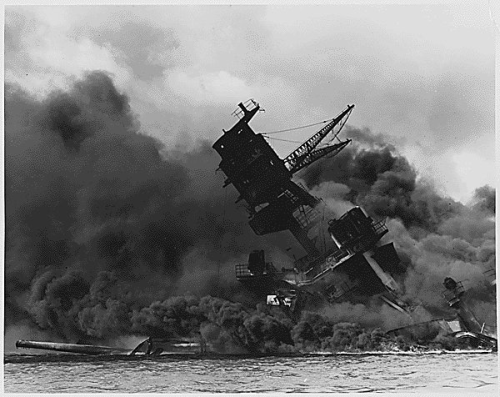
I often reflect on The Great Emancipator’s words on days like today. The attack on Pearl Harbor has dwindled to insignificance for a large majority of Americans, most of whom were not alive that horrible day. The survivors who recall where they were and what they were doing 68 years ago are now in their 70’s and 80’s. Their numbers are falling with every passing remembrance of Pearl Harbor Day while those left behind have made it their cause to remind us of what it was really like to live in an America when our comfortable illusions about our safety and security were smashed so totally, and with a shocking finality.

The white hot anger that took a nation still in the depths of a deep depression and lifted them up in their “righteous might” to smite the Nazis and Japanese militarists is not felt by most of us, although remnants of it still live on in the breasts of those who remember first hand the gigantic betrayal of the Japanese and the evil of Hitler and his henchmen.

December 7, 1941 is one of those “hinges of history” that marks a divide between two eras in our historical consciousness. Before that date, America saw itself as too good to sully its hands by getting involved in the grubby power politics of Europe, or the endless colonial conflicts that afflicted much of Asia. Afterward, we realized that our security depended on building strong alliances and being prepared for war even in peace time.

Our isolationism was tied to traditionalism, in that the experiment of intervening in World War I was almost universally seen as a big mistake. Wilson’s efforts to re-order the world via the Treaty of Versailles and League of Nations was viewed as an aberration by many Americans who took comfort in George Washington’s plea to steer clear of foreign entanglements. Some historians - Page Smith comes to mind - have argued that America wasn’t psychologically ready to assume a leadership role in the world following WW1 and that the rejection by the senate of Versailles as well as our snub of the League of Nations reflected that reality.

In truth, America was not very adept at this imperialist business. Our few colonial possessions served as little more than coaling stations for our merchant marine and navy (the Philippines being one of the only exceptions). And while as early as 1919, the navy developed “War Plan Orange” to fight the Japanese in the Pacific, the prospect of involving ourselves in trying to deflect Japanese imperialist ambitions in Asia were not taken seriously until the mid-1930’s.

Even in 1941, the thought was that war with Germany was much more likely. This was due to the “undeclared war” we were already fighting in the Atlantic. Our destroyers who were convoying supplies to Britain and Russia came under attack several times prior to December 7 - including the attack of October 31 on the USS Reuben James, sunk by a U-boat with the loss of 115 men.

The shock of December 7 wasn’t that we were at war so much as it was the shocking betrayal of the Japanese, who were negotiating with us right to the end. The historical record reveals that the Japanese had every intention of issuing an ultimatum - an hour before the attack. But snafus in decoding and translating the last message meant that the Japanese negotiators weren’t received by Secretary of State Cordell Hull until the attack was well underway.

Still, it is revealing how much we deluded ourselves to the last minute before the bombs began to fall on Pearl Harbor that peace was possible with Japan. Not so much our government, who were fully aware that a huge Japanese naval task force was steaming into the Pacific, destination unknown. Thanks to our breaking the Japanese naval code, the government knew the blow was about to fall but were in the dark where. Roosevelt sent a personal missive to the Emperor pleading for peace just hours before the first planes appeared over Diamond Head.

But the American people were being told that there was still a chance to avoid war, which made the attack all the more shocking, while engendering rage at what seemed to be a stab in the back by Tokyo. Our false sense of security and childlike innocence about the world disappeared in the fire, smoke, and blood of Pearl Harbor, as did much of our Pacific fleet - vanishing beneath the waves along with our too optimistic and too arrogant worldview.

Where does Pearl Harbor fit into our historical consciousness today? We like to take “lessons” from history but in truth, this is nonsense. The currents and eddies underlying the historical tides on which we are but reluctant passengers are too complex, too obscure to glean what we might commonly refer to as “lessons” to be learned from historical events. In this respect, Pearl Harbor was the culmination of decades of history; the rise of Japan as a westernized imperial power went back to the turn of the century, for instance.And from the moment of the opening of Japan in the middle of the 19th century, the prospect of a collision between their imperialist ambitions, and our own commercial empire building in the Far East was virtually assured.

Nothing is ever as easy as it appears as far as history is concerned. And that’s why it is easy to fall into a “false” historical consciousness when it comes to events like 9/11 or even Pearl Harbor. Rather than history teaching us anything, it is far better to have it inform us, animate our spirit, and act as an undergird to our most closely held beliefs and values.

There can be no present or future without a past. Such might be seen as a banal truism except we seem to have forgotten it, as Wilfred McClay, currently a senior fellow at the Ethics and Public Policy Center reminded us in this brilliant lecture at the Heritage Foundation in 1995:

Historical consciousness means learning to appropriate into our own moral imagination, and learning to be guided by, the distilled memories of others, the stories of things we never experienced firsthand. It means learning to make these things our own, learning to look out at the world we experience through their filter, learning to feel the living presence of the past inhering in the seeming inertness of the world as it is given to us. Of course, discernment between and among memories is of great importance. Not all are worth preserving, and not all are reliable. Here is where the practice of professional historians has been especially valuable, in preserving so much that would otherwise be lost and in ferreting out the evidence for certain propositions while uncovering the faulty basis for others. But the advocate of historical consciousness is likely to give preference to those memories whose importance and reliability have been established not merely by a select committee of the American Historical Association, but also by the passage of time. To repeat, historical knowledge and historical consciousness are different things, and the latter can never become the province of a historical priesthood.

The passage of time may have dimmed the immediacy of Pearl Harbor but its significance can never be diminished as long as we lovingly place it in the storehouse of our national memories. It is a part of us now, as surely as Yorktown, New Orleans, Chapultepec Gettysburg, San Juan Hill, Argonne Forest, and all the other place names where American blood was spilled for a cause. Even after the last Pearl Harbor survivor breathes his final goodbye, the “date that will live in infamy” will continue to live in our collective consciousness as a recognized milepost, pointing us on our way to the future.

That is the promise we can make to the survivors today. This is the promise we can make to our children and grandchildren as we teach them to develop their own historical consciousness about America and the world.

That’s a legacy for which the Pearl Harbor generation can be proud.

11/20/2009

COULD WE WIN IF WE HAD TO FIGHT WORLD WAR II TODAY?

Filed under: Decision '08, History, Media, Politics, The Rick Moran Show — Rick Moran @ 1:51 pm

The debate over “The Greatest Generation” and whether the way America is today could duplicate their stunning achievements in winning two wars and fighting through a depression while maintaining unity has been hashed and rehashed by far superior minds than mine.

But I just can’t help thinking about it after watching the History Channel this week and their excellent series, “Word War II in HD.”

If you haven’t been able to catch any of it, they will run the entire 10 hours on Saturday starting at 8:00 am central time.

Quite simply, it is the grandest, the most heartbreaking, the most stirring documentary series on World War II ever made. And that includes both “Victory at Sea” and “The World at War.”

TWAW is the gold standard - 32 hours of in-depth analysis of the politics, the strategy, the personalities, and ordeals experienced by civilians during the war. But it is rather soulless. It’s academic approach can be dry, although the images and words of survivors lend an emotionalism outside the rather clinical analysis offered.

“Victory at Sea,” on the other hand, went hard for dramatic effect. With the sonorous voice of Leonard Graves supplying the narration and music by Broadway impresario Richard Rodgers, VAS was a made for TV blockbuster that went right for the heart and kept the viewer entranced with its quick cuts, and snappy pace.

Other documentaries of individual battles (there have been a couple of excellent treatments of D-Day) have suffered from using stock footage that, if you watch enough of these things, you recognize from other projects.

But the History Channel sojourn into the past with “World War II in HD” is everything a good documentary should be; highly original, well scripted, images lining up with narration in an artistic mix, all the while marching forward with a pace that allows the viewer to digest the information and feel what the documentarian is feeling about his subject.

But it is the images that capture the mind and rend the soul. Culled from literally thousands of home movies - many in color - and long lost color combat footage, there is a freshness and even an immediacy about the entire package that has held me absolutely in thrall for the entire run of the series.

The technique is itself, fresh and original. Focusing on several individuals who fought in both the Pacific and Atlantic theaters, the survivors take us through everything from the home front, their battle experiences, the horror, mud, blood, guts, and monumental sense of loss when a comrade falls. The narration is accompanied by stunning combat footage - real “You Are There” images of mortar rounds exploding just feet from the camera, horrific sights of the wounded and dead, and always, the total destruction that war leaves in its wake.

A small example of the originality of the series can be found in the way that the narration will, from time to time, fade out slowly and the reading of the script is picked up by the actual survivor. It is an extraordinarily effective technique in that it humanizes the actor reading the narration when, after just a few seconds of the survivor reading, the voice of the actor portraying him is slowly brought back up, while the survivor’s words fade away. This is not a new technique but it it works spectacularly.

The music is obtrusive without overwhelming the action. Indeed, the music is used as a dramatic device to measure the pace of the documentary, mirroring the pace of the excellent narration (Gary Sinise). Beautiful editing builds bridges to succeeding each scene, allowing for seamless segues from clip to clip. A truly masterful job.

A word about the HD: It could be that they really didn’t have anything else to call the project, what with “World War II in Color” already taken. Shooting the program in HD is not the reason to watch it, nor is much of it in HD anyway. The films, as you can imagine, are grainy, and out of focus at times so even with an HD TV, it really doesn’t enhance the viewing experience that much.

All in all, “World War II in HD” is a triumph of documentary film making that should do for World War II what Ken Burns’ “Civil War” did for that conflict; bringing the viewer up close to the war while allowing for us to get to know some fascinating characters who increase our understanding of the conflict. (Burns’ “The War” was good but lacked the dramatic punch of the History Channel treatment.)

And as the last scenes of the documentary faded and the survivors, now all near or over 80 years old were left with their memories, it hit me that the hackneyed question about whether America today could pull together and perform such magnificent feats of arms and industry as those of my father’s generation manged, needed another airing.

Strip away our gadgets, our scientific wonders, and all the cultural, economic, and social touchstones that make up America today and ask yourself; How much like them are we? There’s no doubt that we are quite different in some respects. But like Robert Graves, the great essayist of the World War I generation who saw extraordinary love in the sacrifice of soldiers who marched lockstep into the most murderous fire, is there that kind of feeling for America today that would allow us to meet such huge challenges?

By World War II standards, our military is tiny. More than 16,000,000 Americans wore their country’s uniform in the Second World War. But there is little doubt that our current military is every bit as good, soldier for soldier, as those who beat the Nazis and the Japanese. So the question isn’t really a military one. It is a question of character. The real question should be; How similar is the character of today’s American to that of the World War II generation? Are we made of the same stuff? Do we believe in America as passionately as they did - enough to put aside our political differences and unite to see the job through to its conclusion?

I have my doubts. The whole idea of American sovereignty is fast disappearing - or at least the sort of sovereignty the WWII generation believed in. Call it a blind faith if you will, or perhaps you think it small minded and childish to harbor such notions that sometimes, there is only one side to take and that is the side of the country of your birth. It’s called “chauvinism” today and is quite unfashionable. But without it, we might have quit in 1944. Without that absolute certainty that we were in the right felt by the overwhelming majority of Americans whether at the battlefront or the homefront - whether fighting with a gun, or laboring in the factories and fields - I don’t think we could have done it.

There are many who would celebrate this loss of faith as the inevitable result of America “growing up” or worse, the consequence of a government that has betrayed the people time and again whether it was Viet Nam, Watergate, or some other national event that showed our leaders using us, lying to us, or betraying the principles on which the country was founded.

And yet…

We don’t know, do we? As implacable a foe as radical Islamism, it can’t come close to the existential threat of Hitler and his thugs or the economic threat to our emerging commercial empire in the Far East by Japan. And remember, all of this played out with the backdrop of a national depression where unemployment was still over 10% and most people hurting economically.

I want to believe we’d be up to those kinds of threats regardless of about which generation of Americans you want to talk. I don’t think it would matter what era you choose, I still see Americans as comprising a specific, exceptional “race” if you will. There are national characteristics unique to people who live here that are found nowhere else. We simply couldn’t have achieved what we have achieved, overcome what we’ve been able to overcome (self-inflicted or otherwise) without some spark deep within us that makes us “Americans.”

The conventional answer might be that we wouldn’t stand a chance fighting a long war like WWII today. But one thing is for sure; if I were a foreign power, I wouldn’t make the mistake that the Kaiser made in 1917, Tojo and Hitler made in 1941, or Saddam made in 1991.

And that is underestimate the United States of America.

11/7/2009

D-DAY FOR HEALTH CARE TODAY

Filed under: Government, History, Politics, health care reform — Rick Moran @ 10:05 am

No matter how the vote in the House on health care reform turns out, the amateur historian in me is tickled to be living in such “interesting times.”

I think that 200 years from now, this interlude in American history will be seen in the same way that we look upon the Missouri Compromise, or the nullification debates. More modern examples would include the Civil Rights Act and Voting Rights Act. The impact that all those debates had on the future of America cannot be overstated.

Even debates over New Deal or Great Society social legislation were muted and, in retrospect, not as controversial as the health care reform bill that is being brought to the floor today.

Never has such a large part of the American economy been designated for federal control. Never has the government reached so far into the personal lives of its citizens, compelling them through force of law to surrender some of their liberty. Every American will be affected by this bill in ways that not even the bill’s most ardent supporters can say with any certainty.

It is, as was said of the 1981 tax cuts, “a crap shoot.”

There is the potential for great mischief - a veritable smorgasbord of slippery slopes - some more realistic than others. There is the danger that the bill will not do what its supporters say it will do; lower costs and cover more people. There is the certainty that with the government now paying more for health care, they will feel it necessary to, if not dictate, then strongly encourage people through punitive tax laws to change what they consider “unhealthy” behavior.

I have written often over the last months that some reform is vitally necessary. The system is broken. Too many who want and need insurance are priced out of the market. Costs are rising at a ruinous rate and are sucking the life out of our economy. And some provision must be made for those with chronic or pre-existing conditions who are rejected by insurance companies.

Then there are the real biggies; We need to begin now to reform Medicare and Medicaid. There simply is no choice if we don’t want our economy to be destroyed.

But the bill that has been brought to the floor of the House today is far too ambitious in some areas, much too timid in others, way too expensive, and at bottom, an invitation for government to inject itself into the economic and personal lives of its citizens. The president and the Democrats have not made their case that this bill is the answer. Instead, they have made the primary goal of the process not the reform of health care, but a political yardstick by which to measure the president’s success. A failure is to be avoided because it would wound his presidency and damage the Democratic party’s chances for electoral success in 2010. Using that thinking, a bad bill is better than no bill at all - a recipe for unmitigated disaster.

This is not surprising because the monumental complexity of this bill makes it impossible to boil down into coherent policy. It is a slap-dash, confused, utterly incomprehensible mish mash of clashing interests, favors for industry, mandates for business, and the worst that nanny statism has to offer. It is too much for America to digest at once, and the best we can hope for is that the votes to pass it never materialize, forcing its withdrawal.

Despite the Democrat’s huge majority, chances for passage are still up in the air. That’s due to something that the president, in his health care reform speech, said was not in the bill but to no one’s surprise, ended up being included anyway; federal funding of abortions.

An agreement on language that would have set up an “independent monitor” to make sure that federal funds were not spent on abortion fell through last night - largely because the Catholic bishops, who are involved in the negotiations for this issue - wouldn’t support it.

Instead, Pelosi reluctantly agreed to a deal where Bart Stupak would be able to offer a floor amendment banning most federal funding for the procedure. It appears that this will satisfy a couple of dozen Democrats who will vote for the final package once the abortion amendment goes down to defeat.

According to Politico, that’s not nearly enough to assure passage:

“It’s a question of how you can keep everybody together and that’s the challenge before us,” Waxman said of the proposal earlier in the day. “What’s being called the Ellsworth language is also the bishop’s language which is the Stupak proposal. It’s basically to stop any services for abortion coverage in both the public plan and all private insurance. Not just for those who get subsidies but for everybody who goes to private insurance policies.”

“I would like the bishops, who I understand want to see passage of the legislation, to help us work out a way so we don’t have winners and losers,” Waxman said. “Because the losers will make us lose the bill and the winners then wont have won anything.”

Democratic officials said their count of hard “nos” was in the range of about 25. While House Speaker Nancy Pelosi can afford to lose up to 40 votes and still win passage, there are dozens of other lawmakers who remain on the fence publicly.

The last whip count had Pelosi at least 14 votes short, with no doubt a lot of fence sitters added to the “Yes” column. And that was for a bill with a “robust” public option. The abortion and illegal immigrant access issues weren’t even considered.

President Obama will come to the Hill today to twist some arms, and perhaps do a little horse trading with the fence sitters. Indications over the last month is that there may be as many as 60 Democrats who are very nervous about the bill, either because of abortion, or it’s ever climbing cost. No doubt many of them are open to blandishments from the White House. But in the end, it may be that there are just too many who won’t go along with the majority to realize passage - at least now.

It is possible that Pelosi will yank the bill from consideration today and delay the vote for a few days or a week in order to really turn the screws on recalcitrant members. But regardless of what happens, the thrust and parry in this debate has been one of the most fascinating exercises of democracy in our republic I can remember.

How it ends will determine what kind of country we will be forever after.

10/21/2009

BUCHANAN AND HIS ‘WHITE MAN’S LAMENT’

Filed under: Blogging, Culture, Decision '08, Ethics, History, Politics, The Rick Moran Show — Rick Moran @ 10:38 am

Is Pat Buchanan a racist? Is Rush Limbaugh?

Am I? Are you?

I discovered after writing my Rush Limbaugh post that there is no set definition for identifying a racist - at least one not fraught with politics, and informed by partisan rancor. “It’s obvious” is not an argument either way. Nor is there much agreement on whether one can be a racist subconsciously. This “all white people are racists and don’t even know it” idea was very popular a couple of decades back. But I don’t think anyone save committed racialists think that way anymore.

But does that mean that there is not a nurtured outlook of white superiority in our society that makes some of us oblivious to our own bigotry?

In the end, it all comes down to perception, and whether one has a decidedly deterministic worldview. How one experiences race in America has an awful lot to do with how low or how high we set the bar that defines for us whether one is a race hater or not.

Attorney General Eric Holder remarked early in Obama’s term that America was “a nation of cowards” because we wouldn’t talk candidly about race. I think he is right we don’t talk candidly about race but he is wrong when he says the reason is cowardice. How can there be a discussion on race when there is no agreement on what actually constitutes racism? Oh, there are “speech codes” and “hate crime legislation” that deal with the most obvious, outward manifestations of racism that help define, in the broadest possible terms, racists.

In fact, I would argue that speech codes and hate crime definitions further muddy the waters with regard to defining racism. In my estimation, such remedies lower the bar on what defines a racist, mixing legitimate free speech issues with racial issues. If one defines racism according to racial sensitivity, simply stepping on someone’s toes verbally can be construed as “hate.” That defeats the purpose of the First Amendment, and I believe is the reason many conservatives reject the idea of speech codes altogether.

(Hate crime legislation is an entirely different matter and goes to “intent” - a tricky legal definition that I wish would be used judiciously but the potential for abuse, and inconsistent application is too great to justify its passage.)

So are all racially insensitive people racists? Does the use of stereotypes automatically make one a racist? If you reject the NAACP position on affirmative action, are you a racist?

Most mindless partisans eschew the questions and simply go for the jugular. But for those interested in exploring these questions, we have an excellent exhibit in the form of an Op-Ed by paleoconservative Pat Buchanan that, on the surface, appears to be something of a “white man’s lament” at the loss of “traditional” America:

In their lifetimes, they have seen their Christian faith purged from schools their taxes paid for, and mocked in movies and on TV. They have seen their factories shuttered in the thousands and their jobs outsourced in the millions to Mexico and China. They have seen trillions of tax dollars go for Great Society programs, but have seen no Great Society, only rising crime, illegitimacy, drug use and dropout rates.

They watch on cable TV as illegal aliens walk into their country, are rewarded with free educations and health care and take jobs at lower pay than American families can live on – then carry Mexican flags in American cities and demand U.S. citizenship.

They see Wall Street banks bailed out as they sweat their next paycheck, then read that bank profits are soaring, and the big bonuses for the brilliant bankers are back. Neither they nor their kids ever benefited from affirmative action, unlike Barack and Michelle Obama.

They see a government in Washington that cannot balance its books, win our wars or protect our borders. The government shovels out trillions to Fortune 500 corporations and banks to rescue the country from a crisis created by the government and Fortune 500 corporations and banks.

America was once their country. They sense they are losing it. And they are right.

Buchanan is not the first conservative to incorporate these concepts in their critique of the Obama administration. But Buchanan scores the trifecta of hyperbole by collating race, class, and fear of “The Other” in his lament.

And he proves himself once again to have the historical sense of a marmoset about America. What is America ever been about but change? I’ve said it many times, and it is born out by even a cursory understanding of the thrust of American history; this is a nation on the move, has been on the move, and will always be on the move as long as we are free.

We stand still for nothing, for nobody - no institution, no philosophy, no group, industry, or movement. To be static in America means that you are already on your way out. We reinvent ourselves at the drop of a hat, with impossible speed. What takes European democracies decades, we do in one or two election cycles. It is frightening. It is marvelous. It is the defining characteristic of this country and it is one of those things that makes us exceptional.

I know what Buchanan is trying to say - he’s not saying it well and he is mixing a witches brew of politics and racial identity in with his critique. What he refers to as “traditional America” is defined by his enemies as white America. But if we are to postulate that Buchanan’s “traditional Americans” are upset because we have an African American president and preferences for minorities, doesn’t that make “traditional Americans” themselves racist by definition?

Beware, a trap Mr. Serwer:

I’d love to just leave this post with snark, but I have to say one last thing. Black Americans have shed blood in every American war since the Revolution. This country, even the very Capitol building in which today’s legislators now demand to see the birth certificate of the first black president, was built on the sweat and sinew of slaves. Before we were people in the eyes of the law, before we had the right to vote, before we had a black president, we were here, helping make this country as it is today. We are as American as it gets. And frankly, the time of people who think otherwise is passing. If that’s the country Buchanan wants to hold onto, well, he’s right, he is losing it.

Did Mr. Serwer not just define “traditional” Americans?” I believe he did. Race, or gender, or sexual orientation has nothing to do with whether one is a “traditional American.” Some may believe that Buchanan is limiting himself to the white race, but his critique echoes in those communities where “traditional American” is broadly defined as anyone who respects and reveres the first principles upon this nation was founded; among them - self reliance, a respect for individual rights, and the investment of the nation’s sovereignty in the Constitution. One doesn’t need to be a conservative to believe in the traditional American values Buchanan believes are disappearing. And it is insulting, as Mr. Serwer points out, to limit the idea of traditional American to one race.

The question then becomes not whether Buchanan is a racist but whether he’s right. As usual, Buchanan overstates the case but hits upon something that critics ignore at their peril.

It is the pace of change that has people of many races, many backgrounds worried. If it were only tea partiers and loudmouths at town hall meetings, the sense of unease that runs the length and breadth of the land would not be so obvious - obvious enough to be reflected in poll numbers and soon, at the ballot box. It is difficult to argue that the pace of change doesn’t matter or that traditional Americans are not worried that the many changes being proposed by the president cannot be shoehorned into their vision of what America is supposed to be all about.

You can argue that African Americans as a group are less critical, or that the Hispanic community may not be as worried about the pace of change as white Americans. But to dismiss this phenomenon as a white only construct is naive. To do so identifies the critic as someone too enamored in viewing the nation’s problems through the prism of race and racism.

This plays to the idea that many whites are subconsciously racist - that when they lament the passing of an America with which they are familiar, what they are really saying is, “I don’t like that black man as president:”

I agree with the substance of Adam’s case against Pat Buchanan; the vision that Buchanan is putting forth of America is both racist and ahistorical, and is genuinely dismissive of the contributions of every non-white American (not to mention women, immigrants, and so forth). At the same time, I think that there’s more going on; Buchanan has always been more willing than most conservative pundits to make forthright, and in some sense honest, defenses of unpalatable elements of the right wing worldview. I recall at some point in the 1990s that Buchanan was asked why the United States was willing to sacrifice treasure for Bosnia and not Rwanda, and he gave the straightforward answer that Rwandans weren’t white enough.

In this case, I think that Buchanan is invoking a genuine sense of loss of entitlement on the part of a substantial portion of white America. This isn’t to defend or justify the white privilege that created this entitlement entailed, or to justify Pat Buchanan’s nostalgia for it. Nevertheless, I think that Buchanan is pointing to something that’s very real, or at least as real as any sociological fact. White America, as the construct exists in the mind of many Americans, is disappearing, even by some objective criteria; it’s retreating deeper into exurban communities, and it’s very, very slowly ceding political and financial power. Moreover, the idea of America is changing; Buchanan has a very definite vision of what America is, and is smart enough to understand that his vision is losing traction. In this context, it’s hardly surprising that the response is a combination of rage and raw panic. That the ideological structure that supports White America is racist and has a disturbing narrative of American history is academically relevant, but it’s also not the central point. Those who hold Buchanan’s vision (and many do, although often not in terms as explicit as Pat is willing to put forth) really do find themselves under siege, and pointing out that these beliefs are both crazy and immoral has very limited effect.

Spoken like a true determinist. Positing the notion that white Americans obsess about race, or their “entitlement” makes sense if you believe the rush to create a different kind of America doesn’t involve a radical movement away from what all races, all creeds who believe in “traditional America” see as fundamentally important to their identity. How do those black and Hispanic veterans who shed blood in our wars view the president’s foreign policy? Or do the black and Hispanic communities march in lockstep with the idea of national health insurance? Bail outs for big banks and corporations? A larger federal role in educating their children? A radical restructuring of our energy policy?

A determinist can ascribe all of this to white racism because looking at the country through the warped vision of racial conflict, everything becomes explainable as “loss” defined as privilege or status. People don’t think that way, have never thought that way, will not act in that fashion as evidenced by the fact that Communism is, for all intents and purposes, dead. This phenomenon resists a deterministic explanation. We must look to history for answers.

It has never been that white America, or traditionalists of any kind have been resistant to all change, everywhere, all the time. There have been pockets of resistance throughout our history to change (some larger than others, as was the case in southern resistance to integration). The social history of America is replete with examples of a “brake” being placed on change that turned out to be both necessary and good.

But unless you are willing to argue that “traditionalists” wish to see Jim Crow reestablished or women denied the right to vote, you must accept the fact that rapid change, while causing some dislocation, is nevertheless accepted by tradtionalists eventually. This does not mean that southern whites were correct in resisting integration, or men were spot on in their opposition to a woman’s right to vote. But in a nation that can alter its political landscape every four years, some anchors must be recognized if change that is proposed is to be folded into our national consciousness and become part of our national character.

Looking at the long view of history, I find it absolutely astonishing that in my youth, a black man couldn’t get a sandwich at a southern coffee shop and yet, I live in a time where an African American received more white votes for president than his party’s predecessor.

Is it the position of critics that this miracle was accomplished without the traditionalists? I beg to differ. I believe it was the traditionalist’s eventual acceptance of racial integration - begrudging though it might have been - that made the election of Barack Obama possible. And the fact that we have gone from Jim Crow to an African American president in less than one human lifetime only points more strongly to the idea of American exceptionalism and the idea that rapid change, when governed by applying first principles - in this case, equality for all - will eventually be accepted even by those who oppose the change in the first place.

Mr. Serwer rejects the findings of the Democracy Corps focus groups that race plays a small part in opposition to the president because it doesn’t feed his thesis that Buchanan (and Limbaugh) are explicitly lamenting a “loss” to white America as the result of the election of a black man.

I don’t doubt that there is an element of racism - clear, nauseating, and shocking - that is a significant part of Obama hate. But limiting one’s critique to a purely racial explanation belies the fact that traditionalists (sometimes incoherently) are more concerned about the president severing connections to the past than any non-acceptance that a black man can be president, or that the very fact that a black man sits in the White House gives them cause to lament their being marginalized in this “new” America.

I am not accusing Mr. Serwer of deliberately misinterpreting Buchanan’s critique. But rejecting out of hand empirical evidence that your own critique is off base smacks of partisanship, not rigorous analysis.

President Obama ran on a platform of change. He is giving his supporters exactly what they voted for. But from recent poll numbers, it is clear that even many of those who voted for Mr. Obama are feeling uneasy about what he is doing, that he is moving too quickly in some areas, without giving proper respect to the principles that America was founded upon or the “traditions” if you will that binds this nation as one. Whether they are white, black, brown, or purple matters not. And those who seek to muddy the waters by making opposition to the president’s idea of change a question of race hate are missing the boat.

10/19/2009

THE DEMONS ARE STIRRING AGAIN

Filed under: History, Science, The Rick Moran Show — Rick Moran @ 9:14 am

How is it possible that in the greatest age of scientific discovery in human history, millions of people believe that something horrible is going to happen to the world on December 21,2012?

I suppose nothing should surprise me given the widespread belief in astrology, the New Age nonsense related to the mystical power of pyramids, and the continued idiotic acceptance of Nostradamus, Edgar Cayce, and other wackos as having knowledge of what is to come.

Otherwise normal, educated people will let drop in casual conversation the most inane stupidities regarding the occult, or the anti-rational rantings of long dead “prophets” whose vague, elliptical “predictions” are accepted as proof of their genius.

In fact, when it comes to believing in the paranormal or psuedoscientific theories, we Americans are spectacularly inept at being able to tell the difference between science, and psuedoscience, and are thus unable to distinguish between fact and fiction.

The last Gallup poll on the subject of belief in the paranormal in 2005 showed that beliefs in such things as ESP, ghosts, astrology, and clairvoyance, had changed little since a similar survey done in 2001.

Here’s are some results from the 2005 poll:

% Believe in

Extrasensory perception, or ESP - 41

That houses can be haunted - 37

Ghosts/that spirits of dead people can come back in certain places/situations - 32

Telepathy/communication between minds without using traditional senses - 31

Clairvoyance/the power of the mind to know the past and predict the future - 26

Astrology, or that the position of the stars and planets can affect people’s lives - 25

That people can communicate mentally with someone who has died - 21

Witches - 21

Reincarnation, that is, the rebirth of the soul in a new body after death - 20

Channeling/allowing a ’spirit-being’ to temporarily assume control of body - 9

Not all those surveyed believed in all 10 of this paranormal nonsense. But you may take no comfort from that.

A special analysis of the data shows that 73% of Americans believe in at least one of the 10 items listed above, while 27% believe in none of them. A Gallup survey in 2001 provided similar results — 76% professed belief in at least one of the 10 items.

The “cumulative percent” column shows that more than one-fifth of all Americans, 22%, believe in five or more items, 32% believe in at least four items, and more than half, 57%, believe in at least two paranormal items. Only 1% believe in all 10 items.

Further breaking down the data another study used the Gallop poll as a baseline to examine what college educated people believed about the paranormal. The results are pretty shocking:

Even though researchers Bryan Farha at Oklahoma City University and Gary Steward of University of Central Oklahoma admitted that they had expectations of finding contrary results, their poll of college students found that seniors and graduate students were more likely to believe in haunted houses, ghosts, telepathy, spirit channeling and other paranormal phenomena than were freshmen.

[...]

Farha’s and Steward’s survey was based on a nationwide Gallup Poll in 2001 that found younger Americans more likely to believe in the paranormal than older respondents. The results of the Farha/Steward poll discovered that gaining more education was not a guarantee of skepticism or disbelief toward the paranormal. While only 23% of the freshman quizzed professed a belief toward paranormal concepts, the figures rose to 31% for college seniors and 34% for graduate students.

Why is it important that belief in the paranormal be attacked, and efforts made to constantly debunk these beliefs? Here’s famous psychic paranormal debunker James Randi who has offered $1,000,000 to anyone who can prove that ESP is real:

According to J. Randi, “acceptance of nonsense as mere harmless aberrations can be dangerous to us. We live in an international society that is enlarging the boundaries of knowledge at an unprecedented rate, and we cannot keep up with much more than a small portion of what is made available to us. To mix our data input with childish notions of magic and fantasy is to cripple our perception of the world around us. We must reach for the truth, not for the ghosts of dead absurdities”

Experts refer to this as “information pollution” where outrageous ideas are interlaced with facts and what emerges is a wholly distorted view of reality.

This leads us directly to the latest manifestation of dangerous thinking with regard to the paranormal; the “End of the World” meme that is starting to really pick up steam and will only become more pronounced the closer we get to 2012.

I love the History Channel, but they seem to have made the decision to be one of the leading promoters of this nonsense, with a weekly series on Nostradamus and predictions about the end of the world from several cultures. For a network that features two of the best science programs on today - The Universe and How the Earth was Made - I find it preposterous that The Nostradamus Effect could be part of its general programming.

What is the show about?

The end is near. At least that’s what the doomsday predictions from Nostradamus, the Book of Revelation, the Mayan “long count” calendar and others would have us believe. Many unsettling forecasts of global destruction even pinpoint the year: 2012. How worried should we be? If these prophecies are accurate and inevitable, is there any way to avoid or at least postpone them from coming true? Michel de Nostradamus was a 16th-century French physician and astrologer whose very name is synonymous with apocalyptic visions of the near and distant future. His ominous writings appear to have accurately anticipated numerous natural disasters, plagues and wars. Nostradamus Effect examines these and other end-of-time predictions from cultures across the globe, from centuries ago, and connects the dots with current global events to separate the prophecies that appear to be inspired visions from those that are merely crackpot conspiracy theory.

By purporting to “separate prophecies” that are “inspired visions (could be true?) from “crackpot conspiracy theories,” the show does an enormous disservice to the truth. A skeptic would immediately identify all of this nonsense as the work of crackpots - as indeed it is. There is absolutely no evidence whatsoever that “inspired visions” throughout history have been anything but wishful thinking on the part of those who are unwilling to examine such claims with a critical eye. Anyone who believes Nostradamus was anything but a kook needs to look within to find the objectivity to realize that his elliptical and nebulous “quatrains” that supposedly predict the future are nothing more than gibberish.

The History Channel also has broadcast several “specials” on the Mayan Doomsday prophecy that are, if anything, more dishonest than The Nostradamus Effect. They cleverly mix little sprinkles of scientific “fact” about the Mayans and their extraordinary culture in with the false notion that the end of their calendar meant the end of the world, a ridiculous notion long ago debunked by experts in Mayan culture:

But scholars are bristling at attempts to link the ancient Maya with trends in contemporary spirituality. Maya civilization, known for advanced writing, mathematics and astronomy, flourished for centuries in Mesoamerica, especially between A.D. 300 and 900. Its Long Count calendar, which was discontinued under Spanish colonization, tracks more than 5,000 years, then resets at year zero.

“For the ancient Maya, it was a huge celebration to make it to the end of a whole cycle,” says Sandra Noble, executive director of the Foundation for the Advancement of Mesoamerican Studies in Crystal River, Fla. To render Dec. 21, 2012, as a doomsday or moment of cosmic shifting, she says, is “a complete fabrication and a chance for a lot of people to cash in.”

“Cash in” - as the History Channel is doing with both fists.

It should be noted that in each of these broadcasts, the producer has included one or more skeptics to provide “balance.” The Skeptic Foundation’s Robert Shermer has been a frequent voice of reason on these shows, but their commentary is far outweighed by “evidence” that points to the destruction of our planet 3 years hence.

Harmless fun? Not hardly:

Specific harms caused by paranormal beliefs have been summarized as:

* a decline in scientific literacy and critical thinking;

* the inability of citizens to make well-informed decisions;

* monetary losses (psychic hotlines, for example, offer little value for the money spent);

* a diversion of resources that might have been spent on more productive and worthwhile activities (for example, solving society’s serious problems);

* the encouragement of a something-for-nothing mentality and that there are easy answers to serious problems, for example, that positive thinking can replace hard work; and

* false hopes and unrealistic expectations

(Beyerstein 1998: “The Sorry State of Scientific Literacy in the Industrialized Democracies.” The Learning Quarterly 2, No. 2:5-11. ).

Also looking to cash in are hucksters who know exactly how to appeal to the sizable segment of our population who finds believing in these end of the world scenarios to be almost like riding a roller coaster - it’s the fun of being scared that is addicting to some. They find the idea of the world suddenly ending both terrifying and exciting. Not knowing how to judge the efficacy of such claims, they veer between acceptance and rejection with their level of acceptance rising the more they watch or read about the subject.

And if it’s reading they want, there are books galore already, not to mention an endless number of websites devoted to the topic. This one takes itself too seriously:

As 2012 approaches we have a growing list of what “experts” feel might occur. Despite the sincerity and long-winded explanations, it’s all just guesswork. There is no scientific evidence that anything untoward will happen in 2012. All we have to suggest that 2012 will be any different to 2011 or 2013 is that the Mayan Long Count calendar ends on Dec 21, 2012. The Mayans themselves had almost nothing to say about what the end of the calendar held for humankind, and this suggests that they merely inherited the calendar from an earlier culture. In deciding which of the many possible calamities are more likely to wipe us out in 2012, the possibility of an ancient culture predicting such for 2012 must be taken into consideration.

The gentleman then goes on to posit 10 calamaties - including a “Religious Apocalypse,” rapture and all, and - one that I’ve never heard of - “Explosion from the black hole at the center of our galaxy.” He repeats speculation that such a “gravity wave” caused the 2005 tsunami and not the massive Pacific Ocean earthquake scientists know was responsible for the disaster.

The site is actually quite reasonable compared to others. But his benchmark that asks if “Ancients could predict” any one of his scenarios is an indicator that the fellow is a couple of shakes short of a good martini.

The ever present danger of cults arising out of this craziness should not be underestimated. Some experts believe that the madness will not be quite as bad as what occurred during the Y2K hysteria:

The buildup to 2012 echoes excitement and fear expressed on the eve of the new millennium, popularly known as Y2K, though on a smaller scale, says Lynn Garrett, senior religion editor at Publishers Weekly. She says publishers seem to be courting readers who believe humanity is creating its own ecological disasters and desperately needs ancient indigenous wisdom.

“The convergence I see here is the apocalyptic expectations, if you will, along with the fact that the environment is in the front of many people’s minds these days,” Garrett says. “Part of the appeal of these earth religions is that notion that we need to reconnect with the Earth in order to save ourselves.”

Scare stories about global warming - exaggerating for effect - as well as the usual environmental disaster predictions play very well to the non-skeptical among us who, if they read it in the newspaper, hear it on the news, or even just read it on the internet, it must be true.

I wrote about this attitude when a study came out showing only Turkey had a higher percentage of citizens who believed evolution was false:

What is it that the rest of the enlightened world knows and we don’t? Are all the technologically advanced peoples on this planet under some magic spell of the evil Darwinists? What are the real world consequences of this kind of scientific ignorance?

There is little doubt that science education in this country is a joke. While American 4th graders score very well on international standardized tests, finishing 3rd in the most recent TIMSS Report (Trends in International Mathematics and Science Study), it’s all downhill from there. Our 8th graders finish in the middle of the pack while our seniors in high school are almost dead last.

We have a lack of good science programs in middle and senior high school as well as a dearth of good science teachers. But beyond that, it is the very process of learning that is at fault.

Too much rote learning, too much emphasis on being able to regurgitate facts, and not enough problem solving, or learning the basics of critical thinking. Exercising the mind in this way while developing good habits regarding the process of weighing facts and evidence has never been a strong part of the curriculum in public schools and is even weaker today.

I’m not sure if it is possible to reintegrate these concepts into learning. My understanding of current education theory is that the very idea of critical thinking is seen as perpetrating the white power structure by brainwashing children to think only one way and not put “context” into their thinking. That “context” includes placing witch doctors on the same scientific level with western medical doctors. They aren’t superstitious practioners of pseudo medicine (despite the salutary effects of some herbal applications whose effects they ascribe to the supernatural), but rather they should be viewed as objectively on par with real doctors.

And we wonder why so many believe in ghosts?

The candle flame gutters. Its little pool of light trembles. Darkness gathers. The demons begin to stir. [Carl Sagan, The Demon-Haunted World: Science As a Candle in the Dark]

« Older PostsNewer Posts »

Powered by WordPress