Right Wing Nut House

10/21/2005

REACTION TO THE MEHLIS REPORT

Filed under: Middle East — Rick Moran @ 10:22 am

Rather than my usual habit of simply updating a post to detail other reactions by blogs to the same story, I’ve decided to go ahead and devote an entire post on reaction to the Mehlis Report regarding the Hariri assassination.

The MSM has given the story front page treatment. The New York Times leads with the supposedly embargoed information that President Bashar Assad’s brother in law Syria’s military intelligence chief, Asef Shawkat has been implicated in the plot to kill Hariri.

I find it interesting that the State Department would ask that the information be censored while knowing that it would probably leak anyway. According to the “diplomat” quoted in the story, Assad himself may be on the ropes as a result of this obviously botched conspiracy. If so, State may be trying to head off a coup d’etat:

“There is evidence in abundance,” the diplomat said. “But to get every piece of the puzzle they need more time.” He spoke on condition of anonymity because of what he described as the extreme sensitivity of the matter.

Mr. Shawkat is considered the second most powerful man in Syria and has been seen as a likely candidate to take over the country if the embattled Mr. Assad were removed from office.

The diplomat, describing Syria as a “country run by a little family clique,” said the involvement of any one in Mr. Assad’s inner circle would be a severe blow to the government.

“There is absolutely no doubt, it goes right to the top,” he said. “This is Murder Inc.”

By implicating Shawkat, State has cut the legs from underneath any cabal that would wish to overthrow Assad. You’ve got to believe that no one in Syria wants an international criminal as President. Also, relations with Syria are at an extremely delicate point now and publicizing the fact that Assad’s relation is directly responsible for murder would complicate any diplomacy that’s going on. Besides, it’s a nice club to hold over Assad’s head not to publically humiliate him by having his brother in law named as a murderer.

The Washington Post talks about the impact the report might have on the international community:

The findings have been eagerly awaited by U.S. and European officials. Along with a second U.N. report on Lebanon due in days, key members of the Security Council hope to use the findings to increase pressure on the Assad government to end years of meddling in Lebanon and to generally change its behavior both at home and throughout the region, including ending support for extremist groups.

That last may be wishful thinking as Assad needs those “extremist groups” to project his power in Lebanon as well as bother the state of Israel.

The Washington Times takes a different approach, highlighting the potential unrest in Lebanon that the report could engender:

Lebanese police and soldiers have been deployed throughout the capital to maintain order in an increasingly tense environment.

Many Lebanese fear a revenge campaign by Syrian soldiers or loyalists.

“Given the infiltration of Lebanese institutions and society by the Syrian and Lebanese intelligence services working in tandem, it would be difficult to envisage a scenario whereby such a complex assassination plot could have been carried out without their knowledge,” wrote Detlev Mehlis, a German criminal investigator and head of the U.N. panel.

The theme of Lebanese reaction is taken up by Michael Totten:

Lebanon this morning was quiet and subdued in the wake of the news. Automobile traffic is down. Foot traffic is down even more. Downtown Beirut is eerily silent. Military checkpoints have been beefed up substantially. Armored vehicles and heavy artillery are set up in front of potential targets. I noticed some hotels won’t allow cars to enter their parking lots without first having bomb squads check under the chassis with mirrors for bombs. But I saw that last time I was in Lebanon, in April, and I’m unsure if this is a resumed policy or if it has been in place the whole time. I will say that I haven’t noticed it on this trip until now.

I did see a number of large old white people with hats and cameras wandering around downtown. Perhaps a cruise ship just deposited them blissfully unaware into a frying pan.

Global Voices has reaction from from bloggers inside Lebanon:

The Lebanese Blogger Forum came to this Conclusion:

There is probable cause to believe that the decision to assassinate former Prime Minister, Rafik Hariri, could not have been taken without the approval of topranked Syrian security official and could not have been further organized without the collusion of their counterparts in the Lebanese security services.

While the Lebanese Political Journal says:

The streets of Beirut are incredibly quiet. The last time I experienced this was the day after Hariri was assassinated when no cars roamed the streets. Today, is not like that day, but the city is in an unusual state.

The Captain points out that the report will finally get some action against Syria in the Security Council:

This UN report does make it almost impossible for the UN Security Council to dither any longer on this issue. The US-French effort to push devastating sanctions onto Assad’s narrow shoulders should continue apace, and perhaps the report might even convince Russia and China to step aside and withhold their vetoes and protection from Assad. Dictatorships can’t act this stupidly and still expect their allies to unquestionably endorse them forever.

Now if we could only get them to move on Iran’s nukes…

Joe Gandelman has a good analysis highlighting more MSM reaction.

And Mark Noonan puts the report in perspective:

Last week we noted that Syria’s Interior Minister, - and former head of Syrian intelligence in Lebanon - Kanaan was reported to have committed suicide in his office. Given that the UN investigation - for what it was worth - was coming to a head and was bound to show clear Syrian, and especially Kanaan, involvement in the murder of a Lebanese politician, I thought the suicide rather convenient

Kanaan’s “suicide” must be seen in this light. Perhaps the Interior Minister was contemplating turning on his collegues. Or perhaps someone thought he told Mehlis’ people too much. Either way, he was a danger to someone, probably Shawkat.

In this way are minor annoyances dealt with in Assad’s Syria.

SYRIA AND THE HARIRI CONSPIRACY

Filed under: Middle East — Rick Moran @ 8:43 am

This article originally appears in The American Thinker

The report released by the United Nations today that details Syrian involvement in the assassination of former Lebanese Prime Minister Rafiq Hariri reads like a bad spy novel. It seems unbelievable, but the facts are clear; so many people were involved in the conspiracy to kill the popular Lebanese nationalist that it was inevitable that the truth would eventually come out.

The list of accomplices is staggering. Not only Syrian President Bashar Assad himself, who personally threatened the life of Hariri by telling him in a meeting on August 26, 2004 he would “break Lebanon over your head” unless Hariri backed an extension of the term of office of Lebanon’s puppet President Emil Lahoud for three years, but also the Syrian intelligence service, a faction of the Lebanese armed forces loyal to Syria, and even the personal bodyguards of Hariri himself.

The detailed report was authored by German prosecutor Detlev Mehlis and involved more than 400 interviews and a review of more than 16,000 pages of documents. Among those interviewed was Ghazi Kanaan, the former Syrian intelligence chief in Lebanon, who committed suicide last week under suspicious circumstances. President Assad declined to be interviewed, and interviews with top Syrian cabinet officials only seemed to confirm the extent of the conspiracy. According to Mehlis, these top government officials gave “uniform answers” that contradicted the weight of evidence.

One other thing that the Mehlis investigation found was that Syrian influence on the day-to-day operation of the Lebanese government was “pervasive” and was managed by an extensive network of Syrian intelligence officials. While this comes as no surprise, it is shocking to read in black and white the bullying from Damascus that the Lebanese people had to endure for more than a quarter century.

In an interview with Hariri’s son Saad who was recently elected to the Lebanese parliament, investigators got a flavor of Bashar Assad’s brutality as well as some insight into the extent to which Lebanon was treated like the personal fiefdom of the Syrian President:

Saad said: “I discussed with my father, the late Rafik Hariri, the extension of President Lahoud’s term. He told me that President Bashar Assad threatened him telling him: “This is what I want. If you think that President Chirac and you are going to run Lebanon, you are mistaken. It is not going to happen. President Lahoud is me. Whatever I tell him, he follows suit. This extension is to happen or else I will break Lebanon over your head and Walid Jumblat’s. (…) So, you either do as you are told or we will get you and your family wherever you are.”

Jumblat is the old, canny, Druze warlord who has survived these many years by staying one step ahead of the assassin’s knife. He basically kept his mouth shut about the extension of Lahoud’s term until more than a million Lebanese went into the streets to demand the ouster of Syrian troops last spring. To his credit, he then joined with Saad Hariri and several other factions in a grand coalition that swept to victory in the elections last summer.

In addition to being personally threatened by Assad, Hariri was warned by Syrian Deputy Foreign Minister and former Ambassador to Washington Walid Mouallem, in a meeting just days before the assassination, who told him that Syrian security services had him “cornered” and not to “take things lightly.” The former Prime Minister said after the meeting that “it was the worst day of his life.”

Four Lebanese Generals (who are imprisoned on unrelated charges) have also been implicated, as well as the notorious head of the Popular Front for the Liberation of Palestine – General Command, Ahmad Jibreel. The PFLP Commander has been a thorn in the side of Israel for many years and is the author of dozens of terrorist attacks directed against the Jewish state.

One curious note is that there was an intervention at the last moment by the US State Department, who asked that a portion of the report be redacted. The Daily Star report linked above says that “Sources have stated that the uncensored report names the primary suspects in the crime as: Assef Shawkat, Syrian President Bashar Assad’s brother-in-law and head of Syrian intelligence; Bahjat Suleiman, a high ranking Syrian intelligence officer; Ghazi Kenaan, the former Syrian Interior Minister and commander of Syria’s intelligence apparatus in Lebanon between 1982 and 2002.”

One shadowy Lebanese operative appears to have been a conduit for several of the factions involved in the killing. Sheikh Ahmad Abdel-Al, a prominent figure in the Al-Ahbash, Association of Islamic Philanthropic Projects, and a close friend to President Lahoud, made a call minutes before the blast, at 1247 hrs, to the mobile phone of Lebanese President Emile Lahoud and at 1249 hrs had contact with the mobile telephoneone of one of the Lebanese Generals implicated in the plot, Raymond Azar.

The Hariri assassination has clearly been a disaster for Assad’s regime. Showing little of the guile of his father Hafez al Assad, who ruled Syria with an iron fist for nearly 30 years, Bashar has placed his country in an impossible position. Kicked out of Lebanon by a combination of massive protests by the Lebanese and international pressure led by the US and France, Assad’s strategic position in the Middle East is in shambles.

Assad’s father Hafez al Assad was a classic “strongman” controlling the army and intelligence service through a combination of fear and bribes (Assad milked Lebanon commerce dry and used the proceeds to stay in power) while using an efficient and deadly secret police to stifle dissent and maintain control of the populace. His Soviet allies sold him modern weaponry while backing him diplomatically in his quest to use Lebanon as both a buffer state against Israel and a foward staging area to precipitate attacks on the Jewish homeland.

Hafez Assad was a player in the sometimes deadly game of Middle East politics because he could stay one or two steps ahead of his adversaries in Beirut as well as Washington and Tel Aviv. He was sure-handed in his dealings with other Arab states, especially his fellow Ba’athists in Iraq. And he was a survivor, realizing after the first Persian Gulf War that, in order to maintain his position, he would have to at least give the appearance of talking to Israel.

His son Bashar succeeded to the Presidency upon Hafez’s death in 2000. Bashar, an ophthalmologist by training, came to politics late. His older brother Basil, groomed by his father to succeed him, died in a car crash in 1994. Bashar, then, was thrust into the role of putative successor. After 6 years in the military, Bashar was “elected” by the Syrian parliment to the presidency.

There have been reports of dissatisfaction in both the military and factions in the Ba’athist party itself over young Assad’s rule, and this botched conspiracy may threaten his hold on power. The fact that Bashar couldn’t see all this coming has apparently troubled many of the old guard Ba’athists who saw Lebanon as a cash cow, filling their pockets by exploiting that country’s commercial enterprises to the fullest. This begs the question: why kill Hariri in the first place?

A clue may lie in Assad’s relationship with the fanatical Islamists whose guns once did his dirty work in Lebanon. They may have forced his hand regarding Hariri due to the former Prime Minister’s non-sectarian approach to the muddle that is Lebanese politics.

Rafik Hariri was a much-respected political figure. He favored giving women and young people the vote, as well as reconciling with Lebanon’s Christian minority. Although a Shia Muslim by birth, he had a knack for drawing support from all segements of Lebanese society. Two events may have sealed the former Prime Minister’s fate. On January 31st, Hariri met with the Pope in Rome, an event obviously opposed by the Islamists who saw the meeting as confirmation that Hariri was cozying up to the Christian minority. Then, the very next day Hariri gave an interview to the Lebanon Daily Star in which he said he was “not concerned with sectarian issues” and was friends with everyone.

This may have been the last straw for the radical Islamic terrorists who are very concerned with sectarian issues, wanting more than anything else to have Shar’ia law govern the country. Assad may have felt that he had little choice, especially since Hariri’s opposition to an extension of President Lahoud’s term would have complicated the political situation enormously. Under pressure from the international community Syria had granted Lebanon the right to have parliamentary elections in June. With Hariri a logical choice for the opposition to rally around, Assad may have forseen what occurred anyway; instead of the usual fractured sectarian muddle, a powerful, united opposition emerged and is in the process of sweeping away Lahoud and his henchmen.

A second U.N. report on Lebanon is expected next week. It will focus on the implementation of Resolution 1559, which calls for the end of Syria’s meddling in Lebanon and the disbanding of armed groups that are tied to Syria. This would include the terrorist organization Hizballah, whose militia has so far refused to disarm. This has caused problems for the United States because Hizballah may be considered a terrorist organization by the State Department, but the Lebanese people just elected two dozen of its members to parliament. There have been some proposals to incorporate the militia into the regular Lebanese army, but that has been so far rejected by Hassan Nasrallah, Hizballah’s senior political leader. However, Nasrallah has shown some flexibility in the matter and a compromise may still be reached.

The assassination of Rafiq Hariri was a Syrian blunder of monumental proportions. It has isolated Syria from most of the international community. It has placed Syria in a much weaker military position in the Middle East. And it has placed the rule of Bashar Assad himself in danger. On top of all that, the act of assassinating Hariri failed to achieve the desired result, and indeed had the opposite effect: it united the Lebanese opposition who, with the courage of and determination of the Lebanese people, kicked the Syrians out of Lebanon for good.

UPDATE

Michael Young has a fascinating explanation for why several Syrian official’s names were redacted from the published report. While The Daily Star is reporting that it was the US State Department who asked that the report be censored, Young has evidence that it was actually done at the highest level of the UN: The Office of the Secretary General:

It was especially interesting that initial copies of the Mehlis report released to journalists at the United Nations last night came as a Word document, with tracked changes in the text. The final emendations were made by the office of Secretary General Kofi Annan.

In the initial Mehlis draft of the particularly damning paragraph 96 (here is a link to a non-annotated version of the final report), two very senior Syrian officials–Military Intelligence chief Assef Shawkat, Syrian President Bashar Assad’s brother-in-law, as well as the president’s own brother, Maher, are mentioned by a witness as having helped plan Rafik Hariri’s assassination. However, in the final draft redacted by Annan’s office, the names were removed, though the original text is clearly visible via the tracked changes.

This seemed to indicate timidity from Annan’s office, or at least a desire to avoid any accusation of high-level Syrians in the context of a statement by a single witness. However, that may be half the story: Why was the document released in this fashion? It would have been very easy to just make the changes and leave no editing marks. Was this a compromise between Mehlis and Annan, so that people like me could mention that detail, while the U.N. could later claim that the official version was “clean” of the names in question? Judge for yourselves.

For some reason, I trust the Daily Star on this. While UN “timidity” would be perfectly in keeping with Anan’s lack of spine, the only possible explanation I can think of for the UN redacting the information on its own would be its concern for peace in the streets of Lebanon. This kind of censorship would be logical only if Anan’s office feared a bloodbath in Beirut. It would make better sense if Anan censored the report at the behest of the State Department for the reasons I listed here.

Nevertheless, a fascinating theory in that once again, the UN proves its spinelessness. This is the consequence of trying desperately not to offend anyone; you end up covering up murderer’s names.

6/30/2005

THE TIMES WELCOMES A TERRORIST AS PRESIDENT OF IRAN

Filed under: Middle East, War on Terror — Rick Moran @ 6:43 am

The New York Times is nothing if not consistent. They’re still having trouble with “enemy identification:”

Presidential elections in Iran defy easy categorization. The winner assumes Iran’s highest elective office, but no president to date has been able to defy the wishes of the unelected ayatollahs who rule the country. And while the nomination process is very tightly controlled, the eventual winner often comes as a surprise to many Iranians and most outsiders.

That pattern repeated itself with the landslide victory of Mahmoud Ahmadinejad last week. A radically conservative mayor of Tehran and former member of the thuggish Basij militia, Mr. Ahmadinejad little resembles the departing president, Mohammad Khatami, a reformist intellectual. But like Mr. Khatami in his initial upset victory eight years ago, Mr. Ahmadinejad dethroned a better-known establishment candidate, in this case a former president, Ali Akbar Hashemi Rafsanjani.

Mr. Ahmadinejad’s “landslide victory” is by most neutral accounts (The Times excluded) a sham. Voter turnout, announced at 60% was probably closer to 40%. And even those reduced numbers are the result of the Guardian Council ordering anyone connected with the government to the polls. According to some, the struggle was between the hardliners and the really hard liners:

Please keep two basic facts in mind as this melodrama unfolds: Neither Rafsanjani nor Ahmadinejad has any intention of altering the basic structure of the Islamic Republic, nor of “liberalizing” Iranian society (the Reich was not notably more “moderate” after Hitler crushed the SA, was it?). Both are known murderers; one way of evaluating the outcome of today’s events is that the next Iranian president will be wanted for murder either in two countries (Ahmadinejad — Austria and Germany) or in just one (Rafsanjani — Germany). This is not a fight over the future of the country; it’s a power struggle within the tyrannical elite.

And as leftists the world over hailed the Iranian elections as a triumph of democracy and villified Washintong’s dismissal of them, it appears that Mr. Ahmadinejad has some explaining to do to the United States. Apparently, Iranians new President was a hostage taker:

In 1979, he became the representative of Elm-o Sanaat students in the Office for Strengthening of Unity Between Universities and Theological Seminaries, which later became known as the OSU. The OSU was set up by Ayatollah Mohammad Beheshti, who was at the time Khomeini’s top confidant and a key figure in the clerical leadership. Beheshti wanted the OSU to organise Islamist students to counter the rapidly rising influence of the opposition Mojahedin-e Khalq (MeK) among university students.

The OSU played a central role in the seizure of the United States embassy in Tehran in November 1979. Members of the OSU central council, who included Ahmadinejad as well as Ibrahim Asgharzadeh, Mohsen (Mahmoud) Mirdamadi, Mohsen Kadivar, Mohsen Aghajari, and Abbas Abdi, were regularly received by Khomeini himself.

According to other OSU officials, when the idea of storming the U.S. embassy in Tehran was raised in the OSU central committee by Mirdamadi and Abdi, Ahmadinejad suggested storming the Soviet embassy at the same time. A decade later, most OSU leaders re-grouped around Khatami but Ahmadinejad remained loyal to the ultra-conservatives.

And what does the Times say about an architects of one of the most humiliating moments in American history?

Mr. Rafsanjani lost because he was too closely associated with the recent economic failures and political inertia. Mr. Ahmadinejad, in contrast, offered a populist economic platform that implicitly challenged the cronyism and corruption of more than a quarter-century of clerical rule. We wish him luck. But it is hard to see how he can deliver on those promises over the objections of the ruling establishment, whose powers greatly exceed his own.

Wish him luck? For what? In his efforts to convert the entire planet to his version of Islam?

“Thanks to the blood of the martyrs, a new Islamic revolution has arisen and the Islamic revolution of 1384 [the current Iranian year] will, if God wills, cut off the roots of injustice in the world,” he said. “The wave of the Islamic revolution will soon reach the entire world.”

Do ya think he might want to use a shiny new nuclear toy to help him achieve that goal? Here the Times gets serious - sort of:

On the issue of greatest current concern to the United States, Iran’s steady progress toward the ability to produce nuclear bomb fuel, Mr. Ahmadinejad’s victory is expected to lead to greater intransigence and less interest in compromise. Any acceptable deal would have to include an Iranian commitment to halt efforts to enrich uranium or separate plutonium, which can produce nuclear bomb fuel.

Mr. Ahmadinejad’s initial statements on this issue have been ambiguous, favoring continued pursuit of nuclear technology and continued diplomacy. Perhaps, a fiery nationalist like Mr. Ahmadinejad may be just the right man to cut a nuclear deal, just as it took Richard Nixon to reach out to Communist China. But we doubt it; the greater trade and investment that a deal would bring may not mean much to a politician whose greatest political appeal has come from promising a return to the austere, self-reliant ideology of Iran’s 1979 Islamic revolution.

First of all, what the Times doesn’t mention is that a “return to the austere, self-reliant ideology” of 1979 would be a catastrophe for the Iranian people. The Mullah’s definition of “austere” is probably quite different from the definition used by New York Times editorial writers. To the religious nutcases who rule Iran, “austere” means lining up against a wall and shooting anyone who looks sideways at the government. They’ve had a lot of practice. Some human rights groups estimated that following the revolution in 1979, upwards of 100,000 Iranians were executed for political reasons.

Furthermore, as the Times recommends later in the editorial, taking the radioactive Mullah’s before the United Nations would be a waste of time. China’s oil deals with Iran will guarantee a veto of any punitive actions contemplated by the Security Council. Which means that once again, the community of nations will be able to sit back and criticize any actions the US takes to make sure that these fanatics don’t get their hands on nuclear weaponry.

What the election of this terrorist has assured is that Israel will have to be restrained from taking unilateral action in order to protect itself. By late summer or early fall, we’ll probably reach a point of no return with Iran. They’ll have enough nuclear fuel to threaten the existence of Israel. At that point, all bets will be off on some kind of military action taken by either Israel or the United States.

5/18/2005

LEBANESE OPPOSITION TRYING TO UNITE IN TIME FOR ELECTIONS

Filed under: Middle East — Rick Moran @ 3:21 pm

I saw a great “Frontline - World” program last night on the progress of democratic reform in Lebanon featuring some extraordinary interviews by correspondent Kate Seelye with various members of the opposition. From statements made on the show plus more recent meetings of the opposition coalition, the Qornet Shehwan Gathering, the picture that’s emerging is one of a mostly united opposition working hard to paper over their political and sectarian differences in order to defeat the Syrian-backed candidates arrayed against them in the upcoming elections which will begin on May 29.

First, if the United States is under the expectation that Hezballah will disarm and not take part in the political process, we’re going to be sadly disappointed. Despite Hezballah’s terrorist activities against Israel and their acting as Syria’s enforcers during the recent occupation, they’ve become a political force to be reckoned with through both their numbers and their representation in Lebanon’s Parliament. With 12 seats in the 128 seat legislative body, Hezballah is well positioned to play a part in any post election government. And how that government will take shape will have to be hammered out in meetings like the one held yesterday under the auspices of the Qornet Shehwan Gathering and the Maronite Patriarch Nasrallah Butros Sfeir:

Some Christian politicians within the group had already sealed electoral alliances despite opposition from Sfeir and others who were hoping a refusal to participate would force a change in the election law.

But Sfeir denied there was any conflict within the gathering.

The patriarch said: “It is all rumors being circulated in the media to break up the unity of the opposition.”

Sfeir added: “I am sure that the Lebanese will unite despite the electoral process, which might politically separate them briefly.”

The “election law” dates from the year 2000 and was forced down the throat of the Lebanese by Syria. The law is an anathema to Christians because it favors other religious minorities:

The reason other sects are not strongly in favor of helping the Christians in their campaign to reform the electoral law is twofold.

First, the 2000 election law benefits the old, well-established political parties. Although the major politicians may not be the most popular representatives of their constituents, they have a wider range of support. The way the law is written, it is better to have 100 supporters in every city in the South than it is to have 1,000 voters in the same place.

Obviously, given that the government is a major employer in every city in Lebanon and given that Lebanese politicians designate employee status, old politicians have a wider range of support. This is particularly true in the case of Speaker Nabih Berri whose main source of power is in the assignment of government jobs.

Jumblatt’s power base was affirmed in 2000. He now only has problems in Baabda-Aley, but could gain seats in the Bekaa and South through deals with Hezbollah.

The good news is that the Christian minority will not call for a boycott of the elections. Like good democrats, they’re going to wait until after the election and then work within the coalition to radically reform the Lebanese political system. As it stands now, various jobs in government - the President, the Prime Minister, the Speaker of the House - are reserved for specific religious minorities. Also, legislative districts are drawn to maximize sectarian advantage. The Christians want to change this as it puts them at a disadvantage. They do have some support for this:

Following a meeting with U.S. Ambassador Jeffrey Feltman, Sheikh Abdel-Amir Qabalan said the best electoral law would be based on the single-district system and proportional representation. Qabalan said adopting a system of smaller districts, or qadas, will only promote sectarianism and hamper the country’s development.

“Adopting the mohafaza system with proportional representation allows the Lebanese to elect their representatives,” he said, adding that Parliament did not adopt the 2000 electoral law in order to “marginalize any Lebanese faction,” but only to avoid delaying the elections.

“We want to live in harmony and coexistence with different Lebanese sects,” he said.

And the old Druze warlord Walid Jumblatt along with Rafik Hariri’s son Said have also become part of this loose coalition, although Jumblatt is trying to align himself with Hezballah:

During a question-and-answer session with his supporters, Jumblatt tells a man in the crowd that he wants to cooperate with Hezbollah. He tells Seelye that Hezbollah is not a terrorist organization and that one solution to the problem of disarming Hezbollah is to integrate their militia into the Lebanese army. In his vision of a new Lebanon, Jumblatt supports modernizing the country by abandoning the traditional political system, which is based on religious affiliation.

He may get an argument on this integration of Hezballah with other members of the coalition who see Hezballah as too close to the Syrians. And at the very least, the United States (as well as others in the opposition) would like to see the Hezballah militias disarmed:

With Hezbollah embedded so deeply in the current political and social fabric of Lebanon, attacking the organization now could plunge the country back into chaos. Meanwhile, Hezbollah leaders have made several overtures to the United States. After September 11, for example, the group quickly criticized bin Laden’s attack. In recent interviews, Hezbollah leader Sheik Hassan Nasrallah has said that his organization is not a threat to the United States.

Hezbollah’s status is in flux, its future unclear. A few key questions remain to be answered: What will be the likely effect of this U.S. pressure? Can Hezbollah withstand the diplomatic onslaught, rally its allies, and sustain its position? Will the U.S. government launch an all-out assault? Or might Hezbollah be willing to pay a price — that of disbanding its military activities — for its survival, in order to grow even larger as a powerful political party in Lebanon?

Good questions those. And this makes Hezballah something of a wild card when it comes to determining the shape of the Lebanese government. If they forsake their militia role for a purely political one, will they continue to receive support from Assad in Syria? Or the mullahs in Iran?

As for the overall pace of reform, there’s a debate going on now as to how much, if at all, America is helping speed the process. There are some who believe that reform movements should steer clear of American assistance lest they be tarnished by our unpopular policies. But there are others who see George Bush’s commitment to democracy as one of the biggest catalysts for change. Here’s American scholar Michael Hudson (no fan of the President or his policies);

“There is a really substantial stirring for change in societies throughout the Middle East that we have not seen before,” he says. “People are talking, debating, and organizing everywhere, and even members of the ruling elite see that the time has come for real change.” He calls for a serious debate on whether the American government’s Arab reform promotion policies are having any impact, noting that this is not a black and white case where Washington is either presciently honorable or deviously duplicitous. Is there a causal relationship between Washington’s reform promotion policy and the changes taking place in the region? At the least, he believes, President George W. Bush has enjoyed lucky timing, and has tapped into forces and calls for change that were already under way in the Middle East, even though he may have had nothing to do with fomenting those forces.

Clearly Lebanon is at a crossroads. It’s very encouraging that for the moment, the opposition seems to be on the same page. But once the election is held and the grasping for power begins, it will be interesting to see whether or not the “earthquake” that rattled Lebanon following the assassination of Rafiq Hariri will provide enough momentum so that Lebanon’s many factions can safely traverse the rocky road in front of them and achieve the freedom and democracy the people devoutly wish for.

5/14/2005

FOREIGN MEDIA FANS THE FLAMES OF ANTI-AMERICANISM

Filed under: Media, Middle East — Rick Moran @ 7:17 am

It was an innocuous paragraph in an otherwise routine story about investigating abuses at Guantanamo. Newsweek’s Michael Isikoff and John Barry reported that interrogators used various means of psychological pressure on detainees, some of them clearly over the line:

Investigators probing interrogation abuses at the U.S. detention center at Guantanamo Bay have confirmed some infractions alleged in internal FBI e-mails that surfaced late last year. Among the previously unreported cases, sources tell NEWSWEEK: interrogators, in an attempt to rattle suspects, flushed a Qur’an down a toilet and led a detainee around with a collar and dog leash. An Army spokesman confirms that 10 Gitmo interrogators have already been disciplined for mistreating prisoners, including one woman who took off her top, rubbed her finger through a detainee’s hair and sat on the detainee’s lap. (New details of sexual abuse—including an instance in which a female interrogator allegedly wiped her red-stained hand on a detainee’s face, telling him it was her menstrual blood—are also in a new book to be published this week by a former Gitmo translator.)

What caught the attention of al Jazeera and other Arab media outlets was the flushing of the Qur’an down the toilet. So far, no-one has been able to confirm this story, least of all the Newsweek reporters. But that hasn’t stopped al Jazeera and a host of other anti-American press organs from fanning the flames of hate among muslims all over the world:

The spreading anger comes after a report published by Newsweek magazine said that US interrogators at Guantanamo Bay desecrated copies of the Quran by leaving them in toilet cubicles and stuffing one down a lavatory.

Did the Newsweek story say that interrogators left them in toilet cubicles? No. And there are indications that al Jazeera TV in Afghanistan may be responsible for exaggerating the story:

“After people heard the news that a Quran was set on fire and was thrown in the toilet in Guantanamo by US soldiers they were angered and that sparked the demonstration,” car mechanic Mohammed Nadir, 24, said.

Mr. Nadir got his information from al Jazeera television. And while no transcript is available, one wonders how the idea that the Qur’an was set on fire got into his head. The Newsweek story makes no mention of the Muslim holy book being set on fire. This is pure fiction.

Also, the most widely read English language newspaper in the world, The International Herald-Tribune ran with an exaggerated version of the story:

The protests, as before, were over reports in Newsweek on May 9 that U.S. interrogators at Guantánamo Bay, Cuba, placed the Koran on toilets and in one case flushed a Koran down the toilet in order to “rattle” prisoners, a reported act that has angered Afghans more than any other action by American or other foreign troops in Afghanistan in the last three and a half years.

No where in the Newsweek story does it say that interrogators “placed the Koran on toilets.” When even a respected news organ like the Herald Tribune exaggerates a story, one has to wonder at the motives of those responsible.

The protests in Afghanistan began in Jalalabad, a hotbed of anti-American and anti-Western sentiment. They have since pretty much spread across the entire Muslim world:

In three Pakistan cities, Peshawar, Quetta and Multan, hundreds of protesters led largely by religious parties burned American flags and chanted anti-American slogans after Friday Prayer. The protests were peaceful, though, thanks in large part to the large numbers of police officers deployed outside mosques and official buildings.

Hundreds of people gathered peacefully outside a mosque in Jakarta on Friday while a statement was read condemning the United States for the reported abuses. In Gaza, about 1,500 members of the radical Islamic group Hamas marched through the Jabaliya refugee camp as outrage spread over the reports, including a brief item in Newsweek, that interrogators at Guantánamo Bay had flushed a Koran down the toilet in an effort to upset detainees.

Protesters carrying the green banners of Islam and Hamas shouted, “Protect our holy book!” Some burned American and Israeli flags. Anti-American protests are rare among militant Palestinians, who decry American support for Israel but emphasize that their struggle is with Israel, not the United States.

Arab editorial writers have not been shy in expressing their feelings. The United Emerites’ Kahleej Times believes there’s a broader, underlying cause of the unrest in Afghanistan:

This alienation of the majority, the Pashtuns, is at the heart of Afghan unrest. As long as the majority of the Afghan population is kept out of the political process, Afghanistan will continue to remain unstable. The violent demonstrations Wednesday, though stemming from injured religious sensitivities, are an expression of an alienated and suppressed people. The Karzai government and the U.S. would do well to heed the warning signs if they don’t want Afghanistan to go the way of Iraq. At the same time, strong action must be taken against those who perpetrated such outrage against the Holy Book.

And events in that country are starting to move faster than the authorities can handle. President Karzai has admitted his forces cannot handle the demonstrations:

The protesters slammed police for resorting to shooting their weapons and causing bloodshed. “We were staging a peaceful demonstration but police started firing at us without any provocation,” Mohammad Mohsin charged.

Students from three different universities coalesced in Kabul, where law-enforcement personnel had already taken stringent security measures, and marched calmly to Karta-e-Sakhi Square shouting anti-U.S. slogans all along the way.

They demanded that the Karzai government prevent U.S. forces from frisking and arresting Afghans and that it drop plans for a long-term American military presence in Afghanistan.

An editorial in the Arab News is incendiary in its language:

If the report of desecration is true, it will be another example of how ignorant and insensitive the US, particularly the US military, remains to other cultures and what those cultures hold most dear. Coming after Abu Ghraib, after all the stories of humiliation suffered by Muslims arriving at American airports and of attacks on Muslims in the US, and given the general hostility toward Muslims in the US and the anti-Muslim mood in certain sections of the US media, nothing could have been more guaranteed to stir Muslim anger across the world. Washington constantly proclaims that attacks on Muslims will not be tolerated and that the war on terrorism is not a war on Islam. Evidently, the American institutions are not listening; they are not interested in the feelings and beliefs of anyone other than themselves. It is crass insensitivity. It is also appalling stupidity. The US government has spent hundred of millions of dollars trying to improve its image with Muslims worldwide; a story like this undoes all that work at a stroke. It is also disastrous diplomacy. Washington presumably wants to retain its friends in the Muslim world; something like this actively undermines that friendship

Clearly, there has been some exaggeration to this story by those who seek any opportunity to rally ordinary Arabs to their twin causes of anti-semitism and anti-Americanism. I certainly hope either Newsweek or the Pentagon will be able to confirm or deny this story and soon.

If not, expect much more in the way of protests as pro-jihad forces seek to regain ground they’ve lost since the successful elections in both Afghanistan and Iraq.

UPDATE

It looks like the exaggerated story involving US troops placing the Qur’an on top of toilets in addition to flushing them down the commode, could be the work of our old friends at Reuters.

For a while, I was worried that perhaps the print version of Newsweek carried a little different story. Then I saw this from Roger Simon: in which he links to the very same on-line Newsweek story that I did.

Amazing! All these reporters had to do was google-up “Newsweek Koran flush” and they would have found the original article immediately.

UPDATE II

Did Reuters get the part about placing the Qur’an on toilets from AP? Here’s the original AP story (HT: Little Green Footballs)

The source of anger was a brief report in the May 9 edition of Newsweek that interrogators at Guantanamo placed Qurans on toilets to rattle suspects, and in at least one case “flushed a holy book down the toilet.”

As we’ve pointed out in the past, the AP is no more a reliable barometer of what’s happening in the middle east than Reuters. This would tend to prove that assumption.

Cross Posted at Blogger News Network

3/17/2005

RUMORS OF MILITARY COUP IN SYRIA-DENIED

Filed under: Middle East — Rick Moran @ 7:51 am

John Little at Blogs of War links to a Lebanese website that reports a military coup is underway in Syria:

No newspapers are getting in or out of Syria, the media is controlled very tight, and the Syrian scene witnessed a dramatic, security deterioration the last 24 hours.

Precise Intelligence reports coming from Syria indicated massive army troops deployment around the capital Damascus. Most of the military Barracks of the Syrian Army around Damascus gave allegiance to the dissidents: Syrian Interior Minister Ghazi Kanaan and General Ali Safi. These people in the Syrian Army were against the withdrawal from Lebanon.

It is known that President Bashar Assad is in the city of Alleppo, assessing the internal situation within Syria and trying to organize a “forced” return to Damascus.

The Jawa Report has a commenter with this information:

There are several reports on lgf (a couple by me and the original link by someone who’s nic I didn’t get) but they’re all to the free-lebanon.com report. The only other thing I have is some verbal reports that people checking have said the ISPs to Syria have been blocked for a week and that phone calls to friends in Damascus reveal a lot of military and tanks going up and down the streets and in Damascus proper but no one knows why or what happening, just that there’s a lot of rumors going around. And it was a military coup not a coup d’etat. Sorry. But there’s no report of anyone being killed….yet.

If Debka doesn’t have anything, it’s probable that these rumors won’t pan out.

If it is true, it wouldn’t surprise me. Dictators don’t last long when they appear to buckle to outside pressure-especially if it involves a humiliarting retreat for the military.

UPDATE: RUMORS UNTRUE

Got this via Little Green Footballs at Publius Pundit:

DENIED: Just got an email back from Joshua Landis from Syria Comment, who is inside Damascus.

Dear Robert,
Someone has a rich imagination. All is normal here as far as I can tell. Sunny spring day and everyone is bustling about happily. The military attaché at the US embassy just emailed me about what he should wear to dinner tonight - casual or formal? Didn’t suggest bullet proof vest, so I assume all is normal.

Best to you from Damascus.
Joshua

Publius has anothe email from a Syrian in Damascus that says the same thing.

And this on the Lebanese website that started it all:

Ohhhhh. Thanks for the info Robert! Word of warning. Take anything that comes out of LFP with a bucket full of salt. They are the post-Phalange group (the Israeli army’s proxy in Lebanon during the Civil War). Unfortuantely, as much as I support the Lebanese Opposition movement inside Lebanon, the outsiders (like LFP and other American based organisations) have a very different agenda to the real, nationalist independent opposition (like Walid Jumblatt - he’s even called for a dialogue with Hizbollah and close relationship with Syria, even keeping some troops in if there’s no political interference).

Should ‘ve known when even the rumor-mongering Debka site didn’t have anything that it was untrue.

AN AUTHENTIC VOICE OF DEMOCRACY

Filed under: Middle East — Rick Moran @ 6:31 am

Suppose you lived all your life in a country witha brutal dictatorship?

Suppose you lived all your life in a country where the dictator’s statue and likeness were everywhere you looked?

Suppose you lived all your life in a country where expressing your opinion could land you in jail where you would be tortured and end up “disappearing” so that your family and friends would never know what happened to you?

Suppose you lived all your life in a country where cronyism and nepotism were the rule rather than the exception?

Suppose you lived all your life in a country where the dictator routinely siphoned off millions of dollars and placed his ill-gotten gains in foriegn bank accounts?

Then, just suppose a miracle happened and the dictator was suddenly gone and replaced by freely elected representatives of the people? What would you do?

Why, write a letter to the President, of course!

This letter courtesy of Friends of Democracy, the excellent Iraqi blog, reminds us how lucky we really are in this country. With almost childlike wonder and simplicity, the letter writer carefully outlines what he believes the Iraqi President should do, how he should comport himself in office, and warns the Iraqi leader of the consequences of his actions.

What struck me most about this letter is that it is hope personified. To our rather jaded eyes, it appears to be unrealistic and at times contradictory.

But there’s no mistaking the passion of the writer. Nor is there any doubt that the letter writer put a lot of thought into what he was going to say nor that he isn’t deadly serious.

Your Excellency,

This is the first time I have spoken to a president, and the first time I have written a letter to someone I do not know. What I have to say is extremely important to many Iraqis. I am asking you to listen to me before you settle into your chair in the palace that was built from our bones and painted with our martyr’s blood.

Your Excellency. We don’t want to see you more than one minute per day. Respect our private lives, houses, and holidays. Don’t hang your portrait on the wall. Don’t put your statues in the squares. We don’t want to see you wearing a headcord or some other thing whenever we turn around. We don’t want to listen to your news on TV welcoming someone, saying farewell to someone else, holding a meeting, or anything else that reminds us you exist. We don’t want any of this, Your Excellency.
(more…)

3/14/2005

“BACK ATCHYA HIZBALLAH”

Filed under: Middle East — Rick Moran @ 6:00 pm

I wonder how you say “How do ya like them apples” in Lebanese?

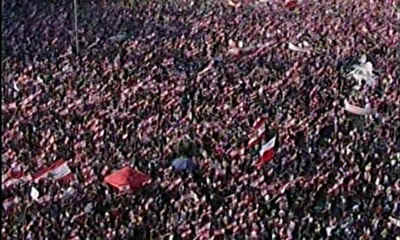
BEIRUT - An emboldened Lebanese opposition mobilized more than 800,000 people Monday to demand an end to Syrian military domination of Lebanon, hurling a potent challenge to the Syrian-backed government here.

Beirut city official Mounib Nassereddine said the estimate of 800,000 did did not include demonstrators who were still arriving from all parts of the country ahead of the rally.

Thousands of Lebanese had made their way throughout the morning to the capital by car, bus and boat, heading for Martyrs Square and the grave of former prime minister Rafiq Hariri, assassinated exactly one month ago in a bomb blast.

Lebanese television aired spectacular pictures of a massive throng in the square, showing thousands of demonstrators waving the red, white and green Lebanese flag in bright sunshine against the deep blue of the Mediterranean in the background.

Some later estimates put the crowd’s numbers at 1.3 million.

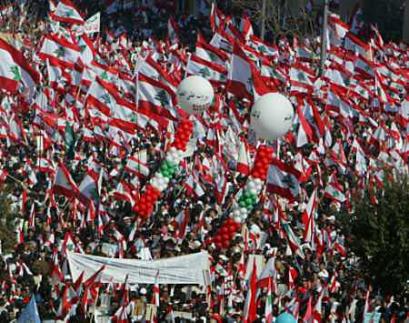
I like this picture too. Pretty damned good for being organized on such short (2 days) notice:

Far from being intimidated by the massive outpouring that Baby Assad and his Hizballah toadies managed to force into into the streets a few days ago (reports say that perhaps as many as half of the 500,000 demonstrators were actually bussed in from the Syrian border) the pro-democracy demonstrators seem to have been energized by it.

Plus, Lebanese President Emile Lahoud may have miscalculated when, after the gun-toting thugs from Hizballah had orchestrated their demonstration, he felt emboldened enough to ask Prime Minister Omar Karameh (who he had fired 10 days ago) to try and form another government. The effort failed when the opposition rebuffed the offer and demanded that the Syrians immediately withdraw from Lebanon and a “government of national unity” made up of Sunni’s, Druze, Christians, and Shia’s be formed.

If I were Lahoud, I’d start listening to the millions in the streets rather than his master in Damascus who finds that he’s slowly losing control of events and running out of time to boot.

UPDATES, PICTURES, AND COMMENTARY AND HOTTIES!:

Chrenkoff
Michelle Malkin
Little Green Footballs
Captains Quarters
Wizbang
Protein Wisdom
Ace of Spadesand here too!

UPDATE II

Athena at the excellent blog Terrorism Unveiled is not only blogging the demonstration, she was kind enough to translate the first line of my post…”How do you say ‘How do you like them apples?’ in Lebanese?”

Roughly translated: Keef toheb hada tufaah? Take that Hizballah!

UPDATE III

More fantastic Photo’s (more hotties and other great shots!)

3/6/2005

LEBANON’S INTERNAL CRISIS

Filed under: Middle East — Rick Moran @ 5:39 pm

While thousands demonstrate in the streets of Beirut for Syria to withdraw its forces, action behind the scenes reveal a political crisis that pits the Lebanese opposition forces, united for the first time in decades, against a pro-Syrian President and his key ministers.

This from the Lebanon Daily Star:

BEIRUT: Lebanon sank deeper into political paralysis Friday with President Emile Lahoud giving no indication that he was willing to set up consultation appointments for the formation of a new government before hearing the Syrian president’s expected announcement regarding the withdrawal of his troops. The opposition’s hardened position had muted Lahoud, forcing him to follow the rhythm of the international community.

However, in the light of increasing domestic and international pressure for Syria to quit Lebanon, the opposition expects Lahoud to make concessions if he wants to avoid an imminent political stalemate.

However, a stalemate seems imminent nevertheless.

The concessions are doozies.

(Walid) Jumblatt reiterated that the opposition is seeking a probe to find former Premier rafik Hariri’s killers, the sacking of the heads of security agencies and the announcement of a Syrian pullout before accepting the formation of any new government.

Jumblatt, the grizzled old Druze warlord, knows that when you have an advantage over your opponent, you go for the jugular. In this case, the opposition will refuse to cooperate in the formation of a new goverment until Lebanese sovereignty is restored.

Why sack the head of the security services? This from (bless ‘em) Al Jazeera on pro-Syrian demonstrations orchestrated by the terrorist group Hizbollah:

Others who came out in support of Syria was the outgoing Environment Minister Wiam Wahhab who warned in remarks published Sunday that “the streets are not for the opposition.”

Meanwhile, Labor Minister Assem Kanso, head of the Lebanese branch of the Baath party ruling in Syria, led a demonstration to the Syrian intelligence headquarters in Beirut.

“We will not allow those traitors to be at the forefront of the scene, we will cut their heads whether they like it or not. We will not allow the withdrawal of the Syrian army unless it is done with dignity,” he said

If your Labor Minister and Environment Minister are both saying that the opposition should stay off the streets or heads will roll, what do you think the heads of the police and military are thinking? Jumblatt knows that in order to win, he’s going to need the army and police to, at the very least, be neutral towards the “people power” that has already transformed the political situation and caused enormous pressure to be placed on Baby Assad to pull his troops out.

Meanwhile, back in Damascus, Assad may have bought himself some time with his “partial pullout” from Lebanon but at what cost to his hold on the regime? Here’s an interesting blurb from Britain’s “The Independent:”

“Syria suffers from a serious PR dilemma,” said Ayman Abdul Nour, a former adviser to the Syrian President. “There is no co-ordination. There is no serious committee established to manage the current crisis. Each minister, if they do speak, does so only out of their own initiative and about their own opinion. There has been no meeting to co-ordinate the government’s position. They are just playing for time.”

This doesn’t sound like a Saddam style iron grip on government and it certainly doesn’t bode well for the relatively inexperienced Syrian President.

Cabinet Ministers with independent thoughts and no fear of expressing them may one day come up with the thought that it may be time for a change at the top. This usually works to the detriment of the fellow who occupies that position.

Cross-Posted at Blogger News Network

3/5/2005

ASSAD HANGING ON

Filed under: Middle East — Rick Moran @ 7:52 am

Syrian President Bashar Assad is apparently ready to withdraw his troops from Lebanon…sort of:

Syria President Bashar Assad is expected to announce today a pullback of his troops in Lebanon to positions near the Syrian border - falling short of a demand by President Bush yesterday for a “complete withdrawal, no halfhearted measures.”

Lebanese officials said that Mr. Assad would outline plans in a speech to the Syrian parliament in response to a growing outrage in the West -and in the Arab world -over Syria’s 29-year occupation of its neighbor.

(Washington Times 3/5/05)

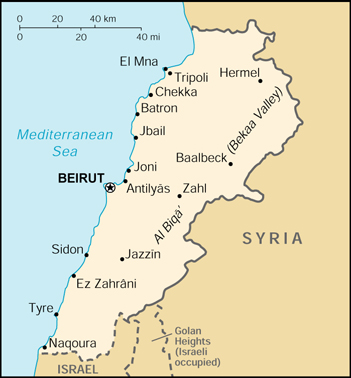
Not surprisingly, the pullout would extend as far as the eastern Bekaa Valley on the Lebanese-Syrian border. It is here that the Syrian’s illicit drug operations are thought to be headquartered. Assad uses the drug money to keep key officials in the armed forces and police loyal to him.

He will probably need that loyalty. By going before the Syrian “Parliament,” Assad is bowing to pressure from his Ba’athist allies to quiet the storm surrounding the assassination of Rafik Hariri, the former Lebanese Prime Minister, that most of the world is now convinced Syria was involved and which has precipitated numerous calls for Syria to honor its agreements under the UN backed Peace Accords with Lebanon and remove its forces.

Also, by partially withdrawing his forces, Assad buys time. The delay will allow him to further consolidate his position at home. Don’t be surprised if there are a few changes in the Syrian cabinet and in the upper echelons of the armed forces over the next few weeks.

« Older PostsNewer Posts »

Powered by WordPress