Right Wing Nut House

2/20/2006

WHAT’S A HYPERPOWER TO DO?

Filed under: Middle East — Rick Moran @ 9:58 am

Francis Fukuyama used to be one of the seminal neoconservative thinkers of our time.

Now he’s just a seminal thinker, having abandoned what he terms the “militaristic” excesses and unrealistic goals of the neocons in favor of a “realistic Wilsonian” approach to American foreign policy.

In a lucid, richly textured argument in yesterday’s New York Times Magazine, Fukuyama takes Neoconservatives to the woodshed and delivers a beating from which they may not recover. The piece is a devastating critique of policies advanced by Dick Cheney, Paul Wolfowitz, Richard Perle (who although out of government is generally credited with wielding considerable influence on the Neoconservatives in the Defense Department) and others which include pre-emptive wars of self defense, promotion of human rights and democracy, a belief in the moral purposes of American foreign policy and of a kind of “benevolent hegemony” by America that could remake the world.

Fukuyama rejects all of those tenets as unrealistic and damaging to our long term foreign policy goals. What he proposes as a replacement is a little muddled but would be something that Henry Kissinger would have no trouble recognizing; a kind of realpolitik light that would feature some of the taste but none of the heft contained in Kissinger’s hard eyed calculations of the application of American power.

Kissinger was an actor in a bi-polar world who, in my opinion, is not given enough credit for guiding American foreign policy through the most turbulent period of the 20th century. It wasn’t just the war in Southeast Asia that presented a challenge to US foreign policy. There was a whole subset of extraordinary historical undercurrents at work in the world that Kissinger was able to recognize and respond to.

A quarter century after the end of World War II Western Europe had finally recovered both psychologically and economically from the almost total destruction wrought by that conflict and began to challenge the United States in competing for overseas markets and exercising influence. There was also the emergence of economies in East Asia as well as the awakening of China that had to be dealt with by Kissinger. I’m sure I’d get a good argument from Christopher Hitchens who believes the former Secretary of State should be tried as a war criminal, but the fact is Kissinger navigated those perilous shoals and brought America safely through with a competence that has been sorely lacking in most of his successors.

As a conservative, I’ve always viewed some of the neocon’s enthusiasms with a jaded eye, having lived long enough to see American idealism regarding our ability to remake the world flounder on the rocks of realism and the limits placed on our exercise of power by a domestic isolationist tradition that spans the ideological spectrum. Peter Beinhart of the New Republic recently wrote that historians would not see September 11 as the beginning of a new, more muscular American foreign policy but rather the apex of an old one. Beinhart correctly viewed the interventionist policy of Bill Clinton as a continuation of the internationalist policies carried out by every President since World War II. Whether 9/11 will be seen as the beginning of the end of that policy is what concerns Fukuyama:

The reaction against democracy promotion and an activist foreign policy may not end there. Those whom Walter Russell Mead labels Jacksonian conservatives — red-state Americans whose sons and daughters are fighting and dying in the Middle East — supported the Iraq war because they believed that their children were fighting to defend the United States against nuclear terrorism, not to promote democracy. They don’t want to abandon the president in the middle of a vicious war, but down the road the perceived failure of the Iraq intervention may push them to favor a more isolationist foreign policy, which is a more natural political position for them. A recent Pew poll indicates a swing in public opinion toward isolationism; the percentage of Americans saying that the United States “should mind its own business” has never been higher since the end of the Vietnam War.

Fukuyama argues that a turn toward isolationism would be a tragedy. I say it is simply an impossibility. American hegemony runs the gamut from military domination to what detractors call a “cultural imperialism” that has overlaid American aspirations for technological modernity over the rest of the world. Fukuyama recognized this in his book The End of History and the Last Man where he saw the people of the world yearning not so much for democracy but rather the accoutrement’s of modern living. Give them flush toilets and electric lights and democracy naturally follows would be an oversimplification of his argument but accurate nonetheless.

The political ramifications of isolationism is that after years of war and domestic political conflict, the American people may indeed be ready for some kind of a “return to normalcy” which was a phrase used by President Warren G. Harding in 1921 to describe how his administration would take America back to the time before World War I so rudely interrupted the march of progress. I wrote last summer (and written about recently by Slate’s Mickey Kaus) that if the Democrats were smart, they would run their 2008 presidential campaign using some variation of that slogan. The return, of course, would be to a pre-9/11 world; something that people may devoutly wish for but which could never be done. In that sense, Fukuyama rightly points out that isolationism would be a trap in that it would make the world more dangerous if America gave up her mission to promote democracy and human rights just at the time her support is most needed. He sees the problem in terms of the innate cautiousness of the American people and their “staying power” in maintaining any kind of hegemonistic foreign policy:

Another problem with benevolent hegemony was domestic. There are sharp limits to the American people’s attention to foreign affairs and willingness to finance projects overseas that do not have clear benefits to American interests. Sept. 11 changed that calculus in many ways, providing popular support for two wars in the Middle East and large increases in defense spending. But the durability of the support is uncertain: although most Americans want to do what is necessary to make the project of rebuilding Iraq succeed, the aftermath of the invasion did not increase the public appetite for further costly interventions. Americans are not, at heart, an imperial people. Even benevolent hegemons sometimes have to act ruthlessly, and they need a staying power that does not come easily to people who are reasonably content with their own lives and society.

Fukuyama’s critique of Neoconservatism is devastating not because he faults the people who are carrying out the policies (as most critics from the left demonize the neocons) but because he sees the policies themselves as classic overreach:

The Bush administration and its neoconservative supporters did not simply underestimate the difficulty of bringing about congenial political outcomes in places like Iraq; they also misunderstood the way the world would react to the use of American power. Of course, the cold war was replete with instances of what the foreign policy analyst Stephen Sestanovich calls American maximalism, wherein Washington acted first and sought legitimacy and support from its allies only after the fact. But in the post-cold-war period, the structural situation of world politics changed in ways that made this kind of exercise of power much more problematic in the eyes of even close allies. After the fall of the Soviet Union, various neoconservative authors like Charles Krauthammer, William Kristol and Robert Kagan suggested that the United States would use its margin of power to exert a kind of “benevolent hegemony” over the rest of the world, fixing problems like rogue states with W.M.D., human rights abuses and terrorist threats as they came up. Writing before the Iraq war, Kristol and Kagan considered whether this posture would provoke resistance from the rest of the world, and concluded, “It is precisely because American foreign policy is infused with an unusually high degree of morality that other nations find they have less to fear from its otherwise daunting power.”

Other neocon writers such as Max Boot have made similar miscalculations about “benevolent hegemony,” Mr. Boot going so far as to advocate embracing our role as an imperial power largely because of our “moral authority.” Other countries don’t concern themselves much with morality. Their power calculations regarding America are based much more on how much and how fast our military could show up at their front door. “Morality” is something they play at when making speeches in the UN General Assembly and other inconsequential places.

In the end, Fukuyama’s reasons for parting company with the neocons has more to do with a recognition that policies he thought wrong headed in the first place were carried out incompetently:

Finally, benevolent hegemony presumed that the hegemon was not only well intentioned but competent as well. Much of the criticism of the Iraq intervention from Europeans and others was not based on a normative case that the United States was not getting authorization from the United Nations Security Council, but rather on the belief that it had not made an adequate case for invading Iraq in the first place and didn’t know what it was doing in trying to democratize Iraq. In this, the critics were unfortunately quite prescient.

The most basic misjudgment was an overestimation of the threat facing the United States from radical Islamism. Although the new and ominous possibility of undeterrable terrorists armed with weapons of mass destruction did indeed present itself, advocates of the war wrongly conflated this with the threat presented by Iraq and with the rogue state/proliferation problem more generally. The misjudgment was based in part on the massive failure of the American intelligence community to correctly assess the state of Iraq’s W.M.D. programs before the war. But the intelligence community never took nearly as alarmist a view of the terrorist/W.M.D. threat as the war’s supporters did. Overestimation of this threat was then used to justify the elevation of preventive war to the centerpiece of a new security strategy, as well as a whole series of measures that infringed on civil liberties, from detention policy to domestic eavesdropping.

Fukuyama makes an excellent point about the competency of those charged with both explaining and carrying out policy. But is there really “misjudgment” and “overestimation” of the threat posed by radical Islamism?

Here’s where Fukuyama is dead wrong. The Ivory Tower he is living in may be a nice perch to view the world and sagely comment on American policy and the Neoconservative movement. But at that height, he appears to have difficulty resolving how truly menacing the fanatical Islamists are and their potential to destroy America and the west.

What Fukuyama misses is that it only takes one - one maniac with one WMD (leaving aside chemical weapons in that calculation) purchasing or acquiring it from one rogue state, and used on one American city. The resulting reaction by the US would likely lead to our own use of WMD not to mention a further loss of civil liberties. Whether or not Iraq would have been that “one state” is beside the point. The real question, unasked by Fukuyama and unanswered by most of the left in this country, is how in good conscience can the United States take the chance that Iraq wouldn’t be that “one?”

Fukuyama optimistically (hopefully?) points out that Saddam could have been contained with “no fly zones” and UN inspectors. As I’ve written on numerous occasions, the pressure to lift sanctions on Iraq and bring them back into the community of nations would have been irresistible without the intervention of 9/11. Along with Saddam’s organized bribery (that Fukuyama fails to mention), the idea that containment of Iraq could have been continued indefinitely makes no sense whatsoever. The very same people who are using this anti-war argument today were yelping the loudest to lift sanctions and stop bothering Saddam with our bellicose “no fly zones” before 9/11. Saddam was already fooling the UN inspectors badly as we’ve recently seen. For Fukuyama to adopt this meme lock, stock, and barrel is a curious example (but not the only one) of leaving out inconvenient facts that get in the way of his critique of the war.

As far as Saddam making common cause with the radicals, he already had arms length relationships with several terrorist groups in the region and was exploring the idea of developing closer ties with al Qaeda. This is the minimum of what we know at the moment. Further information about Saddam’s ties to terror could be brought to light in the nearly 2 million pages of documents that fell into our hands after the fall of Baghdad and are still unexamined.

Knowing all of this, the divide between pro-war and anti-war Americans is still a question of risk: Should we have taken the risk that Saddam would not reconstitute his WMD program and find a way to use them on America or should we pre-emptively attack? Fukuyama believes the risk was acceptable. George Bush did not. History will prove that one of them was wrong.

Fukuyama inadvertently strengthens the neocon’s case by pointing out the recent ascendancy of Shi’ite fundamentalists in Iran and Iraq as well as the victory by Hamas and the political re-emergence of the Muslim Brotherhood in Egypt. What Fukuyama fails to point out is that these radicals all have an enormous problem; their anti-modern politics will clash with the desires and aspirations of their own peoples. Fukuyama is hopeful that the exigencies of governing will moderate Hamas’ bellicosity toward Israel. If so, it may also be possible to expect Iraqi Shi’ites to act more like nationalists than pawns of Iran.

As for Iraq, there is still hope that more secular parties, who received a strong plurality of the vote in January, will have a moderating influence on the Shi’ite majority. Fukuyama may not be aware that the main reason for the success of the Islamic Party was the fact that it had been in existence since the late 1970’s and had been planning for that election for nearly 30 years. With offices in Syria and Iran, the party was able to build up its grassroots organization and hit the ground running when Saddam was toppled. This gave them a huge advantage over other, more broadly based secular parties.

At bottom, Fukuyama proposes that instead of a Neoconservative, unilateralist approach to Islamism, that we adopt what he calls a “Wilsonian realist” approach that will not necessarily include the UN (thank goodness) but more often what he terms “multi-multilateral” groups. He points to Bosnia as an example where a Russian veto blocked UN action but America acted in concert with its NATO allies. Sounds a lot like a Coalition of the Willing” but, of course he doesn’t call it that. It sounds more like a tepid version of Clintonian internationalism.

In an age where there are not only state supporters of terrorism but elements within other, friendlier governments that support our enemies (Saudi and Pakistani intelligence services for example), it is unclear how this idealized Wilsonianism will help protect us. Fukuyama wishes to strengthen and increase funding for USAID, the National Endowment for Democracy (which played a key role in bring down the Iron Curtain) and other internationalist agencies including the State Department itself. While there is much to be said against a purely unilateralist foreign policy, to place any faith in those institutions to head off al Qaeda is dangerously wrong. They are not equipped to deal with or understand the fanaticism that goes to the heart of Islamic radicalism. As such, they may in fact act as a brake instead of facilitating action when the time comes.

I sympathize with much of what Fukuyama is rebelling against. I agree with much of his critique. But when it comes to his prescriptions, I find them lacking in depth and wrong headed in totally abandoning some of the more idealistic aspects of the Bush foreign policy. In short, he wants to throw the baby out with the bath water.

And I also believe he tragically underestimates the threat of Islamism both from a domestic political point of view and a real world miscalculation of their intentions. This is nothing new for intellectuals who have throughout history underestimated fanatics and their determination to achieve their goals. While the necons may be dead wrong about any number of things, their decision to go to war in Iraq and their belief that democracy in the Middle East will eventually make us safer still sounds like the correct policy to me.

UPDATE

I’m glad to see James Joyner has taken on Fukuyama as well:

Realism has long been the natural voice of the foreign policy establishment. Neoconservatism was derided from the beginning. That said, the idea that we are better off supporting authoritarian thugs rather than risking the election of those whose goals are different than ours is short sighted. We have learned time and again that dictators’ aims are almost always out of synch with ours and that their promises are worthless. Further, when and if popular sovereignty emerges–even in the form of a revolution that installs a new dictatorship as in Iran–a history of supporting the previous regime will work against U.S. interests.

Mr. Joyner make many of the same points I do, although he appears to be a little more in step with the neocons than myself. Read the whole thing for both some first class thinking as well as a nice roundup of opinion on what I think will be a blow from which the necons will have a hard time recovering their equilibrium.

UPDATE II

Greg Djerejian links to an excellent counterpoint to Fukuyama’s argument about democracy not being a solution to extremism in the Middle East from Secretary Rice:

Let me take this opportunity to say something about what we’ve just been through, because I’m reading a lot in the papers these days about how — “Well, you know, you made this mistake, you thought democracy could take hold in the Middle East, you supported elections and what have you done? You’ve supported elections that brought to power Islamists or extremists or in the case of Hamas, a group that you consider a terrorist group. Aren’t you sorry that you supported these democratic processes?”
Absolutely not. It was the only thing to do. It was — first of all, from the point of view of the United States, the only moral thing to do. The idea that somehow, it is better for people to lack the means and the chance to express themselves, that it’s better to support that and to, therefore, support dictatorship or oppression or authoritarianism where people don’t have a voice — it’s, I think, morally reprehensible. People have to have a way to express themselves or, if they don’t have a legitimate way to express themselves, they express themselves through extremism.

Rice made the remarks to a group of Arab print journalists. Her remarks can be found in their entirety here.
2/19/2006

THE LEFT HASN’T LEARNED A DAMNED THING FROM 9/11

Filed under: Middle East, War on Terror — Rick Moran @ 12:33 pm

This article originally appears in The American Thinker

Every once and a while over the last few years, I have come very close to saying to hell with it and tossing George Bush and the Republicans over the side. That’s when the left comes to Bush’s rescue and proves all over again why even allowing them to get a whiff of regaining power is extremely hazardous to the collective health of the west not to mention the personal safety and well-being of hundreds of millions of people.

Just when I thought I was out, they pull me back in.

The problem with liberals isn’t only Bush Derangement Syndrome. If that were the case, they would be easy to dismiss. The ragamuffins who mindlessly mouth their hatred of all things Bush and the intellectual dilettantes who enable them have become caricatures, cardboard cutouts of a political opposition. They are as relevant to the political debate in America as a flight of quacking ducks.

The real problem with serious leftist critiques of the Administration is that they actually get some things right - but start from the cockeyed premise that America’s response to 9/11 has made things worse.

I sympathize with some of these critiques on a couple of levels. The choices made by the Bush Administration have indeed sharpened sectarian tensions between Shias and Sunnis in the Middle East, provided fodder for radical Islamists to preach their vision of Holy War against the “Crusaders,” given Iran an opening to acquire influence in the region, and threatened the stability of the corrupt, autocratic regimes who are sitting on top of about 20% of the world’s oil.

All this may be true to one degree or another. The problem with these critiques is that they fail utterly and completely to address in any sane or rational way what else could have been done in response to 9/11.

By sane or rational, I’m talking about the curiously myopic notion advanced by liberals that if only we had done exactly the same things to prevent terrorism after 9/11 as we had done before, none of the problems brought about by going to war in Afghanistan and Iraq would have happened. The belief by the left that the Clinton/Albright law enforcement approach - treating terrorists as criminals - could have been sustained in the face of Bin Laden’s massive success on 9/11 shows that liberals have learned absolutely nothing from that event and indeed, continue to downplay its significance or ignore it altogether.

For example,to say that Iraq was an “elective” war is correct. But by struggling to effectively refute the idea that our liberation of Iraq was the next logical step in the war against the Islamic radicals, their criticism only points to the overarching problem with all serious liberal analyses of the War on Terror; either 9/11 for all intents and purposes didn’t happen or we have “overreacted” to that seminal event.

This is the “We are doing exactly what Osama wants” critique which may be satisfying on a political level in that it makes for an excellent-sounding riposte to Administration arguments. But deluded enemies often wish for disastrous confrontations. Think of the Japanese militarists who pushed for a knockout blow with the Pearl Harbor attack. They wanted war, but they didn’t suspect our strength of resolve.

Osama’s learning the truth of the old infidel saw: be careful what you wish for.

By any yardstick, Bin Laden has been hurt and hurt badly over the last 4 years. His ranks have been thinned considerably. His financial resources have been targeted relentlessly (one of the most underreported successes of the war). His operatives have been killed or captured in dozens of countries. According to recent polls, his popularity has waned considerably throughout the Muslim world. The fact that he himself is still alive and kicking (we think) is almost irrelevant. I say almost because obviously, killing or capturing the maniac would be a victory of sorts. Whether our liberal friends would recognize it as such is doubtful even though they themselves, by their criticism of the Administration for not capturing him, have set the destruction of Bin Laden as a major benchmark in judging the success of the war.

But beyond what we’ve done to him, are we really doing what Bin Laden “wants” or are we doing what he predicted would happen?

The proof is in the pudding. As a terrorist, Bin Laden may be a mastermind. But as a strategic planner, he is an utter failure. While predicting some of the reactions in the Middle East to American countermeasures against terror, he failed to see a host of other, more detrimental outcomes which are in the process of making his dream of a worldwide Islamic Caliphate less probable and in fact, a pipe dream.

While Bin Laden foresaw the overthrow of the old order in the Middle East as a result of American policies, the forces at work to affect change are not of his making or choosing. In fact,they are the antithesis of of what he desired. Even with an ascendant Hamas on the West Bank and a powerful Hizballah in Lebanon, radical Islamists are being either contained or defeated elsewhere in Saudi Arabia, the Gulf States, Egypt, and even Syria. And the admittedly dangerous situations in Iraq and Lebanon - where sectarianism threatens the tiny steps made toward democracy - nevertheless ignores the huge opportunity to deal Bin Laden’s dreams a death blow from which he could not possibly recover.

Where the left correctly sees chaos and confusion, there are also tidal historical forces at work that regardless of what kind of governments emerge in Iraq and a Lebanon, are going to change the face of the Middle East to the detriment of Bin Laden and his plans. In the short term, he may gain from the violence and despair wrought by both the resistance of the old order and his al Qaeda minions. But in the end, he loses due to either the emergence of a new kind of Arab nationalism friendly to democracy and democratic countries or a new kind of hybrid government with a justice system based mostly on Sharia law but also containing elements of western democracy like freedom of the press and tolerance for secular political parties.

In the end, Bin Laden may indeed have “wanted” the kind of response from America to 9/11 but I doubt very much he’s sitting in his cave gloating.

Don’t tell that to Simon Jenkins of the Times Online. Jenkins has written a scathing critique of the Bush/Blair Axis of Evil. And while making some salient points (many of which I outline above), Jenkins analysis suffers from a breathtaking naivete that more than 4 years after 9/11 sounds almost quaint in its old-fashioned, ostrich-like tendency to belittle the impact of 9/11 as well as criticize the American response to it:

On any objective measure, terrorism in the West is a trivial crime. True, New York and London saw outrages in 2001 and 2005 respectively. Both were the outcome of sloppy intelligence. Neither has been repeated, though of course they may be. Policing has improved and probably averted other attacks. But incidents genuinely attributable to Al-Qaeda rather than domestic grievances are comparable to the IRA and pro-Palestinian campaigns. Vigilance is important but only those with money in security have an interest in presenting Bin Laden as a cosmic threat.

Indeed if ever there were a case for collective restraint it is in response to terrorism. The word refers to a technique, usually a bomb, not an ideology. A bombing is an anarchic gesture calling for police and medical services. It becomes a political weapon only if publicised and answered with hysteria. A killing is so staged as to cause over-reaction, violent response, mass arrests and a decay of civilised values. Bin Laden’s intention in 2001 was to portray the West as scared, emotionally vulnerable, over-reactive, decadent and careless of liberal values. The West has done its damnedest to prove him right.

Every liberal canard about the War on Terror is contained in those two paragraphs. Despite the rest of Mr. Jenkins’ article which accurately sums up many of the problems engendered by our response to 9/11 (sans his statements about “latent authoritarianism” in democratic leaders), his only alternatives - “restraint” and “policing” - precisely proves my point: That the left has learned nothing from 9/11 and that following the lead of Jenkins and others of his ideological ilk would be extraordinarily dangerous.

For at bottom, the “alternative strategy” being pushed by Jenkins and most of those on the left is one of reaction - waiting for the terrorists to strike before committing ourselves to countering them. In an era where weapons of mass destruction are becoming more widespread and easier to manufacture and/or acquire, this policy is not only suicidal, but morally reprehensible. It condemns hundreds perhaps thousands of innocent people to death all in the name of a simpering kind of internationalism, a belief that most countries are on the same page when it comes to combating terrorism.

Nothing could be further from the truth. There are many countries - Russia and China come to mind immediately - that would not be averse to seeing a catastrophic attack on America. Mr. Jenkins and his reactive strategy would make such an attack more likely by several degrees of magnitude. I daresay that Beijing especially wouldn’t mind seeing America severely weakened as it would probably mean affecting our ability to block their designs on Taiwan and establishing economic hegemony over the rest of East Asia.

September 11, 2001 has become a date that marks a great divide in American politics. The fact that we are arguing about its significance more than 4 years later should not be surprising given the polarization of our politics. But what is surprising is that the only conclusion the left seems to have drawn from that awful day is that everything the Administration has done after it has been wrong headed and only made the situation worse.

That’s not much of a critique. But given the paucity of ideas coming from liberals about how to stop the terrorists from destroying us, maybe it shouldn’t really surprise us after all.

2/16/2006

SADDAM TAPES: WHY IT’S ALWAYS GOOD TO LOOK BEFORE YOU LEAP

Filed under: Middle East, War on Terror — Rick Moran @ 2:21 pm

When I first heard of the existence of the Saddam Tapes, I was mildly interested. After all, from a purely academic point of view, it would be fascinating to listen to the dictator and try and discover how his mind worked. Saddam is surely one of the most destructive leaders that lived during the 20th century. Not quite in the Hitler/Stalin/Mao class but rather more of a second tier thug, easily as evil as Idi Amin or Slobodon Milosivec.

But when John Loftus, the organizer of this weekend’s “Intelligence Summit” came out and said that there was a “smoking gun” in these tapes that proved the existence of WMD in Iraq prior to our invasion, I was skeptical. I remembered from the Duelfer Report that close aides to Saddam had routinely lied to the dictator about his own WMD program so any conversations about WMD on the tapes would have to be listened to bearing that in mind.

And I also had to consider the source himself. Yesterday, I said that Loftus was considered a “gadfly” by the intelligence establishment. As it turns out, I was being too kind by half. Here’s Byron York on Loftus:

I first encountered his name in the fall of 2003, when I was working on a story about Bush hatred. I was looking at the people who claim that the Bush family got its wealth from financing the Nazis, and I discovered that one of the sacred texts of that particular worldview is a book, The Secret War Against the Jews, by the authors Mark Aarons and…John Loftus. In 1995, when the book appeared, Anti-Defamation League director Abraham Foxman, who can reasonably be counted on to speak out against people who financed the Nazis, called it “so exaggerated, so scantily documented, so overwrought and convoluted in its presentation, that Loftus and Aarons render laughable their claim to offer ‘a glimpse of the world as it really is.’”

A curious gent, this Loftus fellow. It seems also that he is absolutely convinced of a connection between the Enron scandal and…(wait for it) 9/11:

In the article, Loftus reports that the now-defunct energy company had a contract with the Taliban to build a pipeline, and that Vice President Dick Cheney, determined to help out Enron, forbade U.S. intelligence sources from investigating the Enron/Taliban/al Qaeda connection in the months leading up to the September 11 terrorist attacks. After outlining this somewhat Fahrenheit 9/11-like theory, Loftus concludes, “The Enron cover-up confirms that 9/11 was not an intelligence failure or a law enforcement failure (at least not entirely). Instead, it was a foreign policy failure of the highest order. If Congress ever combines its Enron investigation with 9/11, Cheney’s whole house of cards will collapse.”

Does his kookiness rule out the possibility that there might be something valuable on the Saddam tapes? Not necessarily, although for the sake of credibility, one needs to look not only at the message, but the messenger as well.

And in this case, the messenger - the person with actual possession of the tapes - was a former weapons inspector, former translator at Gitmo, and a confessed spy named Bill Tierney.

Actually, Tierney was spying for us while working for UNSCOM which is OK by me but probably didn’t sit well with those fairminded, impartial countries like Libya and France. The problem with Mr. Tierney - depending on who you talk to - is that he is either a certifiable wacko or someone who likes to exaggerate things a little. Taking him at his word is hazardous to the truth.

In 2003, in the immediate aftermath of the Iraq invasion he told Sean Hannity:

“In addition, Tierney said that he has told our government where Hussein has hidden an underground uranium plant. “I can drive there with my eyes shut.”

Also in 2003, Tierney appeared on George Noory’s Coast to Coast radio show and made some startling admissions:

Bill Tierney, a former weapons inspector who worked with UNSCOM in Iraq in the late 1990s, was the guest for the first two hours of Friday night’s show. He believes that Iraq has nuclear capability and the intention to use such weapons. Further, Tierney claims that he has pinpointed a hidden location in Iraq (map here) where there is a uranium enriching processing facility. “You can’t put an underground chamber on the back of a truck,” Tierney said, indicating that if an inspection were made in this suggested area, the Iraqis would not be able to haul off the evidence.

Tierney’s methods of ascertaining this location were rather unconventional. “I would ask God and just get a sense if something was valid or not, and then know if I needed to pursue it,” he said. His assessments through prayer were then confirmed to him by a friend’s clairvoyant dream, where he was able to find the location on a map. “Everything she said lined up. This place meets the criteria,” Tierney said of a power generator plant near the Tigris River that he believes is actually a cover for a secret uranium facility.

Ladies and gentlemen, this is not the way one should go about trying to ascertain whether Saddam Hussein had WMD. It may be a good way to divine a well or fortell the future. But when it comes to “smoking guns” about WMD, I’d trust Michael Moore before I trusted this guy.

An indication of just how loony this whole business with the tapes and the “Intelligence Summit” has gotten is that two top intelligence professionals and dedicated public servants - James Woolsey and John Deutch - have resigned from participation in the event. It seems that there are some very shady characters behind the scenes. Mr. York:

Now, the Sun reports that Woolsey and Deutch resigned from Loftus’ group because of their concern over “new information they received regarding one of the summit’s biggest donors, Michael Cherney, an Israeli citizen who has been denied a visa to enter America because of his alleged ties to the Russian mafia.”

Does any of this matter as to the legitimacy of the tapes? Not really, although according to ABC News, the tapes were taken from the FBI where presumably Mr. Tierney was translating them. As for their impact, Lori Byrd has it about right:

If the tapes are authentic, the discussion of efforts to deceive the inspectors and to be ready to quickly resume WMD production is huge news, but it obviously will not be reported that way. As I said yesterday, it is going to take a heck of a lot to convince the media, and those on the left, that Bush didn’t lie about Saddam’s WMD. Scratch that. They already know he didn’t lie about it. It will take a heck of a lot to convince them to admit that Bush didn’t lie about it.

We already knew there were chemical weapon precursors on site with the artillery shells to deliver them. The fact that they weren’t assembled was the reason given for not listing them as “stockpiled” WMD. Be that as it may, Lori has a good point. The tapes confirm once and for all that Saddam was a threat. Given the left’s eagerness toward lifting sanctions on the dictator’s regime in 2000, it would only have been a matter of time before he had his labs of death up and running again.

There are still nearly two million documents and tapes that our government, for whatever reason, has refused to look at in any meaningful way. The historical value of those documents alone is astonishing, a priceless glimpse into one of the 20th century’s most organized criminal regimes. While it is doubtful the whole truth of Saddam’s WMD’s will ever come out, those documents and tapes can answer other questions that are just as valuable in aiding our understanding of the organized terror and calculated evil that was Saddam and his regime.

UPDATE 2/17

Add to the list of distinuished Americans who have pulled out of the “Intelligence Summit” Debbie Schlussel who has some additional shocking information about John Loftus.

2/15/2006

SOLIDARITY FOREVER

Filed under: Blogging, Middle East — Rick Moran @ 12:11 pm

danish005.jpg

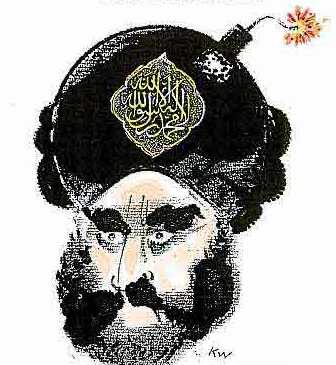
I swore I wasn’t going to publish any of the Mohammed cartoons on this website, mostly out of respect for the religion itself but also because I didn’t really see the need.

If one were to examine every word I’ve written about the Cartoon Jihad, they would find an uncompromising support for freedom of speech. I never criticized anyone’s right to publish them. And where I originally believed that as a matter of empathizing with people who experienced pain at the thought of the prophet being mocked, I have since been enlightened as the so-called moderates shamelessly began to use the controversy for their own ends by using publicity surrounding the violence as a way to draw attention to their own concerns.

But I still had no intention of publishing these cartoons. Until today.

There is a group of Muslim hackers who have declared war on websites that have dared show the offending cartoons. They have attacked more than 1800 Danish websites alone, defacing them with their barely literate scrawl.

And now…they’re coming after us.

One of the on-line leaders in the movement to show solidarity with the Danes and other newspapers around the world who have dared to show the cartoons has been Michelle Malkin. Last Tuesday Mrs. Malkin was subjected to a foreign based denial of service attack. And last night, her hosting company passed along some disturbing news:

Last night, my hosting service notified me that it is receiving ongoing threats from individuals vowing to take down this site–and others along with it–which will presumably continue until I take down the cartoons. For now, we are on guard and continuing with business as usual. But you should know there’s something much wider and deeper going on.

Go to Michelle’s site and read up on the effort of these cyber jihadists and ask yourself; Can I afford to sit on the sidelines any longer? There is a time and a place for everything. This is a time for outright defiance. It is a time for solidarity not just with Malkin but with every blogger, right or left, and every website that publishes these cartoons. This has gone way beyond any kind of cultural sensitivity issue or respect for the belief of others. It is now our beliefs that are under attack and we simply must defend them.

So I proudly join those who feature these cartoons on their websites. A little late to the party perhaps. But I promise not to be a wallflower.

danish011.jpg

LEBANON: HOPE SPRINGS ETERNAL

Filed under: Middle East — Rick Moran @ 9:32 am

They weren’t expecting a huge crowd in downtown Lebanon yesterday to mark the one year anniversary of the assassination of former Prime Minister Rafiq Hariri. The demonstration organizers averred that they would have been pleased if 50,000 Lebanese citizens had marched for democracy and justice - justice for the perpetrators of the assassination who to this day are walking free, beyond the reach of the Lebanese courts or any international tribunal. This was one of the reasons given by the March 14 Forces who organized the demonstration as to why the turnout would probably be so disappointing.

As it played out, nearly 1 million Lebanese poured into Martyr’s Square to both remember the beloved former Prime Minister and show their support for democracy, independence, and bringing Hariri’s killers to justice.

It was spectacular proof that the forces for democratic change who pulled off the astonishing feat of forging a broad based coalition that swept to victory in the Parliamentary elections last summer still have a deep wellspring of support among the people of this tragic, divided land.

But the demonstration also highlighted the monumental problems still facing the country’s leaders as they seek to overcome decades of bloodshed, hate, and suspicion and achieve stable, democratic government free from foreign influence.

Not all of Lebanon was represented at the demonstration in Martyr’s Square. The forces of Hizballah, the Amal Militia, and Michel Aoun’s Free Patriotic Movement held their own, separate remembrances honoring Hariri. And herein lie the seeds of Lebanon’s weakness as well as the potential for disaster. Despite all the uplifting rhetoric, Lebanon is still a country divided not just by religion but also by forces with dual loyalties to Beirut and Damascus. It is a country where many if not most of its citizens sees itself at war with the State of Israel. And it is a country where the very idea of nationhood is tied up in a complex web of expectations and dreams that vary from group to group, region to region, and sect to sect.

The number one problem facing Lebanon today is the same problem it has faced for more than a quarter century; the pervasive and pernicious influence of Syria on the everyday affairs of the nation. Like a parasite that feeds off its host, Syria has invaded the nervous system of Lebanon and has spread its tentacles into every corner of society. Simply getting rid of the Syrian army and the outward accoutrements of Syrian President Bashar al-Assad’s secret police did not solve the problem. Like removing a leech from the body and not removing the head, Syria’s influence on the politics, the economy, and the security services of Lebanon remains to poison the blood and sicken the host.

There are no easy solutions to the problem of Syrian influence. That’s because groups like Hizballah, despite protestations to the contrary by their leader Secretary General Sayyed Hassan Nasrallah, rely on Syria for weapons and as a conduit for aid from their allies in Tehran. On this day honoring the slain former Prime Minister, Nasrallah highlighted what he says Hariri told him; that “Lebanon cannot be ruled from Damascus nor can it be ruled against Damascus.” He further recalled that Hariri had believed that Lebanon was in a state of war with Israel, regardless of whether actual clashes took place.

Those clashes are in fact taking place with Israel as “The Resistance” (as Hizballah insists on calling itself) continues to launch attacks in the disputed Shebaa Farms region. Israel still patrols the Farms, using it as a buffer region to keep the terrorists from killing innocent civilians. It is a major bone of contention between Lebanon and Israel and as long as Hizballah’s 10,000 militiamen are armed with rockets, Israel will refuse to give it up.

In this vicious circle of violence, Hizballah uses Israel’s presence on Lebanese territory as an excuse to keep its weapons despite a UN Resolution (1559) calling for the group to disarm. Recently, the issue of Hizballah’s weapons became a domestic political football as the terrorist group, along with their religious allies, boycotted Lebanese cabinet meetings, demanding that instead of being called a “militia” which would have necessitated their disarmament, they be referred to as “The Resistance.”

For nearly three months, the cabinet was crippled as crucial business had to be deferred. Finally, earlier this month, a compromise was brokered by Prime Minister Fuad Siniora and the Shiite parties returned to the table. But the lesson was clear; Hizballah must be reckoned with as a political force as well as a military one. The hard fact is that Hizballah has 26 members who have been elected to parliament. And their influence over large swaths of the country is undeniable. How to separate Hizballah from their weapons without tearing the country apart will be the number one challenge facing the government of Lebanon for the foreseeable future.

For within that issue lies so many of Lebanon’s internal problems. Secularization versus Islamic law. War or peace with Israel. Politics practiced with guns or words. And unity versus a kind of tribalism that would guarantee a weak, divided Lebanon constantly being pulled this way or that by its more powerful neighbors in Damascus and Tel Aviv.

As far as unity is concerned, Hizballah isn’t the only headache facing the country’s political leaders. There is also the out sized personality and political wild card represented by the Free Patriotic Movement’s Michel Aoun.

A former Prime Minister, the charismatic Aoun recently returned from exile and has stirred up a witches brew of political trouble. Initially participating in the coalition of anti-Syrian parties that kicked Assad’s army out of the country, he left the coalition in a huff when it became apparent he would not play a leading role. In what has become a hallmark of his career, he then flipped and joined pro-Syrian parties in a coalition during the round of elections last summer. He has since been angling for the Presidency, campaigning to replace what most observers agree is a Syrian puppet Emil Lahoud in that office.

The real problem is the Maronite Auon’s unnatural alliance with the Shiites in Hizballah. If Aoun had agreed to his reduced role in the March 14 Forces, Hizballah may have been isolated and been forced to accede to both UN Resolutions and a reduced role in politics. As it is, Aoun’s personal ambition for the Presidency has complicated matters enormously and it remains to be seen even if he is named President, whether he will be able to unite the factions and strengthen the country.

Another political problem is the coalition itself. It is under stress from all sides as the peace brokered prior to last summer’s elections is fraying around the edges. There simply is no dominant personality for all sides to rally around and look to for leadership. Rafiq Hariri’s son Saad could emerge as that leader except that President Assad of Syria realizes that also. Hariri’s security in Lebanon has become so problematic that for the last six months he has lived in self-imposed exile.

In a stirring speech at the demonstration yesterday, the young Hariri issued a clear call for unity:

We meet here today in March 14 square, there are no Muslims and there are no Christians, there are only Lebanese screaming ‘Lebanon first.” There is no place amongst us for criminals … there is no place among us for the symbols of the security apparatus.”

One of those symbols was the target of the crowd’s wrath yesterday; President Emil Lahoud. It is widely believed that Lahoud had a hand in the assassination of the elder Hariri as well as other high profile killings that occurred last summer including a popular anti-Syrian journalist. In fact, the UN Commission set up to investigate the Hariri assassination and headed up by prosecutor Detlev Mehlis discovered calls made by a known conspirator in the assassination to Lahoud’s office both immediately before and after the killing. But Lahoud is a powerful politician with his own base of support. His refusal to resign continues to complicate the politics of reconciliation that many observers believe is vitally necessary if Lebanon is to survive and prosper.

Speaker of the Parliament Nabih Berri has called for a Commission of National Dialog which will bring together all segments of Lebanese society in an effort to come to grips with the numerous problems that weigh so heavily on the future of this divided land. Perhaps the energy and hope contained in the one million beating hearts who demonstrated in the square yesterday will be enough to motivate Lebanon’s leaders to take advantage of that opportunity for dialog and redouble their efforts to achieve unity.

It’s clear that the people haven’t given up hope. It remains to be seen whether the country’s leaders can rise above their differences - both petty and pervasive - in order to fulfill the dream of a Lebanon at peace with itself and the world.

2/14/2006

EVERYONE WANTS TO GET IN ON THE ACT…

Filed under: Middle East, War on Terror — Rick Moran @ 12:35 pm

Not content with demanding that the free nations of the world outlaw the caricaturing of the prophet Mohamed, the “moderate” Muslim group Organization of Islamic Council (OIC) is now trying to piggyback their grievances on the bodies of 3,000 dead Americans.

They are trying to tell us that the Cartoon Controversy is the Muslim world’s 9/11:

The publication of cartoons ridiculing the Prophet Mohamed has had the effect of the September 11 attacks on the Islamic world, argued Ekmeleddin Ihsanoglu, the Secretary-General of the Organization of Islamic Conference.

Muslims are offended by the cartoons, Mr. Ihsanoglu told High Representative of the Common Foreign and Security Policy of the European Union (EU) Javier Solana; currently on tour in the Middle East.

“It is unfortunate that the Islamic world took the satirical drawings as a different version of the September 11 attacks against them,” said Mr. Ihsanoglu. “I hope,” he added, “the EU will adopt a new ruling to fight against Islamophobia.”

This is the same group that wants the United Nations to pass a resolution outlawing “contempt” for religions and impose sanctions on countries and institutions that don’t toe their line against free speech:

The Muslim world’s two main political bodies say they are seeking a UN resolution, backed by possible sanctions, to protect religions after the publication in Scandinavia of cartoons depicting the prophet Muhammad.

Ekmeleddin Ihsanoglu, secretary-general of Organisation of the Islamic Conference, said in Cairo on Sunday that the international body would “ask the UN general assembly to pass a resolution banning attacks on religious beliefs”.

The deputy secretary-general of the Arab League, Ahmed Ben Helli, confirmed that contacts were under way for such a proposal to be made to the UN.

“Consultations are currently taking place at the highest level between Arab countries and the OIC to ask the UN to adopt a binding resolution banning contempt of religious beliefs and providing for sanctions to be imposed on contravening countries or institutions.

I don’t know about you but I’m getting sick and tired of other nations trying to tell me that this or that happening to them is somehow to be equated with the most brutal and deadly terrorist attack in history.

We’ve had Spain’s 9/11 (which was also supposed to be Europe’s 9/11), Great Britain’s 9/11, Indonesia’s 9/11 to name a few. We’ve also had 9/11 used as a metaphor for any number of idiotic issues with the Cartoon Brouhaha only the latest. It makes me wonder if the people trying to piggyback their pet issues and agendas on the ghost of 9/11 ever wonder how totally ridiculous they look.

The OIC wasn’t content with comparing their “plight” to 9/11; they had to throw in references to the Holocaust also, a curious idea since so many of them are Holocaust deniers:

“In Europe unfortunately Muslims have taken the place of Jews during World War II. There is a need for a UN legislation and clarification of existing conventions,” he said.

Ihsanoglu asked for adopting a code of conduct for the European media. “The code of conduct should take into account the sensitivities of the Muslims and defamation in any form or manifestation and the core beliefs of the religions including mocking and criticizing prophets, and it should be considered an ethical offense in the European media code,” he said.

(HT: LGF)

Who do we have to thank for this kind of nonsense? The left in Europe and America of course. The kind of moral relativism that can equate the horrors of Holocaust atrocities with the extinction of snail darters can easily morph into Muslims saying that the mocking of their prophet can equal the death of 6 million human beings. After all, it’s how it makes them “feel” that matters.

I think we should call for a moratorium on the use of both 9/11 and the Holocaust to describe anything but events that are realistically similar in both numbers and impact on history. Don’t hold your breath, though. The world’s “victims” have the media playbook of the left down cold and can manipulate their emotions as easily as a child can be manipulated by fairy tales.

2/12/2006

THINGS I REALLY HATE: VOL. II, PART 4

Filed under: Middle East — Rick Moran @ 7:49 am

I really hate it when other people make me look like a fool.

Most who know me are aware that I need no help in that department. I am quite capable of looking like a fool all by myself without so much as a “by your leave” from anyone else, thank you. Hence, when others, by their actions, show me to be either naive or just plain wrong, I really hate it.

First of all, it requires the obligatory mea culpa post full of angst-ridden questions like “How dare they?” Or perhaps “Am I really that stupid?” This is followed by a flood of comments from readers along the lines of “I don’t like saying “I told ya so’ but I told ya so,” and other deep thoughts. In the end, I give the lie to the old adage “There are no stupid questions, only stupid answers” by proving that if the interlocutor is clueless, no answer on God’s green earth is dumb enough to justify being wrong in the first place.

I have been dead wrong about the Cartoon Controversy. I haven’t been just a little off target or slightly misguided. I have been four square, 100%, dyed in the wool, hugely mistaken about both the issues at stake and my analysis of so-called “moderate Muslims” whose almost virtual silence on these matters has made me look like an imbecile while trying to defend them.

I really hate being made to look like an imbecile by people I’ve stood up for. In short, my call for forebearance and understanding on the cartoon issue has been tossed back at me with a sneer and a kick in the ass by many of the Muslim leaders I counted on to calm the situation. This is no longer an issue of trying to separate the jihadists from the so-called “moderates.” At bottom, they are both using each other and the controversy itself to advance their own agendas while at the same time, viciously attacking the very concept of free speech as we in the west understand it.

When radical Muslims like President Ahmadinejad of Iran start echoing the arguments made by what passes for moderate Muslims in Great Britain, it is time for everyone who supported the notion that the cartoons were making it more difficult for moderate Muslims to marginalize the fanatics to admit they were wrong.

Ahmadinejad is trying to pressure Europeans to address Muslim “sensitivities” by making it illegal to criticize Islam. He is trying to do this through the “moderate” Organization of Islamic Council (OIC) who know a good thing when they see it:

Iran has demanded an emergency meeting of the 57 Muslim countries comprising the Organization of Islamic Council (OIC), which announced it would call on the European Union (EU) to pass laws to counter hostility to Muslims.

“The OIC member countries expect the EU to identify islamophobia as a dangerous phenomenon to be scrutinized and combated as is the case with xenophobia and antisemitism,” the council said in a statement to AFP Saturday.

Europe had to create “appropriate mechanisms of surveillance and to look again at its legislation with the aim of preventing in the future repetition of recent unfortunate events,” the statement said.

By piggybacking their victimhood claims on the back of the cartoon controversy along with the radical’s call for suppressing free speech, we see an instance where the fanatics and “mainstream” Muslims scratch each other’s backs in order to advance their own agendas.

Thanks for that kick in the groin, guys.

Not to be outdone, the Imam of the Grand Mosque in Mecca, the most important mosque in holiest city in Islam, has said “thanks but no thanks” to western apologies for the cartoons and instead, has called for the arrest and trial of the cartoonists:

Speaking to hundreds of faithful at his Friday sermon, Sheik Abdul Rahman al-Seedes, the imam of the Grand Mosque in Mecca, Saudi Arabia, called on the international community to enact laws that condemn insults against the prophet and holy sites.

“Where is the world with all its agencies and organizations? Is there only freedom of expression when it involves insults to Muslims? With one voice…we will reject the apology and demand a trial,” Al Riyad, a Saudi daily newspaper, quoted al-Seedes as saying.

Al-Seedes said the cartoons “made a mockery” of the Islam and the Prophet and called them “slanderous.”

Sheik Abdul Rahman al-Seedes is not some obscure radical preaching from the hinterlands of Islam. He is one of the most important leaders in the Muslim world. To “reject” the meek apologies of the Europeans and call for criminalizing free speech goes beyond the pale. Charles Johnson has noted that the US has taken the Syrians and Iranians to task for stoking the fires of this controversy but have been unconscionably silent about our Saudi friends.

Don’t expect that to change anytime soon.

More suggestions from “moderates” on what the West can do with their free speech comes from the President of the semi-free, military dominated government of Indonesia:

Indonesian President Susilo Bambang Yudhoyono reiterated that many Muslims consider the cartoons an insult to their faith, but he called on Muslims to forgive those who have sincerely apologized.

“Reprinting the cartoons in order to make a point about free speech is an act of senseless brinkmanship,” he said in a commentary in the International Herald Tribune.

“It is also a disservice to democracy. It sends a conflicting message to the Muslim community: that in a democracy it is permissible to offend Islam. This message damages efforts to prove that democracy and Islam go together.”

How very big of President Yudhoyono. He forgives us while accusing the west of “brinksmanship” for practicing free speech and then showing how really clueless he is about the idea of freedom by saying that it is undemocratic to offend Islam.

If I got a dollar every time I’ve read over the past three weeks of some Muslim “leader” giving lip service to the idea of free speech and then undercutting it by saying it should be illegal to criticize Islam, I’d be able to buy a new laptop.

Since my original postings on the cartoon controversy, we have learned about how both the Syrians and Iranians are using it to deflect attention from other problems. We have learned that western Muslims are using the controversy to advance their own agendas by playing upon the timidity and meekness of European governments. And we have witnessed the depth of hatred that the fanatical jihadists have for us and the contempt with which they view our most cherished freedoms.

What good does empathy and forbearance do in the face of such calculated calumny? To be considered whatever the Muslim equivalent of a “useful idiot” is does not sit well with me. It’s a mistake I will not repeat.

In fact, if the moderates want to impress me, they can start by coming out and laying into President Ahmadinejad for his constant denial of the Holocaust. That would be a pretty good start toward initiating a useful dialog that would lead to a better understanding between Islam and the West.

2/6/2006

EMPATHY II

Filed under: Ethics, Middle East — Rick Moran @ 7:34 am

I was surprised by the mild reaction to my post yesterday about what I see as the unnecessary infliction of pain on devout Muslims by republishing the cartoons.

Just goes to show I’m an idiot to underestimate the intelligence of my readers.

The comments were almost all thoughtful, insightful, and made me think. I can certainly understand why some would take my forbearance as a sign of weakness and the point is well taken. However, there are aspects to this war against radical Islamists - and by their silent assent to the tactics of the terrorists, the rest of the Muslim world - where we are still feeling our way. And I think it important to make a couple of points before I leave the subject for a while:

* There is an extraordinary amount of ignorance on the part of Muslims about how we in the West live our lives. The concepts of freedom and liberty as we understand them are so far outside their ability to comprehend that they may as well originate on another planet. I am not talking about the demonstrators in the streets and the evil men egging them on and who have probably carefully planned this “uprising” for months. I am talking about the hundreds of millions of ordinary people who are in Islam’s thrall, mindlessly following the diktats of their holy men who keep their flocks mired in the distant past. There is a school of thought that Muslims seek the accoutrements of the modern world - flush toilets and electric lights - without the concomitant ideological imperative of having to absorb modern ideas. If true, the imams and the mullahs, like the Soviets before them, are in for a big surprise.

* There is an almost equal ignorance on our part in how Muslims actually view the world around them. The fear and suspicion with which we look upon Muslims is not healthy and actually makes the radicals job easier. Until we can see beyond the bloodcurdling rhetoric of the terrorists and their enablers and try and understand ordinary Muslims, we will be unable to enlist them in any meaningful way in this fight. Before it’s over, they are going to have to choose sides. Will they join us if we continue to condemn an entire religion for the actions of a few? By engaging in such sweeping condemnations, it only becomes easier for the terrorists to show which side the bulk of Muslims in the world should be on. And I’ve got news for those of us who persist in such folly - there are 1.3 billion Muslims in the world. We can’t kill them all.

* We absolutely must continue to stand up for freedom of speech. In fact, I am convinced that the only way to reach the majority of Muslims in the world who should be our natural allies in this war is by showcasing our “secular religion” of liberty. If Muslims are willing to die for Allah what do you think the effect on ordinary people will be if they realize we are willing to die for an abstract idea like freedom? I think if we can ever penetrate the propaganda, the lies, and the hate generated by Islam’s leaders against the West and prove by example that our beliefs are as powerful as theirs, the tide will begin to turn. The President sees this in his belief that by bringing at least the outward manifestations of democracy - free elections, free speech, and the free exchange of ideas - the rest will follow. History will prove him right or wrong in this approach. But at the moment, it looks like the best bet we have.

2/5/2006

IN THE END, IT’S ABOUT EMPATHY

Filed under: Ethics, Middle East — Rick Moran @ 8:06 am

I have thought very carefully about what to say in this post regarding the cartoon controversy. This is due to the fact that it will upset most of my regular readers as well as many on the right who have, in my opinion, been pouring gasoline on a fire where water was called for. Despite the best of intentions - the desire to stand up for our precious liberties - we have deliberately and unnecessarily made a bad situation worse by not only reprinting cartoons that 1.3 billion people on the planet find agonizingly offensive but that we have criticized people and institutions for exhibiting a kind of decency and empathy toward others that in almost any other case, any other circumstance, we would be offering praise instead.

The ability to satirize or mock religion - any religion - is well within our rights as American citizens and indeed, is a right in many (not all) countries that we generally consider part of what we used to define in the days before political correctness and cultural relativism as “Western Civilization.” The set of values and precepts that have emerged from 500 years of western thought have been based on the central idea that a human being, made in the image of the Creator, set upon this earth with a free will and free mind, is endowed at birth with certain “natural rights” that no government, no other man can take away. These natural rights to life, to an ever evolving and changing idea of liberty, and to what Jefferson called “the pursuit of happiness” but is actually a Lockean notion of being free to use reason in the search for truth have given us freedoms that few humans have enjoyed in all of recorded history.

How have we used these freedoms? Here in America, we invented an entirely new way for human beings to live together. We willed into existence a government. We forged a new kind of relationship between the people and that government. And we did all of this to protect what our ancestors saw as something so basic it was “self-evident” - by the simple virtue of being born human, people have the right to live and breathe free.

These are things we rightly take for granted. But by not giving our freedoms a second thought, it becomes difficult to imagine what other people in other cultures with entirely different ideas of what freedom is and what it means, think about this riot of confusing and oftentimes contradictory precepts. The kinds of freedoms that we see as absolutely essential are, in some parts of the world, viewed with suspicion and fear. Our idea of freedom of the press is an anathema to people who would see a publication like The National Enquirer as a threat to the stability of their culture. The fact that we consider this wrong headed and dangerous to our idea of liberty doesn’t mitigate the fact that others can no more imagine living with that kind of press freedom than we can imagine living without it.

Which brings us to the current controversy and how we are responding to it. In all of our calls for solidarity with the Danes and criticism of the ignorant hordes who have taken to the streets calling for the death of their fellow man over a series of cartoons, we may have lost sight of something so basic, so self-evident if you will that all of our posturing and chest thumping in support of free speech and freedom of the press has overridden our ability to see it.

Muslims don’t just find these cartoons offensive. They consider them so far beyond the pale that the fact they exist in the first place is an affront to Allah and by not doing everything in their power to wipe the blaspheming cartoons out of existence, they would be complicit in the sin.

Yes there are many in the Muslim world who are using the controversy to stir up hatred at the west. President Assad of Syria, who didn’t try very hard yesterday to prevent the torching of the Danish and Norwegian embassies, is even using the depth of feeling generated against the cartoons to unite his people and consolidate his hold on power. Other religious/political leaders in the Muslim world are also shamelessly using the issue to raise their own profiles or advance their political careers. But for hundreds of millions of ordinary Muslims, the cartoons and, just as importantly, the reaction in the west to their protests (republishing the caricatures far and wide), have caused pain - real physical discomfort - to people (not a religion or the bastardization of it advanced by the jihadists) who have done nothing to us.

I have tried to imagine anything similar in my own experience that would cause me the kind of pain being experienced by Muslims who feel so violated by the publication of these cartoons. The closest I can come would be watching as the flag is abused and burned by my fellow Americans. I get physically ill when watching people desecrate the flag. It isn’t just feelings of impotent rage and the desire to lash out at the perpetrators. There is also a feeling of nausea, a physical manifestation of contempt and disgust. It’s like peeling something a dog left on the street off the bottom of your shoe or cleaning up a drunk’s vomit off the floor of your house.

It doesn’t help me to be reminded that the protesters who desecrate the flag are exercising their right of freedom of speech. In fact, it makes me feel worse as I recall that millions have served under that flag, have protected it, and that such scum as these are spitting in their faces by carrying out their desecration.

Similarly, we are not reminding Muslims of the profound differences between our two cultures when we throw the caricatures in their faces and challenge them to be tolerant. We are, at bottom, causing them enormous pain. And for that, we should be ashamed of ourselves.

Yes we have the freedom to mock religion and satirize other people’s belief systems. And I would fight and die to maintain that right as I’m sure most of you would. But must we lose our empathy in the process? Must we be deliberately hurtful in order to get our point across?

By condemning the publication of the cartoons anywhere and everywhere, it is not a question caving in to those who seek to destroy us by using our freedoms against us. Pat Curley has said it most succinctly: “We can defend their right to publish the cartoons without saying, ‘They are right to publish the cartoons.” This simple idea is the essence of freedom of speech in that it illustrates the fact that there are two sides to almost every issue and that by acknowledging one’s right to speak their mind, we also acknowledge a responsibility to take into account the feelings of others.

I reject the notion that there is no responsibility attached to freedom of speech. For the rational among us, it is simple, common decency to think of how one’s words will impact others before uttering them. This doesn’t mean we have to necessarily moderate what we say. But it does mean that idiots like Julian Bond and others who refer to their fellow citizens as “Nazis” or “Hitler” are being irresponsible and should be taken to task not only for the meaning behind their words but also for deliberately causing another human being unnecessary and unconscionable discomfort. There is no difference between calling a Republican “Hitler” and pulling the wings off of a fly - both are done to deliberately inflict pain. And if this were pointed out each and every time it was done, I daresay such comparisons would dramatically diminish.

The forbearance of the major networks and newspapers in not publishing the cartoons is, I’m convinced, an act not of “dhimmitude” but of simple. common decency. It is also an editorial decision made in the interest of both the news entity as a business and a responsible member of the community. Can the decision be questioned? Of course it can. But to criticize based on the unwarranted speculation that they are somehow fearful that publishing the caricatures will cause them physical harm is beyond the pale. Calling into question the editorial judgment of a news organ is perfectly legitimate. Questioning their physical courage is simple, playground name calling, not worthy of being part of a debate over the sacred rights that we seek to protect and promote.

There is a clash of civilizations going on as I write this. I happen to believe the civilization I live in represents a way of life and thinking that offers the best hope for all of humanity to live as they were intended while extending material benefits that prolong life, hold out the promise of good health, and enjoin its members to achieve a state of being that allows for common people to realize their hopes and dreams both for themselves and for their children. If we are to win this fight, it will not come by force of arms but rather by the strength of our commitment to the battle itself. We don’t give anything up by empathizing with others when pain is inflicted. We do however, lose ground when - whether intentionally or not - we force feed our views of freedom on people who have no cultural touchstone that would enable them to understand what we are trying to accomplish.

I appreciate the fact that I’m swimming against the stream on this issue. But the behavior of many of my friends on the right - people I respect and admire - has been disappointing to me. I don’t expect to change many minds. But if I cause you to think before you next call someone a “dhimmi” for not agreeing with your take on this issue, I will be content.

10/24/2005

UN BURIES A PALESTINIAN CONNECTION TO THE HARIRI ASSASINATION

Filed under: Middle East, WORLD POLITICS, War on Terror — Rick Moran @ 9:31 am

Not content with redacting portions of the Mehlis report that named Syrian President Assad’s brother in law and other high ranking Syrian nationals as assassins of Lebanese nationalist Rafiq Hariri, the United Nations has also suppressed a report from the Lebanese Medical Examiner in the case that shows a “70% probability” that the driver of the Mitsubishi truck that exploded last February 14 killing Hariri and 21 others was a Palestinian:

BEIRUT: The UN team investigating the assassination of former Premier Rafik Hariri has disregarded a report by the Lebanese medical examiner Fouad Ayoub following a thorough investigation of its content.

Ayoub said a tooth was found belonging to a Palestinian whose remnants were subject to DNA analysis and is now believed to be the suicide bomber who drove the explosives laden Mitsubishi truck to the site of the explosion.

According to his report, these remnants belong to a 23rd corpse at the bomb site.

The bones of the corpse were found by a British diving team off the coast of the St. George Yacht Club, where the explosion occurred.

The remnants were matched with others found 100 meters away from the scene, on the premises of the Riviera Hotel.

Other forensic evidence that would point to a possible Palestinian connection to the assassination was also ignored:

The security sources also indicated the Swiss experts who took samples of explosives from the scene were able to determine the explosive used was C4.

C4 is commonly used in Eastern Europe, a region where the Popular Front for the Liberation of Palestine-General Command is known to have procured explosives in the past.

One of the names in the report not suppressed by the UN was the notorious head of the Popular Front for the Liberation of Palestine - General Command Ahmad Jibreel. The PFLP Commander has been a thorn in the side of Israel for many years and is the author of dozens of terrorist attacks directed against the Jewish state.

Although suicide attacks in Lebanon were prevelant at one time, today they are all but unknown, the preferred method of assassination and terror being the remotely detonated bomb. The occurences of suicide bombings are rare enough that responsibility has usually been traced to factions in sympathy with the Palestinian cause; most notably Hizballah and the Amal Militia:

Modern suicide bombings was introduced by the Shi’ite terrorist organization Hizballah in 1983 in Lebanon, and it was in Lebanon that this modus operandi was refined throughout the 1980’s. During the 1990’s the attacks continued, but declined in frequency, until today, suicide attacks in Lebanon are a rare occurrence. All together, 50 suicide bombings were carried out in Lebanon, half of which were perpetrated by the Hizballah and Amal, and the remainder by secular communist and nationalist organizations, including the Lebanese Communist Party, the Socialist-Nasserist Organization, the Syrian Ba’ath Party, and the P.P.S.

The rise in the political power of Hizballah in Lebanon can be directly correlated with the drop in suicide attacks against other factions in Lebanese society. This presents an enormous problem for the US State Department in that they have named the so-called “Party of God” as a terrorist organization. The fact is that Hizballah political leader Sheikh Hassan Nasrallah is one of the most popular and charismatic politicians in Lebanon. And despite his call for continued attacks agains the Jewish homeland, his influence in the government currently taking shape in Lebanon cannot be ignored. Even though UN Resolution 1559 calls for the disbanding of all militias, Nasrallah has so far refused to cooperate in disarming Hizballah’s military wing which has in the past worked side by side with Syrian intelligence to control the population.

How to disarm Hizballah and mitigate Nasrallah’s influence so that Lebanon doesn’t become a base for terrorist attacks against Israel is perhaps one of the biggest under reported stories in American foreign policy. It will test our resolve in the war against terror as well as prove to the rest of the world whether or not our deeds will match our rhetoric in this war.

And complicating this picture is the UN’s Mehlis report that now brings the issue of direct Syrian interference in the affiairs of the Lebanese state into stark relief. Could the Syrians have been in cahoots with Hizballah in the assassination? Such a revelation would roil the streets of Lebanon and tax the abilities of the new government to deal with such a crisis.

One curious note also via the Daily Star: They originally reported that it was not the UN that suppressed the names of Syrian nationals in the assassination plot but rather the US State Department who asked the names be redacted. I have seen no other media reports that implicate the State Department in the cover-up and the PDF version of the dead tree Daily Star story has been taken off their website.

For the UN to ignore the report from the on-scene pathologist so that they would not have to deal with the implications of Palestinian fingerprints on the assassination of a popular, non-sectarian politician shows to what length that international body will go to in kowtowing to the murderous thugs currently in control of the Palestinian cause.

Here’s the Daily Star’s story on the missing paragraphs from the Mehlis Report.

« Older PostsNewer Posts »

Powered by WordPress