Right Wing Nut House

5/28/2009

DEALERGATE: STATISTICAL COINCIDENCE OR POLITICAL BIAS? (IMPORTANT UPDATE BELOW)

Filed under: Bailout, Blogging, Politics — Tags: — Rick Moran @ 8:32 am

Doug Ross and Joey Smith are doing a helluva job in researching the data on the Chrysler dealer closings story. And in typical internet fashion, the story now has some legs and is being addressed by other outlets.

Notably, World Net Daily - sometimes not the most reliable of sources - has a piece of straightforward reporting where they scanned the 789 dealers being closed, matched the donations to presidential candidates, and discovered the following:

$450,000 donated to GOP presidential candidates; $7,970 to Sen. Hillary Clinton; $2,200 to John Edwards and $450 to Barack Obama.

What does this mean?

It could mean nothing. It is a given that a large percentage of dealers - small businessmen - are Republican to begin with. Liberal poll expert Nate Silver has done a great job in researching all donations made by auto dealers (or most anyway) and pegs the percentage at  8-1 Republican which matches up pretty well with what Doug and others have found. Nate was looking at donors to political campaigns from all car dealers and those figures shake out to be overwhelmingly GOP.

Therefore, it is probably useless to try and make a case based on the amount of monies donated to the two parties. What is needed is an analysis of which dealers were allowed to stay open and whether they benefited from GOP dealers that were being closed. Doug Ross came up with some interesting coincidences based on his analysis of one dealership group owned by prominent Democrats where their dealerships were all allowed to stay open while neutral or GOP donor dealerships were closed. He made this connection in three separate territories where the Democratic auto group - RLJ - operated.

This is compelling but still not enough evidence. It is, after all, only one dealer group. In the end, what is needed is solid information about who exactly made the individual decisions to close the dealers.

We know it wasn’t the bankruptcy judge. We also know that the criteria for closing announced by Chrysler is not being followed. In dozens of cases, profitable dealers are being closed for no apparent reason.

So if the judge and Chrysler had little or no say in who was being torpedoed, that leaves the White House auto task force shoving these decisions down Chrysler’s throat. So far, Chrysler has remained quiet. But eventually, they are going to have to say something in response to the building pressure put on them by dealers who think they are being treated unfairly and a media that may be getting more curious.

Mark Tapscott in the Washington Examiner picked up the story today:

Florida Rep. Vern Buchanan learned from a House colleague that his Venice, Florida, dealership is on the hit list. Buchanan also has a Nissan franchise paired with the Chrysler facility in Venice.

“It’s an outrage. It’s not about me. I’m going to be fine,” said Buchanan, the dealership’s majority owner. “You’re talking over 100,000 jobs. We’re supposed to be in the business of creating jobs, not killing jobs,” Buchanan told News 10, a local Florida television station.

Buchanan, who succeeded former Rep. Katharine Harris in 2006, reportedly learned of his dealership’s termination from Rep.Candace Miller, R-MI. Buchanan owns a total of 23 dealerships in Florida and North Carolina.

Also fueling the controversy is the fact the RLJ-McCarty-Landers chain of Arkansas and Missouri dealerships aren’t being closed, but many of their local competitors are being eliminated. Go here for a detailed look at this situation. McClarty is the former Clinton senior aide. The “J” is Robert Johnson, founder of the Black Entertainment Television, a heavy Democratic contributor.

A lawyer representing a group of  Chrysler dealers who are on the hit list deposed senior Chrysler executives and later told Reuters that he believes the closings have been forced on the company by the White House.

Another respected blogger, Megan McCardle , is dubious but willing to look at the question if compelling evidence is presented:

My operating assumption is that this story is a red herring.  Democratic and Republican dealers are unlikely to be found in the same place, and the rural counties that tend to be red are probably less profitable.  I would be less surprised to find out that the administration rescued specific donors from the hit list than to find that they deliberately closed Republican dealerships.

Still the administration should answer this; it gives the appearance of Chicago-style corruption that is going to further taint a Chrysler takeover which has already left a number of people in the business and finance community wondering how firm the rule of business law is these days.

McCardle mentions Silver’s analysis in an update and points out that it will be hard to prove bias based solely on donation patterns:

Nate Silver points out that most auto dealers are Republicans.  That doesn’t quite explain why so far only one Obama donor has been closed down, but it makes it difficult to definitely conclude bad faith.

Does this mean that all of this is just a statistical coincidence?

Given what we know about the Obama White House and its hyper-partisan ways (anyone who believes Rahm Emanuel isn’t a partisan bully doesn’t know anything about his service during the Clinton years). Given also that we have seen the bullying tactics, the threats, the blackmail, the arrogance of Obama’s people when dealing with the auto companies, one can combine those facts with the appearance of partisan bias in closing the dealerships and believe that it is entirely possible for this to be true. In other words, it is hardly a stretch of the imagination to think that this has been part of the plan.

But even if it isn’t, the closing of dealerships is a tragedy for the communities in which these dealers operate. Many of the dealers who are complaining that they are profitable and shouldn’t be closed are good community citizens. They sponsor boys and girls sports teams. They’re always there when the community needs help to put on events like parades and fireworks. They are Rotarians, Chamber of Commerce members, and volunteers whose loss will be keenly felt by the communities they serve.

I wouldn’t put it past Obama and his crew to compound this tragedy by making a lot of those closings unnecessary because they were based on the party affiliation of the dealer.

UPDATE: 5-29

Fox News performed a random survey of dealers who were closed and dealers allowed to remain open. It pretty much shuts the door on the subject:

A preliminary study by FOXNews.com found that the data do not support the charges. Among the dealerships set to close, 12 percent of a random 50 selected for review donated to Republicans and 8 percent to Democrats. Of the dealerships remaining open, 14 percent of a random 50 selected donated to Republicans and 10 percent to Democrats. In both samples, the average size of donations was similar for both parties.

According to the sample, one major factor in determining whether a dealership was closed or not was the size of the dealership, measured by the number of product lines carried (the four lines are Chrysler, Jeep, Dodge and Dodge Truck). The average store that will be closed in the FOXNews.com sample carries 2.5 of those product lines whereas the average store that will stay open carries 3.64.

A Chrysler representative said part of the decision on consolidating dealerships was to reduce overlap and have the remaining dealers sell all three company brands.

“It makes sense to have all three brands under one roof,” Chrysler spokeswoman Kathy Graham told FOXNews.com.

I will point out, 1) the statistical analysis would seem to indicate no foul play in the closings, and 2) Chrysler finally opened their mouths and said the first sensible thing about criteria used to close the dealers. Hence, the remote chance that this story would get some legs has all but disappeared.

Anyone who says this was not an issue worth looking into is politically naive and probably a partisan hack to boot. Of course the idea of politically motivated dealer closings was a possibility - especially with the bunch of arrogant cutthroats Obama has assembled in the auto task force. It would have been irresponsible not to check into this possibility. Who else was going to do it? The media? Only after blogs had been flogging the story for 3 days.

If I listed similar investigations by the opposition over the last 8 years that didn’t pan out either, I would run out of pixels on this site (the earpiece Bush wore in the debate, anyone?). Suffice it to say, the blogs did their job. Evidence was presented. Further digging revealed reasons to be skeptical as well as reasons to continue digging. And further analysis has pretty much laid the issue to rest.

One point; the possibility that there was interference on the part of the White House to keep politically connected dealerships open cannot be dismissed. But that would be impossible to prove and would not be a productive avenue to go down.
5/27/2009

PRINCIPLE SHOULD TRUMP PRAGMATISM IN SOTOMAYOR VOTE

Filed under: Politics, Supreme Court — Rick Moran @ 8:38 am

Jeanne Cummings of Politico is making too much of a big deal over the fact that opposition to President Obama’s pick to replace the retiring David Souter in the Supreme Court has not gelled as of yet. But her column does raise the salient issues that will be debated over the next couple of months, until Sonia Sotomayor’s confirmation hearings get underway.

To filibuster or not? Attack her liberal record and statements away from the bench or perhaps concentrate on specific decisions like Ricci or Didden?

No doubt a combination of the latter will be visible. But the question of whether to filibuster the nomination by trying to coax a couple of Democrats to cross the aisle and vote with the GOP (assuming the party can keep their caucus on the same page) will probably divide the opposition, as the article makes pretty clear:

“The Republicans have got to take a stand on this one,” said Pat Robertson, founder of the Christian Coalition and a proponent of a filibuster. “If they don’t, they can kiss their chances of ever getting back into power away,” he added.

Operation Rescue founder Randall Terry, an anti-abortion rights activist, is urging members to block a Senate vote on Sotomayor.

“Do GOP leaders have the courage and integrity to filibuster an activist, pro-Roe[v. Wade] judge?” asked Terry, who argued that Democrats - including then-Sen. Obama - opened the door to such action after threatening to filibuster Justice Samuel Alito’s nomination in 2005.

In addition to pressuring Republicans, Terry is urging supporters to send e-mails to Sens. Ben Nelson (D-Neb.) and Bob Casey (D-Pa.), both of whom oppose abortion rights.

Meanwhile, the Judicial Confirmation Network, an umbrella group representing more than 60 organizations, is trying to build a more traditional case against Sotomayor by culling through her prior statements and cases and questioning her qualifications.

“We’ve always said a filibuster is not appropriate for judicial nominees,” said Wendy Long, counsel to the network. “A filibuster is a legislative tool designed to extract compromises. A judicial nominee is a person. You can’t take the arm or leg of a nominee.

What this really boils down to is how much political courage will Republican senators demonstrate both at her confirmation hearings and on the floor of the senate?

In other words, are the principles involved in this nomination fight so important that a Republican senator should be prepared to go down to defeat rather than act pragmatically and tone down their opposition and perhaps even vote to confirm?

It may come as a shock to some of you but us pragmatists have principles too. One of the greatest political pragmatists in American history, Henry Clay, stood on principle time and time again in order to save the union. Through the Missouri Compromise, the nullification crisis of the 1830’s, and finally, the Compromise of 1850, Clay went against the wishes of many of his party, his constituents, and his friends in order to broker agreements that saved us from civil war. For Clay, pragmatism was a means to uphold his overarching principle of saving the union. While the firebreathers on both sides condemned him, and his last compromise drove a stake through the heart of his own party - the Whigs - Clay put his principles above everything else in order to keep the union together.

So in the SCOTUS nomination, I don’t see any way around it. There is little doubt that Sonia Sotomayor, while qualified to sit on the high court based solely on her experience as a 10 year jurist on the Second Circuit, would nevertheless be a disaster for America. Given that fact, and given that the principles that conservatives should stand for are at risk of being obliterated by justices like Sotomayor, there should be no other option for a principled politician than to stand up and be counted as a proponent of equality of opportunity, fair and impartial justice, and the rule of law.

For politicians, there’s a time for pragmatism and a time where standing for one’s principles cannot be avoided. This is the a time for the latter. No matter the personal or political cost. No matter what their constituents might want them to do. This is a “Profiles in Courage” moment for those senators who claim to be proud consrevatives around election time. They know what must be done. They know the right thing to do.

John Kennedy’s book Profiles in Courage listed many examples of politicians who braved the wrath of their party and constituents in order to stand on principle. Among those profiled by Kennedy was Massachusetts Senator Daniel Webster who welcomed political defeat in order to save the union during the compromise of 1850:

Daniel Webster was a Massachusetts Senator (Whig) and one of the most distinguished members in Senate history. His trial by fire began in 1850 when he agreed to help Henry Clay of Kentucky push through a compromise bill that would keep the Union together. Webster’s famous “Seventh of March” speech in favor of Clay’s compromise bill asserted that slaveholders were entitled to property rights, that fugitive slave laws should be strengthened, and that the issue of slavery should be put aside in order to keep the Union together at all costs. The speech enraged his constituents and ended his career as a Senator, since Webster knew that his speech would make him unelectable in Massachusetts thereafter. On July 22, 1850, Webster resigned from the Senate to become secretary of state.

Think of how difficult it was for Webster to make that speech and yet, his principled stand defending an unprincipled practice in order to head off civil war remains an example to be followed when the very idea of America as we know it is at stake.

The Republican party must speak with one voice on this nomination, shouting from the top of the Capitol dome that justices like Sotomayor who believe the law should be twisted so that the proper “outcome” is achieved have no place on the Supreme Court. At risk, gun rights, property rights, impartiality, and equal justice under the law for all.

But will they? They might if enough of us hold their feet to the fire and remind them that even going down to defeat is honorable if one is standing on their principles while doing so.

Whatever tactics the opposition decides upon, there must be a clear message sent to the American people that the nomination of Sonia Sotomayor is a bridge too far and is antithetical to the founding principles of the republic. On that, Republican senators should reflect before genuflecting to Obama’s crass identity politics and cynical use of the race card to pander to a minority constituency.

5/22/2009

CAN GINGRICH RIDE AN ANTI-ESTABLISHMENT WAVE TO THE OVAL OFFICE?

Filed under: GOP Reform, Politics, conservative reform — Rick Moran @ 9:29 am

I’m absolutely convinced Newt Gingrich would love to be president. But every time he starts making noises like a candidate, he seems to back off as if remembering his sky high negatives and problematic personal life.

This is a shame because if ever we needed an idea man in the White House - someone who could grasp the essentials of a problem and offer a solution (some more viable than others), it is the former speaker, public intellectual, and I believe, the primary carrier of the Reagan legacy today.

Listening to Gingrich speak is a treat for the mind and his columns are equally thought provoking. His latest points up something that many in the MSM and pundit class are ignoring; that the vote in California rejecting tax increases was, at bottom, a vote against the political establishment and a victory for the grass roots:

This vote is the second great signal that the American people are getting fed up with corrupt politicians, arrogant bureaucrats, greedy interests and incompetent, destructive government.

The elites ridiculed or ignored the first harbinger of rebellion, the recent tea parties. While it will be harder to ignore this massive anti-tax, anti-spending vote, they will attempt to do just that.

Voters in our largest state spoke unambiguously, but politicians and lobbyists in Sacramento are ignoring or rejecting the voters’ will, just as they are in Albany and Trenton. The states with huge government machines have basically moved beyond the control of the people. They have become castles of corruption, favoritism and wastefulness. These state governments are run by lobbyists for the various unions through bureaucracies seeking to impose the values of a militant left. Elections have become so rigged by big money and clever incumbents that the process of self-government is threatened.

Sacramento politicians will now reject the voters’ call for lower taxes and less spending and embrace the union-lobbyist-bureaucrat machine that is running California into the ground, crippling its economy and cheating residents. This model of high-tax, big-spending inefficiency has already driven thousands of successful Californians out of the state (taking with them an estimated $11 billion in annual tax revenue). The exodus will continue.

Gingrich points out that this anti-establishment mood is exactly what powered Ronald Reagan into office as his victory followed closely on the heels of the 1978 anti-property tax revolt in California that then swept the country.

And Newt has some choice words for the Democratic party and their bevy of unions, interest groups, and bureaucrats who are pushing states like California and New York into bankruptcy:

This system of ruining communities on behalf of interest groups first appeared in Detroit. Bad government, bad politicians and bad policies drove a city that had, in 1950, the highest per capita income of any large American city to No. 62 in per capita income as of 2007. The population has declined from 1.8 million to fewer than 950,000. Recently, 1,800 homes were sold for under $10,000 each. The human cost of bad politics and bad government in Detroit is staggering.

Now President Obama, House Speaker Nancy Pelosi and Senate Majority Leader Harry Reid want to impose on the nation this style of politics in which interest groups, politicians and bureaucracies dominate. Look at their record: a $787 billion stimulus no elected official had read, 8,000 earmarks, an Environmental Protection Agency plan to control the economy through carbon regulations, the government threatening retaliation against those who would protect their property rights against theft in the Chrysler bailout — again and again, this team is moving toward a government that owns the country rather than a government that is owned by the people.

Watch Sacramento politicians and interest groups work to overrule the people of California. Watch Albany politicians and interest groups continue to undermine the economy of New York. Watch the arrogance of the elites in Washington as they impose their costs and special deals on the American people.

Then look again at the 62 percent-plus majority in California in favor of smaller government and lower taxes.

In the great tradition of political movements rising against arrogant, corrupt elites, there will soon be a party of people rooting out the party of government. This party may be Republican; it may be Democratic; in some states it may be a third party. The politicians have been warned.

I find it interesting that Gingrich doesn’t play any favorites when it comes to bashing the establishment. Clearly, a GOP governor in California, not to mention Pataki’s terms in New York (which differs from Paterson’s reign only in the fact that George had an “R” after his name) matters little in his broad criticism that the political elites from both parties are dragging this nation down.

On my radio show the other night, Stacey McCain talked about  shifting the debate in the Republican party from moderate vs. conservative to elites vs. the grass roots. There, he said, is the real divide. The elites are ignoring the very people who elect them by promulgating policies that go against the principles and beliefs held by the base. In this, I somewhat agreed, pointing out that most politicians are forced to show at least some pragmatism or they would be voted out of office. Stacey countered that this doesn’t excuse their abandonment of small government, fiscally responsible policies that would mirror the desires of their constituents.

And that may be the key to bringing factions together. Washington and statehouse elites must find a way to compromise on issues without abandoning what should be their core beliefs. I have said many times that this would require give on the part of the base in that “small government,” while a desirable goal, is quantified in different ways, in different areas of the country. At the same time, elites have to recognize this populist feeling for what it is; a true demonstration of how the base feels about the direction that the elites are leading the country.

Gingrich strongly supports the tea party movement and ties it in with the California vote, citing these twin protests as evidence there may be a groundswell of anti-government sentiment waiting to be tapped.

Is he the politician to do it and by doing so, ride that wave all the way to the Oval Office? As for the former, I have no doubt. But if he runs, he will reopen old wounds as well as bare his private life which at times has been pretty sordid. Moreso than Clinton’s? No, but what does that matter when he will have the MSM gunning for him in ways they never went after Clinton.

All of this I’m sure he is taking into account as he ponders his future while directing his intellect and energies toward fighting Obama and his ruinous policies. In the end, he may find that he can be more effective outside the political arena than in it.

5/21/2009

NOT SOCIALISM: GANGSTERISM

Filed under: Financial Crisis, Government, Politics, Too Big To Fail — Rick Moran @ 10:41 am

You may have missed this blog post at American Thinker a couple of days ago. Rush read it on the air and it got a little play - not nearly enough as it should, however. This “Letter from a Dodge Dealer” brings home in stark, human terms the cost of Obama’s power grabs and points up a fact that many may have dismissed or simply not recognized; when you’ve got a gun to your head, you’re even willing to destroy your family to save your own life.

That gun is being held by Obama’s auto team as it struggles to keep as many UAW jobs at Chrysler as possible regardless of whether the businesses involved get hurt. Case in point; George C. Joseph, sole owner of Sunshine Dodge-Isuzu in Melbourne Florida, a business that had been in his family for 35 years, who received the bad news that Chrysler was yanking his dealership agreement as part of their restructuring under the forced bankruptcy of the company ordered by the Obama auto team.

Mr. Joseph says that his dealership was “financially strong” and was seen as having “great respect in the market place and community.” He added, “We have strong local presence and stability.”

This was not enough to save Mr. Joseph or any of the other 788 dealers who are being dropped by the automaker. Beyond that, the “terms” of the break with Chrysler would no doubt have made Al Capone proud:

On Thursday, May 14, 2009 I was notified that my Dodge franchise, that we purchased, will be taken away from my family on June 9, 2009 without compensation and given to another dealer at no cost to them. My new vehicle inventory consists of 125 vehicles with a financed balance of 3 million dollars. This inventory becomes impossible to sell with no factory incentives beyond June 9, 2009. Without the Dodge franchise we can no longer sell a new Dodge as “new,” nor will we be able to do any warranty service work. Additionally, my Dodge parts inventory, (approximately $300,000.) is virtually worthless without the ability to perform warranty service. There is no offer from Chrysler to buy back the vehicles or parts inventory.

Our facility was recently totally renovated at Chrysler’s insistence, incurring a multi-million dollar debt in the form of a mortgage at Sun Trust Bank.

This is happening all over the country as this Chicago Trib article from May 17th explains:

But inside the 789 Chrysler showrooms to be cast aside, fear is starting to set in as dealers try to figure out what to do with expensive inventories that weren’t selling well even before the Auburn Hills, Mich., automaker entered bankruptcy protection last month.

“They’ve told us that the inventory is our problem,” said Keith Hollern, one of the owners of a Dodge dealer in Windber, Pa. “Want to buy one? We’re having a fire sale.”

Dealers borrow money to buy their inventories, then repay the loans and make a profit when the vehicles are sold. But Chrysler sales were down 46 percent the first four months of the year, so many dealers have been paying interest for months. Even if the vehicles are sold at cost, dealers still lose thousands in interest payments.

Chrysler doesn’t have the money to buy back the vehicles, said company spokeswoman Kathy Graham, but it also doesn’t want to leave dealers in a bind or see the inventory flood the market at bargain prices.

So it has signed a deal with GMAC Financial Services, Chrysler’s new finance company, to float loans to dealers that Chrysler plans to keep can take on the 789 dealers’ unsold inventory. The deal, though, doesn’t include about 4,000 2008 models still on the lots.

We are talking about around 44,000 cars that would need to be bought back. Are you trying to tell me that Obama can find the tens of billions of dollars to bail out his union buddies but can’t find one red cent to help the small businessman? Where is the logic that you must bail out the auto maker but allow the company that sells those cars to perish ignomiously?

Obama’s corporatism does not mean he is friendly to business but rather only to those businesses that can do him political good. Mr, Joseph asks the $64,000 question:

HOW IN THE UNITED STATES OF AMERICA CAN THIS HAPPEN?

THIS IS A PRIVATE BUSINESS NOT A GOVERNMENT ENTITY

This is beyond imagination! My business is being stolen from me through NO FAULT OF OUR OWN. We did NOTHING wrong.

This atrocity will most likely force my family into bankruptcy. This will also cause our 50+ employees to be unemployed. How will they provide for their families? This is a total economic disaster.

HOW CAN THIS HAPPEN IN A FREE MARKET ECONOMY IN THE UNITED STATES OF AMERICA?

It can happen because at the moment, the opposition forces are scattered, dispirited, and engaged in a fruitless quest to determine who is a “real” conservative and who is an Obama loving, free market hating, wimpy, squishy RINO.

It can happen because we are barking up the wrong tree when we accuse the Democrats of practicing socialism. Any Chicagoan recognizes what’s going on as pure gangsterism - the application of power through the use blackmail, threats, and pure muscle and the devil take the Constitution, the rule of law, and simple fairness.

It can happen because we’ve elected a president who aggrandizes power unto himself while running roughshod over individual rights.

It can happen because we are allowing it to happen. We are too busy, too worried about the economy, too frightened of the future, and too complacent about the idea that “It could never happen here.” It’s happening now and not enough of us are raising our voices in protest. Not enough of us are demanding that our politicians be held to account for meekly accepting Obama’s fait accomplis.

What can we do about it? Hope that most of Obama’s ruinous interventions can be reversed once people wake up to the fact that this is not about saving the free market, or curing the economy, or stimulating production, or anything else save the naked application of power by presidential fiat to further the ambitions of one man and his party. The automatic complaint that the right never protested Bush power grabs will ignore the fact that, while overreaching in many cases I believe, the Bush administration was seeking to restore a balance lost in Congressional power grabs of the 1970’s and early 80’s. Bush was not seeking new powers (in most cases) but rather to restore power to the executive lost when Congress usurped several presidential perogatives, especially relating to national security. Not a “unitary executive” but rather the restoration of the same powers exercised by presidents in war time from Washington through Nixon.

What Obama is doing is much, much different and on a scale that makes Bush look like a presidential power grabbing piker. The incredible amount of debt he is piling up has a purpose; to ensure federal intervention in the economy for the foreseeable future. It will also, no doubt, make more people dependent on government for their livelihood - a good reason to vote for the party that will promise to keep the spigot open and the dollars flowing.

The tea parties are a good start but obviously not enough. Obama is moving too fast, his reach will soon engulf bankrupt states like California and probably New York eventually. Only voters can stop him and the Democrats from turning this country into something that is unrecognizable to those of us who still believe that the Founders intended America to be different and not a pale imitation of some moribund European social demcracy.

We feel for Mr. Joseph. But Obama’s got the muscle to do pretty much anything he pleases. And that includes holding a gun to the head of Chrysler and making them an offer they can’t refuse.

5/20/2009

GOP UNVEILS HEALTH INSURANCE PLAN

Filed under: Politics, health care reform — Rick Moran @ 10:36 am

Reading through the excellent summary by Peter Ferrara at The American Spectator, I don’t see much new or revolutionary in the GOP alternative. Much of it was offered by John McCin during the campaign. And it appears that the authors of the bill - Senators Tom Coburn (R-OK) and Richard Burr (R-NC), and House members Reps. Paul Ryan (R-WI) and Devin Nunes (R-CA) - borrowed heavily from Heritage Foundation and American Enterprise Institute ideas put forward over the years. I suppose what’s different is that the plan is pretty comprehensive and, from my viewpoint, has a chance to work if the goal is to cover those who are uninsured, allow people to keep the coverage they have, provide more choices of affordable health insurance, and reduce health costs.

I won’t attempt to summarize the entire plan here but, according to Ferrara, “The bill would assure essential health coverage and health care to every U.S. citizen, without increased federal spending and taxes, and without the federal government taking over your health care.”

Much of the heavy lifting will be left to the states as they would set up insurance “exchanges” that will be like insurance bazarrs where consumers can shop for the best plan at the best price. States would also have to set up uninsurable risk pools to spread out the costs of covering people with pre-existing conditions.

But they don’t call it the “Patients Choice Act” for nothing. Health care consumers would be in the driver’s seat:

The key to the bill is that it shifts the tax benefits for employer provided health insurance from corporations to all workers. As a result, every citizen not retired on Medicare will get a refundable tax credit of $2,300 per year for individual health insurance or $5,700 per year for family coverage. For workers who don’t have insurance now or who pay for their own insurance, that is thousands of dollars a year they don’t have today to help pay for health insurance. Workers with employer-provided coverage can keep that or use these credits to purchase their own preferred insurance instead.

This immediately shifts health care power to workers and patients, who would be the ones making health insurance choices rather than employers. All consumers would be free to choose from the full range of coverage alternatives available in the marketplace, from Health Savings Accounts (HSAs) to Health Maintenance Organizations (HMOs) to standard fee-for-service coverage with different health provider network arrangements. The consumer could choose coverage options with maximum choice of doctors and hospitals and alternative treatments and care, like HSAs, or could choose coverage where the insurer takes responsibility for managing health care in return for lower premiums, like HMOs. Workers can take the health insurance they choose with them when they change jobs, as this new system makes such insurance fully portable.

The Wall Street Journal has a bare bones summary:

Four Republicans in Congress — Sens. Tom Coburn (Oklahoma) and Richard Burr (North Carolina) and Reps. Paul Ryan (Wisconsin) and Devin Nunes (California) — will today introduce a bill that moves away from federal centralization. Aptly called the Patients’ Choice Act, it provides a path to universal coverage by redirecting current subsidies for health insurance to individuals. It also provides a new safety net that guarantees access to insurance for those with pre-existing conditions.

The nexus of their plan is redirecting the $300 billion annual tax subsidy for employment-based health insurance to individuals in the form of refundable, advanceable tax credits. Families would get $5,700 a year and individuals $2,300 to buy insurance and invest in Health Savings Accounts.

Low-income Americans would get a supplemental debit card of up to $5,000 to help them purchase insurance and pay out-of-pocket costs. They would have an incentive to spend wisely since up to one-fourth of any unspent money in the accounts could be rolled over to the next year. The combination of the refundable tax credit and debit card gives lower-income Americans a way out of the Medicaid ghetto so they can have the dignity of private insurance.

The great majority of Americans with job-based health insurance would see little more than a bookkeeping change with the Patients’ Choice plan. But implicit in the policy is the acknowledgment that our system of tying health insurance to the workplace is not working for upwards of 45 million uninsured Americans.

That’s a pivotal point in the fight over reform: Will the next health-reform bill lock in a system of job-based health insurance or allow more individual choice and portability to fit a 21st century work force?

Arnold Kling:

The basic idea is a health care voucher (like food stamps) as opposed to a health insurance mandate. This is a logical approach, one which every health care policy wonk can appreciate and support. However, it does not give government the kind of hands-on, top-down control over the health care system that the Democrats want, and hence it is a political non-starter.

He’s right, of course. The Democrats will treat this with the same contempt they gave the GOP budget alternative. This is really a shame because the last we heard, it appears that there will indeed be some kind of mandate in the Democrat’s final version that will force every American to buy into their scheme.

We are told that this is no big deal, that Americans already are forced to buy auto insurance so what’s a few hundred extra dollars out of the consumer’s pockets in order to to get everyone covered - an absolute must, experts say, if health care costs are to come down and make national health insurance work?

The problem from a conservative standpoint is twofold. First, just because one bad idea - mandated auto insurance - is accepted by the voter doesn’t mean that a second mistake should be made by mandating health insurance. Secondly the auto-insurance analogy should frighten anyone who thinks that mandating insurance for anything is a good idea:

In some respects, requiring auto insurance coverage is a poor analogy. In others, it points out challenges that a mandatory individual health insurance plan would find it hard to overcome.

There is still no guarantee that the uninsured will join the insurance pool. Despite auto liability insurance being mandatory in almost all states, large numbers of uninsured drivers take to the roads anyway. In New Jersey, the highest-cost state for auto insurance, about 12 percent of drivers are uninsured, contributing to higher rates for others.

Penalties for non-compliance for lacking health insurance would be harder to assess. The uninsured driver can be fined or have his license revoked. Most Americans would find it draconian, on the other hand, to refuse medical care altogether to the uninsured. Assessing financial penalties on the uninsured who have sought health care would be similarly counterproductive.

“Counterproductive” is an understatement. From yesterday’s Politico:

Under the Senate proposals, taxpayers would be required to obtain insurance by 2013 and report their coverage on federal tax returns. Those who do not purchase coverage would pay an excise tax, which could be as high as 75 percent of the premium for the lowest-cost health plan in the individual’s area. “This ‘individual mandate’ has been embraced by an array of stakeholders, but we do not know whether or not it enjoys broad appeal across partisan and sociodemographic groups,” three health policy and political experts wrote last month in Health Affairs, a leading health care journal.

Empowering the IRS to police the health insurance mandate will have predictable results with our bureaucratic overlords being able to assess thousands of dollars in penalties. Of course, they will never make a mistake. And the Congressional Budget Office has figured that millions will still refuse to get health insurance even if it is made affordable. This sets up a nightmare enforcement operation for the IRS where the more important job of going after income tax cheats will probably suffer - unless the agency is expanded considerably in order to handle the additional responsibilities.

The conservative alternative offered by Republicans would use the tax system as an incentive not the threat of having the IRS on your tail. Which plan has a better chance of succeeding in insuring most Americans? I think the GOP plan would work to bring more of the most resistant groups to health insurance into the game such as the poor and those who are single, young adults. There would be additional subsidies to low income folk and the basic coverage a healthy, young single adult would want to carry would almost be completely covered by the tax credit (Here in Illinois, a good major medical plan costs a single healthy adult around $300 a month). It is not too much of a stretch to imagine a better outcome with the Patients Choice Act.

Predictably, the left is looking at the plan as warmed over McCaincare, although Mathew Yglesias makes some good points on the differences:

— This plan seems to try to grapple with the problems involved in the individual insurance market, and in that sense is a big step forward from McCainCare, but it’s not clear that it successfully grapples with them.

— One clear step forward from McCainCare is that it broadens the scope of consideration and does various things in the prevention and wellness space.

— On the other hand, near the end they appear to be trying to gut Medicare and replace it with a more-expensive but less-generous system of subsidies to private insurance firms.

— Relatedly, very brief discussions of the VA health system and the health care system for Native Americans point toward privatization and subsidies of private firms.

Actually, the plan doesn’t “gut” Medicare but rather mostly expands existing programs:

Medicare includes an option for retirees to choose private coverage, called Medicare Advantage. Almost 11 million retirees have chosen such private coverage, close to 25% of all Medicare enrollees. The Republican plan would expand this option by allowing private insurers to competitively bid down the Medicare payments they would receive for providing the specified benefits. The insurers would also be able to modify benefits to provide more of what seniors are telling them they want, and then compete in the marketplace to sell those benefits to seniors. This same competitive bidding system has been in use for Medicare prescription drug benefits and is estimated to have reduced costs by 26%, with premiums charged to seniors 37% lower than originally expected. This private option would enable seniors to avoid the increasing threat of rationing under Medicare.

The bill also provides new performance for pay incentives for Medicare services. Physicians, hospitals, pharmacists, nurses, and others could form Accountable Care Organizations (ACOs) and receive bonuses for documented improvements in quality and patient satisfaction while lowering health care costs.

Overall, I’d give the plan a B+. I think the family subsidy is probably too low and it is probably overly optimistic that insurance companies will suddenly develop a soul and compete fairly on these exchanges to be set up by the states. They are going to have to be watched like a hawk to prevent price fixing and other ways they will try and game the system. And there is the probability that these uninsurable pools will not perform as advertised which may require additional funding. Critics of these ideas over the years have pointed out that the biggest failing of market based solutions to health insurance is that it won’t solve the problem of rising medical costs.

Yglesias points to this curious measure in the bill that appears to be targeted toward preventative care but does so in a strange way:

Government health programs should adhere to the Hippocratic Oath to “First, do no harm.” This means federal programs should not promote or support unhealthy behaviors and taxpayers should not be expected to support programs that do not show positive results. This act would require reviews of existing programs and the consolidation of overlapping programs and the elimination of ineffective programs. Additionally, “junk food” that does not meet nutrition standards would be prohibited for purchase under the federal Food Stamp Program.

Taking poor people’s potato chips away won’t change the fact that people who receive food stamps are still largely ignorant of what constitutes a proper diet despite efforts for 40 years to pass on nutrition information by the government. A better, more comprehensive effort there might be better than simply denying people a snack.

But overall, a good stab at addressing a very complex and thorny problem. And who knows” A few years of Obamacare and America might beg for a change to a system that will give them adequate care at an affordable price without having to deal with rationing or tax increases.

5/19/2009

GOP MORE POPULAR THAN AT ANY TIME SINCE YESTERDAY

Filed under: GOP Reform, Politics, conservative reform — Rick Moran @ 10:06 am

True to my newly minted oath to report only good news about the Republican party, I am pleased to tell you that the popularity of the GOP is the highest its been - since yesterday:

The decline in Republican Party affiliation among Americans in recent years is well documented, but a Gallup analysis now shows that this movement away from the GOP has occurred among nearly every major demographic subgroup. Since the first year of George W. Bush’s presidency in 2001, the Republican Party has maintained its support only among frequent churchgoers, with conservatives and senior citizens showing minimal decline.

Hooray! We are now officially the old, white, male, southern, protestant party! Well, that might be a little optimistic.

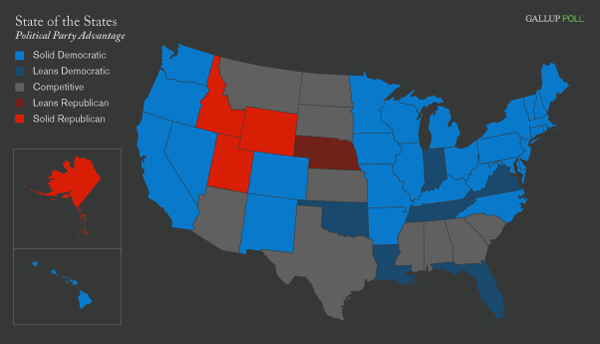
Here’s a handy map of state party ID from a Gallup poll taken back in January:

1-1

Those three little red blotches look pretty lonely, don’t they? And my, my, will you just look at all that blue! Reminds me of spring and Robin’s eggs.

Of course, that map doesn’t tell the whole story. Like, how far the GOP has collapsed in party ID since 2001:

1-1

My question is where are all the conservatives hiding? I mean, according to the current logic being propounded by a lot of smart people, the key to a GOP comeback is to run candidates that the base finds acceptable. (If they can find any. Their ever narrowing definition of “conservative” and vastly expanded definition of “RINO” would make finding enough candidates to fulfill that mandate an exercise in futility.)

Then, people will come flocking back to the GOP like geese returning from their winter quarters in Tijuana. Those invisible northeastern Republicans will take off their magic cloaks and show up at the polls to vote for “true” conservatives. Those midwestern conservative farmers who buried themselves in the rich loam of the prairie will dig themselves out and rush to the polls in order to cast their ballot for “real” candidates from the right.

And all those college graduates and holders of secondary degrees will come out of their coma and realize what they’ve been missing in life; voting for a “genuine” conservative.

Of course, if all those candidates were, by some quirk of fate or turn of bad luck, lose their elections it would force “real” conservatives back to the drawing board where they no doubt will come up with the brilliant idea that the reason for the defeat was that those candidates just weren’t “conservative enough” which will require an even narrower definition of who can wear the non-union label of “true” conservative.

Eventually, there will be so many litmus tests for who can call themselves a conservative that the base will start eying even Rush Limbaugh with suspicion. Do real conservatives smoke cigars? And what about all those divorces? I don’t know any true conservatives who have ever been addicted to anything.

The point is simple, my friends. There aren’t enough “true blue” conservatives in the country who would vote for your idealized, highly (and rigidly) ideological conservative candidate to win many elections outside of the old south and the Goldwater west. Stacey McCain makes sense here but I don’t think even he grasps the difficulty of creating a coalition where membership is so exclusive that running candidates that appeal to only one segment of the group will lead to failure:

This is something that the Nutroots figured out in 2004: If the Democratic Party’s liberal base were going to sit around passively while the out-of-touch party elite and the “expert” consultant class kept “reaching across the aisle” (and predictably losing) then they were on the superhighway to political irrelevance.

Nothing succeeds like success, and nothing fails like failure. A political party that is disloyal and disrespectful toward its core constituents, as the GOP was during the Bush/Mehlman era, will not attract new adherents. Who wants to sign up to be treated like a doormat?

The Bush-era GOP believed that its base would be satisfied with superficial gestures (e.g., the Terri Schiavo drama) and ignore the party leadership’s pursuit of policies (e.g., McCain-Feingold, No Child Left Behind, Medicare Part D) which were directly at odds with the party’s fundamental principles.

I don’t recall national Democrats “reaching across the aisle” at any time in the last 25 years. And the liberal party picked up 50+ seats in the House and 10 senate seats in the last two elections not by running Ned Lamont type candidates but rather Heath Shuler kind of Democrats who are strong 2nd amendment advocates, oppose gay marriage, favor tight controls on spending, and are business friendly. While some of the base grumbled, the netroots largely got behind the effort to find attractive, more moderate candidates to defeat conservative Republicans.

If the national Democrats had listened to their base, they would still be in the minority. As it is, the lure of power convinced activists like Kos and others that they should swallow some of their opposition to the Blue Dogs and embrace Dean’s 50 state strategy.

Stacey knows all this which is why I am puzzled about why he is insisting that more pragmatic candidates are not “true” to GOP principles (which doesn’t include getting the federal government to intervene in the Schiavo matter) and should be, if not drummed out of the party, then shunned as candidates not worthy of support. (I exclude Crist from this criticism because of the dishonesty of the NRSCC and Crist’s own chameleon-like political nature.)

So the base should support small government conservatives? Absolutely yes.

But how small?

And low tax, low spending conservatives? Yes please.

But what level of spending is “low?” And can taxes be so low that they cause the deficit to soar and damage the economy?

Stacey believes this is more a fight between the “elites” (who are apparently mostly RINO’s) and conservatives in the hinterlands who, it seems to me, view anyone who isn’t 100% at war with Democrats with a jaundiced eye. They chalk up such cooperation and nice talk to the idea that the elites have liberal friends and don’t want to be unpopular at DC or New York cocktail parties. This presupposes that the “elites” have no principles whatsoever and are shameless self promoters who want nothing more than to exercise power.

No doubt there are some GOP leaders who fit that bill. But to use a recent example, how about Jon Huntsman in Utah? I made a stink yesterday that many who consider themselves true conservatives were tarring Huntsman as a RINO despite the fact that his approval ratings in the most conservative Republican state in the Union is in the 80’s and he proved himself every bit the tax cutting, spending hawk, government shrinking conservative that the base loves.

However, Huntsman committed the sin of pragmatism by not only taking money from the Stim bill but actually saying nice things about the president in the bargain. He has also mentioned that perhaps less emphasis should be placed on social issues - not that they should disappear which some numskull social cons believe he said (If abortion and gay marriage can’t be front and center as national GOP issues, there appears to be a large minority of the base who believe that this would be “abandoning” conservative principles). “Less emphasis” means exactly that and no more. And yet, the litmus testers take that as a sign of apostasy.

Building a winning coalition means allowing more than those ideologically attuned to the positions on issues advanced by the base. As it stands now - and the base talks a good game about being “inclusive” but when push comes to shove, they do both in order to make people who don’t think like they do disappear - the only acceptable candidates who would receive the “Good Conservative Seal of Approval” are just as ideological, just as rigid and uncompromising on everything (not just principles) as the base.

And that’s the reason the GOP is in such a bad odor. Not because the majority of Americans agree with GOP pragmatists on the issues. They do. But because conservatism is seen as too rigid, too ideological, too white, too southern, too Christian, and too old.

Change that perception and the party’s fortunes will rise.

5/18/2009

REPORT FROM THE FRONT: PRAGMATISTS HAVE NO SOUL

Filed under: GOP Reform, Politics, conservative reform — Rick Moran @ 11:21 am

Ideological definitions on the right are fluctuating so wildly lately I am almost afraid to see where I am being pegged today. Having been drummed out of the party for my suspect committment to Obama hatred as well as my lack of enthusiasm for Rush worship, it has become something of an entertainment to discover where my critics are placing me on the ideological spectrum at any given point in time. It really doesn’t matter, I suppose, because the spite generated in my direction is usually illogical and not based on what I write or think but rather what some nitwit divines of my intent. Some of them need to undergo a high colonic and get rid of all that constipated spite welling up in their bowels else they will explode and make a smelly mess - something they are quite adept at doing without the benefit of colon cleansing.

Scatological humor aside, I am constantly amazed at the shifting definitions of who or what is a “good conservative” from people who themselves haven’t a clue of first principles and are especially ignorant of politics and governing. When you hit your knees tonight, you may thank God that none of these jamokes were present at the founding. Can you picture some of these purists at the Constitutional Convention? Holy Jesus, we’d still be operating under the Articles of Confederation - or worse.

“No compromise with that reprobate Hamilton, by God! And tell Madison he’s nothing but a squishy FINO (Federalist in Name Only)! How dare they compromise with those lickspittles from New Jersey to reach an agreement. Why do they always ignore what the Federalist base wants? They’re nothing but a bunch of elitists (Note: They were.). Not one red cent to elect any of them until they put up true Federalists for office.”

My broadly exaggerated point is that there would have been no Constitution without compromising closely held beliefs on the part of both sides. In fact, there is no governance without compromise as the Democrats are amply demonstrating these days in spades. The GOP may be the party of “no,” but that is only because none of their concerns about legislation are being taken into consideration. And, quite rightly, some issues cut so deeply as far as conservative principles are concerned that no compromise is possible. But on issues like health insurance and climate change, Republicans don’t even have a dog in the hunt to recommend changes that would both address the problems and be true to conservative principles. And that goes for legislation likely to be addressed down the line on education, trade, basic research, and social programs.

But these issues won’t be addressed by Republicans because it is believed that anyone who tries to cooperate with the Democrats gets nothing but the back of their hand and besides, those aren’t “conservative” issues anyway. No self respecting man of the right thinks about education in any way except by shouting at the top of their voice “Vouchers! Vouchers! Vouchers!” This mindless adherence to shallowness and closed minded arrogance leaves the political impression that Republicans don’t care about the concerns of ordinary voters - the overwhelming majority of whom are not as conservative as they are and are worried about their families and their jobs.

Case in point is the celebration by some conservatives that Utah Governor Jon Huntsman is eschewing a run for president in 2012 by accepting President Obama’s invitation to serve as Ambassador to China.

Utah, if you are not familiar with the state, is the most Republican outpost in the nation, regularly racking up 65-70% majorities for GOP candidates in national races. Needless to say, no squishes need apply if you are going to run for statewide office in Utah.

But apparently, Huntsman just isn’t conservative enough for some on the right - especially those who have taken on the job of policing the Republican party and trying to marginalize or, if possible, destroy those they consider insufficiently wild eyed and committed to the “cause.”

To refer to Huntsman as anything but a conservative is an indication of just how far right conservative activists have lurched since the election. It’s as if the defeat at the hands of a radical liberal has driven the base mad and any deviation from their extraordinarily narrow definition of “conservative” is cause to cast the luckless perpetrator into the outer darkness.

Incredibly, many in the base have referred to Huntsman as a RINO. The governor of Utah - the most socially conservative state in the nation - has been branded an apostate because…well, he accepted stimulus monies from the federal government for one. And he supports civil unions for gays. And he has doubts that climate change is a crock. And most egregiously, he thinks that the GOP should stop pushing social issues front and center in every election. He doesn’t support gay marriage or abortion. His values are as right wing as any conservative’s outside of very right wing Utah.

Other than that, the guy is more conservative than Reagan (he’s a tiger as a tax cutter and spending hawk not to mention an innovator in shrinking the size of state government). But being a governor in a severe financial bind that threatens to disable government services in his state, he can’t afford to posture like House GOP members and make the easy call (easy politically) and refuse the monies. So he was grateful for the cash and despite his record and conservative bona fides, his pragmatism gets him called a RINO by many who obviously don’t even know what a conservative is if they think Huntsman isn’t good enough. (My guess is he is conservative enough for about 90% of the country - maybe more.)

And yet, here’s some reaction from the conservative base to his being named Ambassador to China and the fact that the job will cost him a shot in 2012:

With all the RINOs in the Republican Party, it’s good to see whenever one of them bails. Latest is Utah Governor Huntsman who’s takin the ambassadorship to China:

That’s why I’d prefer Obama to “take out” all the RINOs. If the ony people left are true conservatives–in the same genre as Ronald Reagan–then Obama may yet go the way of “Jimmy” Carter–out in 1 term.

Oba-mao shuttles another rino into a post where he can dictate to him. Another rino turns his back on the USA for perceived self-interest.

Governor Jon Huntsman, RINO-Utah, who earlier this year was introduced to South Carolina Republican leaders at a dinner hosted by Attorney General Henry McMaster, has won praise from the leading homosexual advocacy group, Human Rights Campaign, for his support of civil unions. The liberal, Mormon Governor, who is expected to be a leading candidate for the Republican presidential nomination in 2012, is a close associate of John McCain and Lindsey Graham.

Lest ye think that this is not a representative sample of what the base thinks of Huntsman, I suggest you simply Google up “Jon Huntsman RINO” and tell me if that belief isn’t widespread.

This is nuts. I know that there are many in the base who do not agree with that assessment but when so many are so quick to condemn a conservative for…what? Being a responsible governor? Believing that when Americans say they are sick of the devisiveness that social issues bring to the fore that a politician should listen to them? Having a different opion about gays than many in the base?

The battle is not between conservatives and moderates but between ideologues and pragmatists. When I am told I am not a good conservative because I think waterboarding is torture, one has to marvel at the mind that posits that notion. Since when does a conservative litmus test rest on whether one believes that a strict definition of the law should be applied in torture cases? Or is it just that you can’t be a good conservative unless you believe that inflicting pain on another human being is more than alright, that you also must believe they deserve worse?

Can you be a good conservative and not be a Christian? To many, no. Can you be a good conservative and believe in a government that must function in a 21st century industrialized democracy of 300 milion people and not some pie in the sky, radical “small government” paradise that no one can precisely define? Can you be a good conservative and believe that there’s more to environmental protection than opposing climate change, condemning the EPA’s very existence, and believing that environmental legislation and regulations should be written by business interests?

I could go on and on. The point being, there are conservative alternatives to liberal overreach on every issue congress will address. But as I mentioned earlier, the conservativebase doesn’t even want to make an effort to address the issues because even thinking about them is verboten. It makes you a RINO, or a “moderate,” or a “centrist,” if you see government as a sometime solution to problems and that Washington has a role to play in many areas that the states have either abrogated responsibility or refuse to address.

This attitude is so pronounced on the right that by the time these folks are done, the Republican party will truly be so insignificant that we will be 50 years trying to make our way back:

Too often, labeling one’s self as “centrist” is just the moral shorthand of saying, “I don’t care.” When asked about abortion, candidate Obama stated that questions about the beginning of life were above his pay grade. Translation: “I don’t care.”

I’m not calling Obama a centrist, he’s clearly not, but centrist do share with him a lack of moral conviction. Centrists avoid the hard work of forming opinions, preferring to let the “cool kids” tell them what they believe. Back to the subject of abortion, centrists will often say that they are personally opposed to it, but they are just okey dokey with other people killing babies. Translation: “If I answer, they’ll make me sit at the dork’s table in the cafeteria.”

If centrists have any credo at all it is, “let’s sit back and see how it all shakes out.” RS McCain points out more clearly than I ever could why cozying up to centrists is a loser’s game. Broken down, you can’t shape opinion by relying on people who have no interest in holding an opinion.

I debunked this nonsense here. But the ignorance is so ingrained that I fear equating pragmatism with unprincipled politics will be part of rote conservative dogma for the foreseeable future. Presently, the idealogues in the party have the upper hand in that they will make or break a candidate’s chances on election day. Pragmatists have no such power as will probably be proved when the last of them is tossed out into the cold for some apostasy real or imagined.

Will the last moderate conservative who leavese the Repubican party please turn off the lights?

5/17/2009

CBO ESTIMATES ON OBAMACARE TOP $1 TRILLION

Filed under: Government, National Health Insurance, Politics, health care reform — Rick Moran @ 7:30 am

That $1 trillion is a number the Congressional Budget Office is looking at right now. Estimates by others have used $1 trillion as a starting point and go up to $1.5 trillion.

Please recall that our president “budgeted” only $637 billion for health insurance. But that number presupposes that almost everyone who is not now insured will buy the subsidized package. The only way to realize the $2 trillion in savings Obama needs to make the plan work is for nearly everyone to be on board.

But the CBO says that’s a crock as The New Republic’ s Jonathan Cohn points out in his exclusive look at the early CBO estimates:

So what does CBO think this time around? Late last month, after weeks of working overtime to keep up with the huge domestic agenda, CBO began delivering some prelimiary estimates on health reform. According to several sources familiar with the estimates, it’s something of a good news/bad news story:

The good news for reformers is the CBO’s determination that expanding health-insurance coverage would cost a lot less than many outside experts had predicted. Instead of a politically daunting $1.5 trillion, the CBO figures the price tag will be closer to $1 trillion, at least under certain parameters. But the reason for the lower estimate is a bit unsettling. Even with a requirement that everybody obtain insurance–a so-called individual mandate–the CBO assumes a that between a quarter and a third of the uninsured still wouldn’t have coverage. That would leave the country short of universal coverage, the goal Obama and his allies have repeatedly cited.

What Cohn doesn’t mention is that the reason Obama needs almost everyone on board his health insurance boondoggle is that the uninsured are one of the major reasons for skyrocketing health care costs. No one knows the true number of uninsured in the country. The Democrats like to throw around the number 48 million but that is too high by almost a factor of 4. Many of those 48 million are between jobs and will get health insurance when they are employed again or there are other factors as this AP article, summarized by The National Review Institute makes clear:

  • The Census Bureau itself says that “Health insurance coverage is likely to be underreported…” (See Appendix C of THIS report) For example, “16.9 percent of people with an MSIS record indicating Medicaid coverage reported…that they were uninsured.”
  • According to Sally Pipes of the Pacific Research Institute, “as many as 12 million uninsured Americans are eligible for Medicaid and the State Children’s Health Insurance Program-but they haven’t signed up.”
  • More than half of the uninsured are between 18 and 34 years of age, a group which has relatively few expensive health issues and for whom self-insuring (paying their own medical bills) makes sense. Only 14% of people over the age of 55% are uninsured.
  • Over 9 million of the “uninsured” have household incomes over $75,000.
  • Roughly 30% of the uninsured are without insurance for less than 6 months (though this statistic will likely worsen during the current recession).
  • And finally, estimates are that between 7.5 million to over 10 million of the uninsured (15% of them or more) are illegal immigrants.

A more cautious estimate of the uninsured is perhaps 12 million - most of them young and single. And that’s not the only myth about health care that the left has been promoting:

The top three myths are: 46 million Americans have no health insurance and therefore no health care; an individual mandate will lead to universal coverage; and socialized systems such as those in Canada and Europe are cheaper and more efficient than ours. If I were to write the book today, I would add another myth: that America’s health-care system puts our employers at a competitive disadvantage and hurts our economy. No less an authority than the Congressional Budget Office has debunked this myth, noting that it is employees who pay the tab, not the company, as it’s merely a substitute for wages. Yet this is a major selling point in the Democratic push to government health care.

The more uninsured, the higher the cost of health care. The higher health care costs will mean a larger subsidy for health insurance. This is exactly what they are finding in Massachusetts where the state subsidy has skyrocketed.

The estimate of $9.3 trillion in deficits the budget will run over the next decade has to be increased - perhaps by as much as $800 billion. Here’s Robert Samuelson writing in Investor’s Business Daily:

It’s true that since 1961 the federal budget has run deficits in all but five years. But the resulting government debt has consistently remained below 50% of GDP; that’s the equivalent of a household with $100,000 of income having a $50,000 debt. Adverse economic effects, if any, were modest.

(Note: Deficits are the annual gap between government’s spending and its tax revenues. The debt is the total borrowing caused by past deficits.)

But Obama’s massive, future deficits would break this pattern and become more threatening. At best, the rising cost of the debt would intensify pressures to increase taxes, cut spending - or create bigger, unsustainable deficits.

By CBO’s estimates, interest on the debt as a share of federal spending will double between 2008 and 2019, from 8% of the total to 16%. Huge budget deficits could also weaken economic growth by “crowding out” private investment.

At worst, the burgeoning debt could trigger a future financial crisis. The danger is that “we won’t be able to sell it (Treasury debt) at reasonable interest rates,” says economist Rudy Penner, head of the CBO from 1983 to 1987. In today’s anxious climate, this hasn’t happened.

At risk in this fiscal crisis is spending on national defense. At a time when our military must reassess its priorities due to the changing nature of enemy threats, it is likely we will be hamstrung by the massive deficits. Since most experts believe we have to increase the size of the army, Marines, and Special Forces, it is difficult to see where the money will come from - especially since cutting entitlements is off the table with Democrats in charge.

More likely, Obama will take a meat cleaver to our defense budget, cutting modernization and perhaps even cutting benefits to defense personnel. There are several vital programs that will likely see the ax, including the F-22 fighter and a drastic cutback in the number of next generation destroyers for the navy.

Samuelson guesses that the reason that few are speaking out about these catastrophic deficits and piling up of a massive amount of debt is the severity of the recession. But given the stratospheric budget deficits being run by Obama, any recovery will be stillborn as interest rates will have to be raised significantly to entice people to purchase Treasuries in order to fund the debt while inflation is likely to take hold as the trillions in bail out monies dumped into the economy by the Fed means too many dollars will be chasing too few goods and services.

Even a Keynesian can understand those basic economic principles.

We are in for a very rough ride for the next several years. It will take someone with courage and leadership ability to call for making tough choices. Obama has said time and time again that such choices are “false,” that we can have it all by only raising taxes on the rich.

When that chicken comes home to roost, it will probably be too late to stop the disaster from occurring.

5/15/2009

CAGE MATCH: CRIST vs. RUBIO

Filed under: GOP Reform, Politics, conservative reform — Rick Moran @ 10:48 am

They might want to call it “Death Wish 2010,” or perhaps, “How I Learned to Stop Worrying and Embrace Disaster.”

Just don’t call it “The Way Back.”

The Florida senate race, featuring moderate conservative Governor Charlie Crist being challenged in the GOP primary by former Florida House Speaker Marco Rubio, is shaping up to be a cage match between the party pragmatists and the litmus test conservatives. The contest will be played out before the entire nation and with the media gleefully watching as their newest made for television spectator sport — a real time broadcast of the Republican party’s destruction — comes to an HD flat screen near you.

Rubio, an attractive, dynamic, true blue conservative is the kind of candidate for which the right has been praying. John McCormick of The Weekly Standard got a little carried away in this panegyeric to Rubio, comparing the 37 year old to Barack Obama:

In some respects, Rubio is a little like another state legislator who ran for the U.S. Senate, Barack Obama. Like the president, Rubio points to his biography as a testament to the American dream. The son of Cuban immigrants who fled Castro’s regime, Rubio grew up in a working-class home–his father was a bartender and his mother a factory worker, casino maid, and Kmart stock clerk. He spent a year at Tarkio College in Missouri on a football scholarship before transferring to earn his bachelor’s degree at the University of Florida and his law degree at the University of Miami. He married his longtime girlfriend Jeannette, once a Miami Dolphins cheerleader and now the mother of their four young children. Raised and confirmed a Catholic, Rubio worships with his family at an evangelical church.

A compelling history indeed. Moderate Reihan Salam describes Rubio as something of a Republican Atlas with his “square-jawed all-American looks,” and a “deep belief in the healing power of tax cuts.”

Meanwhile, Crist had been the target of an intense lobbying effort by several top level GOP pols who believed that the governor would have the best chance of holding the seat being vacated by Mel Martinez. They convinced Crist to drop his re-election effort and enter the senate race thereby assuring the enmity of many conservatives in Florida and around the country.

To make matters worse, National Republican Senatorial Campaign Committee Chairman, Senator John Cornyn, flip flopped on his promise to remain neutral in the senate race and 15 minutes after Crist’s announcement, he threw the resources of the NRSCC behind the governor. No doubt the endorsement was part of the deal to get Crist to run for the senate but it still makes the NRSCC look weak and untrustworthy.

Already, calls for Cornyn’s head are making the rounds in the conservative blogosphere and Eric Erikson of RedState started a Facebook Page “Not One Penny to the NRSCC.”

Rubio himself has already drawn blood by releasing an ad showing Crist with President Obama and a voice over of doom accusing him of being in favor of spending trillions of dollars and piling up debt for our children and grandchildren. It is very effective and gets to the nub of why conservatives are angry with Crist, who participated in a dog and pony show with President Obama, appearing with him at a town hall meeting supporting the stimulus bill.

But that’s not the only problem the base has with Crist. The guy is a political chameleon who a decade ago found it advantageous to portray himself as a Reagan conservative when it was kewl to be a man of the right. He even earned the nickname “Chain Gang Charlie” for his tough law and order personae during his stint as Attorney General.

Now, the political winds are blowing left and Crist is blowing with them. Salam has some choice words for Crist in his Daily Beast article:

One of the key conservative charges against Crist is that his decision to back President Obama’s stimulus package was utterly bankrupt. Crist seemed more interested in currying favor with the state’s army of public-sector workers than keeping the faith with conservative principles. And honestly, that’s exactly right. Crist is not a conservative. With his permanent tan and slick white mane, he’s more like a kinder, gentler Latin American caudillo, who wants nothing more than to be cheered on by adoring throngs. Crist would be right at home with Juan and Eva Peron, dancing the night away and promising free T-bone steaks to the impoverished masses. As governor, Crist has enjoyed tremendous popularity—he has Obama-like job-approval numbers—and he’s done it by hardly ever making tough calls.

There’s no question that Florida is trending Democratic, and it doesn’t help that the state’s economy is sinking into the marshy deep from whence it came. Crist is keenly aware of this, and he’s moved accordingly. In flush times, a decent number of Florida’s must-win Latinos, notably Miami’s highly influential Cuban-American community, were open to small-government Republicans. A punishing wave of foreclosures—which hit Latino families particularly hard—has changed all that. Earlier in his political career, when hard-edged conservatism was on the rise, Crist was known as “Chain Gang Charlie” for backing extreme punishments for convicted felons. Now he’s better known for his efforts to fight climate change and save the Everglades. There’s little doubt that Crist looks himself in the mirror every morning and sees a future president. So why not run for reelection as governor?

Why not, indeed, Salam points out that the next Florida governor will have to make some very tough calls as the tax base shrinks and needs grow. Crist decided to get while the going’s good in order to remain “the most popular political figure in Florida.”

Of course, his wooing by the NRSCC and establishment Republicans did not take into account that his run for the senate would leave a huge vacuum in Talahassee that a Democrat is very likely to fill come election time. Crist was a near sure thing for re-election and his playing musical chairs with GOP politics in Florida could very well cost the Republicans a governorship in a crucial swing state.

So instead of re-election, Crist will rain on conservative’s parade by elbowing Rubio aside. This is sure to anger Rubio’s mentor and cheerleader Jeb Bush who, despite being out of office, still maintains a great network of fundraisers and political operatives across the state. Will Jeb join in the civil war and choose sides, backing Rubio by steering money and political know how his way? I think it will depend on whether Jeb Bush wants to run for president himself some day. Going against establishment Republicans and openly supporting Rubio would anger the very people he would depend on for a presidential run down the road. Prior to Crist’s entrance in the race, it seemed a foregone conclusion that he would give a boost to his disciple. Already he had steered some fund raisers his way, resulting in a haul of about $360,000 in a couple of weeks. But the smart money says that Jeb will play a behind the scenes role while urging his supporters to do all they can to help Rubio.

What kind of a chance does he have? Better than you’d expect. A recent poll showed Crist far ahead with 54% to Rubio’s 8%. But that same poll showed only 23% of Republicans in the state who would “definitely” vote for him in the primary. And more than 65% of the state’s Republicans don’t know enough about Rubio to make a judgment.

With a solid base of support among Cuban Americans, Rubio may surprise - if he can raise the millions of dollars to compete with Crist’s proven fund raising acumen. Florida is a very expensive state to run a race and Rubio’s challenge will be to raise enough money - not as much as Crist but enough to be competitive - and hope that the anti-establishment attitudes that some pollsters are already seeing in the electorate will translate into victory for him in the August, 2010 primary.

The new conservatives have the race they say they’ve always wanted; one of their own versus a “moderate.” If the evangelical, family values, small government, low tax Rubio pulls it out it will shake the party establishment to the core. Not a bad thing necessarily although if Rubio gets slaughtered in the general election, where will the new conservatives be then?

Maybe they’ll say that Rubio wasn’t “conservative enough” and try again. One thing’s for sure, if the new conservatives can’t win in Florida, the question will be asked how they can possibly pull off a victory anywhere else?

5/14/2009

FIRE STEELE AND BRAND THE RUMPS OF RNC COMMITTEEMEN

Filed under: GOP Reform, Politics, conservative reform — Rick Moran @ 10:40 am

I suppose it could have been worse. Instead of passing a resolution officially branding the opposition the “Democrat (sic) Socialist Party,” the RNC might have voted the GOP out of existence.

In the end, the one will hasten the day that the other is realized.

This may be the silliest thing a political party has ever done in American history. I’m with Allah 100%:

More than anything, this reeks of impotence, operating almost as a concession that the right’s argument on the merits that the left is evolving towards socialism isn’t working to shift public opinion. So now they’re going to up the ante by trying the hard sell: Just repeat “socialism” as much as possible to try to drive it into people’s skulls, never minding the fact that that term’s already lost some of its taboo and might well lose more as it goes further mainstream. Or at least, I hope that’s the GOP strategy here. The alternative, that they’re simply sticking their fingers in their ears and repeating “socialist” over and over out of spite like a five-year-old, is too depressing to contemplate. What’s next, a formal resolution declaring french fries “freedom fries” in the Republican Party henceforth and forevermore?

Unfortunately, I believe their reasoning for passing this resolution is more attuned to the latter rather than the former. There is no sense, no rhyme, no reason to “officially” branding the opposition socialists. It is nothing more than a cry in the wilderness; a pathetic ploy (and a childish one at that) to inititate a round of name calling and finger pointing when what is needed are policy alternatives.

This is truly the party of Limbaugh now. The casual use of the word “socialism” on talk radio, the internet, and anywhere the “new conservatives” gather is an affront to common sense not to mention proof positive that the party is in the control of ill-educated, anti-intellectual brigands. Since around 99.9% of American businesses are NOT being taken over by the government and a similar percentage of workers are NOT having their salaries and bonuses manhandled by the feds, one wonders where the idea that the Democrats want “socialism” came from in the first place.

What Obama is doing should be opposed with every fiber of our beings. But Obama is corrupting the free market, not eliminating it. Here’s George Will today:

This is not gross, unambiguous lawlessness of the Nixonian sort — burglaries, abuse of the IRS and FBI, etc. — but it is uncomfortably close to an abuse of power that perhaps gave Nixon ideas: When in 1962 the steel industry raised prices, President John F. Kennedy had a tantrum and his administration leaked rumors that the IRS would conduct audits of steel executives, and sent FBI agents on predawn visits to the homes of journalists who covered the steel industry, ostensibly to further a legitimate investigation.

The Obama administration’s agenda of maximizing dependency involves political favoritism cloaked in the raiment of “economic planning” and “social justice” that somehow produce results superior to what markets produce when freedom allows merit to manifest itself, and incompetence to fail. The administration’s central activity — the political allocation of wealth and opportunity — is not merely susceptible to corruption, it is corruption.

Not a peep about socialism from a man who was fighting the expansion of the federal government when most new conservatives weren’t even a lacisvious gleam in their father’s eye. If you wish to call what Obama and the Democrats are doing “socialism,” then petition Webster’s to change the definition. And what is that definition?

1: any of various economic and political theories advocating collective or governmental ownership and administration of the means of production and distribution of goods.
2 a: a system of society or group living in which there is no private property b: a system or condition of society in which the means of production are owned and controlled by the state

3: a stage of society in Marxist theory transitional between capitalism and communism and distinguished by unequal distribution of goods and pay according to work done

Considering that a minuscule part of the economy is, at the moment, being run by the Feds, the grossly exaggerated (and, I would add, hysterical) notion that the Democrats desire to close Wall Street, seize all private property, convene an industrial production board to set targets for economic activity, prevent the creation of new businesses, and control capital on a much grander scale than they do now - can only be explained by a shocking ignorance of politicl theory and the lack of even a beginner’s overview of the nature of the political economy shown by new conservatives from the RNC down.

Are Obama’s moves troubling? You betchya. Not because he is instituting socialism but because he and the Democrats are ignorantly corrupting the free market. The more they fiddle with it the more they screw it up. That much should be obvious even to the Keyenesians at Treasury and the White House. But the basic principles of the free market as it relates to the macro economy are still well in play. If you doubt me, pay a visit to the Chicago Board of Trade where capitalism - real devil take the hindmost capitalism - still rules the roost.

The laws of supply and demand still propel our economy despite the Fed’s best efforts to muck things up. And that’s what makes this move by the RNC to brand the Democrats as socialist so silly. Not only are they tarring tens of millions of Americans (and potential voters) with the slimey appellation, but they are lowering the bar on the definition of socialism to the point that about the only people in the US who wouldn’t be considered socialists are pie in the sky libertarians and corporate Republicans like Limbaugh and his ilk on talk radio.

And what of our illustrious leader, RNC Chairman Michael Steele? A cigar store indian has more influence with the RNC than he does:

A member of the Republican National Committee told me Tuesday that when the RNC meets in an extraordinary special session next week, it will approve a resolution rebranding Democrats as the “Democrat Socialist Party.”

When I asked if such a resolution would force RNC Chairman Michael Steele to use that label when talking about Democrats in all his speeches and press releases, the RNC member replied: “Who cares?”

Which pretty much sums up the attitude some members of the RNC have toward their chairman these days.

Steele wrote a memo last month opposing the resolution. Steele said that while he believes Democrats “are indeed marching America toward European-style socialism,” he also said in a (rare) flash of insight that officially referring to them as the Democrat Socialist Party “will accomplish little than to give the media and our opponents the opportunity to mischaracterize Republicans.”

I can hear my new conservative friends already: “We shouldn’t care what the media and the opposition will say about us. Anyone who does is a cowardly wretch who willingly plays into their hands by accepting their characterization of conservatives and Republicans.”

Okay, you win. I totally and completely reject the characterizations of conservatives by the media and the Democrats. I’ll even agree that even thinking about the subject should be cause for being kicked out of the Republican party. We don’t want pantywaists who wet themselves if the media and the Democrats successfully paint conservatives as a bunch of loony tunes nitwits who smear 60 million potential voters by calling them socialists. Be a man. Stand up. Look like an idiot, go ahead.

Lord deliver us.

Michael Gerson calls it “A Driving Desire to Lose:”

Witness the reaction to the National Council for a New America — an anodyne “listening tour” by Republican officials recently kicked off at a pizza parlor in Northern Virginia. Social conservatives attacked this forum on education and the economy for the offense of not being a forum on abortion and the traditional family. Neo-Reaganites searched the transcript for nonexistent slights: How dare former Florida governor Jeb Bush criticize “nostalgia” for the “good old days”? Why didn’t he just spit on Ronald Reagan’s grave? Other conservatives criticized the very idea of a listening tour, asking, “What’s to hear?”

During a recent conversation, Bush described himself as “dumbfounded by the reaction.” He added: “I don’t think listening is a weakness. People are yearning to be heard. Perhaps we should begin with a little humility.”

[snip]

Each of these policies — carbon restrictions, universal health insurance and immigration reform — could eventually be important to the Republican recovery. But would a candidate carrying these ideas transform the Republican Party, or be destroyed by it? The hostile reaction to the pizza parlor putsch provides one answer.

But this is a snapshot, not a prophecy. As the years pass, the kingdom of irrelevance seems less and less pleasant, even to its rulers. Policy shifts that seem incredible become inevitable. This is how a party prepares to win.

Fighting over who should rule this “Kingdom of Irrelevance” is all we have left. There are issues of vital importance to almost all Americans that the GOP continues to ignore not because there aren’t conservative alternatives to what the Democrats are offering but because the ignoramuses currently in the ascendancy in the party have deemed them “Democratic issues” and anyone who advocates conservative solutions to those problems is automatically branded a “moderate” - a virtual death knell in today’s purest atmosphere. The notion that addressing vital issues is nothing more than acting like a Democrat is so absurd on its face that it is little wonder serious people do not take the party seriously.

Steele has got to go. He’s been emasculated already so putting him out of his misery would seem to be the charitable thing to do. And as for the RNC members who want to make an irrelevant statement by passing an irrelvant resolution, from an irrelevant group representing an irrelevant party with irrelevant ideas - they should all be forced to take their pants down and a great big “I” for “Irrelevant” branded on their rumps. That’s my idea for “rebranding” the party.

That way, when they pass a resolution requiring Republicans to moon Democrats whenever they see them, people will know where they’re coming from.

« Older PostsNewer Posts »

Powered by WordPress