Right Wing Nut House

10/21/2009

BUCHANAN AND HIS ‘WHITE MAN’S LAMENT’

Filed under: Blogging, Culture, Decision '08, Ethics, History, Politics, The Rick Moran Show — Rick Moran @ 10:38 am

Is Pat Buchanan a racist? Is Rush Limbaugh?

Am I? Are you?

I discovered after writing my Rush Limbaugh post that there is no set definition for identifying a racist - at least one not fraught with politics, and informed by partisan rancor. “It’s obvious” is not an argument either way. Nor is there much agreement on whether one can be a racist subconsciously. This “all white people are racists and don’t even know it” idea was very popular a couple of decades back. But I don’t think anyone save committed racialists think that way anymore.

But does that mean that there is not a nurtured outlook of white superiority in our society that makes some of us oblivious to our own bigotry?

In the end, it all comes down to perception, and whether one has a decidedly deterministic worldview. How one experiences race in America has an awful lot to do with how low or how high we set the bar that defines for us whether one is a race hater or not.

Attorney General Eric Holder remarked early in Obama’s term that America was “a nation of cowards” because we wouldn’t talk candidly about race. I think he is right we don’t talk candidly about race but he is wrong when he says the reason is cowardice. How can there be a discussion on race when there is no agreement on what actually constitutes racism? Oh, there are “speech codes” and “hate crime legislation” that deal with the most obvious, outward manifestations of racism that help define, in the broadest possible terms, racists.

In fact, I would argue that speech codes and hate crime definitions further muddy the waters with regard to defining racism. In my estimation, such remedies lower the bar on what defines a racist, mixing legitimate free speech issues with racial issues. If one defines racism according to racial sensitivity, simply stepping on someone’s toes verbally can be construed as “hate.” That defeats the purpose of the First Amendment, and I believe is the reason many conservatives reject the idea of speech codes altogether.

(Hate crime legislation is an entirely different matter and goes to “intent” - a tricky legal definition that I wish would be used judiciously but the potential for abuse, and inconsistent application is too great to justify its passage.)

So are all racially insensitive people racists? Does the use of stereotypes automatically make one a racist? If you reject the NAACP position on affirmative action, are you a racist?

Most mindless partisans eschew the questions and simply go for the jugular. But for those interested in exploring these questions, we have an excellent exhibit in the form of an Op-Ed by paleoconservative Pat Buchanan that, on the surface, appears to be something of a “white man’s lament” at the loss of “traditional” America:

In their lifetimes, they have seen their Christian faith purged from schools their taxes paid for, and mocked in movies and on TV. They have seen their factories shuttered in the thousands and their jobs outsourced in the millions to Mexico and China. They have seen trillions of tax dollars go for Great Society programs, but have seen no Great Society, only rising crime, illegitimacy, drug use and dropout rates.

They watch on cable TV as illegal aliens walk into their country, are rewarded with free educations and health care and take jobs at lower pay than American families can live on – then carry Mexican flags in American cities and demand U.S. citizenship.

They see Wall Street banks bailed out as they sweat their next paycheck, then read that bank profits are soaring, and the big bonuses for the brilliant bankers are back. Neither they nor their kids ever benefited from affirmative action, unlike Barack and Michelle Obama.

They see a government in Washington that cannot balance its books, win our wars or protect our borders. The government shovels out trillions to Fortune 500 corporations and banks to rescue the country from a crisis created by the government and Fortune 500 corporations and banks.

America was once their country. They sense they are losing it. And they are right.

Buchanan is not the first conservative to incorporate these concepts in their critique of the Obama administration. But Buchanan scores the trifecta of hyperbole by collating race, class, and fear of “The Other” in his lament.

And he proves himself once again to have the historical sense of a marmoset about America. What is America ever been about but change? I’ve said it many times, and it is born out by even a cursory understanding of the thrust of American history; this is a nation on the move, has been on the move, and will always be on the move as long as we are free.

We stand still for nothing, for nobody - no institution, no philosophy, no group, industry, or movement. To be static in America means that you are already on your way out. We reinvent ourselves at the drop of a hat, with impossible speed. What takes European democracies decades, we do in one or two election cycles. It is frightening. It is marvelous. It is the defining characteristic of this country and it is one of those things that makes us exceptional.

I know what Buchanan is trying to say - he’s not saying it well and he is mixing a witches brew of politics and racial identity in with his critique. What he refers to as “traditional America” is defined by his enemies as white America. But if we are to postulate that Buchanan’s “traditional Americans” are upset because we have an African American president and preferences for minorities, doesn’t that make “traditional Americans” themselves racist by definition?

Beware, a trap Mr. Serwer:

I’d love to just leave this post with snark, but I have to say one last thing. Black Americans have shed blood in every American war since the Revolution. This country, even the very Capitol building in which today’s legislators now demand to see the birth certificate of the first black president, was built on the sweat and sinew of slaves. Before we were people in the eyes of the law, before we had the right to vote, before we had a black president, we were here, helping make this country as it is today. We are as American as it gets. And frankly, the time of people who think otherwise is passing. If that’s the country Buchanan wants to hold onto, well, he’s right, he is losing it.

Did Mr. Serwer not just define “traditional” Americans?” I believe he did. Race, or gender, or sexual orientation has nothing to do with whether one is a “traditional American.” Some may believe that Buchanan is limiting himself to the white race, but his critique echoes in those communities where “traditional American” is broadly defined as anyone who respects and reveres the first principles upon this nation was founded; among them - self reliance, a respect for individual rights, and the investment of the nation’s sovereignty in the Constitution. One doesn’t need to be a conservative to believe in the traditional American values Buchanan believes are disappearing. And it is insulting, as Mr. Serwer points out, to limit the idea of traditional American to one race.

The question then becomes not whether Buchanan is a racist but whether he’s right. As usual, Buchanan overstates the case but hits upon something that critics ignore at their peril.

It is the pace of change that has people of many races, many backgrounds worried. If it were only tea partiers and loudmouths at town hall meetings, the sense of unease that runs the length and breadth of the land would not be so obvious - obvious enough to be reflected in poll numbers and soon, at the ballot box. It is difficult to argue that the pace of change doesn’t matter or that traditional Americans are not worried that the many changes being proposed by the president cannot be shoehorned into their vision of what America is supposed to be all about.

You can argue that African Americans as a group are less critical, or that the Hispanic community may not be as worried about the pace of change as white Americans. But to dismiss this phenomenon as a white only construct is naive. To do so identifies the critic as someone too enamored in viewing the nation’s problems through the prism of race and racism.

This plays to the idea that many whites are subconsciously racist - that when they lament the passing of an America with which they are familiar, what they are really saying is, “I don’t like that black man as president:”

I agree with the substance of Adam’s case against Pat Buchanan; the vision that Buchanan is putting forth of America is both racist and ahistorical, and is genuinely dismissive of the contributions of every non-white American (not to mention women, immigrants, and so forth). At the same time, I think that there’s more going on; Buchanan has always been more willing than most conservative pundits to make forthright, and in some sense honest, defenses of unpalatable elements of the right wing worldview. I recall at some point in the 1990s that Buchanan was asked why the United States was willing to sacrifice treasure for Bosnia and not Rwanda, and he gave the straightforward answer that Rwandans weren’t white enough.

In this case, I think that Buchanan is invoking a genuine sense of loss of entitlement on the part of a substantial portion of white America. This isn’t to defend or justify the white privilege that created this entitlement entailed, or to justify Pat Buchanan’s nostalgia for it. Nevertheless, I think that Buchanan is pointing to something that’s very real, or at least as real as any sociological fact. White America, as the construct exists in the mind of many Americans, is disappearing, even by some objective criteria; it’s retreating deeper into exurban communities, and it’s very, very slowly ceding political and financial power. Moreover, the idea of America is changing; Buchanan has a very definite vision of what America is, and is smart enough to understand that his vision is losing traction. In this context, it’s hardly surprising that the response is a combination of rage and raw panic. That the ideological structure that supports White America is racist and has a disturbing narrative of American history is academically relevant, but it’s also not the central point. Those who hold Buchanan’s vision (and many do, although often not in terms as explicit as Pat is willing to put forth) really do find themselves under siege, and pointing out that these beliefs are both crazy and immoral has very limited effect.

Spoken like a true determinist. Positing the notion that white Americans obsess about race, or their “entitlement” makes sense if you believe the rush to create a different kind of America doesn’t involve a radical movement away from what all races, all creeds who believe in “traditional America” see as fundamentally important to their identity. How do those black and Hispanic veterans who shed blood in our wars view the president’s foreign policy? Or do the black and Hispanic communities march in lockstep with the idea of national health insurance? Bail outs for big banks and corporations? A larger federal role in educating their children? A radical restructuring of our energy policy?

A determinist can ascribe all of this to white racism because looking at the country through the warped vision of racial conflict, everything becomes explainable as “loss” defined as privilege or status. People don’t think that way, have never thought that way, will not act in that fashion as evidenced by the fact that Communism is, for all intents and purposes, dead. This phenomenon resists a deterministic explanation. We must look to history for answers.

It has never been that white America, or traditionalists of any kind have been resistant to all change, everywhere, all the time. There have been pockets of resistance throughout our history to change (some larger than others, as was the case in southern resistance to integration). The social history of America is replete with examples of a “brake” being placed on change that turned out to be both necessary and good.

But unless you are willing to argue that “traditionalists” wish to see Jim Crow reestablished or women denied the right to vote, you must accept the fact that rapid change, while causing some dislocation, is nevertheless accepted by tradtionalists eventually. This does not mean that southern whites were correct in resisting integration, or men were spot on in their opposition to a woman’s right to vote. But in a nation that can alter its political landscape every four years, some anchors must be recognized if change that is proposed is to be folded into our national consciousness and become part of our national character.

Looking at the long view of history, I find it absolutely astonishing that in my youth, a black man couldn’t get a sandwich at a southern coffee shop and yet, I live in a time where an African American received more white votes for president than his party’s predecessor.

Is it the position of critics that this miracle was accomplished without the traditionalists? I beg to differ. I believe it was the traditionalist’s eventual acceptance of racial integration - begrudging though it might have been - that made the election of Barack Obama possible. And the fact that we have gone from Jim Crow to an African American president in less than one human lifetime only points more strongly to the idea of American exceptionalism and the idea that rapid change, when governed by applying first principles - in this case, equality for all - will eventually be accepted even by those who oppose the change in the first place.

Mr. Serwer rejects the findings of the Democracy Corps focus groups that race plays a small part in opposition to the president because it doesn’t feed his thesis that Buchanan (and Limbaugh) are explicitly lamenting a “loss” to white America as the result of the election of a black man.

I don’t doubt that there is an element of racism - clear, nauseating, and shocking - that is a significant part of Obama hate. But limiting one’s critique to a purely racial explanation belies the fact that traditionalists (sometimes incoherently) are more concerned about the president severing connections to the past than any non-acceptance that a black man can be president, or that the very fact that a black man sits in the White House gives them cause to lament their being marginalized in this “new” America.

I am not accusing Mr. Serwer of deliberately misinterpreting Buchanan’s critique. But rejecting out of hand empirical evidence that your own critique is off base smacks of partisanship, not rigorous analysis.

President Obama ran on a platform of change. He is giving his supporters exactly what they voted for. But from recent poll numbers, it is clear that even many of those who voted for Mr. Obama are feeling uneasy about what he is doing, that he is moving too quickly in some areas, without giving proper respect to the principles that America was founded upon or the “traditions” if you will that binds this nation as one. Whether they are white, black, brown, or purple matters not. And those who seek to muddy the waters by making opposition to the president’s idea of change a question of race hate are missing the boat.

10/20/2009

THE RICK MORAN SHOW: HAVE A LITTLE PORK WITH THAT SAUSAGE

Filed under: The Rick Moran Show — Rick Moran @ 4:38 pm

You won’t want to miss tonight’s Rick Moran Show, one of the most popular conservative talk shows on Blog Talk Radio.

Tonight, I welcome Dan Riehl and Fausta Wertz for a discussion of health care, an update on Honduras, and the issue of American Conservative Union chief David Keene’s “pay to play”controversy.

The show will air from 7:00 - 8:00 PM Central time. You can access the live stream here. A podcast will be available for streaming or download shortly after the end of the broadcast.

Click on the stream below and join in on what one wag called a “Wayne’s World for adults.”

The Chat Room will open around 15 minutes before the show opens,

Also, if you’d like to call in and put your two cents in, you can dial (718) 664-9764.

Listen to The Rick Moran Show on internet talk radio

10/19/2009

THE DEMONS ARE STIRRING AGAIN

Filed under: History, Science, The Rick Moran Show — Rick Moran @ 9:14 am

How is it possible that in the greatest age of scientific discovery in human history, millions of people believe that something horrible is going to happen to the world on December 21,2012?

I suppose nothing should surprise me given the widespread belief in astrology, the New Age nonsense related to the mystical power of pyramids, and the continued idiotic acceptance of Nostradamus, Edgar Cayce, and other wackos as having knowledge of what is to come.

Otherwise normal, educated people will let drop in casual conversation the most inane stupidities regarding the occult, or the anti-rational rantings of long dead “prophets” whose vague, elliptical “predictions” are accepted as proof of their genius.

In fact, when it comes to believing in the paranormal or psuedoscientific theories, we Americans are spectacularly inept at being able to tell the difference between science, and psuedoscience, and are thus unable to distinguish between fact and fiction.

The last Gallup poll on the subject of belief in the paranormal in 2005 showed that beliefs in such things as ESP, ghosts, astrology, and clairvoyance, had changed little since a similar survey done in 2001.

Here’s are some results from the 2005 poll:

% Believe in

Extrasensory perception, or ESP - 41

That houses can be haunted - 37

Ghosts/that spirits of dead people can come back in certain places/situations - 32

Telepathy/communication between minds without using traditional senses - 31

Clairvoyance/the power of the mind to know the past and predict the future - 26

Astrology, or that the position of the stars and planets can affect people’s lives - 25

That people can communicate mentally with someone who has died - 21

Witches - 21

Reincarnation, that is, the rebirth of the soul in a new body after death - 20

Channeling/allowing a ’spirit-being’ to temporarily assume control of body - 9

Not all those surveyed believed in all 10 of this paranormal nonsense. But you may take no comfort from that.

A special analysis of the data shows that 73% of Americans believe in at least one of the 10 items listed above, while 27% believe in none of them. A Gallup survey in 2001 provided similar results — 76% professed belief in at least one of the 10 items.

The “cumulative percent” column shows that more than one-fifth of all Americans, 22%, believe in five or more items, 32% believe in at least four items, and more than half, 57%, believe in at least two paranormal items. Only 1% believe in all 10 items.

Further breaking down the data another study used the Gallop poll as a baseline to examine what college educated people believed about the paranormal. The results are pretty shocking:

Even though researchers Bryan Farha at Oklahoma City University and Gary Steward of University of Central Oklahoma admitted that they had expectations of finding contrary results, their poll of college students found that seniors and graduate students were more likely to believe in haunted houses, ghosts, telepathy, spirit channeling and other paranormal phenomena than were freshmen.

[...]

Farha’s and Steward’s survey was based on a nationwide Gallup Poll in 2001 that found younger Americans more likely to believe in the paranormal than older respondents. The results of the Farha/Steward poll discovered that gaining more education was not a guarantee of skepticism or disbelief toward the paranormal. While only 23% of the freshman quizzed professed a belief toward paranormal concepts, the figures rose to 31% for college seniors and 34% for graduate students.

Why is it important that belief in the paranormal be attacked, and efforts made to constantly debunk these beliefs? Here’s famous psychic paranormal debunker James Randi who has offered $1,000,000 to anyone who can prove that ESP is real:

According to J. Randi, “acceptance of nonsense as mere harmless aberrations can be dangerous to us. We live in an international society that is enlarging the boundaries of knowledge at an unprecedented rate, and we cannot keep up with much more than a small portion of what is made available to us. To mix our data input with childish notions of magic and fantasy is to cripple our perception of the world around us. We must reach for the truth, not for the ghosts of dead absurdities”

Experts refer to this as “information pollution” where outrageous ideas are interlaced with facts and what emerges is a wholly distorted view of reality.

This leads us directly to the latest manifestation of dangerous thinking with regard to the paranormal; the “End of the World” meme that is starting to really pick up steam and will only become more pronounced the closer we get to 2012.

I love the History Channel, but they seem to have made the decision to be one of the leading promoters of this nonsense, with a weekly series on Nostradamus and predictions about the end of the world from several cultures. For a network that features two of the best science programs on today - The Universe and How the Earth was Made - I find it preposterous that The Nostradamus Effect could be part of its general programming.

What is the show about?

The end is near. At least that’s what the doomsday predictions from Nostradamus, the Book of Revelation, the Mayan “long count” calendar and others would have us believe. Many unsettling forecasts of global destruction even pinpoint the year: 2012. How worried should we be? If these prophecies are accurate and inevitable, is there any way to avoid or at least postpone them from coming true? Michel de Nostradamus was a 16th-century French physician and astrologer whose very name is synonymous with apocalyptic visions of the near and distant future. His ominous writings appear to have accurately anticipated numerous natural disasters, plagues and wars. Nostradamus Effect examines these and other end-of-time predictions from cultures across the globe, from centuries ago, and connects the dots with current global events to separate the prophecies that appear to be inspired visions from those that are merely crackpot conspiracy theory.

By purporting to “separate prophecies” that are “inspired visions (could be true?) from “crackpot conspiracy theories,” the show does an enormous disservice to the truth. A skeptic would immediately identify all of this nonsense as the work of crackpots - as indeed it is. There is absolutely no evidence whatsoever that “inspired visions” throughout history have been anything but wishful thinking on the part of those who are unwilling to examine such claims with a critical eye. Anyone who believes Nostradamus was anything but a kook needs to look within to find the objectivity to realize that his elliptical and nebulous “quatrains” that supposedly predict the future are nothing more than gibberish.

The History Channel also has broadcast several “specials” on the Mayan Doomsday prophecy that are, if anything, more dishonest than The Nostradamus Effect. They cleverly mix little sprinkles of scientific “fact” about the Mayans and their extraordinary culture in with the false notion that the end of their calendar meant the end of the world, a ridiculous notion long ago debunked by experts in Mayan culture:

But scholars are bristling at attempts to link the ancient Maya with trends in contemporary spirituality. Maya civilization, known for advanced writing, mathematics and astronomy, flourished for centuries in Mesoamerica, especially between A.D. 300 and 900. Its Long Count calendar, which was discontinued under Spanish colonization, tracks more than 5,000 years, then resets at year zero.

“For the ancient Maya, it was a huge celebration to make it to the end of a whole cycle,” says Sandra Noble, executive director of the Foundation for the Advancement of Mesoamerican Studies in Crystal River, Fla. To render Dec. 21, 2012, as a doomsday or moment of cosmic shifting, she says, is “a complete fabrication and a chance for a lot of people to cash in.”

“Cash in” - as the History Channel is doing with both fists.

It should be noted that in each of these broadcasts, the producer has included one or more skeptics to provide “balance.” The Skeptic Foundation’s Robert Shermer has been a frequent voice of reason on these shows, but their commentary is far outweighed by “evidence” that points to the destruction of our planet 3 years hence.

Harmless fun? Not hardly:

Specific harms caused by paranormal beliefs have been summarized as:

* a decline in scientific literacy and critical thinking;

* the inability of citizens to make well-informed decisions;

* monetary losses (psychic hotlines, for example, offer little value for the money spent);

* a diversion of resources that might have been spent on more productive and worthwhile activities (for example, solving society’s serious problems);

* the encouragement of a something-for-nothing mentality and that there are easy answers to serious problems, for example, that positive thinking can replace hard work; and

* false hopes and unrealistic expectations

(Beyerstein 1998: “The Sorry State of Scientific Literacy in the Industrialized Democracies.” The Learning Quarterly 2, No. 2:5-11. ).

Also looking to cash in are hucksters who know exactly how to appeal to the sizable segment of our population who finds believing in these end of the world scenarios to be almost like riding a roller coaster - it’s the fun of being scared that is addicting to some. They find the idea of the world suddenly ending both terrifying and exciting. Not knowing how to judge the efficacy of such claims, they veer between acceptance and rejection with their level of acceptance rising the more they watch or read about the subject.

And if it’s reading they want, there are books galore already, not to mention an endless number of websites devoted to the topic. This one takes itself too seriously:

As 2012 approaches we have a growing list of what “experts” feel might occur. Despite the sincerity and long-winded explanations, it’s all just guesswork. There is no scientific evidence that anything untoward will happen in 2012. All we have to suggest that 2012 will be any different to 2011 or 2013 is that the Mayan Long Count calendar ends on Dec 21, 2012. The Mayans themselves had almost nothing to say about what the end of the calendar held for humankind, and this suggests that they merely inherited the calendar from an earlier culture. In deciding which of the many possible calamities are more likely to wipe us out in 2012, the possibility of an ancient culture predicting such for 2012 must be taken into consideration.

The gentleman then goes on to posit 10 calamaties - including a “Religious Apocalypse,” rapture and all, and - one that I’ve never heard of - “Explosion from the black hole at the center of our galaxy.” He repeats speculation that such a “gravity wave” caused the 2005 tsunami and not the massive Pacific Ocean earthquake scientists know was responsible for the disaster.

The site is actually quite reasonable compared to others. But his benchmark that asks if “Ancients could predict” any one of his scenarios is an indicator that the fellow is a couple of shakes short of a good martini.

The ever present danger of cults arising out of this craziness should not be underestimated. Some experts believe that the madness will not be quite as bad as what occurred during the Y2K hysteria:

The buildup to 2012 echoes excitement and fear expressed on the eve of the new millennium, popularly known as Y2K, though on a smaller scale, says Lynn Garrett, senior religion editor at Publishers Weekly. She says publishers seem to be courting readers who believe humanity is creating its own ecological disasters and desperately needs ancient indigenous wisdom.

“The convergence I see here is the apocalyptic expectations, if you will, along with the fact that the environment is in the front of many people’s minds these days,” Garrett says. “Part of the appeal of these earth religions is that notion that we need to reconnect with the Earth in order to save ourselves.”

Scare stories about global warming - exaggerating for effect - as well as the usual environmental disaster predictions play very well to the non-skeptical among us who, if they read it in the newspaper, hear it on the news, or even just read it on the internet, it must be true.

I wrote about this attitude when a study came out showing only Turkey had a higher percentage of citizens who believed evolution was false:

What is it that the rest of the enlightened world knows and we don’t? Are all the technologically advanced peoples on this planet under some magic spell of the evil Darwinists? What are the real world consequences of this kind of scientific ignorance?

There is little doubt that science education in this country is a joke. While American 4th graders score very well on international standardized tests, finishing 3rd in the most recent TIMSS Report (Trends in International Mathematics and Science Study), it’s all downhill from there. Our 8th graders finish in the middle of the pack while our seniors in high school are almost dead last.

We have a lack of good science programs in middle and senior high school as well as a dearth of good science teachers. But beyond that, it is the very process of learning that is at fault.

Too much rote learning, too much emphasis on being able to regurgitate facts, and not enough problem solving, or learning the basics of critical thinking. Exercising the mind in this way while developing good habits regarding the process of weighing facts and evidence has never been a strong part of the curriculum in public schools and is even weaker today.

I’m not sure if it is possible to reintegrate these concepts into learning. My understanding of current education theory is that the very idea of critical thinking is seen as perpetrating the white power structure by brainwashing children to think only one way and not put “context” into their thinking. That “context” includes placing witch doctors on the same scientific level with western medical doctors. They aren’t superstitious practioners of pseudo medicine (despite the salutary effects of some herbal applications whose effects they ascribe to the supernatural), but rather they should be viewed as objectively on par with real doctors.

And we wonder why so many believe in ghosts?

The candle flame gutters. Its little pool of light trembles. Darkness gathers. The demons begin to stir. [Carl Sagan, The Demon-Haunted World: Science As a Candle in the Dark]

10/13/2009

THE RICK MORAN SHOW: A NOBEL DESERVED?

Filed under: The Rick Moran Show — Rick Moran @ 5:11 pm

You won’t want to miss tonight’s Rick Moran Show, one of the most popular conservative talk shows on Blog Talk Radio.

Tonight, I welcome Cassy Fiano, Melissa Clouthier, and Kim Priestap to discuss Obama’s Nobel, health care reform, and other current issues.

The show will air from 7:00 - 8:00 PM Central time. You can access the live stream here. A podcast will be available for streaming or download shortly after the end of the broadcast.

Click on the stream below and join in on what one wag called a “Wayne’s World for adults.”

The Chat Room will open around 15 minutes before the show opens,

Also, if you’d like to call in and put your two cents in, you can dial (718) 664-9764.

Listen to The Rick Moran Show on internet talk radio

10/6/2009

THE RICK MORAN SHOW: WHY CHICAGO - AND OBAMA - LOST

Filed under: The Rick Moran Show — Rick Moran @ 4:54 pm

You won’t want to miss tonight’s Rick Moran Show, one of the most popular conservative talk shows on Blog Talk Radio.

Tonight, I welcome fellow Chicagoan Rich Baehr and my good friend Ed Morrissey for a discussion of health care reform. Chicago Oympic fail, and Iran.

The show will air from 7:00 - 8:00 PM Central time. You can access the live stream here. A podcast will be available for streaming or download shortly after the end of the broadcast.

Click on the stream below and join in on what one wag called a “Wayne’s World for adults.”

The Chat Room will open around 15 minutes before the show opens,

Also, if you’d like to call in and put your two cents in, you can dial (718) 664-9764.

Listen to The Rick Moran Show on internet talk radio

9/29/2009

THE RICK MORAN SHOW: ROMAN POLANSKI - VICTIM OR PERVERT?

Filed under: The Rick Moran Show — Rick Moran @ 4:37 pm

You won’t want to miss tonight’s Rick Moran Show, one of the most popular conservative talk shows on Blog Talk Radio.

Tonight, I welcome my good friends Jennifer Rubin, Andrew Ian Dodge, and Jazz Shaw as we look at the Roman Polanski arrest, Obama’s Olympic sales job, and the latest on health care reform.

The show will air from 7:00 - 8:00 PM Central time. You can access the live stream here. A podcast will be available for streaming or download shortly after the end of the broadcast.

Click on the stream below and join in on what one wag called a “Wayne’s World for adults.”

The Chat Room will open around 15 minutes before the show opens,

Also, if you’d like to call in and put your two cents in, you can dial (718) 664-9764.

Listen to The Rick Moran Show on internet talk radio

9/22/2009

THE RICK MORAN SHOW: AFGHANS, ARTISTS, AND ARSES

Filed under: The Rick Moran Show — Rick Moran @ 4:19 pm

You won’t want to miss tonight’s Rick Moran Show, one of the most popular conservative talk shows on Blog Talk Radio.

Tonight, I welcome my good friends Fausta Wertz and Jimmy Bise for a discussion of the situation in Afghanistan, the NEA scandal, and Zelaya’s return to Honduras.

The show will air from 7:00 - 8:00 PM Central time. You can access the live stream here. A podcast will be available for streaming or download shortly after the end of the broadcast.

Click on the stream below and join in on what one wag called a “Wayne’s World for adults.”

The Chat Room will open around 15 minutes before the show opens,

Also, if you’d like to call in and put your two cents in, you can dial (718) 664-9764.

Listen to The Rick Moran Show on internet talk radio

9/17/2009

WHEREVER JACKIE PAPER IS TODAY, HE IS WEEPING

Filed under: Blogging, Ethics, History, The Rick Moran Show — Rick Moran @ 9:44 am

1-5

A dragon lives forever
But not so little boys
Painted wings and giant rings
Make way for other toys.

One gray night it happened,
Jackie Paper came no more
And Puff that mighty dragon,
He ceased his fearless roar.

“Puff the Magic Dragon”
Lyrics and music by Leonard Lipton and Peter Yarrow
Released in 1963

Social progress in America has never come easy. We are a nation in love with the past, wedded to tradition, and curiously schizophrenic about our notions of freedom and justice.

We were born proudly proclaiming our liberty from tyranny while at the same time, holding 3 million human beings in bondage - a situation that moved English author and compiler of the first dictionary Samuel Johnson to wryly remark during the Stamp Act controversy of 1765, “How is it that we hear the loudest yelps for liberty among the drivers of negroes?”

We spent more than 150 years glorifying American womanhood while denying them the vote and other rights. We patted ourselves on the back for a 100 years about how we had rid ourselves of slavery, only to hold their children through their great, great, grandchildren in the even more insidious embrace of Jim Crow. We put on our most iconic symbol - the Statue of Liberty - words of welcome to immigrants, asking the world to send “…Your tired, your poor, Your huddled masses yearning to breathe free…” — only to put up “No Irish Need Apply” and other signs, visible and invisible, to make their treatment a blot on our collective conscience.

We don’t keep our history locked in a closet, guarded 24 hours a day by CIA agents. Neither do we take that history out and dust it off often enough to relearn the lessons it teaches us about ourselves, and how social progress in America never comes cheap, or easy, or bloodless.

The point is not that we aren’t a perfect society and never have been. The point is that the revolutionary nature of our heritage and history has always held out the promise that we can be better. Not the absolute certainty of designed outcomes that enamors many on the left today. Not the “perfect” equality sought by the Utopians. Rather, simply the promise that if enough of us demand change — demand it loudly enough and long enough - progress toward making the words of the Declaration of Independence and the Constitution mean what they say will occur.

These reflections were rattling through my head this morning after the news reached me that Mary Travers died. The New York Times may be decidedly biased in their political coverage, but few match them when it comes to obits of the famous:

Mary Travers, whose ringing, earnest vocals with the folk trio Peter, Paul and Mary made songs like “Blowin’ in the Wind,” “If I Had a Hammer” and “Where Have All the Flowers Gone?” enduring anthems of the 1960s protest movement, died on Wednesday at Danbury Hospital in Connecticut. She was 72 and lived in Redding, Conn.

[...]

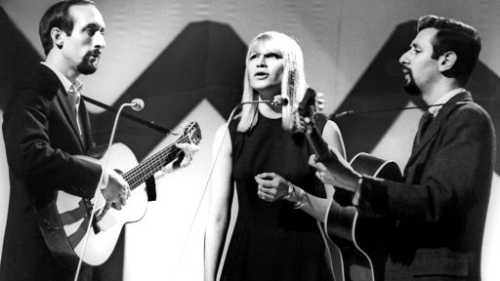
Ms. Travers brought a powerful voice and an unfeigned urgency to music that resonated with mainstream listeners. With her straight blond hair and willowy figure and two bearded guitar players by her side, she looked exactly like what she was, a Greenwich Villager directly from the clubs and the coffeehouses that nourished the folk-music revival.

“She was obviously the sex appeal of that group, and that group was the sex appeal of the movement,” said Elijah Wald, a folk-blues musician and a historian of popular music.

Ms. Travers’s voice blended seamlessly with those of her colleagues, Peter Yarrow and Paul Stookey, to create a rich three-part harmony that propelled the group to the top of the pop charts. Their first album, “Peter, Paul and Mary,” which featured the hit singles “Lemon Tree” and “If I Had a Hammer,” reached No. 1 shortly after its release in March 1962 and stayed there for seven weeks, eventually selling more than two million copies.

I have written previously of our family’s immersion into the Folk revival of the 1950’s and 60’s, commenting on the passing of the Kingston Trio’s Nick Reynolds and the Clancy Brothers Tommy Makem. (My brother Jim’s emotional tribute to KT’s John Stewart can be found here.).

And now, another link in the chain stretching back to my early childhood and my exposure to the Great American Songbook of traditional folk tunes has been broken with the death of Travers. We don’t realize at the time how childhood experiences shape our lives, our thinking, or our interests. My fascination with American history surely is at least partly the result of learning and listening to the traditional Scotch-Irish folk tunes, the sea shanties, the songs to which men marched off to war, performed backbreaking manual labor, dreamed of freedom, lived, loved, and died over the centuries.

They are songs mostly about ordinary people - a social history of the United States set to music - and it fired my imagination, spurring me to discover more about an America you don’t usually find in grammar school textbooks or High School reading assignments. What really happened in Harlan County, Tennessee Kentucky? How did the Underground Railroad work? Why are the Irish so fatalistic?

Mary Travers, Peter Yarrow, and Paul Stookey sang songs that posed questions about American society - and the human condition - that demanded answers. And around campfires, and library sing alongs, our family belted out the music, harmonizing and sharing our sheer joy of being together, learning, laughing, loving. This is why the death of these folk icons are almost like a death in the family to me. The memories the songs they wrote and sang are so powerful, so sweet, so full of the things that make life worth living for all of us, that I cannot help but allow a tear or two to course down my cheek.

As a musical group, Peter, Paul, and Mary were polished, professional, and chose their music with the utmost care. Their manager/producer, the legendary Milt Okun saw to that. With his keen ear and unfailing sense of a commercially viable package, Okun made Peter, Paul, and Mary into a hugely popular act whose success lasted almost a decade. Okun would go on to manage other iconic folk groups like The Chad Mitchell Trio, the Brothers Four, and John Denver.

It was their rendition of Dylan’s Blowin’ in the Wind that launched their careers. At once beautifully harmonized and featuring a driving rhythm, the song - along with their other huge hits If I had a Hammer and Where have all the Flowers Gone - became anthems of the civil rights and anti-war movements. It is perhaps telling that Hammer and Flowers were both written and originally sung by Pete Seeger and his 50’s era group The Weavers, who were banned in many jurisdictions for their left wing sympathies.

When you’re a kid, you don’t think much about the politics of a song. You sing it because it’s good music and stirs emotions in your breast. Today, I probably don’t agree with 90% of the politics promoted by Seeger, Travers, Baez, and the rest of the folkies from that time. But you can’t argue with the fact that they were dead right about civil rights, and I still think they were mostly right about the Viet Nam War.

I learned long ago you can love left wing writers, artists, singers, and actors by admiring the talent while ignoring the politics. Barbara Streisand is a putz about politics, but an extraordinary talented singer. Joan Didion writes achingly beautiful prose (as does John Updike), but I wouldn’t give a fig for their political opinions. That’s how I feel about Mary Travers and Peter Paul and Mary.

Perhaps our favorite PPM song was not about politics, or protest, but rather the magical imagination of a little boy named Jackie Paper who conjured up a friendly dragon with whiom he had wonderful, exciting adventures. No, Puff the Magic Dragon is not about smoking dope or tripping on LSD. It is a classic American folk song rooted in celebrating a child’s imagination and how, sadly, we all grow up and move on to other adventures.

Together they would travel
On a boat with billowed sail.
Jackie kept a lookout perched
On Puff’s gigantic tail.
Noble kings and princes
Would bow whenever they came,
Pirate ships would lower their flags
When Puff roared out his name. Oh!

(Chorus)
Puff, the magic dragon
Lived by the sea
And frolicked in the autumn mist
In a land called Honah Lee. Oh!
Puff, the magic dragon
Lived by the sea
And frolicked in the autumn mist
In a land called Honah Lee.

Today, somewhere near Honah Lee, Jackie Paper read of Mary Travers death and is weeping.

UPDATE: 9/18

A shout out to all the good people at Kingston Crossroads who come here because I paid my brother Jim an exorbitant fee to promote my blog with all you left wing folkies. After all, he’s just a poor teacher, poisoning the minds of our young people with his Marxist claptrap and needs every cent he can get just so that his subscription to The Daily Worker doesn’t expire.

Don’t worry. There’s not much chance of contamination as long as you don’t breathe the air or touch anything. And please watch where you step. I recently slaughtered a few liberals and I haven’t had time to clean up yet…

9/15/2009

THE RICK MORAN SHOW: IG-GATE UPDATE AND THE LATEST ON ACORN

Filed under: The Rick Moran Show — Rick Moran @ 4:22 pm

You won’t want to miss tonight’s Rick Moran Show, one of the most popular conservative talk shows on Blog Talk Radio.

Tonight, two of the best bloggers on the right will be joining me. Stacy McCain and Dan Riehl will discuss the latest on the Inspector General scandal and we’ll look at the shocking news about ACORN.

The show will air from 7:00 - 8:00 PM Central time. You can access the live stream here. A podcast will be available for streaming or download shortly after the end of the broadcast.

Click on the stream below and join in on what one wag called a “Wayne’s World for adults.”

The Chat Room will open around 15 minutes before the show opens,

Also, if you’d like to call in and put your two cents in, you can dial (718) 664-9764.

Listen to The Rick Moran Show on internet talk radio

NO WONDER BUSH WAS A FAILURE AS PRESIDENT

Filed under: Blogging, History, Media, Politics, The Rick Moran Show, conservative reform — Rick Moran @ 10:17 am

As far back as 1999, it was apparent to anyone who listened closely to what he was saying that George Bush was not much of a conservative. This despite the lip service he gave to some conservative ideas (I wouldn’t say he was a study in advocating conservative principles), and his ability to excite the party’s evangelical base.

True, he was “more conservative” than Al Gore in 2000 and John Kerry in 2004. But so was about 70% of the country. It took about 5 years for the scales to fall from the eyes of many conservatives (some have never lost their true belief) for them to see that George Bush was a crony loving, big government elitist whose tangential connection to conservatism was more for convenience and political calculation than any belief in the efficacy of its principles.

Were we taken in? Partly, yes. But an honest appraisal of my former support for the man must include the fact that I was fooling myself more than anything. The writing was on the wall all along regarding the man’s faux conservatism - not to mention his many screw ups including the wars in Iraq and Afghanistan, the prosecutors fiasco, justification for torture, and his curious habit of promoting and appointing incompetents for important jobs in government who also happened to be big campaign contributors or other cronies.

Now a book has been written by a former Bush speechwriter which has pretty much confirmed what most on the right now think of the ex-president. Matt Latimer reveals Bush to be an arrogant, self centered, elitist who looked down his nose at the conservative movement:

Latimer is a veteran of conservative politics. An admirer of Republican Sen. Jon Kyl, for whom he worked for several years, Latimer also worked in the Rumsfeld Pentagon before joining the Bush White House in 2007.

The revealing moment, described in “Speechless: Tales of a White House Survivor,” occurred in the Oval Office in early 2008.

Bush was preparing to give a speech to the annual meeting of the Conservative Political Action Conference, or CPAC. The conference is the event of the year for conservative activists; Republican politicians are required to appear and offer their praise of the conservative movement.

Latimer got the assignment to write Bush’s speech. Draft in hand, he and a few other writers met with the president in the Oval Office. Bush was decidedly unenthusiastic.

“What is this movement you keep talking about in the speech?” the president asked Latimer.

Latimer explained that he meant the conservative movement — the movement that gave rise to groups like CPAC.

Bush seemed perplexed. Latimer elaborated a bit more. Then Bush leaned forward, with a point to make.

“Let me tell you something,” the president said. “I whupped Gary Bauer’s ass in 2000. So take out all this movement stuff. There is no movement.”

Bush seemed to equate the conservative movement — the astonishing growth of conservative political strength that took place in the decades after Barry Goldwater’s disastrous defeat in 1964 — with the fortunes of Bauer, the evangelical Christian activist and former head of the Family Research Council whose 2000 presidential campaign went nowhere.

Now it was Latimer who looked perplexed. Bush tried to explain.

“Look, I know this probably sounds arrogant to say,” the president said, “but I redefined the Republican Party.”

Yes, Mr. Bush. You certainly “redefined” the Republican party by showing the GOP could be even more careless with the public purse than Democrats, as well as being a political cynic of the first order by pandering to the base of the party - the “movement” - while sneering at what it represented.

The charge of “patrician” made against his father back in the day should also be applied to the son. Here, the blue blood shows why you can’t trust elites. At bottom, their arrogance directed toward ordinary people is so profound as to cloud their judgment.

Given everything we now know about Bush, would I have pulled an Andrew Sullivan and voted for Kerry in 2004? Definitely not. But, as I did in 1992 when his father ran for re-election, the chances are pretty good that I would not have voted for president at all.

True, Bush’s fiscal profligacy was known back then, but weighed against the war on terror and what most of us believed was a slowly improving situation in Iraq, it would have been enough to dissuade me from voting against him.

Now we have a different story - that of Bush the hypocrite who had few, if any, guiding principles save “Whatever’s best for George Bush, is best for the party and the country.” That kind of selfish conceit may be endemic among presidents - it certainly was for Nixon, and probably Johnson - but it explains a lot as far as Bush’s cronyism as well as his cozying up to Wall Street, his sticking with Rumsfeld long after he had outlived his usefulness, and other stubborn acts that many conservatives still mistake for resolve. Quite simply, it didn’t matter if all the wise heads in government were telling him to change course in Iraq. He, George Bush, knew better. And the United States paid a bitter price in blood and treasure because of this hubris.

And, it explains Karl Rove to some extent. No doubt that Clintonites like James Carville had vast knowledge about the intricacies of American politics. But Rove is a human computer - a veritable font of information about the most arcane, and fractional tidbits of political trivia. There may never have been his like in the White House.

But Rove was decidedly not a creature of ideology. He possessed a burning desire to win as all good political consultants have. Beyond that, Rove eschewed the idea of using the movement for anything except what he termed a “permanent Republican majority” that combined massive numbers of evangelical Christians energized by relying on “wedge” issues like gay marriage and abortion to turn them out, as well as the foreign policy hawks. Fiscal conservatives could come along for the ride if they wished but it was clear that neither Rove nor Bush gave a tinker’s damn about them. Add supply siders and libertarians and Rove believed he had his “permanent” majority - a majority not based on conservative issues as much as on political expediency.

The results were predictable; a fracturing of the “permanent” coalition within two years of his 2004 victory. The corruption, the spending, and the war between libertarans and evangelicals over the Terri Schiavo matter exploded any hope that Rove’s makeshift, rickety political construction would outlast his boss.

So here we are in the wilderness with many conservatives still clinging to the notion that Bush made some mistakes but was still a good president. I have said in the past that fingering Bush as the “worst president in American history” is ridiculous. In the bottom ten, yes. But I abhor those who would use history for political purposes and the facts simply do not bear that judgment out.

Until conservatives can let go of Bush and his checkered legacy, we will not learn the lessons from supporting him and probably end up voting for someone similar. That is the mistake Democrats made when they were in the political badlands and we would do well not to repeat it.

(Note: Please do not crow in the comments “I told you so.” What - you expect me to listen to partisan lefties at the time? That’s unreasonable and you know it. Your verdict on Bush was reached looking through the prism of partisanship just as mine was. Just because the left was right about some of Bush’s shortcomings does not mean they had - or have today - a corner on truth when it comes to criticizing him. I would also add that their hate of the man - as virulent a hate directed against another politician I had not seen before, even against Clinton - disqualifies most on the left from making any rational judgment on Bush that a reasonable person could agree with.)

« Older PostsNewer Posts »

Powered by WordPress