Right Wing Nut House

11/18/2009

PALIN AND HER SUPPORTERS IN A TIME WARP

Filed under: Decision '08, Palin, Politics, conservative reform — Rick Moran @ 11:09 am

Reading this interview of Sarah Palin by Rush Limbaugh was alarming if you care about the direction of the conservative movement and the Republican party.

It’s alarming because Sarah Palin is not living in this century. Example:

RUSH: You mean that you don’t even hear it (tax cuts) being discussed on the Republican side or within the administration?

GOV. PALIN: Within the administration, and as it is discussed on the Republican side, Republicans need to be bolder about it. Independents need to be bolder about that solution that has got to be considered and plugged in. This is the only solution that will be successful. We need to rehash some history that proves its success. Let’s go back to what Reagan did in the early eighties and stay committed to those commonsense free market principles that worked. He faced a tougher recession than what we’re facing today. He cut those taxes, ramped up industry, and we pulled out of that recession. We need to revisit that.

This recession is far different than the one faced by Reagan in 1980 when he took office. First, this recession is much deeper. The labor market has totally crashed. Whereas in 1980, most workers were laid off or furloughed, with the promise they would be called back eventually, not so this time.

This piece on the Reuters blog points out that there are several reasons why unemployment may top 12% before it begins to come down and why recovery will be incredibly slow - no matter how many tax cuts you can come up with:

1. For the first time in at least six decades, private sector employment is negative on a 10-year basis (first turned negative in August). Hence, the changes are not merely cyclical or short-term in nature. Many of the jobs created between the 2001 and 2008 recessions were related either directly or indirectly to the parabolic extension of credit.

2. During this two-year recession, employment has declined a record 8 million. Even in percent terms, this is a record in the post-WWII experience.

3. Looking at the split, there were 11 million full-time jobs lost (usually we see three million in a garden-variety recession), of which three million were shifted into part-time work.

4.There are now a record 9.3 million Americans working part-time because they have no choice. In past recessions, that number rarely got much above six million.

[...]

6. The number of permanent job losses this cycle (unemployed but not for temporary purposes) increased by a record 6.2 million. In fact, well over half of the total unemployment pool of 15.7 million was generated just in this past recession alone. A record 5.6 million people have been unemployed for at least six months (this number rarely gets above two million in a normal downturn) which is nearly a 36% share of the jobless ranks (again, this rarely gets above 20%). Both the median (18.7 weeks) and average (26.9 weeks) duration of unemployment have risen to all-time highs.

7. The longer it takes for these folks to find employment (and now they can go on the government benefit list for up to two years) the more difficult it is going to be to retrain them in the future when labour demand does begin to pick up.

Sorry, Sarah. Tax cuts alone ain’t gonna fix this. Millions of jobs have been permanently lost - millions. You are living in a dream world - or time warp - if you believe that a little Reagan-like tax cutting will lift all boats.

(The fact that it was Reagan/Volker monetary policy that most economists credit with taming inflation which allowed the tax cuts to work their magic seems lost on Palin.)

And I am all for “common sense” whether it be applied to free market principles or anything else. But as far as “ramping up industry?” Would someone please inform our uninformed former Alaskan governor that the manufacturing sector has shrunk by 2/3 since 1980 and “ramping up” a disappearing sector of the economy is something akin to ramping up the horse and carriage industry?

Yes, it is a time warp - tired, old solutions to problems that sound as grating and tinny on the ear as a wax disc being played on an old gramophone. Almost since this blog’s inception, I have been agitating for the GOP to drop this 1980’s mantra of “cut taxes, cut spending, shrink government, strong defense.” There is nothing much wrong with any of those ideas except they need to be refashioned to reflect 21st century realities.

How much can you cut taxes when the deficit is at $1.7 trillion and climbing? When the national debt is soaring over $12 trillion? Without corresponding cuts in the budget, it would be the height of irresponsibility to add to the problem. And if memory serves, when the GOP was in the majority the last time, they weren’t enamored of cutting anything from the budget.

Shrink government? Fine idea, I’m all for it. Where to begin? Whose services do you cut first? The old? The poor? The Middle Class? Entitlement reform is a good place to start but since bi-partisanship is out of the question (so I am told), how do you accomplish that politically suicidal manuever?

We’re already spending half a trillion on defense while engaged in two wars. Perhaps we could amend the “strong defense” goal with a “smart defense” battle cry. I don’t think we’ll be fighting the Russians on the plains of mittel europa for the foreseeable future. But much of our defense spending is geared in that direction. A reordering of priorities is desperately needed if we are to fight the wars of the 21st century.

The long and short of it is Palin and most of her supporters believe you can slap the template used to achieve victory 30 years ago and win going away in 2010-12. What’s eerie is that the 1980-era Democrats offered New Deal solutions to the recession, making the exact same mistake today’s conservatives are proposing. Trying decades-old remedies for what ails us is myopic. The world has moved on, conditions have changed, the economy is as different as can possibly be imagined today compared to 1980 and yet Palin wants to graft those ideas onto the today’s economic problems.

And if you want more evidence that Sarah Palin is out of touch with the modern world, here she is again:

GOV. PALIN: I think just naturally independents are going to gravitate towards that Republican agenda and Republican platform because the planks in our platform are the strongest to build a healthy America. We’re all about cutting taxes and shrinking government and respecting the inherent rights of the individual and strengthening families and respecting life and equality. You have to shake your head and say, “Who wouldn’t embrace that? Who wouldn’t want to come on over?” They don’t have to necessarily be registered within the Republican Party in order to hook up with us and join us with that agenda standing on those planks. In Alaska, about 70% of Alaskans are independent. So that’s my base. That’s where I am from and that’s been my training ground, is just implementing commonsense conservative solutions. Independents appreciate that. You’re going to see more and more of that attraction to the GOP by these independents as the days go on.

“Who wouldn’t embrace that?” Oh, say about 65 million voters.

And there are plenty of commenters who point out that Palin has abandoned her “independent” personae and is now fully engaged as the tribal chieftain of right.

Larison:

Everything she has done since arriving on the national stage has involved steadily distancing herself from her short record as governor. Reihan has already given up on her as a viable political leader, and I’m not surprised. Reihan is a smart writer interested in policy ideas and their application in reforming government, and there would not be much call for that in Palin’s GOP. Continetti has embarked on a project of rehabilitating the national political fortunes of someone who dropped out of elective office in her own state mostly because she could not put up with the tactics of her opposition and the scrutiny of the media. Why should we take such a project seriously? If arguments in support of Palin’s political future don’t deserve to be dismissed pretty quickly, no argument ever should be.

I would have thought that anyone interested in promoting reasoned, thoughtful discussion would shudder at the thought of a Republican Party led and defined by Sarah Palin, whose national political career has been one episode of inflammatory, uninformed agitation after another. That is the kind of party and the kind of conservatism Continetti is working to create. Fortunately, his preferred candidate is so politically radioactive to most of the country that it will never take hold.

“[I]nflammatory, uninformed agitation,” you say? How’s this?

Palin blamed a culture of political correctness and other decisions that “prevented — I’m going to say it — profiling” of someone with Hasan’s extremist ideology. “I say, profile away,” Palin said. Such political correctness, she continued, “could be our downfall.”

OK - so is that “reasoned thoughtful discussion,” or “inflammatory, uninformed agitation…?”

The point isn’t that it is better to risk the caterwauling from CAIR about placing an emphasis on searching Muslim men at the airport. The point is the incredibly cavalier manner in which she offered her opinion. How can anyone take someone like that seriously as a potential president?

Reading the Limbaugh interview proves that she is better at articulating talking points and that the talking points themselves are a little better. But one is still left with the impression that she is a depthless wonder with an understanding of the issues that’s a mile wide and an inch deep. This is fine for your run of the mill congressman or even if you want to aspire to the senate. Joe Biden got by on such shallowness for a couple of decades and look where it got him.

I fully realize my opinion of Sarah Palin is not that of a majority of true conservatives. But then, it appears that the majority would rather go down in flames with Palin than take down Obama in 2012:

A new national poll suggests that the Democrats may be the party of pragmatism and Republicans may be the party of ideological purity.

The CNN/Opinion Research Corporation survey’s release on Tuesday comes just two weeks after internal party divisions led to the GOP loss of a seat in the House of Representatives that it had held since the 19th century.

The poll indicates that a slight majority, 51 percent, of Republicans would prefer to see the GOP in their area nominate candidates who agree with them on all the major the issues even if they have a poor chance of beating the Democratic candidate. Forty-three percent of Republicans say they would rather have candidates with whom they don’t agree on all the important issues but who can beat the Democrats.

I would vote for Marco Rubio even though I disagree with him on a few issues. But would a majority of Republicans vote for Charlie Crist if he were to beat Rubio in a primary? I also disagree with Crist - probably more than I disagree with Rubio - but would vote for either man because our agreement on issues far outweighs any disagreements.

And this is “unprincipled?” Some conservatives are acting like spoiled brats who, if they don’t get absolutely everything they want out of a candidate, are going to take their vote, go home, and sit on it. This is not responsible citizenship. There is nothing “principled” about it either. It is childish to act in this manner.

This is not to say there shouldn’t be primary challenges from conservatives to some GOP incumbents. There are a few who deserve it. But if conservatives take the position that anyone who doesn’t agree with them on 100% of “their” issues should be tossed aside, there will indeed be a bloodbath that will weaken the party at a time when opportunity is beckoning.

I might also add that with that kind of attitude, even if the Republicans experience massive gains in 2010, the chance to take the White House and hold on to those gains in 2012 will be a big question mark. Even if the economy is still horrible in 2012, this desire to eat our own will fatally weaken the party and it is likely that a lot of winners from 2010 will go down to defeat in 2012.

In total, I would have to say that the Sarah Palin phenomenon is poison for conservatism and deadly to the Republican party. But blinded by an inexplicable attraction to this polarizing, ill-informed, political Svengali, it is quite possible that the movement and the party will go down to defeat to the sound of thunderous applause.

11/17/2009

THE RICK MORAN SHOW: SARAH PALIN: TEA PARTY PRINCESS OR SERIOUS POL?

Filed under: The Rick Moran Show — Rick Moran @ 5:44 pm

You won’t want to miss tonight’s Rick Moran Show, one of the most popular conservative talk shows on Blog Talk Radio.

Tonight, Andrew Ian Dodge, Melissa Clouthier, and Sister Toldjah join me for a discussion on the relevancy of Sarah Palin in national politics.

The show will air from 7:00 - 8:00 PM Central time. You can access the live stream here. A podcast will be available for streaming or download shortly after the end of the broadcast.

Click on the stream below and join in on what one wag called a “Wayne’s World for adults.”

The Chat Room will open around 15 minutes before the show opens,

Also, if you’d like to call in and put your two cents in, you can dial (718) 664-9764.

Listen to The Rick Moran Show on internet talk radio

THE GOOD LIBERAL

Filed under: Politics, conservative reform — Rick Moran @ 10:37 am

I have been criticized on this site, sometimes for good reason, for being too general in trashing the left. This was especially true earlier in the history of this blog when I was enamored of the possibility that total victory by the right was ultimately necessary and possible. I have grown up a bit since then, intellectually speaking, tightened my reasoning and dropped the idea that any of us have a corner on truth. In a real sense, this was liberating as well as satisfying; it describes the world more accurately while allowing the objective examination of all ideas regardless of their source, thus contributing to understanding and knowledge.

But I still admit to a certain intellectual laziness in this regard. It’s always easier to generalize and readers would recognize my rather caustic comebacks to commenters who lump me together with the likes of Glenn Beck and Rush Limbaugh.

In truth, there are a liberals out there who I read who resist their own impulses to generalize about conservatives, and who offer cogent, logical arguments advancing their positions on issues and countering the arguments from the right in a thoughtful, civil manner. Just a few I can name off the top of my head would be Matthew Yglesias, Ezra Klein, Josh Marshall, David Weigel, Jonathan Cohn, Marty Perez and a gaggle of lefties at The New Republic. Most of these gentlemen and ladies I have disagreed with - violently at times - over policy. But they are far above the average lefty blogger whose gross exaggerations and oversimplifications of conservatism really rankle me.

I was pleased today to discover another liberal who I will be able to read without my head exploding. In this reprint of an article in The American Conservative from last December, conservative author Patrick Allitt introduces us to George Scialabba, a liberal “public intellectual” who reflects what is termed a “neo-liberal” point of view on economic matters, while delivering a hearty critique of industrial capitalism.

Scialabba’s views, as they are described by Allitt (I am off to Amazon later to buy his book), sound more Von Mises or Hayek than John Maynard Keynes. Allitt describes him thusly:

Scialabba is a rare bird among serious nonfiction writers in that he’s not a professor or a foundation fellow. In some ways reminiscent of the longshoreman-philosopher Eric Hoffer, he comes to the work of Plato, David Hume, Matthew Arnold, and Karl Marx not on the basis of a life spent in university seminars but from his own experiences as a social worker and office clerk. He can always produce an appropriate insight from John Stuart Mill or a scintillating quip from George Bernard Shaw. He keeps alive the ideals of the Enlightenment, dares to think utopian thoughts, and still feels the romantic pull of the Left, but hardly ever succumbs to wishful thinking. This collection of his essays and reviews from the 1980s, 1990s, and 2000s makes surprising reading, not least because Scialabba, from a principled position on the Left, makes so many assertions with which conservatives will readily agree.

Those of us on the right who identify with Burke rather than Locke will see a conflict in Scialabba. There has always been more “romance” with liberal ideas and personalities because in many ways, these concepts speak to the longing for if not a perfect world, then certainly a more livable one. There have been very few conservative Utopians - at least not in the traditional sense of the word, because the right realizes such schemes always come with a price; someone’s idea of “Utopia” might not match everyone else’s. The germ of coercion is plainly evident in any practical realization of a “Utopian” society.

Surprisingly, while Scialabba recognizes this by reluctantly accepting the fact that that the world is far too complex for any realistic hope for creating a perfect society, he nevertheless still pushes the idea because something so good is worth striving for anyway:

But must increasing complexity and the sinister reach of propaganda end the dream of a better world? In a meditation on utopianism, Scialabba says no. He understands the intellectual progress of recent centuries as a joint venture undertaken by skeptics and visionaries, who challenged ancient falsehoods and dreamed of a finer world: “The skeptics can be seen as clearing a space for the utopian imagination, for prophecies of a demystified community, of solidarity without illusions. The skeptics weed, the visionaries water.” He is not ashamed to outline his own utopia, a world in which everyone will sing in harmony at least once a week, in which folks will know plenty of great poems and speeches by heart, have useful and stimulating work, enjoy civil arguments with one another, won’t depend on consumerism for a feeling of self-worth, and will be able to hike in unspoiled wilderness. I would be glad to join him there.

Heh - sounds pretty good to me too.

Scialabba also has some thoughts about most modern liberal intellectuals, taking them to task for being too “academic” and not getting into the trenches with other activists to effect change:

Scialabba regrets that most leftist intellectuals have given up on utopia and retreated completely into academic life. They deceive themselves, he argues, when they claim that their esoteric work in critical theory has political significance. Their ventures in multiculturalism, he adds, are often mere academic empire building, which do little or nothing to aid the actual disadvantaged members of society. Worse, by asserting that their academic work is “political,” they feel absolved from doing the hard and joyless work of organizing and agitating that their predecessors generally undertook.

Equally, he regards the Left’s politicization of high culture as “misguided and counterproductive,” and he deplores the “staggering amount of mediocre and tendentious” art that has been produced on behalf of political correctness. In an essay about The New Criterion, he notes that its editors, Hilton Kramer and Roger Kimball, find it difficult to specify the exact aesthetic and moral criteria by which all art should be judged. Never mind, he says, it is enough that they “muddle along, employing and occasionally articulating the criteria that have emerged from our culture’s conversation since the Greeks initiated it, and showing that what used to and still usually does underwrite our judgments about beauty and truth is inconsistent with giving Robert Mapplethorpe a one-man show … or Toni Morrison a Nobel Prize.”

This is a liberal who actually values substance over form, and recognizes that modern liberalism (as much of modern conservatism) has degenerated into a riot of personal conceits where a strict ideological construct prevents freedom of thought: Where forms like “political correctness” and multi-culturalism” stifle independent thinking in attempting to shoehorn art, politics, and cultural conformity into an “accepted” narrow, definitional framework.

No, it is not as “conservative” as it might sound. What Scialabba appears to be after, above all, is an intellectually honest, liberal critique of modernity that, while recognizing the market as a far better mechanism for spreading and creating wealth than any other system, nevertheless takes as dim a view of the right as he does with some of his friends on the left:

Scialabba opposes the standardization and facelessness that often accompany modernity. In an essay on Michael Walzer, he speaks up against abstractions and in favor of particular, usually national, loyalties. “The minimal code of near-universally recognized rights that underwrites international law is too thin to support a dense moral culture. Only a shared history—which usually means a national history—of moral discourse, political conflict, and literary achievement can generate values of sufficient thickness and depth.” Again, conservative readers would nod in agreement.

Moreover, Scialabba resists the temptation to think that the end sometimes justifies the means. He praises Lionel Trilling for his chastened sense of progressivism, his insistence that moral scrupulosity always matters, no matter how desirable the political objective. Trilling’s view, he argues, was “yes to greater equality, inclusiveness, cooperation, tolerance, social experimentation, individual freedom … but only after listening to everything that can be said against one’s cherished projects, assuming equal intelligence and good faith on the part of one’s opponents, and tempering one’s zeal with the recognition that every new policy has unintended consequences, sometimes very bad ones.” Insights like these, scattered throughout this collection, offer a welcome reminder that the distance between at least some parts of the Left and Right is far smaller than our more irritable pundits would like us to believe.

Most conservatives today would take exception to the idea that our differences with the left - on some issues at least - are indeed “far smaller than our more irritable pundits would like us to believe.” But why shouldn’t that be so? After all, we share pretty much the same Enlightenment values (with admittedly a different emphasis on which ones are important), and there are areas of agreement to one degree or another on the value of liberty and human dignity.

Where we part company are on the means to achieve common goals. I am not sure what kind of bridges can be built with most of today’s liberals. But perhaps seeking out areas of commonality is a good place to start.

11/16/2009

IS THERE ANY WAY SARAH PALIN CAN RECOVER?

Filed under: Blogging, Decision '08, Decision 2012, Ethics, Media, Palin, Politics — Rick Moran @ 10:35 am

I risk life and limb writing about the former Alaska governor. Like the supporters of failed presidential candidate and official GOP weirdo Ron Paul, any negative comments I would make about the real conservative’s favorite MILF is going to bring an army of supporters to her defense while trashing me in the most unseemly terms imaginable.

Fortunately, I am well hidden in this corner of the blogosphere, and few real conservatives would be caught dead reading anything I write. However, Google search is ubiquitous in its reach and chances are, there are a couple of dozen Palinbots who will receive an email in their inbox informing them of my post. At that point, their email lists will fairly crackle with activity as my offense against the Goddess will be spread far and wide, bringing wrack and ruin down upon me.

Thus, I wade into the morass that Palin has made of her career with a little trepidation, but with a clear eye and my usual muddled head. The latter might usually be seen as a deficiency but when writing about Palin, it may actually prove a boon since what other frame of mind can you employ to write about a woman so challenged by fact and in love with fancy?

Let’s get the facts out of the way first; there has never been a vice presidential candidate that was treated so unfairly by the media in the modern age. The number of rumors, falsehoods, and lies that were published as fact about her is truly astonishing and has no parallel in modern politics. (Such blackening the name of candidates with prevarications was routine in the 19th century but died out when newspapers became more independent of parties.)

I am surprised that I have not read that Sarah Palin bites the heads off chickens and drinks their blood. Charles Martin took the trouble of listing the media lies about Palin, stopping at 84 linked entries - that’s links to the lies as well as links that clearly debunk the lies.

This does not include the vicious attacks made in various magazines from Vanity Fair to Redbook that repeat some of the lies while making up a few more of their own. I challenge any fair minded liberal to refute these facts.

I normally hate to see any conservative treated so abysmally by those who claim to be, if not unbiased, then fair; if not balanced, then reasonable. Palin’s treatment has been neither fair nor reasonable. Many explanations have been given for this including the unprovable assumption that liberals hate strong conservative women. I think many liberals hate all conservatives whether they are men, women, transgendered, or eunuchs. Their mode of attack changes a little from sex to sex so perhaps it appears they single out women of the right for special treatment, but it’s really all part of the same mindset; conservatives are poopy heads and nothing is out of bounds in criticizing them.

The question before us is can the narrative regarding Palin be altered to make her a viable candidate for 2012? With 60% of the American people currently dead set against voting for her for president under any circumstances, it would seem to be a very tall mountain for her to climb in order for her to achieve the respect of the voters; something she never had to begin with among a majority and seems to have damaged herself further by abandoning her office. Her tabloid like-presence in American culture has also dragged her down, as has the fact that very few of the elites in the Republican party take her seriously as a party leader.

And well they shouldn’t. They may fear her influence with the 20% or so of the party who would support her aspirations in 2012, but beyond that, they and most of the rest of us find it difficult to take one so shallow and uninformed seriously. As far as I can tell, she has done little in the intervening year since the election to rectify her appalling ignorance of the world, and even domestic issues like health care. The author of the “death panels” remark may have succeeded in scaring old people to death but if I were her, I would hardly stand on that as an accomplishment.

Her fan base - and indeed many on the right - applauded her fear mongering because they believe it slowed down the legislative process and got conservatives back in the game. I believe they are overstating her influence as there were other factors, including senior citizens both Democrat and Republican who were already up in arms over the proposed Medicare cuts who showed up in droves at town hall meetings and voiced their concerns. In effect, Palin may have simply tossed some nitro on an already volatile situation.

And this is the kind of leader these jamokes want?

What Daniel Larison and others refer to as her “psuedo-populism” appears to highlight her very “ordinariness” and “just folks” personae. The trouble with this as I see it is that there is an undercurrent of anti-intellectualism that undergirds her anti-establishmentarian shtick. She has made her shallow, depthless understanding of the world into a badge of honor, and indeed, her supporters push the idea that this is a positive good, that having a president as unversed in nuance as they are of policy and programs would be kind of neat. Sure would be a switch from all those brainy establishment elitists who don’t want to roll back the New Deal and Great Society, making this country into a true conservative paradise.

This is not to say that Palin is stupid. She’s intellectually lazy. I wouldn’t necessarily call her incurious in a George Bush sort of way but neither would I refer to her as possessing the innate intelligence of a Ronald Reagan who actually did change the narrative about himself. Reagan had an active, curious mind and the good sense to reach out to experts who educated him, as well as filling in knowledge gaps by reading voraciously. Palin does not seem to have that spark, that drive, that hunger for knowledge that anyone as ill informed as she admits herself to be should possess. Therefore, I hold no hope that she can transform herself into a reasonably well informed politician.

You can see where this piece has been going. No, I don’t think Palin can alter the narrative about herself in time for 2012, and I think it improbable that she will ever be able to rise above the level in American politics as a curiosity, a side show -grist for the conservative base who, if they get their wish and nominate her in 2012, will find that the political baggage she carries along with her determined ignorance will lead to a Reaganesque landslide for Obama.

In order for her to flip her position with the electorate, she has to want to change the reasons they hold such a low opinion of her - alter their perceptions by addressing their concerns about her. Unless and until I see that happening, the chances are good that she won’t even be able to win the GOP nomination much less the general election.

11/15/2009

WHAT’S IN A BOW?

Filed under: Politics — Rick Moran @ 11:09 am

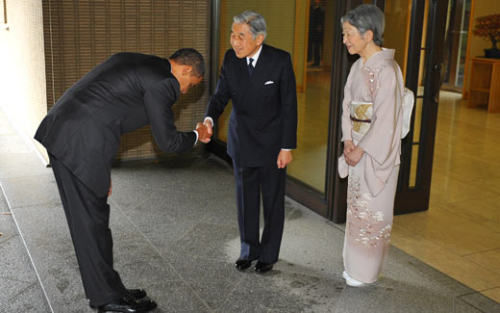
OK, so the president of the United States made a bow to the Emperor of Japan. Yes, he also bowed to the Saudi King, even though press secretary Gibb’s nose grew about 6 inches when he offered that the president was really trying to pick something up off the floor.

I can understand the motivation for lying - hysterical kooks saying that the bow proves the president is really a Moooooslim - but really, couldn’t he have come up with something a little more imaginative? Maybe the president was trying to stretch his back - he hurt it playing basketball, you see. Or perhaps the president had a cramp and was doubled over in pain. Either one of those explanations would have been better than the invisible whatever that was on the floor that the president felt compelled to reach down and pick up just as he was greeting the Saudi King Abdullah.

Whether to the Sheikh of Araby or Hirohito’s son, I am told it doesn’t matter by my liberal friends, that this is a distraction, that it’s typical right wing hand wringing, that nobody cares, that you’re supposed to bow to the emperor, that everybody does it so what’s the big deal besides Obama never does anything wrong and is perfect….

OK - Well, I just sort of extrapolated from their argument that last bit.

One wonders if there will ever be any monumental goof this president makes that would rise above the level of “distraction” and actually be a cause for complaint. And by “monumental” I mean a serious breach of protocol. Tom Lifson at American Thinker spent many years in Japan and offers this:

I agree with Scott Johnson, Steve Gilbert, Andrew Malcom, and many others that the President of the United States should not be bowing before any head of state. But unlike these astute observers, I actually know a little something about the art of the bow in Japan, having lived in Japan four different times on a resident visa, taught East Asian Studies at Harvard, and counseled many hundreds of American, European, Middle Eastern, and Australian executives on how to work and negotiate with the Japanese — including teaching them the right way to bow.

Obama’s bow (below) violates a fundamental precept: NO TOUCHING while bowing.

1-6

Here is one of many websites that illustrates how to bow in Japan. The one thing that virtually everyone who teaches bowing etiquette stresses is under no circumstance try to combine a bow with a handshake.

The Emperor appears to smile, which is something polite Japanese are taught to do when embarrassed. Unlike just about everyone who comes into the Emperor’s presence, Obama obviously received no instruction on Imperial etiquette. (Note: The Japanese take their monarch and etiquette in general about 100 times more seriously than do the British.)

That’s fine with me. I wouldn’t like our president to receive such instructions from a foreign entity. But he obviously did not indicate to any of the American embassy staff, nor to any aides familiar with Japan that he intended to bow, and bow deeply. Anyone with about two days’ familiarity with Japan knows about bowing. The average person in Japan bows dozens of times a day. You see it everywhere.

Lifson goes on to say that the emperor’s reaction was in keeping with someone who has been embarrassed and chooses to smile broadly instead. Looking at pics of other world leaders greeting the emperor, seems to bear that out.

So is it a big deal that Obama bows to the son of Hirohito, a man who could have easily stopped the attack on Pearl Harbor but didn’t? The son of a man who acquiesced in atrocities as his army literally raped its way across Asia? The son of a man whose real war crimes would have had him hanging from a gibbet without the intercession of McArthur who needed him as a figurehead to control the post-war Japanese population?

Is it a big deal that we fought a revolution so that no American forevermore would ever have to bow to another sovereign? This isn’t just some quaint little tradition that conservatives shouldn’t get their panties in a twist over. This means something - to history, to the nature and character of Americans, to how we define ourselves as a people. No bowing - ever. That has been the standard American presidents have followed for 240 years. Why is it all of a sudden a “distraction” to point this out? Can we at least criticize the president for his doltish understanding of protocol? His towering ignorance? His arrogance in making us look like a bunch of international rubes who don’t know the first thing about greeting an ally?

Apparently, the definition of America to Obama and his snickering, simpering, ultra-cynical supporters includes not only fashioning a foreign policy that gives the appearance of groveling, but performing the actual act as well.

I wonder if he’ll kow tow to the Chinese when he visits later this week? That would be another “distraction,” I suppose. He might as well considering that the thugs in Beijing hold about $3 trillion of our debt. Maybe if he kneels and touches his head to the floor they won’t ask him how he intends to pay it back.

CORRECTION

Steve Pendlebury at AOL’s The Sphere points out that I am in error for making the sweeping statement that no president ever bowed to a monarch in our history.

“His bow is neither (1) unprecedented nor (2) a sign of cultural understanding,” an academic who knows Japanese culture well explained in a message to ABC’s Jake Tapper. In 1971, President Nixon bowed to
Emperor Hirohito and his wife and repeatedly referred to them as “Your Imperial Majesties.”

Nixon got the bow right, though — a slight bend from the waist with hands at his side. “Obama’s handshake/forward lurch was … jarring and inappropriate,” according to Tapper’s friend.

Referring to a monarch by their title is fine - I have no problems with that. That, indeed, is protocol and part of the diplomatic rituals to which all presidents must adhere.

And it would satisfy my curiosity if there was anything said about that bow of Nixon’s at the time. A brief search of the New York Times archives failed to turn up anything, although the good professor didn’t mention the year of Nixon’s visit. Given the contempt the national press felt for Nixon, I wonder if any of them took the opportunity to take him to task for it.

I apologize for my error in making Obama the only president who dissed our revolution. But while we’re discussing it, why did the White House lie again about the bow, calling it “protocol?”

If that were the case, several dozen other world leaders who met the emperor and didn’t bow were breaking protocol. Obviously, the White House is once again full of it. The question is; what are they ashamed of?

When Obama bowed to the Saudi King Abdullah, why not come out and say that the president was showing respect to the Guardian of Mecca? Or when he bowed to the emperor, why not just say he was humoring an old man or something? The president has made a point to deny American exceptionalism. That is his choice. If he wants to bow to every prince and potentate on the planet, he can do so. Maybe it is a kind of “distraction.”

Except they’re lying about it. That is not a distraction, that is a question of presidential credibility. We supposedly just went through a period of 8 years where a president had no credibility because he lied all the time. Obama’s lies are becoming painful and obvious. This may be one small lie but it fits into a larger pattern that should concern even liberals. If you want honest government, you don’t excuse lies, you don’t defend lies, you call them out and shame the liars.

I still think it was wrong for the president - any president - to bow before royalty.

11/14/2009

SOME SHORT NOTES ON KSM AND AMERICAN JUSTICE

Filed under: Government, Homeland Security, Media, Politics, War on Terror — Rick Moran @ 12:43 pm

The news that Khalid Sheikh Mohammed will be tried in New York City kind of shocked me yesterday. It has cheered some, worried others, and made some on the right white hot with anger.

Those who see this as a “triumph of the American Justice system” are blowing smoke out of their ass - including Obama. Let’s face it - he is gambling with the lives of God knows how many New Yorkers that we can stop any terrorist attacks occurring during the trial. Some on the right are accusing Obama of not thinking about this possibility, but that is certainly not true. The government is going in to this situation with their eyes wide open and the fact that we are bringing KSM to New York when he easily could have been tried in exactly the same manner at Guantanamo (or out in the middle of the Mojave desert for that matter) shows us that they wish to make some kind of grandiose statement about American justice.

This then is the calculated risk being taken by the president; that it is worth the threat to innocent Americans to prove our justice system is capable of handling even the most dedicated and evil enemy combatant. I don’t deny that this is a worthy goal. But weighed in the balance against what it might cost us, I believe, quite simply, it is a monumental mistake.

Not only are innocents at risk, but how sure is the administration that this trial won’t degenerate into the kind of idiocy we witnessed during the Simpson trial? Would that prove the efficacy of our justice system? Or would it be remembered as a shameful moment in the history of American jurisprudence?

Can any judge anywhere prevent this trial from becoming a media circus? Not unless they want to lock up half the journalists in America or censor their work. Is it even remotely possible that this trial will not be televised? Fat chance. Can both the defense attorneys and prosecutors resist the temptation to grandstand, to play to the TV audience rather than the jury? How about the judge?

The belief that this trial will show-off the “American justice system” in all its solemnity and seriousness is a laugher. And again, the government is not stupid. They know this will happen. This will be the OJ trial on steroids - the highest rated legal series on TV since Law and Order was in its heyday. And yet, despite the real possibility that terrorists - even the lone wolf Nidal Hasan variety - will try and grab the limelight by slaughtering a bunch of innocent New Yorkers, the government is insisting on idiotic posturing rather than protecting the people.

At bottom, this is a political decision, not a legal one. The Wall Street Journal:

Please spare us talk of the “rule of law.” If that was the primary consideration, the U.S. already has a judicial process in place. The current special military tribunals were created by the 2006 Military Commissions Act, which was adopted with bipartisan Congressional support after the Supreme Court’s Hamdan decision obliged the executive and legislative branches to approve a detailed plan to prosecute the illegal “enemy combatants” captured since 9/11.

Contrary to liberal myth, military tribunals aren’t a break with 200-plus years of American jurisprudence. Eight Nazis who snuck into the U.S. in June 1942 were tried by a similar court and most were hanged within two months. Before the Obama Administration stopped all proceedings earlier this year pending yesterday’s decision, the tribunals at Gitmo had earned a reputation for fairness and independence.

As it happens, Mr. Holder acknowledged their worth himself by announcing that the Guantanamo detainee who allegedly planned the 2000 bombing of the U.S.S. Cole off Yemen and four others would face military commission trials. (The Pentagon must now find a locale other than the multimillion-dollar, state-of-the-art facility at Gitmo for its tribunal.)

Taking the side of the administration, the New York Times praises this “return” to the rule of law (the military courts, as the WSJ notes, were operating under rules passed by a bi-partisan Congress which means that the Times agrees with the tea partyers that Congress can act unlawfully.)

Putting the five defendants on public trial a few blocks from the site of the former World Trade Center is entirely fitting. Experience shows that federal courts are capable of handling high-profile terrorism trials without comprising legitimate secrets, national security or the rule of law. Mr. Bush’s tribunals failed to hold a single trial.

The fact that defense lawyers are likely to press to have evidence of abuse aired in court — Khalid Shaikh Mohammed was tortured by waterboarding 183 times — is unlikely to derail the prosecutions, especially given Mr. Holder’s claim to have evidence that has not been released yet.

I don’t think there is a debate that our courts are completely unable to handle terrorist cases, or other sensitive trials where national security is a concern. I would note that the Times, while taking John Cornyn to task for the senator’s characterization of the government’s action of trying KSM and his friends as “common criminals,” makes the same mistake with KSM; they assume he is a “common terrorist” and that previous court cases prove that justice can be served.

KSM is a “common” nothing and the Times is being disingenuous throughout that entire editorial. If ever there was a special case where exceptions to the rule are in order, it is this one.

I am not concerned that KSM may be acquitted. I’m sure the charges will be sufficiently broad to allow him to be convicted of something. I am also sure that he will never see the outside of a cell in his lifetime.

The question is one of intelligently balancing the need for security and the need for justice - something that the left accused Bush of failing to do by pointing out that he bent over backward toward the goal of security while justice suffered.

Isn’t President Obama doing exactly the same thing? Aren’t we now putting the concept of justice far ahead of security? If justice was the goal, a New York venue for the trial would not have been necessary. There is no rational argument that makes it so without also making the point that security should be a secondary consideration.

This is what the administration has done.They have consciously made a choice to put the lives of American citizens at risk for what is, in effect, propaganda - to show the world (and satisfy his domestic liberal base) that American justice is a superior system, or, in the words of the Times, KSM will be “…tried in a fashion that will not further erode American justice or shame Americans.”

I’ll believe that when I see it. This trial has all the potential to “further erode American justice and shame Americans.” Legal circuses usually have that effect.

11/13/2009

WHY AMERICA NEEDS A SHRINK

Filed under: Blogging, Decision '08, Government, Politics — Rick Moran @ 11:05 am

If America were an individual, she would long since have experienced an intervention where a trip to a competent psychiatrist would have been highly recommended.

Maybe our good friends France, Germany, and Great Britain could step in and gently make us confront our schizophrenia, pointing us toward the psychological help we need. I hear Russia is reasonable as far as hourly rates but Iran’s shock therapy might be just what the doctor ordered.

On one level, the debate in America over national health care is a political tussle. The mud wrestling, eye gouging, and hair pulling that is going on between the two sides can be seen in the context of many of our more contentious debates over issues like race, war and peace, or gay marriage.

But on another level - and I am not trying to be melodramatic - this is a fight over the soul of America. Perhaps all big political battles have this element lurking underneath the debate, but national health insurance, far more than any previous political scrum, holds the potential to change America in ways that even the most die hard proponents of the bill can’t imagine.

I have written often that change is what America is all about; that we stand still for nothing or nobody and that we either adapt to change and prosper or refuse to accept it and wither away. This process has always been affected by conservatism and it’s notion that there has to be some elements in our society that are worthy of handing down to the next generation, that change must be orderly, channeled, and that it fits in the framework laid out at our founding. In this way, the vast majority of Americans come to accept the change peacefully.

Why then the resistance to national health care? It isn’t just “tea baggers,” I would say to my liberal friends. There is genuine distress over this issue among at least 1/2 the population - probably more. Dismissing these concerns in a political context where opponents of reform are caricatured as (take your pick) racists, heartless monsters, or wildly out of touch “angry white men,” may be unavoidable, but I wonder if you realize that most opponents of national health care take issue with those cartoonish criticisms.

At bottom, most Americans really do see this issue as a question of what kind of country we should be. The latest Gallup poll reveals that there is great uneasiness over what the Democrats are trying to ram through:

More Americans now say it is not the federal government’s responsibility to make sure all Americans have healthcare coverage (50%) than say it is (47%). This is a first since Gallup began tracking this question, and a significant shift from as recently as three years ago, when two-thirds said ensuring healthcare coverage was the government’s responsibility.

Gallup has asked this question each November since 2001 as part of the Gallup Poll Social Series, and most recently in its Nov. 5-8 Health and Healthcare survey. There have been some fluctuations from year to year, but this year marks the first time in the history of this trend that less than half of Americans say ensuring healthcare coverage for all is the federal government’s responsibility.

The high point for the “government responsibility” viewpoint occurred in 2006, when 69% of Americans agreed. In 2008, this percentage fell to 54%, its previous low reading. This year, in the midst of robust debate on a potentially imminent healthcare reform law, the percentage of Americans agreeing that it is the government’s responsibility to make sure everyone has health insurance has fallen even further, by seven points, to 47%. Half of Americans now say this is not the government’s responsibility.

I would hazard a guess and say that all the while that national health care was an abstract idea, it enjoyed broad support. But now that we’re getting close to actually realizing that goal, people are getting cold feet. And the reason goes to the heart of defining what this country is all about.

Whither government in America, ask the people? How much should we allow it to do for us without losing something essential that makes us who we are? Are we really all that different of a people from everyone else on the planet? Is there an identifiable “American character” that sets us apart?

Our ancestors certainly thought so. Alexis de Tocqueville agreed. Indeed, it may be out of fashion to talk about the basis of our Constitution, but if we ever forget the idea that all power flows from the consent of the governed and not the other way around, we are doomed to suffer a significant loss of personal freedom simply because government can do pretty much whatever it chooses to do unless the people withhold their consent. There hasn’t been a lot of that these last 40 years and government’s ravenous appetite to do what all governments, once created, and regardless of who is in charge, seek to do - control - has gotten out of hand.

This despite the best of intentions of government’s major cheerleaders, and their belief that society can be perfected with the application of the principles of social science; seek out root causes of society’s problems and address them.

In their eagerness to improve the lot of the American citizen, a government has been created that stopped asking permission and now simply runs roughshod over the very idea of “consent of the governed.” Perhaps American society has become too complex for government to stop its manifest destiny to control, influence, and otherwise interfere in our lives. It certainly seems that way when looking at national health care. And those Gallup numbers reflect that notion. No one understands what’s in the bill. All they know is that, for the moment, it massively increases the role of government in people’s daily lives.

I liken it to the very first draft initiated by President Lincoln during the Civil War. The riots that took place in New York City and elsewhere, along with the general unease with the very idea of conscription demanded by Washington was a symptom of something much bigger; the idea that the national government, for the very first time in American history, could reach out and tap the ordinary citizen on the shoulder. Prior to that, the only contact that most people had with Washington was through the Post Office. The draft (and other Civil War era initiatives like nationalizing currency) went against the ideal people held in their imaginations of what kind of country America was.

I think those Gallup numbers reflect a similar unease. And here is where the real schizophrenia of the American people is demonstrated.

People actually want health care reform. They want a public option. They want health insurance to be cheaper and available to all. And they don’t think people should be denied insurance just because they have a pre-existing condition that insurance companies say makes them ineligible. Every poll taken confirms these facts. We talk a good game with regard to self-reliance, individual liberty, and being true to our Founding principles. But when it comes right down to it, the majority of us want government to relieve our burdens and make our lives easier.

It may make us less free, but many of us are willing to trade that freedom for a little security.

You can argue that we’re not losing anything by having government eventually taking over 1/6 of the American economy, but that is nonsense. We are about to hand government an enormous amount of power along with the ability to control our lives in ways that can only dimly be glimpsed at this point. If you think this a positive good, fine. But please do not insult our intelligence by claiming that national health care will be so much better because we will get rid of evil insurance companies, ride herd on Big Pharma, or stick it to those rich doctors and hospitals.

I imagine despite the unease that people feel over health care reform, we will eventually come around to accept it if it passes. And we will continue to fool ourselves that the version of America many of us hold in our heads that celebrates the freedom and individualism that marked roughly the first 150 years of the American experiment is still a viable model to define who we are.

But eventually, that disconnect between who we are and who we think we are will have to be confronted. What will replace it? I haven’t a clue.

Maybe we can ask Spain for a second opinion.

11/12/2009

MORE THAN POLITICAL CORRECTNESS OR VICTIMHOOD AT WORK IN FORT HOOD ATTACK

Filed under: Decision '08, Politics — Rick Moran @ 9:52 am

We all like things to be simple. This is probably due to an evolutionary quirk that rewarded simpleminded hominids who didn’t expend the enormous energy in calories that would have required us to think hard about something. The brain eats up about 40% of our caloric intake so it makes sense that those early pre-homo sapiens would have been natural Clintonites and “kept things simple, stupid.”

The way everyone is furiously writing about the Fort Hood shootings - specifically why this painfully obvious jihadist was allowed to stay in the army - verifies that hypothesis.

It’s really quite simple, you see. The American government and the military are lousy with PC and we paid for our timidity in the face of evil with the lives of 14 brave soldiers.

Or, an equally simple explanation is that war and cruelty to Muslims drove Hasan over the edge so of course he snapped. That and the prospect that he was going to be sent to Iraq.

For the fringes, it’s even easier; the only good Muslim is a dead Muslim and, on the other side, it really is America’s fault that Hasan “went Muslim.”

You can box, wrap, and tie up in a bow explanations given by both right and left for why the Fort Hood attack occurred. They are that pat, that logical, that simple - so easy to understand in the context of ideology and partisanship that going beyond and digging a little deeper is discouraged because it might complicate things.

I am not satisfied by these explanations and you shouldn’t be either. There is a germ of truth in the explanations offered by both sides, but I think large gaps need to be filled in to prevent us from making Hasan a cartoonish representation of the Evil Muslim, or blameless victim.

There is history to consider, for instance. The 9/11 attacks placed the American government - indeed all Americans - in a bind; how do we fight an ideology animated by religious fanaticism without condemning hundreds of millions of believers who are peaceful adherents to that same religion to guilt by association?

We failed to make this distinction in World War II with the Japanese to our eternal shame. You simply cannot tar an entire group - ethnic, racial, religious, or even those of a certain sexual orientation - with the sins, no matter how grievous, of a few. To do so is to toss the very idea of American exceptionalism out the window.

This does not mean that you must totally sacrifice security in order to avoid the conundrum. The Hasan case clearly proves that. This is a fellow that dozens of people knew did not belong in the United States Army due to his radical, treasonous statements. At this point, we don’t know why no one turned him in, or if they did, why nothing was done. It is a distinct possibility that more latitude has been given Muslims in the military with regard to their views than is granted others, but there is no direct evidence that this is so. It makes sense that this is the case, but lacking facts, it is still rank speculation.

It is also speculation that no one turned him in because they feared PC retribution. What Hasan did is so far beyond the pale of rationality that most who heard him spout no doubt believed him chillingly odd but not a real threat. I think that would be the reaction of most of us if we had encountered Hasan in our everyday lives. We get the same kind of reaction from friends and neighbors of serial killers, despite warning signs that we never pick up on. It may very well be that Hasan’s acquaintances in the army did indeed fear the consequences of turning him in. But we don’t have a clue so why the certainty in such speculation?

Not wanting a repeat of the Japanese experience in World War II is not political correctness. But perhaps the way our government implemented policies to avoid that historical deja vu will be seen as having gone too far. Clearly, the Hasan case cries out for a thorough review by the military of its policies. But I suspect it wasn’t a policy failure that led to Hasan’s continued association with the Army but rather a failure of imagination on the part of his co-workers and friends who either fooled themselves into believing he wasn’t a killer, or dismissed his treasonous utterances as someone “just letting off steam.” The prospect that he would pick up guns and kill fellow soldiers was so far beyond the pale of  imagination that those who knew of his views and heard his bloodcurdling threats never put two and two together, never made the psychic connection, between thought and act.

Does this mean that it was, in fact, political correctness that was involved in the “failure of imagination?” I can hear many of you who subscribe to this theory telling yourself that you never would have made that mistake, that because you are PC free, you would have reported Hasan immediately.

I congratulate you on your perspicaciousness. But if you worked with someone everyday for years and the change was gradual, I question whether in fact, such would be the case. And for those, like the seminar participants at Walter Reed who heard Hasan in all his jihad glory, the failure of imagination would have been even more applicable given their unfamiliarity with the terrorist.

Hindsight allows us to read into Hasan’s jihad anything that fits our preconceived notions of political correctness or victimhood. But for all of us, the conundrum remains. Bending too far toward PC is a recipe for disaster. Leaning toward treating every Muslim as a potential threat is equally distasteful and un-American. Finding the middle ground would seem to be impossible given the way this incident has now become a war between the ideologies.

But find it we must. Is there a way to satisfy our security needs while refraining from engaging in emotionally satisfying Muslim bashing or ignoring the eventualities posed by radical, fundamental Islamism that led to Hasan’s rampage?

Not quite as easy to explain now, is it?

11/11/2009

OBAMA’S “CHALLENGER MOMENT” AT FORT HOOD

Filed under: Politics — Rick Moran @ 9:26 am

Some of you may know that I am an aficionado of American political rhetoric. There was a time in this country where speeches actually made a difference in politics and policy, and the great orators were known to sway voters, members of Congress, prince, potentate, and history itself with their thundering orations.

Think Patrick Henry. Think Lincoln at Gettysburg, or Bryan’s “Cross of Gold” speech that catapulted him to the Democratic nomination for president. Think of FDR throwing down the gauntlet of war to the mighty Japanese empire. Think of a smallish man addressing half a million souls in front of the Great Emancipator’s statue, and demanding that his dream of racial equality become a reality.

Those days are gone now. Reagan briefly revived the spoken word as a powerful weapon for the presidency. But his successors have been decidedly lacking in the consistent application of political rhetoric to dramatically alter the status quo. It’s not their fault. None were of a political tradition that prized the spoken word over the soundbite culture of political communication that arose in the last quarter of the 20th century.

Except in times of national tragedy. Here, where man, moment, and the spoken word all combined to lift us up, to assuage our grief, and to restore the American spirit, each of Reagan’s successor’s rose to the occasion in their own way, performing magnificently on the largest of stages.

Clinton’s speech at Oklahoma City was agonizingly good - a personal, elevated remembrance and national pep talk all in one. Bush at Washington Cathedral and in front of a joint session of Congress after 9/11 (I liked his Cathedral speech a lot better), overcame his limitations as a communicator and achieved heights of rhetorical and stylistic splendor he was never to reach again.

President Obama’s magnificently delivered, marvelously written, heartfelt speech at Fort Hood yesterday was, to my mind, the best piece of American political rhetoric since Reagan’s Challenger address in the aftermath of that tragedy. It was by far and away the best speech he’s given as president, and it bests two other superior efforts of his that preceded his election; his keynote address to the 2004 Democratic convention, and his speech on race in Philadelphia during the campaign.

Technically, the speech was extremely well crafted. Reading it, you are struck by its humble simplicity, it’s logical progression, its smooth, effortless transitions, and soaring peroration. We don’t know enough about the president to see his imprint on the written words. But by the way he imbued the speech with his living spirit, you could tell that even if he didn’t have much of a hand in writing it, he was feeling it intensely.

There has been much criticism on the right for it’s tone of “political correctness” in not mentioning the word “terrorism” or “jihad.” I understand where my fellow righties are coming from, but I think they are a little off base. This was not a time for a call to action; it was a time to grieve. The president walked right up to saying the “T” word and, while he didn’t say it, everyone knew what he was talking about:

It may be hard to comprehend the twisted logic that led to this tragedy. But this much we do know - no faith justifies these murderous and craven acts; no just and loving God looks upon them with favor. And for what he has done, we know that the killer will be met with justice - in this world, and the next.

These are trying times for our country. In Afghanistan and Pakistan, the same extremists who killed nearly 3,000 Americans continue to endanger America, our allies, and innocent Afghans and Pakistanis. In Iraq, we are working to bring a war to a successful end, as there are still those who would deny the Iraqi people the future that Americans and Iraqis have sacrificed so much for.

We had a discussion on the debate over how to define Hasan’s act last night on my radio show. Yes, I believe the government is overly sensitive to offending Muslim sensitivities, and it is possible that the military paid for this walking on eggshells attitude when they ignored Hasan’s obvious radicalism.

But calling the shooter a “terrorist” animated by radical Islam to carry out jihad against those who he perceived to be an enemy wouldn’t have helped the families in their grief nor would it have said anything profound to the nation. Obama rightly said that there was no justification - religious or otherwise - for the shooting. In this venue, it was exactly the right thing to say and I believe it a little bit of a stretch to criticize him for not going farther. There may be a time for criticism as more becomes known about what our government knew about this killer and why they did nothing to deal with him. But that time was not yesterday.

Not discussed very much as far as I can tell is the overall theme of the president’s address; that this generation is second to none as it relates to self-sacrificing service to our country. The president expertly connected each of the dead - reading their names and giving a short snippet of personality to go along with the identification of the fallen - to this idea that these were among the best of their generation:

As we face these challenges, the stories of those at Fort Hood reaffirm the core values that we are fighting for, and the strength that we must draw upon. Theirs are tales of American men and women answering an extraordinary call - the call to serve their comrades, their communities, and their country. In an age of selfishness, they embody responsibility. In an era of division, they call upon us to come together. In a time of cynicism, they remind us of who we are as Americans.

We are a nation that endures because of the courage of those who defend it. We saw that valor in those who braved bullets here at Fort Hood, just as surely as we see it in those who signed up knowing that they would serve in harm’s way.

Again and again, the president returns to this theme, and connects those who served in the past with our present day heroes:

For history is filled with heroes. You may remember the stories of a grandfather who marched across Europe; an uncle who fought in Vietnam; a sister who served in the Gulf. But as we honor the many generations who have served, I think all of us - every single American - must acknowledge that this generation has more than proved itself the equal of those who have come before.

We need not look to the past for greatness, because it is before our very eyes.

This generation of soldiers, sailors, airmen, Marines and Coast Guardsmen have volunteered in a time of certain danger. They are part of the finest fighting force that the world has ever known. They have served tour after tour of duty in distant, different and difficult places. They have stood watch in blinding deserts and on snowy mountains. They have extended the opportunity of self-government to peoples that have suffered tyranny and war. They are man and woman; white, black, and brown; of all faiths and stations - all Americans, serving together to protect our people, while giving others half a world away the chance to lead a better life.

Absolutely translucent rhetoric, delivered in Obama’s inimical, well modulated voice with expert phrasing.

Many a good speech has crashed on the shoals of a bad peroration. It is said that Edward Everett’s 2 hour memorial speech that preceded Lincoln’s at Gettysburg suffered from a weak, and forgettable climax. I don’t see it myself and it’s hard for us who are unfamiliar with 19th century rhetoric to critique such things intelligently. But when Obama reached his own high point yesterday, you heard echoes of John Kennedy and Martin Luther King:

Here, at Fort Hood, we pay tribute to thirteen men and women who were not able to escape the horror of war, even in the comfort of home. Later today, at Fort Lewis, one community will gather to remember so many in one Stryker Brigade who have fallen in Afghanistan.

Long after they are laid to rest - when the fighting has finished, and our nation has endured; when today’s servicemen and women are veterans, and their children have grown - it will be said of this generation that they believed under the most trying of tests; that they persevered not just when it was easy, but when it was hard; and that they paid the price and bore the burden to secure this nation, and stood up for the values that live in the hearts of all free peoples.

So we say goodbye to those who now belong to eternity. We press ahead in pursuit of the peace that guided their service. May God bless the memory of those we lost. And may God bless the United States of America.

It doesn’t beat, “…slipped the surly bonds of earth to touch the face of God,” but then, those weren’t Reagan’s words anyway. Nevertheless, the same “mystic chords of memory” are elicited in both speeches.

It wasn’t until I both saw and read the speech that it hit me; it is the first major address that Obama has given where he did not try to cycle the moment back to himself with the use of personal pronouns - a rather jarring habit of Obama’s that subtracts from what he is trying to say.

In total, this was a triumph for the president. The moment, the venue, and the words all came together in what will certainly be remembered as the best speech of this young century.

11/10/2009

THE RICK MORAN SHOW: FORT HOOD — WHY THE DEBATE?

Filed under: The Rick Moran Show — Rick Moran @ 4:59 pm

You won’t want to miss tonight’s Rick Moran Show, one of the most popular conservative talk shows on Blog Talk Radio.

Tonight, it’s an All American Thinker night as I welcome Rich Baehr, and Larrey Anderson for a discussion of the Fort Hood shooting as well a discussion the future of health care reform in the senate.

The show will air from 7:00 - 8:00 PM Central time. You can access the live stream here. A podcast will be available for streaming or download shortly after the end of the broadcast.

Click on the stream below and join in on what one wag called a “Wayne’s World for adults.”

The Chat Room will open around 15 minutes before the show opens,

Also, if you’d like to call in and put your two cents in, you can dial (718) 664-9764.

Listen to The Rick Moran Show on internet talk radio

« Older PostsNewer Posts »

Powered by WordPress