HISTORY VERSUS HERITAGE
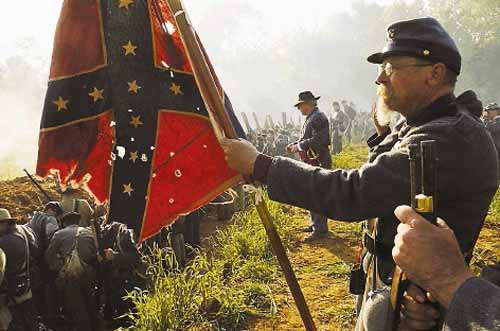
A Civil War re-enactor displays the Confederate Battle Flag which is different than the Official Flag of the Confederate States of America that you can see here.
It may have been the last time in history that such a sight was seen by mortal eyes.
Fifteen thousand men formed in 3 lines nearly 2 miles from end to end marching with lock step precision across 8/10 of a mile of open ground toward a barely discernible rise known locally as cemetery ridge - a name that forever after would be drenched in the blood of thousands of young men wearing both blue and gray. Snapping in the breeze were dozens of Confederate Battle Flags; the famous cross of St. Andrew on a red background with stars inset on the blue cross.
The majesty and color of the scene imparted a sense of awe and wonder to those watching. Robert E. Lee thought the scene “sublime.” Some of the boys in blue manning the stone wall at the top of the ridge actually cheered the Southerners good order. The visual must have been absolutely breathtaking.
Shortly thereafter came the shooting, the clubbing, and the stabbing as the nation’s most visible drama played out with an intensity not seen before or since.
The history of the Battle of Gettysburg says that the Union won. But the heritage of the battle belongs to the south.
Perhaps not so much today as the cloying grip of mass media has blurred the sectionalism so much responsible for that long ago conflict. But it’s also true that many southerners alive today are just one or two degrees of separation from that time in their history. After all, the last Civil War soldier lived until 1954. Many a southern grandfather can tell stories of long ago Fourth of July’s with some of those same boys that trudged up the ridge at Gettysburg, grown old and bent but still proud, marching in parades behind that most distinctive of American symbols.
Distinctive and yes, hurtful. For many Americans, the Confederate Battle Flag represents a hateful system that held human beings as chattel slaves. For them, there is no heritage only history; a shameful chronicle of rape, of whippings, of oppression that colors our politics and culture down to this very day.
The modern battle over the displaying and even the meaning of the Confederate Battle Flag has aroused emotions not seen since the darkest days of the struggle for civil rights in the 1960’s. The story of the people and emotions behind this struggle is told in a new book by John M. Coski “The Confederate Battle Flag : America’s Most Embattled Emblem .” Coski is library director for the Museum of the Confederacy in Richmond, Virginia.
In his excellent review of the book for The Weekly Standard, Edwin M. Yoder relates an anecdote about C. Vann Woodward, generally recognized as the greatest of all southern historians and the subject of the book’s dedication that reveals why southerners to this day are just a little bit different than the rest of us:
During the McCarthyist inquisition of the 1950s, he was once asked to certify that neither he nor his relatives had ever advocated the violent overthrow of the government of the United States. He was obliged to note that some of his ancestors had fought for the Confederacy and had contemplated exactly such mischief. Wit can defuse passionate differences.
Indeed, that’s usually the case. But in the matter of the Confederate Battle Flag those differences are too profound, too emotional to lend itself to anything but all out war.
Coski gives some post civil war history of the battle flag and in the process, destroys some cherished myths of its detractors:
It is not true, for instance, that we owe its negative symbolism to the Ku Klux Klan. In fact, Coski insists, the Kluxers made greater display of the Stars and Stripes, at least down into the KKK revival of the 1920s, when its ragtag and bobtail knights first seized on the Rebel banner as an emblem of racial and religious bigotry.
All along, such guardians as the United Daughters of the Confederacy and Sons of Confederate Veterans deplored this abuse. In 1948, when the hustings were loud with revivified Confederate rhetoric, and Dixiecrat rallies tended to be festooned with battle flags, the UDC pointedly condemned the flag’s use in “any political movement.”
Instead, the author points to the “flag fad” of the 1950’s when football fans and others used the emblem as a symbol of southern pride and school spirit leading one Atlanta editor to complain it had become “confetti in careless hands.”
Then came the civil rights struggles of the 1960’s and the battle flag took on a whole new meaning - that of southern resistance to both federal encroachment on states’ rights and the struggle to maintain Jim Crow segregation. In one way or another, Georgia, Alabama, South Carolina, and Mississippi incorporated the battle flag into their dissent. And that’s what has aroused the modern argument over the meaning and symbolism of the flag:
What has lately intensified the battle over the battle flag has been the struggle in four traditionalist southern states that had incorporated the battle flag in their state banners (Mississippi and Georgia), or flown it over their capitols (South Carolina and Alabama).
Mississippi had superimposed the battle flag on its state banner as far back as 1894. That gesture may have been connected with the so-called “redemption” of the state from federal control and black suffrage. But it obviously could have had nothing to do with the prolonged fight over school integration that prompted Georgia, in 1956, to make the battle flag part of its state flag as an explicit gesture of defiance.
Alabama Governor George Wallace famously flew the battle flag over the state capitol when Bobby Kennedy came down to discuss desegregating the University of Alabama. And South Carolina takes a perverse sort of pride in being the first state to secede from the Union following Lincoln’s election hence the flag has taken on iconic status as a symbol of the history of the state’s leadership.
This is what the NAACP and other opponents of the battle flag point to when demanding its eradication as a symbol of southern glory. But is that what the argument is really about? Coski doesn’t think so:
These latter-day battles, in any event, underscore one of Coski’s principal themes–namely, that flag flaps are actually surrogate conflicts over the meaning of the history allegedly symbolized, and in particular that of the Confederacy and the Civil War. This truism would seem to require no emphasis, except that the “history” invoked by the warriors for and against the battle flag is often of a quality so inferior as to make so-called “law office history” seem real.
One comes away from The Confederate Battle Flag with two signal reactions. One is that the warring parties need a cram course in semiology, the better to grasp the mundane truth that responses to signs and symbols vary with the beholder. I personally would enjoy dispatching to my remedial cram school some of the more volatile warriors–notably former senators Carol Moseley Braun and Jesse Helms, who conducted an emotional quarrel on the floor of the Senate in 1993 when Senator Moseley Braun persuaded her colleagues to deny the poor old UDC (United Daughters of the Confederacy) a continued courtesy patent on its flag logo.
Does this mean we’re still essentially fighting the Civil War? In a large way, yes. When Coski talks about “law office history” he’s speaking of the broad brush approach to history most people take when talking about the Civil War. The North fought for “freedom for the slaves” while the South fought to keep their “peculiar institution. In fact, the war was about neither and both. Most of the Northern boys (with the exception of a few New England regiments where abolitionism was strongest) would have been shocked to discover they were fighting to free the slaves. As an example, when Lincoln issued his Emancipation Proclamation, several Northern units deserted vowing not to fight to free the black man.
Similarly, according to James McPherson nearly 95% of Lee’s army that fought at Gettysburg did not own a single slave.
Why all the shouting then? It comes down to perception and, in the end, an empathy with those who have suffered:
We hardly need to be reminded that we Americans squander much time, words, and emotion on phantom battles over vaguely defined symbolic issues, while avoiding dispassionate study of the past. I do agree with my old friend, the witty Chapel Hill sociologist John Shelton Reed, who usefully suggests that white southerners ought to learn from St. John Calhoun that his famous theory of the “concurrent majority” requires due consideration of minority views; that is, some consideration of the sense of black southerners that this flag is a symbol of servitude and oppression.
Personally, I can understand the symbolic power of the Battle Flag in that it remains to this day a potent talisman and touchstone of southern pride and patriotism. But in the clash of history versus heritage, the sheer ugliness associated with the chronicle of slavery must win out and the battle flag must be relegated to the dusty attics and dank cellars of southern homes perhaps to see the light of day again when its symbolism does not cause so much pain and anguish.