Right Wing Nut House

6/11/2005

THE TOP 20 AMERICANS OF ALL TIME

Filed under: History — Rick Moran @ 11:16 am

John Hawkins has a list of his top 20 Americans of all time and is inviting bloggers to come up with their own catalog of influential Yanks. Hawkins is responding to the ludicrous list voted on by people nationwide and plastered all over the Discovery Channel. Any list that contains Oprah Winfrey and Bill Clinton in its top twenty can be safely ignored. As John says, the list “tells you all you need to know about how well America’s public schools teach history.”

I wouldn’t blame it entirely on the schools but rather on a lack of curiosity by most Americans about their past. This phenomenon has been commented on since the beginning of the Republic and I doubt that it will ever change. We are a nation that has never dwelt on the past but rather looked to the future. And people in this day and age who constantly try and remind us of the past tend not to be very popular except when the reminder is used to evoke patriotic feelings toward the present.

All this being said, here are my top twenty Americans. And unlike Mr. Hawkins, I will not chicken out (lol) by not ranking them:

1. George Washington

“Father of our Country” is more than just a saying, it’s a literal truth. No George Washington, no America. Period.

2. Thomas Jefferson

Jefferson may have been the most brilliant American ever. His list of abilities, of interests, and accomplishments are absolutely staggering. John F. Kennedy, entertaining a group of Nobel Prize winners at dinner summed it up best. He quipped ” that so much talent had not been present in the room since Thomas Jefferson dined alone. … ”

3. Martin Luther King

For his “I Have a Dream” speech alone King would be in the top five. Simply put, that speech changed America and the effects of it are being felt to this day. A little commented on ability of King’s was that he was also a terrific organizer. He was tireless. He was focused. And he was perhaps the second most important American of the 20th century.

4. Franklin Roosevelt

FDR’s communication skills were rivaled only by Reagan. He changed the way government interacts with its citizens forever. This was not always for the best but we’re talking about influential Americans. No one American had more influence on present policy and politics than FDR.

5. James Madison

Madison could have been ranked higher if his Presidency had been more effective. As it was, he got us embroiled in an unnecessary war with Great Britain that almost tore the young country apart. He was, however, the primary author and the main defender of the Constitution. He, along with Hamilton made that document a reality.

6. Abraham Lincoln

Could any other man have kept the Union together? Doubt it. Also responsible for modern Republican party.

7. Teddy Roosevelt

TR pretty much made the modern Presidency. Also, many of his activist attitudes toward government were a harbinger of his cousin FDR’s policies. He gets the top 10 ranking for being such a dominating figure in his time.

8. Benjamin Franklin

Where to rank Franklin is a puzzle. He wasn’t really a politician. But we have Franklin to thank for putting America on the map. His popularity in France was largely responsible for the absolutely vital alliance between that country and the newly minted United States. Without French help, independence would probably have remained elusive. And without Franklin, no French treaty. Also, Franklin was instrumental in steering the colonies toward independence in 1775-76.

9. Henry Clay

For nearly 40 years, Clay dominated first in the House and then the Senate. Beginning with the Compromise of 1821 almost till his death in 1852, the triumvirate of Clay, John C. Calhoun, and Daniel Webster kept the country from flying apart at the seams over slavery. No Congressman before or since had so much influence on events.

10. James Watson

James Watson and Englishman Francis Crick discovered the secret of life, the DNA molecule from which so much science and medicine is derived today it’s impossible to catalog. Next to the Englishman Ernest Rutherford’s discoveries about atomic structure, there has been no more influential scientists in history.

11. Albert Einstein

I may get an argument about that last statement from Einstein fans. But the fact is, Einstein’s enormous achievements lie in the theoretical while Crick/Watson’s discoveries have a wealth of practical applications. Clearly though, Einsteins theories on light, on gravity, and most importantly on energy changed the modern world.

12. Susan B. Anthony

No women’s vote without Anthony? No, which is why she’s not ranked higher. However, that said, her leadership and more importantly, her inspirational writings on women’s suffrage changed the course of history.

13. Ronald Reagan

I know, I know…all my conservative friends are probably upset that I didn’t rank the Gipper a little higher. Frankly, I think we’re all a little too close emotionally to Reagan to truly measure his greatness. He can be credited with starting so many things - fall of communism, a conservative revolution, a change in the way people look at government - but the tote board of his actual accomplishments is still unfinished. I think he’ll eventually be ranked higher. But for the moment, he stays where he is.

14. Orville and Wilbur Wright

Not only were the Wright brothers responsible for the first powered flight, the machine they built had so many original ideas in it that it can be truly be said the world has seen nothing like it up until that time. The story of flight is one of the most interesting things you’ll ever read. To Conquer the Air: The Wright Brothers and the Great Race for Flight is the most fascinating book I’ve read in 20 years.

15. Dwight Eisenhower

Successful D-Day invasion without Eisenhower? Probably. But Ike’s gifts were on display after D-Day. He managed the final year of the war masterfully, keeping together one of the most unlikely coalitions in history; two ultra-capitalist states and one ultra-socialist state. That plus Ike’s Presidency that saw the birth of NASA, which assured civilian control of the space effort (a move that guaranteed the computer age) as well as the construction of the Interstate highway system put him on the list.

16. Thomas Edison

Edison isn’t ranked higher because his inventions were really improvements on other people’s work. That said, he was an original thinker and represents culturally the iconic American tinkerer. He was also a shrewd businessman and marketer.

17. Andrew Jackson

Jackson’s Presidency was the culmination of the first truly populist movement in American history. An inveterate Indian hater, his policy toward the tribes was unconscionable. However, he more than anyone else was responsible for expanding the power of the executive in relation to Congress.

18. Mark Twain

Before Samuel Clemons, there was no such thing as American literature in the eyes of the rest of the world. Not only that, his books have worn extremely well down through the years. His influence on the American novel is huge. Besides all that, he’s my personal favorite.

19. Daniel Boone

Boone is important in real life as well as legend. His pioneering of Kentucky opened the west to the rest of America. His cultural identity as a hunter-hero is equally important. All countries need legends. He was our first.

20. John Adams

Only because he’d be upset if I kept him off this list. Actually, Mr. Adam’s reputation has enjoyed a boost recently thanks to the wonderful biography by historian David McCullough. His importance to the cause of American independence is well known. But his ineffectiveness as President coupled with an unreasoning hatred of Jefferson caused our young republic enormous problems. But then, the last 15 years of his life, he and Jefferson exchanged personal correspondence that, when read today, is a remarkable record of the thinking of two great Americans.

What? No Alexander Hamilton? The short answer is not on this blog. Hamilton was a schemer. And while his policies as Treasury Secretary were very influential, any good he did must be tempered by the realization that he constantly tried to manipulate those around him - including Washington - to do his bidding. To my mind, he’s the most unattractive major figure in American history.

UPDATE

I am either the bravest or the dumbest blogger on the planet.

After looking at Hawkin’s trackbacks, I see I’m the only one who actually ranked my picks. In doing so, I got an eerie feeling of deja vu. The last time I ranked my picks for something was when Hawkins did a post on Best Star Trek Characters of all Time.” My response allowed every trekkie in the world to not only disagree with me but call me nasty names to boot.

Please be nice to me, oh gentle readers. I bruise very easily…
6/6/2005

IKE’S D-DAY MESSAGE AND A PRAYER FROM FDR

Filed under: History — Rick Moran @ 7:07 am

Here’s the message sent by General Dwight Eisenhower to the troops and read to them prior to the battle.:

Soldiers, Sailors and Airmen of the Allied Expeditionary Force!

You are about to embark upon the Great Crusade, toward which we have
striven these many months. The eyes of the world are upon you. The
hopes and prayers of liberty-loving people everywhere march with you.
In company with our brave Allies and brothers-in-arms on
other Fronts, you will bring about the destruction of the German war
machine, the elimination of Nazi tyranny over the oppressed peoples of
Europe, and security for ourselves in a free world.

Your task will not be an easy one. Your enemy is well trained, well
equipped and battle hardened. He will fight savagely.

But this is the year 1944! Much has happened since the Nazi triumphs of
1940-41. The United Nations have inflicted upon the Germans great defeats,
in open battle, man-to-man. Our air offensive has seriously reduced their
strength in the air and their capacity to wage war on the ground. Our Home
Fronts have given us an overwhelming superiority in weapons and munitions
of war, and placed at our disposal great reserves of trained fighting men.
The tide has turned! The free men of the world are marching together to
Victory!

I have full confidence in your courage and devotion to duty and skill in
battle. We will accept nothing less than full Victory!

Good luck! And let us beseech the blessing of Almighty God upon this great
and noble undertaking.

SIGNED: Dwight D. Eisenhower

This prayer was part of FDR’s announcement of the beginning of the invasion. Both Tom Browkaw in The Greatest Generation and Stephen Ambrose in D-Day: June 6, 1944 have pointed out the profound effect this prayer had on the people of the United States. Churches and synogogues were full as people gathered to pray for the success of the invasion and for God to watch over their loved ones. It truly was a day when the nation collectively held its breath.

Last night, when I spoke with you about the fall of Rome, I knew at that moment that troops of the United States and our Allies were crossing the Channel in another and greater operation. It has come to pass with success thus far.

And so, in this poignant hour, I ask you to join with me in prayer:

Almighty God: our sons, pride of our Nation, this day have set upon a mighty endeavor, a struggle to preserve our Republic, our religion, and our civilization, and to set free a suffering humanity.

Lead them straight and true; give strength to their arms, stoutness to their hearts, steadfastness in their faith.

They will need Thy blessings. Their road will be long and hard. For the enemy is strong. He may hurl back our forces. Success may not come with rushing speed, but we shall return again and again; and we know that by Thy grace, and by the righteousness of our cause, our sons will triumph.

They will be sore tried, by night and by day without rest - until the victory is won. The darkness will be rent by noise and flame. Men’s souls will be shaken with the violences of war.

For these men are lately drawn from the ways of peace. They fight not for the lust of conquest. They fight to end conquest. They fight to liberate. They fight to let justice arise, and tolerance and good will among all Thy people. They yearn but for the end of battle, for their return to the haven of home.

Some will never return. Embrace these, Father, and receive them, thy heroic servants, into Thy kingdom.

And for us at home — fathers, mothers, children, wives, sisters and brothers of brave men overseas — whose thoughts and prayers are ever with them — help us, Almighty God, to rededicate ourselves in renewed faith in Thee in this hour of great sacrifice.

Many people have urged that I call the Nation into a single day of special prayer. But because the road is long and the desire is great, I ask that our people devote themselves in a countenance of prayer. As we rise to each new day, and again when each day is spent, let words of prayer be on our lips, invoking Thy help to our efforts.

Give us strength, too — strength in our daily tasks, to redouble the contributions we make in the physical and the material support of our armed forces.

And let our hearts be stout, to wait out the long travail, to bear sorrows that may come, to impart our courage unto our sons wheresoever they may be.

And, O Lord, give us faith. Give us faith in Thee; faith in our sons; faith in each other; faith in our united crusade. Let not the keenness of our spirit ever be dulled. Let not the impacts of temporary events, of temporal matters of but fleeting moment — let not these deter us in our unconquerable purpose.

With Thy blessing, we shall prevail over the unholy forces of our enemy. Help us to conquer the apostles of greed and racial arrogancies. Lead us to the saving of our country, and with our sister nations into a world unity that will spell a sure peace — a peace invulnerable to the schemings of unworthy men. And a peace that will let all men live in freedom, reaping the just rewards of their honest toil. Thy will be done, Almighty God. Amen.

Pres. FRANKLIN D. ROOSEVELT, June 6, 1944

REMEMBERING WHY I LOVE HISTORY

Filed under: History — Rick Moran @ 6:37 am

One of the reasons I love history is that it forces you to travel backward in time and actually live the events that the historian is writing about. You’re compelled to experience the event from the perspective of someone from that time, that era. What do you believe? What are your prejudices? How would you interact with the characters? What would you see? Whose side would you be on?

A million questions answered differently by each and every one of us. This is especially true when I read about transcendent historical occurrences, those “hinges of history” where events transpire that shape the present and whose effects will be felt far into the future.

“Real” historians don’t give as much weight to individual events, They point to underlying forces and historical trends that one single event rarely impacts. That’s why for the longest time, counterfactual or alternative history was debunked by historians as an intellectual parlor game, a pointless exercise in sophistry.

This attitude on the part of professional historians may be softening a bit thanks in large part to Niall Ferguson’s compilation of scholarly alternative history scenarios in Virtual History. The book is worth reading if only to peruse the first 90 pages where Ferguson gives a history of historiography, or the study of how history has been viewed and written since the time of Homer. It explains a lot about why contemporary historians pooh-pooh the idea of counterfactualism and how a quasi-Marxist or deterministic view has dominated the writing of history for most of the last century.

That being said, I believe there is enormous value to looking at individual historic events and how the decisions made by so few affected the destiny of so many.

Today is the 61st anniversary of the most important single event of the 20th century: D-Day. I’ll get a lot of flack for saying that from some of my readers who have been kind enough to share their love of history with me. Some would point to the dropping of the atomic bomb on Hiroshima or the Apollo Moon Landing. Perhaps a hundred years from now some historian will point to another event, a decision made in obscurity which will have consequences that at the moment are hidden from us.

But there are aspects to D-Day that make it one of the true “make or break” moments in the history of man. First and foremost is the fact that if the invasion had failed, if Eisenhower would have been forced to abandon the beachhead, the consequences would have been catastrophic. Stalin, who had been clamoring for two years for the Allies to open a second front against the Germans, could have decided to make a separate peace with Hitler. We know now that he contemplated such a move several times. Whether Hitler would have been smart enough to let him off the hook is another matter. But freeing up 3 million German troops from fighting Russians to manning the defenses of the Western Wall would have made any additional attempt to land in France problematic.

If Stalin didn’t make a separate peace, then surely he would have been in trouble himself. With the prospect of an Allied invasion in France dead for a year, Hitler would have been able to transfer the bulk of his western armies to the east in an attempt to defeat the Red Army. At the very least, the breakout battles fought by the Red Army later that summer may have had a different outcome indeed. The Wehrmacht could have blocked any Russian advances that would have prolonged the war by at least a year, possibly two. Just think of the headaches for Roosevelt and the Americans who were also fighting the Japanese in the Pacific.

Ain’t history fun?

How about the Presidential election of 1944? Would the American people look at the failure of D-Day as Roosevelt’s fault? Or the British parliamentary elections in 1945? Would the British have been willing to turn Churchill out with the war still going on? What would the delay have meant to the post-war British turn to the left? What about the independence of India? Would the British have been so willing to partition India with the Nazi threat still present? What about the mass of supplies that we were sending to Stalin and Chiang Kai Shek in China? If we were going to make another attempt at breaching the Atlantic Wall, wouldn’t our troops need those supplies? Would Chiang have been forced to surrender to the Japanese? Would Stalin have been able to hold on? Would we have used the atom bomb on Germany?

The list of “what if” questions about D-Day are limited only by one’s imagination. And as Stephen Ambrose points out in his must-read history D-Day: June 6, 1944: The Climactic Battle of World War II, the success or failure of the invasion depended entirely on a pitifully small number of men, the first waves that hit the beach at dawn on that fateful day. This was especially true at Omaha Beach.

The carnage, the confusion, the terror present on that ridiculously small strip of insignificant French territory became the crucible by which our present was forged. The entire war effort had telescoped down to the actions of less than 8,000 American soldiers who were pinned down by some of the most intense fire ever experienced by American fighting men. The original plan, which called for the American forces to break out from the beach and up several draws to a causeway where ideally, they would link up with Allied forces from other landing sites had fallen by the wayside. The troops hadn’t landed at their designated points on the beach, German obstacles hadn’t been cleared, the tanks that were supposed to land with the troops had sunk into the English Channel, and many, many of the troops officers were dead or wounded.

It was at this point that the ultimate test of civilizations played itself out. Would the sons of democracy be able to defeat the sons of dictatorship? As Ambrose dramatically points out, the answer was a resounding yes. Trained as they were to think on the battlefield and encouraged to improvise if necessary, one by one - first in small groups and then by company - the America’s made their way up the murderous bluffs, through the minefields, and began to silence the German guns. There was no plan to it, no coordination. Just individual American soldiers taking it upon themselves to do the job. In short, for all of Eisenhower’s careful planning, it was the improvisation and sheer courage of the American soldier that won the day and made June 6 a date to remember victory rather than tragic defeat.

I wonder, would I have had that kind of courage? What would I have done if it were me trapped behind the seawall with mortars and machine guns firing incessantly, casualties all around me, many of my friends killed or wounded, and suffering from the shock and terror associated with battle? Would I have been a leader or a follower? What would I have been thinking?

That’s why I love history. Doesn’t asking questions like that tell you something about yourself? It isn’t important if there are answers, it’s the questions that make you think.

Those beaches at Normandy have been quiet for 61 years now. The men who gave the “last full measure of devotion,” whose young lives were snuffed out in a cause greater than themselves are still being mourned by the ever shrinking number of comrades who survived them. And as we look back and marvel at their sacrifice and courage, we do them honor by asking ourselves if placed in their boots, would we have done as well?

The answer, if there is one, reveals as much about ourselves as it does about them.

Cross Posted at Blogger News Network

6/1/2005

MOORER-RADFORD AND A POSSIBLE DEEP THROAT CONNECTION

Filed under: History — Rick Moran @ 12:38 pm

Earlier today, I highlighted the possibility that Al Haig could be a second piece in the composite Deep Throat puzzle. I still believe there’s more to discover about the sourcing of the Wood/Stein stories and the outing of Mark Felt as the one and only Deep Throat just doesn’t close the books as far as I’m concerned. I may be tilting at windmills here in trying to pin something on Haig, but I thought that this would be as good a time as any to look into what has to be one of the most bizarre incidents in the history of the executive branch, the Moorer-Radford Affair and how a relationship developed between a young naval briefing officer for the Pentagon named Bob Woodward and the Assistant to the National Security Adviser, Alexander Haig.

The Joint Chiefs of Staff had maintained a liaison office with the National Security Council for many years. This office kept the Chiefs informed of White House thinking on security matters as well as other items of potential interest to the military. There was nothing unusual about this as the Pentagon liaised with a number of committees and boards throughout the national security establishment.

Then Nixon was elected and things changed dramatically. Nixon’s paranoia made him suspicious of all but a handful of close aides. Couple that with Henry Kissinger’s well known desire to keep as much of the decision making power for national security in his own hands and the Joint Chiefs suddenly found themselves left out in the cold on matters vital to the military. The Viet Nam war was still raging at the time and Nixon’s back channel negotiations with the Russians and the Chinese along with his plans to draw down troop strength was done with very little input from the Chiefs.

When Admiral Moorer took over as Chairman of the JCS, he named Admiral Robert Weland as JCS liaison to the NSC. Weland reported directly to Moorer and brought along a Yeoman to assist him, one Charles Radford. Where in the past, there was little if any clandestine activity on the part of the liaison office with regards to the NSC, Welander began what became nothing less than a covert operation on behalf of the Joint Chiefs of Staff to try and pry loose the secrets Nixon so desperately wanted to keep from them.

It was at this point that a young Pentagon briefer entered the picture. Bob Woodward’s role in the affair has always been speculated on because it became clear after a while that in addition to Yeoman Radford rifling through secret papers and the like, the Chiefs were being assisted by someone else on the White House staff. This was revealed when Jack Anderson, the muckraking columnist, published excerpts from highly classified briefings about the 1971 India-Pakistan conflict in which instead of being neutral, the US was “tilting” toward Pakistan.

Nixon was angry enough to sick John Erlichman on the leakers. What Erlichman discovered astonished the President. Accompanying NSC Deputy Haig on trips, Radford would return with gobs of information purloined from Haig’s briefcase. The Nixon tapes make clear that the President, Haldeman and Erlichman all believed that Haig was complicit in the Affair but could probably never pin anything on him.

The speculation about Haig centers on where his “loyalties” lay. Many observers believe that Haig could very well have been passing information on to the JCS due to his lifelong love and commitment to the military. And what better way to keep the Chiefs informed than by using the young Bob Woodward as a conduit back to Woodward’s boss Admiral Welander? At the very least, the briefings Woodward gave Haig in the basement of the White House establishes a prior relationship.

The final act of this drama was an anti-climax. After tracing the leaks to Radford, the Yeoman confessed his role in the spy ring and implicated both Welander and Moorer. When questioned, Welander implicated Moorer and perhaps even Haig, although some believe the record was expunged when Fred Buzzardt, Nixon’s lawyer and a good friend of Haig’s “reinterviewed” Welander sans the references to the former NATO Commander.

Nixon was in a quandary. Revelations like the ones made by Radford could roil the country even more than it already was in addition to lowering the stature of a military already suffering the effects of bad press from the Viet Nam war.

So Nixon sat on the scandal. It wasn’t until several years later that the Affair came to light. And by then, the impact of disclosure was muted by Nixon’s legacy of deceit. It just didn’t seem surprising that the JCS would have to spy on the executive in order to find out information they thought they were entitled to.

Some writers have taken this incident and run wild with speculation that the military somehow orchestrated Nixon’s downfall. What Moorer-Radford makes clear is that in the end, these guys weren’t clever enough to carry something like that off. Radford’s activities were amateurish and not very effective. Whether someone else was supplying the JCS with information is unknown to this day. Nixon’s idle speculation about Haig could very well have been a product of his penchant for paranoia with Haldeman and Erlichman as his chief enablers in this regard, always agreeing with him, always egging him on to more fantastic flights of fancy as to who was against him.

But one fact is undeniable and confirmed by Admiral Welander. Bob Woodward briefed Alexander Haig many times in the basement of the White House in the years 1969-1970. And when Woodward went to work for the Washington Post shortly after his leaving the military in 1971, he already knew where to go for information about the Nixon White House.

5/31/2005

DID FELT TATTLE BECAUSE HE WAS PASSED OVER?

Filed under: History — Rick Moran @ 5:15 pm

Anonymous sources are a pain. You have to decide why they don’t want their names associated with the information they’re giving. What axe, if any, do they have to grind? Personal? Professional? Sexual?

In the case of Deep Throat, there was apparently another motivation. Sour grapes.

Woodward said Felt helped The Post at a time of tense relations between the White House and much of the FBI hierarchy. He said the Watergate break-in came shortly after the death of legendary FBI director J. Edgar Hoover, Felt’s mentor, and that Felt and other bureau officials wanted to see an FBI veteran promoted to succeed Hoover.

Felt himself had hopes that he would be the next FBI director, but Nixon instead appointed an administration insider, assistant attorney general L. Patrick Gray, to the post.

Felt wouldn’t be the first Washington bureaucrat to dish some dirt as the result of being passed over for promotion. Information is power. And Felt’s talking out of school eventually made L. Patrick Gray’s position untenable to the point where the Acting FBI Director declined to be in the running as a permanent replacement for Hoover.

Now I’m sure that Felt sees in his own mind a nobility of purpose and purity of motive that blinds him to the more unsavory aspect of his deed. There’s a reason FBI reports aren’t made public; they alert the target of the investigation to the interest of the Bureau. And in Felt’s case, he guided Wood/Stein in such a way as to throw suspicion on people who could have been squeezed by the Special Prosecutor Archibald Cox before their names were associated with the crime. Would this have made a difference in the final analysis? Probably not. But it certainly made the job of Cox and his successor, Leon Jaworski that much harder.

And what about the $64,000 question? The counterfactual of counterfactuals?

What if Felt had kept his mouth shut? Would things have played out the same way? Would Nixon have been forced to resign?

The answer is a resounding yes. And that’s because Felt was more important to the Post than he was to the overall investigation.

The honor for the single most important cog in the Watergate investigation goes to a minor White House functionary named Alexander Butterfield. Butterfield had a rather unique job in in the White House. He liaised with the Secret Service to maintain the massive bugging system that Nixon, in what could only be described as revealing the tragic flaw of overarching hubris, had installed to record his every sentence, every word, every breath for posterity.

The story of Butterfield’s outing is a classic case of serendipity and best told here. And once the information about those tapes were out there, Nixon’s fate was sealed regardless of anything Deep Throat could tell Wood/Stein about the scandal.

So, the mystery is solved in something of an anticlimactic manner. There will be no more funeral watches of Watergate related figures for Woodward sightings. Instead, a very old and very sick man who may or may not have been angry at being passed over as Director of the FBI, tells a second tier monthly magazine a story that’s pretty much of surpassing interest only to political junkies and historians.

But it’s still a great story. And I’m glad it’s finally been told.

DEEP THROAT SWALLOWED BY HISTORY

Filed under: History — Rick Moran @ 12:49 pm

The revelation today that Mark Felt could very well be the “unnamed” source known as Deep Throat for Carl Bernstein and Bob Woodward’s sensational Watergate exclusives has set off a wave of nostalgia among Nixon haters and a wave of revulsion among many others.

First, it appears that Woodward had contact recently with Felt looking to make a media extravaganza out of the revelation:

The Vanity Fair article said Felt’s family had convinced him that his actions during Watergate were heroic and worthy of acknowledgment and he should come forward. His daughter had spoken to Woodward, who visited Felt in Santa Rose in 1999, by phone more than a half-dozen times to discuss a potential joint announcement, Vanity Fair said.

But Woodward would often begin those conversations with a caveat, the magazine said, saying, ”Just because I’m talking to you, I’m not admitting that he is who you think he is.”

Couple this with both Bernstein and Woodward’s failure to immediately squelch the story and you have the makings of a pretty interesting news day.

That being said, what this will do is open a whole bunch of unhealed wounds on both sides of the Watergate divide. Anytime another set of Nixon White House tapes has been released by the National Archives, a veritable feeding frenzy by the press ensues in which Nixon’s every off the cuff utterance is given front page treatment. The themes are familiar; Nixon the racist, Nixon the anti-Semite, Nixon the madman.

Nixon may have been all of those and worse. But what doesn’t get much attention are the recent release of the Johnson and Kennedy tapes that reveal some pretty nasty stuff about those fellows too. When it does make the news (Johnson’s tapes have been written about by Presidential historian and TV talking head Michael R. Beschloss) Presidential peculiarities are chalked up to the “complexity” of the men, not any inherent evil present in their personalities.

With Nixon, it’s different. Any revelation about his Presidency is viewed as further justification for his fall from grace. What’s never addressed in this orgy of self congratulations is the very real role played by the national press in bringing down a President.

In short, unelected elites decided Nixon was guilty of not just the Watergate coverup, but a wide variety of crimes that necessitated his removal from office.

How much better would a Senate trial have been? At least we would have gotten the satisfaction of having representatives of the people remove him. And the consequences that have flowed from the realization of the mainstream press that they can make or break or even remove President’s have been dire. For going on 30 years, every journalist in America has dreamed of being the next Woodward and Bernstein. The fame, the riches, the adulation attendant to bringing down a President has motivated more than one journalist to make every “scandal” in Washington into a “gate.” Koreagate, Contragate, bimbogate…the list is endless.

This is unhealthy for the republic as well as being ridiculous.

If Mark Felt is indeed Deep Throat he probably should be applauded for bringing the corruption surrounding Watergate to the attention of the people through the Washington Post. But like all stories regarding Nixon, there’s very little context to go with the condemnation.

Will historians 100 years from now see things a little differently? Will they take into account that there thousands of Americans actively working to overthrow the government, who believed that by fomenting violence they could achieve a socialist paradise? Will they see that leaks from high government officials on issues like arms control were not only a threat to national security but a threat to human life on the planet as well? Will they see the shortsightedness of the press in their relentless pursuit of a President who they didn’t like personally?

I don’t know. I’m not an historian a hundred years from now. What I do know is that Nixon governed in the most difficult time in this nation’s history since the Civil War. There were thousands of people in the streets cheering for victory by an enemy that was killing American boys on the battlefield (We hadn’t yet become inured to this spectacle. When it happens today we pay it no mind because we’re used to American citizens wishing for the death of American servicemen). The social fabric of the nation was fraying at the edges not just because of Viet Nam but because the pent up demand for equality from so many deserving minorities was spilling out into the streets and rocking the establishment. Add to that Nixon’s secretive, almost paranoid personality that was manipulated by sycophantic aides - small, petty men of much ambition and little talent - who played on the President’s desperation as he tried to understand and deal with the maelstrom threatening to suck the country into a de facto civil war.

It’s too easy to forget that this is the way it was. And while Nixon should never be excused, I have a sneaky suspicion that historians of the future will indeed put his many accomplishments and spectacular failures into a perspective that neither his supporters nor detractors could possibly do today.

ADDITIONAL THOUGHTS:

Captains Quarters
Wizbang
Political Teen has video of Felt’s grandson.

UPDATE…WITH A BULLET

WOODWARD, BRADLEE, AND BERNSTEIN HAVE CONFIRMED THAT FELT WAS IN FACT DEEP THROAT.

5/30/2005

MEMORIAL DAY AND GENERAL LOGAN

Filed under: History — Rick Moran @ 6:07 am


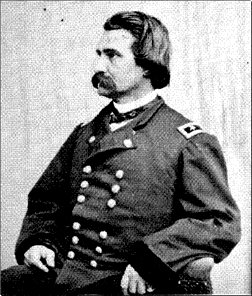
GENERAL JOHN A. LOGAN

Congressman John Logan was angry. His party, the Democrats, had just lost the election of 1860 to Abe Lincoln and the Republicans. But his opposition to the fire eaters of the South who were agitating for secession had incurred the wrath of men who just recently had called him a “son of the South.” In a speech on the floor of the House, Logan warned his Southern colleagues that if they persisted in their folly, the union would crush them. He returned to his district and gave a speech at Marion, Illinois that today is widely seen as helping keep that vital part of Illinois - “little Egypt” - loyal to the Union.

Resigning from Congress, he was one of a handful of Democratic lawmakers that fought on the Union side during the war. Most of these political officers were a disaster. Benjamin Butler, for instance, was a Massachusetts Democrat whose ineptitude as a soldier was surpassed only by his incompetence as an administrator. While overseeing the military occupation of New Orleans, Butler issued the infamous “General Order #28″ that stipulated that “any female shall, by word, gesture, or movement, insult or show contempt for any officer or soldier of the United States, she shall be regarded and held liable to be treated as a woman of the town plying her avocation.”

Other political generals were equally unfit for command and ended up costing thousands of lives because of their incompetent leadership. But not so John Logan.

Logan organized a regiment of volunteers and was named a Colonel. Immediately distinguishing himself on the field of battle, Logan made it his business to study the art of war. Attached to the Army of the Tennessee, General Grant recognized Logan’s leadership ability and promoted him to General. He played a key role in the victory at Raymond, Mississippi that cleared the way for Grant’s march to Vicksburg and eventual capture of that vital city.

When Grant moved North to take command of the Union armies, Sherman, who had nothing but disdain for political generals, took over the Army of the Tennessee. But after seeing Logan in action during the Battle of Atlanta, Sherman was impressed enough to give Logan command of the entire left wing of his army on its march to the sea. Again, Logan distinguished himself as he fought off whatever resistance the South could throw at Sherman as he devastated the countryside.

Popular with the men under his command, Logan was a rarity - a commander the men could trust. They sensed his concern for their welfare as Logan made it a habit of visiting the company mess to taste the food himself. If he found it inadequate, he’d dress down the company commander and order him to fix the situation. Usually it was something simple like changing cooks or cleaning the cooking pots once and a while. In addition, Logan made sure the men under his command were properly supplied with shoes, blankets, and other necessities that kept the men comfortable during winter months.

Logan’s concern for his men was evident after the war as well. Elected to Congress again in 1866, Logan took part in the first memorial day observance in Illinois. It’s thought that Logan became especially interested in the issue of a decoration day for the nation following a gesture by the women of Columbia, Mississippi who, during a remembrance for the dead, placed flowers on the graves of both Union and Southern soldiers. Logan had fought with Grant at the battle of Columbia and remembered well the hatred of civilians toward the Union Army. Horace Greeley wrote a famous editorial about the Columbian women and Francis Miles Finch wrote a beautiful poem for the Atlantic Monthly entitled “The Blue and the Grey.”

Logan’s popularity with the men paid off when he was named Commander in Chief of the Grand Army of the Republic (GAR). In 1868 he issued his famous general order that designated May 30th as Decoration Day “for the purpose of strewing with flowers or otherwise decorating the graves of comrades who died in defense of their country during the late rebellion, and whose bodies now lie in almost every city, village, and hamlet churchyard in the land.”

Because of Logan’s leadership, the GAR grew into the most influential voting bloc in the Republican party. For more than 30 years, no Republican could get the Presidential nomination without the support of the GAR. At it’s peak, more than 400,000 veterans of the civil war were members. Their presence during parades and remembrances of that war became a source of inspiration to an entire generation of American historians and writers.

Logan would go on and be elected Senator and even be nominated on the 1884 Democratic ticket for Vice President. He was a strong advocate of public education and served on the Committee for Military Affairs. When he died in 1886, he lay in state in the Rotunda of the Capitol. Thousands of tearful veterans filed past his coffin to pay their last respects to the man they nicknamed “Blackjack.”

Some historians have taken a less than charitable view of Logan’s motivations for initiating Decoration Day. They point out that Logan probably used the holiday to promote his own political career. His bid for the Senate in 1871 played up his role in boosting the holiday and he never failed to remind audiences of his service in that regard.

However, Logan also wrote a loving tribute to his men in a book that came out after his death entitled The Volunteer Soldier in America which was written partly in response to U.S. Grant’s autobiography that criticized the performance of volunteers during the war.

John Logan didn’t come up with the idea of Memorial Day. But his generous inclusion of Southern dead in his General Order authorizing Decoration Day was a magnanimous gesture that helped heal the wounds of that conflict and bring us together as a nation.

It might not be a bad idea this Memorial Day to take a page from our forefathers and recognize that those on the other side of the debate of the War in Iraq mourn our losses as well. For this one day, let us be united in recognition of the service these brave men performed and the fact that no matter what you believe, they have given that “last full measure of devotion” to a grateful nation.

5/26/2005

A KILLER IN THE SHADOWS

Filed under: History, Science — Rick Moran @ 2:16 pm

It must have seemed like all the furies had been unleashed to torment an already agonized world. The year 1918 saw not only the continuation of the senseless slaughter of World War I, but also the outbreak of an influenza pandemic that killed up to 40 million people worldwide. Scenes that would have been reminiscent of what happened during the Black Death in Europe during the middle ages were occuring daily as thousands of victims, many already weakened by the effects on diet as a result of the war, succumbed to the onslaught.

This is what was occuring in the United States:

The effect of the influenza epidemic was so severe that the average life span in the US was depressed by 10 years. The influenza virus had a profound virulence, with a mortality rate at 2.5% compared to the previous influenza epidemics, which were less than 0.1%. The death rate for 15 to 34-year-olds of influenza and pneumonia were 20 times higher in 1918 than in previous years (Taubenberger). People were struck with illness on the street and died rapid deaths. One anectode shared of 1918 was of four women playing bridge together late into the night. Overnight, three of the women died from influenza (Hoagg). Others told stories of people on their way to work suddenly developing the flu and dying within hours (Henig). One physician writes that patients with seemingly ordinary influenza would rapidly “develop the most viscous type of pneumonia that has ever been seen” and later when cyanosis appeared in the patients, “it is simply a struggle for air until they suffocate,” (Grist, 1979). Another physician recalls that the influenza patients “died struggling to clear their airways of a blood-tinged froth that sometimes gushed from their nose and mouth,” (Starr, 1976). The physicians of the time were helpless against this powerful agent of influenza.

Could this horrifying spectacle be repeated?

The answer is yes, it’s possible. The culprit this time is Avian or Bird Flu. According to the Centers for Disease control. the chances for a Bird Flu pandemic are small - but not impossible.

The H5N1 virus (Bird Flu) does not usually infect humans. In 1997, however, the first case of spread from a bird to a human was seen during an outbreak of bird flu in poultry in Hong Kong. The virus caused severe respiratory illness in 18 people, 6 of whom died. Since that time, there have been other cases of H5N1 infection among humans. Most recently, human cases of H5N1 infection have occurred in Thailand, Vietnam and Cambodia during large H5N1 outbreaks in poultry. The death rate for these reported cases has been about 50 percent. Most of these cases occurred from contact with infected poultry or contaminated surfaces; however, it is thought that a few cases of human-to-human spread of H5N1 have occurred.

So far, spread of H5N1 virus from person to person has been rare and spread has not continued beyond one person. However, because all influenza viruses have the ability to change, scientists are concerned that the H5N1 virus could one day be able to infect humans and spread easily from one person to another. Because these viruses do not commonly infect humans, there is little or no immune protection against them in the human population. If the H5N1 virus were able to infect people and spread easily from person to person, an “influenza pandemic” (worldwide outbreak of disease) could begin. No one can predict when a pandemic might occur. However, experts from around the world are watching the H5N1 situation in Asia very closely and are preparing for the possibility that the virus may begin to spread more easily and widely from person to person

The problem is that flu viruses have a nasty habit of mutating. The reason they mutate is as old as life on the planet; microbes do whatever gives them the upper hand in the fight for species survival. In Jared Diamond’s fascinating Pulitzer Prize winning book Guns, Germs, and Steel, the author lays out a natural history of infectious disease and how those diseases made the jump from animals to humans. Diseases like Measles (cattle), flu (pigs and ducks), Pertussis or whooping cough (pigs and dogs), and smallpox (cattle), made the successful leap in early farming societies because people lived in such close proximity to both the animals and their waste products. Microbes discovered (quite by accident) that humans were just as good a place to reproduce as animals.

Only recently has Bird Flu made the jump from birds to humans. Are we seeing the beginning of a new infectious disease? Here’s the CDC’s take:

Influenza viruses have eight separate gene segments. The segmented genome allows viruses from different species to mix and create a new influenza A virus if viruses from two different species infect the same person or animal. For example, if a pig were infected with a human influenza virus and an avian influenza virus at the same time, the viruses could reassort and produce a new virus that had most of the genes from the human virus, but a hemagglutinin and/or neuraminidase from the avian virus. The resulting new virus might then be able to infect humans and spread from person to person, but it would have surface proteins (hemagglutinin and/or neuraminidase) not previously seen in influenza viruses that infect humans.

This type of major change in the influenza A viruses is known as antigenic shift. Antigenic shift results when a new influenza A subtype to which most people have little or no immune protection infects humans. If this new virus causes illness in people and can be transmitted easily from person to person, an influenza pandemic can occur.

It also is possible that the process of reassortment could occur in a human. For example, a person could be infected with avian influenza and a human strain of influenza at the same time. These viruses could reassort to create a new virus that had a hemagglutinin from the avian virus and other genes from the human virus. Theoretically, influenza A viruses with a hemagglutinin against which humans have little or no immunity that have reassorted with a human influenza virus are more likely to result in sustained human-to-human transmission and pandemic influenza. Thus, careful evaluation of influenza viruses recovered from humans who are infected with avian influenza is very important to identify reassortment if it occurs.

This is what’s giving the folks at CDC nightmares. If Bird Flu were to mutate into a strain that could easily be spread by casual contact among humans, it could wreak havoc on the world’s population and the economy. Why the economy? Here’s a look into a possible future where a Bird Flu pandemic is already a reality in the United States. It’s from a mythical blogger: (Hat Tip: Instapundit)

The United States is battened down before the storm. The government has outlawed all gatherings in public places. In past pandemics that never worked. But epidemiologists say that if we do it early on, it might slow the spread. Modelling also suggests that closing schools and universities is especially important as teenagers and young adults are among the worst hit. We just need to stop them from hanging out elsewhere. Stay at home, is the message blaring from every TV screen.

On CNN it’s now round-the-clock coverage, with a red ‘Pandemic’ banner running across the bottom of the screen. “We’re in the twenty-first century, and they’re telling us about how to wash our hands properly, and practise ‘respiratory etiquette’,” exclaims Jonathan. “Why aren’t there drugs? And I can’t believe there’s no vaccine. This can’t be happening in America.”

Can you imagine the effects on the economy if the government banned public gatherings? Malls would have to shut down. Millions of people would lose their jobs. Tens of thousands of businesses would go under. And that’s just the malls. What about air travel? What about the hospitality, travel, and tourism industries?

The ripple effects would plunge the world into the deepest depression since the 1930’s. We’d be a decade recovering.

Just as a side note, this same scenario would play out if we came under a serious biological terrorist attack. And you might have been wondering what would be so serious about a biological as opposed to nuclear attack by terrorists?

I leave you with with a post from our mythical blogger from the future at the heighth of the pandemic here in the United States:

I watch the scenes of a society descending into chaos from the relative security of my mother’s isolated home. Red tail lights snake to the horizon as people pour out of the cities. Half the doctors haven’t turned up for work; many are either ill, or caring for loved ones.

Who should get the few mechanical respirators that can mean the difference between life and death? The youngest, or those with the best chances of pulling through? “Our leadership must be prepared to make calculated decisions that will force raw prioritization of life-saving resources,” explains a colonel on CNN.

Be afraid? Maybe not. But when Drudge has those stories on Bird Flu I’m going to read each and every one from now on.

5/9/2005

BUSH: A SOLITARY VOICE FOR REMEMBRANCE

Filed under: History, WORLD POLITICS — Rick Moran @ 6:24 am

An orgy of remembrance took place all across Europe this last weekend as the continent’s increasingly passive and pacific countries celebrated the very war-like achievements of their grandfathers in tossing the regime of Adolph Hitler and all it stood for on the ash heap of history. Even France, where 2.5 million men of its armed forces never fired a shot in anger before their cowardly government surrendered thus leaving the British to face the Nazi onslaught alone, celebrated the end of World War II, confident in the knowledge that no one would bring up uncomfortable truths like their collaboration with Hitler or the myths surrounding the small minority of citizens who were actually involved in the resistance.

Where the French are concerned, some things are just better left unsaid lest Gallic huffiness spoil a good party.

Even George Bush was silent about the duplicitous French whose wartime actions as “ally” included armed resistance to the American landings in North Africa, handing tens of thousands of European Jews who had taken refuge in “unoccupied” France over to the tender mercies of the Nazi death merchants, and saddling the western world for a generation after the war with the prickly personality and insufferable haughtiness of Charles De Gaulle.

While the President may be faulted for his selective memory where the French are concerned, he should receive the thanks and admiration from all of us for being the only world leader to recall one of the immediate and proximate causes of the war; the Nazi-Soviet Pact signed a scant 2 days before the outbreak of Hitler’s unprovoked attack on Poland.

The fact that Bush spoke of this agreement in Latvia, one of the Baltic states that both Hitler and Stalin coveted is significant in that he connected the brutality of Hitler with the perfidy of Stalin and the Soviet Union in a way that’s rarely been done by an American President:

But in his speech, Mr. Bush indirectly acknowledged that the United States and Britain shared some blame for the annexation of the Baltics, noting that the 1945 Yalta agreement, in which Europe was carved up by Roosevelt, Churchill and Stalin, was in an “unjust tradition” of earlier treaties like the Munich and Molotov-Ribbentrop pacts.

“Once again, when powerful governments negotiated, the freedom of small nations was somehow expendable,” Mr. Bush said. “Yet this attempt to sacrifice freedom for the sake of stability left a continent divided and unstable. The captivity of millions in Central and Eastern Europe will be remembered as one of the greatest wrongs of history.”

And Bush recalled the spirit of defiance of the Baltic states following Stalin’s occupation for their own “protection” following the Nazi-Soviet Pact:

The Baltic states had no role in starting World War II. The battle came here because of a secret pact between dictators. And when the war came, many in this region showed their courage. After a puppet government ordered the Latvian fleet to return to port, sailors on eight freighters chose to remain at sea under the flag of free Latvia, assisting the United States Merchant Marine in carrying supplies across the Atlantic. A newspaper in the state of South Carolina described the Latvian crew this way: “They all have beards and dressed so differently… They are … exhausted, but full of fighting spirit.”

By the end of the war, six of the Latvian ships had been sunk, and more than half the sailors had been lost. Nearly all of the survivors settled in America, and became citizens we were proud to call our own. One American town renamed a street Ciltvaira — to honor a sunken ship that sailed under a free Latvian flag. My country has always been thankful for Latvia’s friendship, and Latvia will always have the friendship of America.

Curiously, this acknowledgment went unnoticed in the press who instead played up Bush’s “apology” for US inaction after Yalta to halt the spread of communism across eastern Europe.

The sad history of Batlic occupation is a direct result of Stalin’s greed and Hitler’s warped vision for Germany. Small German minorities in Lithuania, Latvia, and Estonia allowed Hitler to cast a covetous eye toward the prosperous little countries while Stalin, ever the expansionist, had similar designs to incorporate them into his growing empire. But Hitler had a strategic problem of the first magnitude. Before he could gobble up the Baltics, he had to make sure his rear was secure. That meant a final showdown with France and Britain, the only two military powers that could challenge him in the west.

The problem arose because Stalin was nominally committed to come to the aid of France if she went to war with Germany. And Hitler’s plan to invade and occupy Poland would most surely trigger a response from France, goaded on by Britain. So Hitler needed to somehow separate Stalin from the west. He was fully prepared to invade Poland regardless of anything Stalin did, but realized a two front war would be as disastrous for him as it had been for the Kaiser.

Hitler scheduled the invasion of Poland to begin on August 26, 1939. But less than 24 hours before the Nazi blitzkrieg began to roll, Hitler evidently got cold feet. He recalled some of his forward units who had already moved up to the German-Polish frontier and delayed the strike for 72 hours.

The reason was Stalin. The Soviet Union was, as usual, in horrible shape economically. And on the 25th, German Foreign Minister Johann Von Ribbentrop had begun negotiations that promised Stalin not only gigantic deliveries of raw materials like coal and copper, but also grain, fodder, and meat stuffs for his perpetually starving country. All Stalin had to do was sit on the sidelines while Hitler dealt with, in order, the Poles, the French, and the British.

Stalin, a shameless opportunist and as two American Presidents could attest, a canny and tough negotiator, realized he had Hitler over a barrel and went for the gold. How about settling all of our differences? Poland, the Baltics, and the mutual defense pact with France could all be on the table.

Thus, in one of the most cynical deals in modern history, Hitler and Stalin carved up eastern Europe between them. For the third time in 500 years, Russia and Germany partitioned Poland with Hitler getting the prize port of Danzig as well as the bulk of Polish industrial production. Stalin, whose forces invaded Poland on September 22 with the excuse of protecting ethnic Russians in “a country that no longer existed,” got western Poland’s vast agricultural holdings as well as what he thought was a 1000 mile buffer between himself and Hitler’s Wehrmacht.

In addition, Hitler recognized Stalin’s “sphere of influence” in the Baltics and Finland while Stalin promised to do nothing to to fulfill his mutual defense obligations with France. Both dictators got exactly what they wanted. And both should be held equally responsible for the carnage and slaughter that followed. The treaty of “Friendship and Non-Aggression” was signed on August 29. Hitler invaded Poland on September 1.

There are some who argue that the Nazi-Soviet Pact was Stalin’s response to the Munich Agreement signed 2 years earlier where Britain and France colluded in the partition of Czechoslovakia, leaving the Soviet dictator to believe that both western democracies wanted Stalin to be the one to bear the brunt of stopping Hitler. He was right of course. But that doesn’t lessen Stalin’s culpability one whit. The fact is there was no reason for Stalin to insist on the partition of Poland nor the occupation of the Baltic States by Soviet troops. The last was pure greed on Stalin’s part. And his country was to pay for his greed and shortsightedness with the loss of more than 20 million Russians.

There was no mention of all of this in Moscow yesterday while Putin basked in the reflected glow of dozens of world leaders watching Russian troops carrying the old Hammer and Sickle flag while modern jets screamed overhead as a reminder of more recent Soviet military achievements. Until Russia comes to terms with its part in starting World War II instead of celebrating its role in ending it, the legacy and true meaning of that conflict will never be understood and the wrong lessons will be drawn from it.

This may be what Putin is after. Russian revanchism would complicate matters immensely both for the United States and the recently freed Baltic states. As they turn to the west, the question uppermost in their minds must be will we once again become the pawns in the deadly games played by big powers?

Hopefully George Bush’s speech eased some of those concerns.

Cross Posted at Blogger News Network

5/7/2005

MAY 7, 1945

Filed under: History — Rick Moran @ 6:35 am

“The mission of this Allied Force was fulfilled at 0241, local time, May 7, 1945.”

Seventy million dead and that’s the best Ike could come up with?

Actually, Eisenhower wrestled with what to say about the German surrender that had just taken place at Reims, France in the early morning of May 7, 1945. He knew full well his words would echo down through the ages and wanted the announcement to be memorable. But the truth was, he and his staff were exhausted. They had been up for nearly 48 hours tracking the disintegration of the German armed forces as Army Group after Army Group surrendered locally to Allied forces.

On May 4 1945, the British Field Marshal Montgomery took the military surrender of all German forces in Holland, Northwest Germany, and Denmark on Lüneburg Heath; an area between the cities of Hamburg, Hanover and Bremen. Monty had flatly refused to accept the surrender of Nazi armed forces fighting the Russians in the east, preferring to deal with the capitulation of the troops facing his forces alone. Previously, the Germans had surrendered in Italy (May 2), Austria (May 5), and Bavaria (May 5).

Finally, Admiral Donitz who had assumed control of what was left of the Nazi government, sent General Alfred Jodl, Chief of Staff for the German High Command to Reims to negotiate. Ike would have none of it. At one point, Eisenhower threatened to resume offensive operations against the Germans unless Jodl accepted the surrender terms unconditionally. Bowing to the inevitable, Jodl and the government representative Admiral Hans Georg Friedeburg signed the instrument of surrender early in the morning of the 7th. Eisenhower had tried unsuccessfully to coordinate an announcement of the surrender in London, Washington, and Moscow which became moot when the news leaked out anyway.

Friedburg later committed suicide. Jodl was executed for war crimes following his trial at Nuremberg.

As his staff gathered in the little schoolhouse that served as SHAEF heaquarters following the surrender, Eisenhower pondered what he should say in breaking the news of the German capitulation. His top aide, General Walter “Beedle” Smith says that Ike fiddled with the statement for about a half an hour, taking suggestions from other equally exhausted members of his staff until finally settling on the simple declarative statement he sent in a telegram.

While seeming to be anticlimactic, the statement relfects the mood of SHAEF headquarters at that time. Following the surrender, there was no joyous celebration. A bottle of champagne was brought out but when opened, was found to be flat. Most of his staff simply went to bed.

The next day, Jodl showed up at Marshall Zuhkov’s headquarters outside of Berlin where the Russians made a great show of taking the surrender. This is why the Putin’s celebration will be taking place tomorrow, the 8th.

Officially, V-E Day was celebrated by the Allied people on May 9.

Cross Posted at Blogger News Network

« Older PostsNewer Posts »

Powered by WordPress