Right Wing Nut House

1/25/2010

HOW DUMB ARE THE AMERICAN PEOPLE?

Filed under: Media, Politics, War on Terror — Rick Moran @ 1:51 pm

This will only be semi-snarky because Joe Klein raises a good question about the stim bill and people’s total lack of understanding of what it was for:

Absolutely amazing poll results from CNN today about the $787 stimulus package: nearly three out of four Americans think the money has been wasted. On second thought, they may be right: it’s been wasted on them. Indeed, the largest single item in the package–$288 billion–is tax relief for 95% of the American public. This money is that magical $60 to $80 per month you’ve been finding in your paycheck since last spring. Not a life changing amount, but helpful in paying the bills.

The next highest amount was $275 billion in grants and loans to states. This is why your child’s teacher wasn’t laid off…and why the fire station has remained open, and why you’re not paying even higher state and local taxes to close the local budget hole.

It turns out that what people are really upset about is all that wasteful money that has gone to political public works projects…except that the overwhelming portion of that money hasn’t been spent yet. Remember all those “shovel-ready” projects? Well, they didn’t exist. The big jobs-creating projects like the rebuilt “smart” electric grid, major highways and fast trains will come on line during the next year. (Although these projects might have gotten greater public support if they’d been chosen by a National Infrastructure Bank–a panel of experts, like the fed–that would have picked them according to their value added, rather than by the bozo appropriators in the Congress.)

So, two thoughts:

1. The Obama Administration has done a terrible job explaining the stimulus package to the American people…especially since there have been very few documented cases of waste so far.

2. This is yet further evidence that Americans are flagrantly ill-informed…and, for those watching Fox News, misinformed.

No sense in arguing about what was in the stim bill, although I think Klein hugely exaggerates the effects of the bill at the state level for most people who don’t live in California, New York, Illinois, and a few other states where budgets nearly doubled over the last decade. And, of course, no mention of the money the federal government won’t be sending to pay for increased mandates in unemployment insurance and health care.

But is one of the problems that the Obama administration hasn’t explained the package properly? I seem to recall that the impetus to pass this bill in the first place was to avoid unemployment rising above 8% and that it was desperately needed to create and “save” jobs. In fact, this bill was so desperately needed that Members of Congress were told to forget about reading the bill and just pass it already. It was a national emergency and that unless the bill was passed, we would be doomed - doomed I tell you!

Perhaps what Klein really means is that the American people paid too much attention to what the administration was saying and should have had the cynical sophistication to realize they were lying through their teeth spreading around that kind of bullsh*t. How stupid can we be to have taken Obama and the Democrats at their word?

And Klein’s childlike contention that “there have been very few documented cases of waste so far…” is so precious, don’t you just want to give the fellow a great big hug for being so cute? Kids and liberals say the darndest things, don’t they?

Income transfer payments did not belong in an economic stimulus bill. Education funds did not belong in a bill to stimulate the economy. Democrats just didn’t want to take those two spending programs up separately where they would have met resistance due to their price tag. I doubt, for instance, that Congress would have approved $6 billion for construction at universities and colleges - not when almost all of them had building funds to begin with and endowments the size of many African country GDP’s.

But let’s get to the thesis of Mr. Klein’s essay; that we Americans are too uninformed - “flagrantly” so - and that Fox News “misinforms.” (Nice that you can make a statement like that and not have to back it up with any concrete example - not like if we said the same thing about Time.)

Klein also calls us a bunch of extinct birds:

It is very difficult to have a democracy without citizens. It is impossible to be a citizen if you don’t make an effort to understand the most basic activities of your government. It is very difficult to thrive in an increasingly competitive world if you’re a nation of dodos.

First of all, the stim bill is a long way from being a “basic activity” of the federal government. That’s pretty much an idiotic and ill informed thing to say yourself, Joe. There probably aren’t more than a couple of thousand Americans who read the entire bill and fewer than that who understood it. Klein obviously didn’t understand what was in it or he wouldn’t have made an ass of himself saying there was very little waste in it.

There was a time 221 years ago when we were a coastal republic of 8 million people that any reasonably aware citizen could pick up a newspaper and follow along with what the government was doing, understanding what Congress was talking about in a way that is absolutely impossible today.

No one understands what our government is doing today. No one person can possibly be aware of what the hundreds of departments, agencies, boards, and panels that make decisions every single day that affect our lives, our economy, and our security are up to. It is a physical impossibility to keep up with it all. Even addicts like those reading this catch only glimpses, hints, and broad generalities of what is going on in Washington and all the satellite bureaucracies that dot the countryside.

As for Congress, there may be a couple of thousand lobbyists, lawyers, media, and C-Span addicts who are up to speed on what the people’s representatives are doing in the people’s name. And many fewer still can grasp the mind boggling complexity of much of the legislation that is crafted on Capitol Hill. Ever read a 50 page amendment to ERISA? No language course on earth could prepare you to grasp the reason for the legislation much less what it said.

How many citizens in the US understand the budget process? I can guarantee that Klein doesn’t, the dodo. Is he trying to tell us that he has been hired by Time, is paid an untold amount of money to tell us What It All Means, and he can’t even explain how the budget process is supposed to work? Not the cliffs notes version, but the way that Congress intended.

The way I see it is simple, logical, and elegant; the American people understand as much about government as they feel they need to - no more, no less. Some don’t want to know anything. In this country, they enjoy that freedom and shouldn’t have to worry about some snot nosed demi-reporter like Klein telling them otherwise. They also have the perfect freedom not to vote which, if you correlated knowledge about government with non-voting, the instances of both merging together would probably be fairly high.

For the great majority, there is interest in local issues much more than national ones. There are millions who couldn’t tell you the outline of the stim bill but who might be able to quote you chapter and verse on the latest school funding issue. This is the way it should be, even if Bozo’s like Klein wring their hands like old women that citizens don’t find important the same things they do.

Sure it would be great if everyone could intelligently discuss cap and trade or the latest Commerce Department regs dealing with sales of restricted items overseas. We could all sit down in Klein’s drawing room, good cigar smoke wreathing our heads, a glass of Courvoisier giving everything an agreeable blurriness around the edges, while Klein and his friends could tell us what we should be thinking.

Until then, Joe is just going to have to put up with people and their own, flawed perceptions of government and politics. After all, we can’t all be as astute and brilliant as Joe Klein. If that were the case, who would pay him too much money to write like an elitist pig?
1/23/2010

WHAT’S ALL THE HUB-BUB ABOUT CAMPAIGN FINANCE?

Filed under: Blogging, Decision '08, Ethics, Government, Media, Politics, Supreme Court, The Law, War on Terror — Rick Moran @ 11:40 am

Wow, the Citizen’s United decision seems to have unhinged a whole bunch of people who claim membership in a “reality based” community. The fact is, I can’t for the life of me figure out what everyone is so upset about.

Am I missing something here Keith?

Today, the Supreme Court, of Chief Justice John Roberts, in a decision that might actually have more dire implications than “Dred Scott v Sandford,” declared that because of the alchemy of its 19th Century predecessors in deciding that corporations had all the rights of people, any restrictions on how these corporate-beings spend their money on political advertising, are unconstitutional.

In short, the first amendment — free speech for persons — which went into affect in 1791, applies to corporations, which were not recognized as the equivalents of persons until 1886. In short, there are now no checks on the ability of corporations or unions or other giant aggregations of power to decide our elections.

None. They can spend all the money they want. And if they can spend all the money they want — sooner, rather than later — they will implant the legislators of their choice in every office from President to head of the Visiting Nurse Service.

This quote was after 500 turgid words trying to explain why Dred Scott was the worst Supreme Court decision evah, and the Chief Justice at the time, Robert Tawney, the 19th century equivalent of Olby’s popular segment “Worst person in the world.” This may indeed be true; but equating the Citizen’s United decision with Dred Scott?

(”Legislators” in the Visiting Nurse Service office? Does anyone read what he writes before he says it on air? Obviously not.)

It gets worse:

It is almost literally true that any political science fiction nightmare you can now dream up, no matter whether you are conservative or liberal, it is now legal. Because the people who can make it legal, can now be entirely bought and sold, no actual citizens required in the campaign-fund-raising process.

And the entirely bought and sold politicians, can change any laws. And any legal defense you can structure now, can be undone by the politicians who will be bought and sold into office this November, or two years from now.

And any legal defense which honest politicians can somehow wedge up against them this November, or two years from now, can be undone by the next even larger set of politicians who will be bought and sold into office in 2014, or 2016, or 2018.

Good thing the above scenario is only “almost literally true.” Had me worried for a minute.

But here’s a question for Keith and the rest of the hyperbolic left who have been falling all over themselves trying to outdo one another in the outrage quotient of their screeds condemning this decision:

Were politicians less beholden to corporate and union interests between 2002-2010 when McCain-Feingold was the law of the land than they were prior to 2002 when the exact same rules will now apply again? Anyone who answers yes, please go back to sleep.

The facts are a little more prosaic:

While the Court held that the ban on corporate political speech is unconstitutional, it did uphold the disclaimer and disclosure requirements. Also, corporate contributions to candidates, national party committees, and the hard money accounts of state and local party committee are still prohibited.

No direct contributions to candidates or parties by corporations, with full disclosure in the ad regarding who or what is sponsoring it. Olbermann’s massively overemoted diatribe is nonsense - unless you believe, as I point out above, that McCain-Feingold actually lessened the influence of corporations and unions on the electoral process.

Many on the left are trying to make the point that corporations are not “people” and therefore, do not enjoy any free speech protections. This is a novel idea. It presumes that non-humans run the companies, work for them, and invest in them. It also presumes that these same non-humans have no interest in democracy, and are uncaring of who might want to regulate them, and legislate for or against their interests. The left evidently believes that the non-people who work for corporations should be at the total mercy of politicians with no ability to influence the outcome of electoral contests where the sub-human’s vital interests are involved.

Why stop with preventing them from speaking out? Why not just take away the right to vote of these non-people too? I see no logical reason why this shouldn’t be the ultimate goal of those who seek to silence corporations and unions whose members, employees, and shareholders have a vital stake in who makes the laws that govern their life and death.

Politicians will be no more beholden to special interests than they are now - which is to say, it’s hard to exaggerate how beholden most members are to corporations and unions prior to the Citizen’s United decision. Corporations and unions will not be able to buy any more access to Members of Congress than they currently enjoy - largely because that access is at Max Q now.

McCain-Feingold - as all previous efforts to “reform” campaign finance laws - only made the situation worse. Every single effort since the 1970’s to remove the influence of corporations and Big Labor from campaigns has only made lawyers versed in campaign finance law rich, and has not achieved even a modicum of success in eliminating the supposed dastardly influence of large institutions on the electoral process.

It is heartening that the Supreme Court continues to recognize political donations as an important form of free speech. And I consider it a triumph for the First Amendment that they also recognize that organizations made up of individuals have a right to participate in the electoral process and make their voices heard.

The problem, I gather, is that these issue committees that will be funded by unions and corporations are wont to make devastatingly effective ads that skewer their opponent. Their very success is a detriment. It is perceived to be unfair by some to highlight an idiotic position taken by a politician, or a vote for an unpopular piece of legislation, or even that his brother in law consorts with criminals.

No - they will not be the most edifying ads, that’s for sure. But they will be protected speech, guaranteed by the First Amendment. And, as Matt Welch asks, “What’s Worse, “Disingenuously waving the flag of the First Amendment,” or Burning it?” Putting up with speech we disagree with from people we abhor is as American as apple pie.

At least, that’s what we’ve been told by those who have been chewing the carpet over the Citizens United decision.

1/22/2010

NEW BANKING REGS A BOON FOR MAIN STREET

In the midst of doing a lot of things wrong, the Obama administration appears to be about ready to take some steps in regulating the big banks on Wall Street that, if the details are carefully drawn, will make our financial system more secure while reining in institutions that were determined to be “too big to fail.”

The Wall Street Journal:

On Thursday, Mr. Obama proposed a plan that would prevent banks that receive a federal backstop from investing their own money in financial markets—what is known as proprietary trading. He also pushed for new limits on the size and concentration of financial institutions. Both moves echo the Glass-Steagall Act, the Depression-era banking curbs that was repealed in 1999.

The proposal marked the return of Mr. Volcker to center stage in the Obama White House. The 82-year-old chairman of the president’s Economic Recovery Advisory Board consulted closely with Democrats in the House and Senate as they drafted their proposals to address “too big to fail” entities, referring to financial behemoths whose collapse might bring down the economy. Mr. Volcker spoke frequently with Mr. Obama as well.

But he faced a philosophical divide with others on the economic team.

The Geithner-Summers axis in the White House has been opposing the virtual re-imposition of Glass-Steagall for months. This decision by the president makes me think that one or both of them is on their way out - and soon. Geithner is the logical choice to take a long walk off a short pier, having angered just about everybody but executives who benefited from his bank bonus policies.

My guess is the ax will fall right before the State of the Union speech, perhaps as soon as this weekend. Obama will use SOTU to probably ask for a fresh start from the American people and he’s not going to be able to do that without some heads rolling - especially among those who have been responsible for implementing his economic policies.

The experiment of having a financial system free of Glass Steagall constraints has failed. Jim Manzi at American Scene, in an excellent summary of the new regs, explains why:

Finance professionals, like members of all occupational categories, attempt to build barriers that maintain their own income. One of the techniques used is to shroud what are often pretty basic ideas in pseudo-technical jargon. The reason that it is dysfunctional to have an insured banking system that is free to engage in speculative investing is simple and fundamental. We (i.e., the government, which is to say, ultimately, the taxpayers) provide a guarantee to depositors that when they put their savings in a regulated bank, then the money will be there even if the bank fails, because we believe that the chaos and uncertainty of a banking system operating without this guarantee is too unstable to maintain political viability. But if you let the operators of these banks take the deposits and, in effect, put them on a long-shot bet at the horse track, and then pay themselves a billion dollars in bonuses if the horse comes in, but turn to taxpayers to pay off depositors if the horse doesn’t, guess what is going to happen? Exactly what we saw in 2008 happens.

If you want to have a safe, secure banking system for small depositors, but don’t want to make risky investing illegal (which would be very damaging to the economy), the obvious solution is to not allow any one company to both take guaranteed deposits and also make speculative investments. This was the solution developed and implemented in the New Deal. We need a modernized version of this basic construct, and as far as I can see, this is what President Obama has proposed.

Glass-Steagall put up a wall between commercial banks and those banking institutions that make their living on Main Street. What was seen as an antiquated, outdated notion in 1999 when it was repealed, makes a lot more sense in retrospect. The deregulators forgot one gigantic truth about human nature; we are a fallen species, and if an opportunity presents itself to aggrandize one’s own wealth and power at the expense of another, few will resist such temptation.

Manzi’s point about risk is also well taken. We cannot overregulate to the point that risk is discouraged - especially in the competitive global business environment we find ourselves today. Intelligent risk taking is the essence of entrepreneurship and the government will have to walk a fine line between mandating responsible behavior by big investors while still allowing the magic of the market to bring new products and new ideas to the fore.

While some of the administration’s rhetoric on this issue has bordered on anti-business, the political ramifications of slapping Wall Street with new regs that will force them to act more responsibly to the economy as a whole are profound. Manzi again:

The political aspects of such reform are compelling. People are disgusted at recent bank bonuses. I’m a right-of-center libertarian businessman, and I’m disgusted by them. Make no mistake, many banking executives right now are benefiting from taxpayer subsidies. Even if they pay back the TARP money, the government has demonstrated that it will intervene to protect large banks. This can’t be paid back. And this implicit, but very real, guarantee represents an enormous transfer of economic value from taxpayers to any bank executives and investors who are willing to take advantage of it. Unsurprisingly, pretty much all of them are.

The “populist” observation that the fact of a bunch of well-connected guys each pulling down $10 million per year while suckling on the government teat constitutes almost certain evidence of self-dealing is accurate, and all the fancy finance talk in the world can’t get around it. President Obama has a clear political incentive to pursue this proposal. I assume Republicans will see that they have a clear political incentive to go along, rather than standing up for such a situation. Hopefully, this will create the political dynamic that will allow real, positive reform.

If the result of these regs is that we never hear the words “too big to fail” again, that will be fine by me. I am a little more convinced a year later that the intervention by government at the time was at least partly necessary, although I ask would it have been possible for the government to have tried a little harder to effect mergers and controlled bankruptcies rather than shelling out such huge amounts of taxpayer dollars. We’ll never know, which is why creating a regulatory regime to make sure that we never - ever - put the taxpayer in that position again is of paramount importance.

1/21/2010

ZUCKERMAN’S LAMENT, KRUGMAN’S DISGUST

Filed under: Government, Politics — Rick Moran @ 9:28 am

I’m not even an Obama supporter and I found Mort Zuckerman’s towering rant yesterday against the president painful to read. I genuinely feel for this fellow, who by many reports has been one of the nice guys in the media over the last few decades. Editor in Chief of US News and World Report, as well as publisher of the New York Daily News, Zuckerman has been a moderate liberal voice in the Democratic party for a generation.

An early Obama supporter, and great admirer of the president still, Zuckerman went off on Obama’s policies and performance like there was no tomorrow in a piece entitled “He’s done Everything Wrong”:

Obama punted on the economy and reversed the fortunes of the Democrats in 365 days.

He’s misjudged the character of the country in his whole approach. There’s the saying, “It’s the economy, stupid.” He didn’t get it. He was determined somehow or other to adopt a whole new agenda. He didn’t address the main issue.

This health-care plan is going to be a fiscal disaster for the country. Most of the country wanted to deal with costs, not expansion of coverage. This is going to raise costs dramatically.

In the campaign, he said he would change politics as usual. He did change them. It’s now worse than it was. I’ve now seen the kind of buying off of politicians that I’ve never seen before. It’s politically corrupt and it’s starting at the top. It’s revolting.

Five states got deals on health care—one of them was Harry Reid’s. It is disgusting, just disgusting. I’ve never seen anything like it. The unions just got them to drop the tax on Cadillac plans in the health-care bill. It was pure union politics. They just went along with it. It’s a bizarre form of political corruption. It’s bribery. I suppose they could say, that’s the system. He was supposed to change it or try to change it.

I’ve been reading Zuckerman’s writings for nearly 30 years and the only other examples I can think of where his emotions pour forth in such a raw, uncorrelated way is when he talks of the dangers facing Israel. But this is truly remarkable. The entire article is, in internet parlance, a “screed.” It’s structure is haphazard. There is no attempt to clean up the rank emotionalism that dominates the piece. There isn’t much reason and less logic. It is the wailing lament of someone who obviously feels betrayed, or more relevantly, of a man who has had the scales fall from his eyes.

Obama’s ability to connect with voters is what launched him. But what has surprised me is how he has failed to connect with the voters since he’s been in office. He’s had so much overexposure. You have to be selective. He was doing five Sunday shows. How many press conferences? And now people stop listening to him. The fact is he had 49.5 million listeners to first speech on the economy. On Medicare, he had 24 million. He’s lost his audience. He has not rallied public opinion. He has plunged in the polls more than any other political figure since we’ve been using polls. He’s done everything wrong. Well, not everything, but the major things.

I don’t consider it a triumph. I consider it a disaster.

One business leader said to me, “In the Clinton administration, the policy people were at the center, and the political people were on the sideline. In the Obama administration, the political people are at the center, and the policy people are on the sidelines.”

I’m very disappointed. We endorsed him. I voted for him. I supported him publicly and privately.

Specifically, Zuckerman rails against the stim bill and health care reform as examples of what we on the right have been accusing Obama of for months; farming out the writing and shaping of major legislation to the Pelosi-Reid axis in Congress:

I hope there are changes. I think he’s already laid in huge problems for the country. The fiscal program was a disaster. You have to get the money as quickly as possible into the economy. They didn’t do that. By end of the first year, only one-third of the money was spent. Why is that?

He should have jammed a stimulus plan into Congress and said, “This is it. No changes. Don’t give me that bullshit. We have a national emergency.” Instead they turned it over to Harry Reid and Nancy Pelosi who can run circles around him.

It’s very sad. It’s really sad.

The final criticism is perhaps the most disturbing; despite being popular overseas, Obama is not respected:

He’s improved America’s image in the world. He absolutely did. But you have to translate that into something. Let me tell you what a major leader said to me recently. “We are convinced,” he said, “that he is not strong enough to confront his enemy. We are concerned,” he said “that he is not strong to support his friends.”

The political leadership of the world is very, very dismayed. He better turn it around. The Democrats are going to get killed in this election. Jesus, looks what’s happening in Massachusetts.

Mr. Zuckerman and other cold war liberals don’t get it. The president has made a deliberate decision to curtail American power and influence in the world, going so far as to say in Cairo that no one nation should dominate. The unipolar world is history - partly due to our own misguided attempts to influence events but also because the president sees us as equal partners with the UN. There is less emphasis on our alliances, a stepping back from some of our closer relationships as demonstrated by a pulling away from the “special” relationship we have had for 130 years with Great Britain.

It’s not as if the president was trying to hide his policies. In fact, this aspect of his presidency is one of the few that receives any support from his progressive base. If Zuckerman is just catching on to this now, he has only himself to blame for his myopia.

You can’t say that if Obama has lost Mort Zuckerman, he’s lost the center left of the Democratic party. But you can say that if he’s lost Paul Krugman, he’s lost an important voice among far left progressives:

Health care reform — which is crucial for millions of Americans — hangs in the balance. Progressives are desperately in need of leadership; more specifically, House Democrats need to be told to pass the Senate bill, which isn’t what they wanted but is vastly better than nothing.

[...]

Maybe House Democrats can pull this out, even with a gaping hole in White House leadership. Barney Frank seems to have thought better of his initial defeatism. But I have to say, I’m pretty close to giving up on Mr. Obama, who seems determined to confirm every doubt I and others ever had about whether he was ready to fight for what his supporters believed in.

“Fight for what his supporters believe in?” What about what the president believes in? Presidents don’t pick up the fallen standard of their fringe supporters and go into battle in order to commit suicide. That might be fine for the Krugmans of the Democratic party who don’t have skin in the game. The Times columnist isn’t running for anything, which gives him the luxury of cheering on the combatants from the safety of the peanut gallery.

And, of course, Krugman isn’t making any new charges against the president by the progressive wing of the party. His thoughts find an echo in many online activist’s critique of Obama and his administration.

But coming on the heels of Zuckerman’s tirade, and several other scathing criticisms of the president in other venues - all the result of the Massachusetts debacle - Krugman et al might legitimately ask, “What now, Mr. President?” Whither Obama? Where goes the left?

Some of this is certainly hand wringing by the usual suspects. Massachusetts was, after all, only one senate race although a great, big, red warning sign of a race for the president. But in the end - and I tried to make this point on my radio show on Tuesday night - there are other issues where one or two Republicans could be pried away from their caucus to support the administration. For example, a dramatically scaled back health care initiative would probably pick up close to a half dozen Republicans, including Snowe, Collins, Grassley, Graham, McCain, and probably Scott Brown himself. All have announced support for some of the goals of Obama’s health care reform and the right package could elicit what the president so dearly desires; a bi-partisan bill.

The Krugmans of the party would scream bloody murder and such a bill might not even fly in the House. But it is indicative of the fact that the Obama presidency is not over - if the president and his people would take what the Massachusetts voters were trying to say in a constructive manner and switch gears.

Not a turn to the right or a “pivot” necessarily. These are liberals after all and one shouldn’t expect the impossible. Recalculation might be a better term. More emphasis on the economy is good advice everyone is giving the president. Cutting the deficit substantially would ease a lot of fears among centrists. Modest health care reforms, an energy policy that makes sense, and perhaps a shot at reforming immigration are all on the table, and doable with the right kind of leadership.

In short, the situation is salvageable if there is a noticeable and substantive change in course. Low approval ratings are not set in stone, nor is the growing perception of his administration being incompetent.

I suppose I should be rooting for epic fail from this crew. Indeed, I cheer the demise - if true - of the monstrosity of Obamacare. But this country has big problems that must be addressed. Anyone who cares about America realizes this and hopes that the political leadership can get their act together in order to deal with them.

Politics may be a zero sum game but that’s no reason governance should be. Party men and ideologues will no doubt damn me for my apostasy, and there is little hope that the kind of government we need will arise from the ashes of the political wild fire that raced through Massachusetts.

But America is in crisis - economically and otherwise. While some see paralysis in government as a blessing, the only result of such will be the continued decline of our economic fortunes, and a lowering of our standard of living. That, and a people living in fear of the future is what awaits us without a dramatic change in Washington. Flipping the House and Senate will not be the answer. The same kind of obstructionism and partisan hatred will simply be transferred from the Republicans to the Democrats and still, nothing will get done.

Obama will never get my vote. But he can earn my respect by trying to deliver on his promise to change the political culture in Washington. So far, he hasn’t impressed me, Zuckerman, or Krugman for that matter.

We’ll see if he can change that.

1/20/2010

IN FOR A PENNY, IN FOR A POUND: MORE EYOREISM ON BROWN

Filed under: Politics, conservative reform, health care reform — Rick Moran @ 10:59 am

My post yesterday drew the usual praise and congratulations from some of my friends on the right. I am always heartened when such open mindedness, thoughtfulness, and attention to nuance pours forth from such a perspicacious crew. They always reinforce my core beliefs about many conservatives who have set themselves up as gatekeepers and arbiters of acceptable thought.

And I am heartily glad that I make a conscious effort to eschew their anti-intellectual, anti-reason, pro-conformist worldview.

Disagreeing with someone because you believe they are wrong is fine. Posing counter-arguments based on logic and rationalism is the goal of enlightened discussion. But trying to suppress, or otherwise condemn reasonable points of view by making unsupportable attacks on my intellectual integrity and character bespeaks a mind incapable of prudent, reflective discourse.

Every now and then, the bilious rants, unthinking diatribes, and ignorant bombast directed at me by legions of right wing conformists becomes too much to ignore and I feel that some kind of response is necessary. The trap, of course, is that complaining about it automatically brands one as a “whiner.” This tactic, employed by those without the chops to argue on the merits of the proposition thus shielding themselves from their own stuporous inanity, is similar to the left’s stratagem of calling anyone who disagrees with Obama a “racist,” - an ironic juxtaposition for the ages.

I reject the idea that talking about the ugliness, the stupidity, the outright fallaciousness of one’s detractors is indicative of “whining.” I consider it a large part of my continuing critique of modern conservatism. After all, the whole point of their philippics are that I am not a conservative - by their shallow and benighted definition of the term.

I suppose I shouldn’t let it bother me after all these years but celebrating one’s own ignorance by glorying in ad hominem attacks is more than an internet phenomenon. It is the same kind of crap pushed by Hannity, Limbaugh, and other cotton candy conservatives whose influence on the base is so profound. Parroting such louts does not make one sound intelligent. It makes you sound like, well, a parrot who’s been taught to screech obscenities.

Yeah I’m guilty of the same thing at times in response. I’ve tried being reasonable in the past and it’s like talking to a brick wall. I’m supposed to be “reasonable” in responding to this?

It was the Tea Party Movement that just won Mass…and…and…I was going to put something in that was nasty. But victories by the Real Roots of Conservatism, that part which doesn’t require big names and big money to be successful, make me giggle about some of the sanctimonious posts you have made, Rick.

LOL! :giggle:

Do you really think you have a part in the future of conservatism? And if you do…why?

Can an adult reason with a two year old? I would think a spanking would be more to the point.

The ugly truth is, many who call themselves “conservative” today haven’t a clue what that means - not because they disagree with me but because their conformist mentality - the palpable fear of being caught thinking differently than the cool conservatives on the radio and TV - drives them to view any deviation from what they know as “conservatism” as enemy propaganda. Nuance is suspect because conservatism is something you should feel in your gut, not reason out with your mind. And for many, intellectualism equals elitism - the “ism” most in bad odor these days.

Allow me to say that I am pleased as punch at Scott Brown’s stunning win yesterday. I am buoyed by the fact that in 6 months, I will still feel that way while the overwhelming majority of my detractors will be spitting blood at Brown for being a traitorous wretch, a RINO, an apostate, and an ungrateful lout.

Tom Blumer:

The worries about Brown’s vulnerability to selling out only grow when one learns, as Politico reported on Monday, that Brown’s campaign was “filled with staffers who once worked” for Romney. Expect Romney, who I believe is the only potential GOP presidential candidate guaranteed to lose in 2012 if nominated, to take major credit within party circles for Brown’s win in an attempt to revive his flagging viability and to quietly attempt to minimize the importance of tea partiers and others on the ground and throughout the country who did the dirty work. Sadly, top-echelon Republican leaders are still enamored of Romney based on his money and supposed charm. They don’t call it the Stupid Party without reason.

“Selling out?” To whom? For what? I think it significant that Brown did not utter the words “tea party” last night in his acceptance speech. The base may have rallied to his candidacy but to believe that Brown would commit political suicide in Massachusetts by redefining himself in the image of a Rush Limbaugh conservative is idiocy. For about 80% of the country, Scott Brown is plenty conservative enough; a fiscal hawk, supporting tax cuts, against Obamacare, and interested in a robust but reasonable kind of federalism.

But in a couple of months, the Blumers of the movement will realize that Brown also believes in - gasp! - spending tax money on stuff like education, alternative energy, infrastructure, and unholy of unholies, health care reform. This will be enough for apoplexy to set in among some conservatives who either didn’t bother to read where this guy is coming from, or who believed that because “true conservatives” supported him, he’d change his stripes and start thinking as they do.

A telling poll done by Rasmussen on how Bay State voters viewed Brown:

In the end, Brown pulled off the upset in large part because he won unaffiliated voters by a 73% to 25% margin. The senator-elect also picked up 23% of the vote from Democrats. [Our polling shows that 53% of voters in Massachusetts are Democrats, 21% Republican and 26% not affiliated with either party.]

[...]

Twenty-eight percent (28%) say Brown is Very Conservative politically; 44% say he’s Somewhat Conservative, and 22% view him as a political moderate.

Two-thirds of Brown’s fellow Massachusettians see him as a moderate conservative or a political moderate. And how much further left are political independents in Massachusetts than anywhere else in the country? When Brown ends up disappointing those who believe he is the future of the Republican party due to his strong conservative beliefs, they will have only themselves to blame. Blinding oneself to reality is what many conservatives are all about these days.

And Scott Brown will pay the price for their myopia.

1/16/2010

SCOTT BROWN BITES THE HEADS OFF LITTLE CHILDREN AND DRINKS THEIR BLOOD

Filed under: Politics — Rick Moran @ 2:16 pm

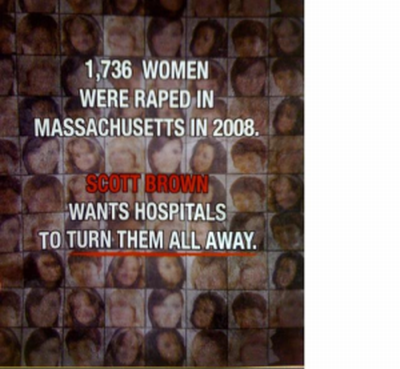
The charge against Scott Brown made above is a follow up to the one the Democrats in Massachusetts are making today in a mailer:

1-6

The justification for this outrageously exaggerated, and deliberately falsified charge is that Brown voted for a provision that would allow hospital workers not to inform rape victims of the availability of the “Morning After” pill if their religious convictions prevented them from doing so.

Not exactly - or even remotely similar to - “turning away” rape victims from hospitals but hey! Who’s keeping track, right?

A side note of reality; there has never been a recorded instance of any hospital worker refusing to give the morning after pill to a rape victim if it was requested. In fact, those workers who are uncomfortable informing rape victims of this option invariably bring someone else into the consultation who will. That’s the way the system works and the Democrat’s ad is as much an indictment of hospital workers with religious convictions as it is Brown.

Now, if you’re a Republican, it does absolutely no good to condemn this ad. That’s because some mouth breathing, thumb sucking liberal will come back and throw up the equivalency thing in your face. Never mind that it takes someone with the mind of a 5 year old to essentially say, “Yeah, well yous guys does it too - and worse!” No matter. What counts is that nothing Democrats ever do is worse than any one thing a Republican has done. I will faint dead away if a Democrat were ever to categorically and without reservation or qualification condemn an ad like this.

This is the way of the world as it is perceived in the “reality based community.”

Correction:

Apparently, I was wrong about there not being any instances of health care workers denying morning after pills or contraception to patients out of conscience.

As a pro-choice humanist with great respect for the individual’s exercise of conscience - on both sides of the issue - it was my understanding that states where this “conscience law” was in force had urged medical facilities to develop guidelines for everyone from intake clerks to doctors and pharmacists on what to do when confronted with a case where their religious convictions conflicted with the patient’s right to receive the care they desired. The goal was to satisfy both needs and this was accomplished by, where possible, allowing other medical workers to handle the case or, referring the patient to another provider who would.

Of course, in Coakley’s world, it is sneeringly believed that if you hold those religious beliefs, you shouldn’t work in an emergency room. I personally think that if Coakley believes that, she shouldn’t be a politician.

Oh, wait…that’s right.

5 HEALTH CARE REFORM SCENARIOS IF BROWN WINS

Filed under: Blogging, Decision '08, Government, Politics, health care reform — Rick Moran @ 10:37 am

The panicked Democrats are thrashing about trying to come up with a way to save health care reform if Republican Scott Brown wins the special election in Massachusetts on Tuesday to fill Ted Kennedy’s seat.

The first scenario involves challenging the results of the election, no matter how much Brown wins by. The Democrats have already deployed their crack team of election law lawyers who will attempt to muck up the process of counting the ballots, challenging machine counts, trying to force a recount if the result is close enough, and generally throwing a monkey wrench into the proceedings.

The Massachusetts Secretary of State must certify the results within 10 days of the election. That means it’s likely that the earliest Brown could be seated would be January 29 - barring challenges to the vote. It would only be earlier if the Democrats in the senate agreed to swearing Brown in before certification - good luck with that one.

If a Brown victory is within the 3-5% margin, it will be days, perhaps weeks before he is sworn in. The watchword will be “Delay” and if it’s close enough, they will probably succeed in keeping the caretaker senator Paul Kirk in his seat until health care reform is safely passed which, according to ABC’s Rick Klein, won’t be until February 2 at the earliest.

But suppose Brown wins by a large margin or the Democrats run out of challenges before reform is passed? Then things can get a little sticky.

Jonathan Chait at TNR:

As the likelihood grows that Republicans could win the special election in Massachusetts, it’s worth thinking again about alternatives for health care reform in case that happens. I see three, in descending order of preference:1. Finish up the House-Senate negotiations quickly and hold a vote before Scott Brown is seated. Republicans will scream, but how could they scream any louder? It’s a process argument of murky merits that will be long forgotten by November.

2. Get the House to pass the Senate bill, and maybe use a reconciliation bill (which only needs a Senate majority to pass) to implement as many House-Senate compromises as possible.

Option #3 is to flip Olympia Snowe. The Maine senator may very well end up voting for the revised package since, according to Chait, all of her concerns about the bill have been met. Her calculation now is purely political; how badly does she want to remain in the Republican party?

Mainer Andrew Ian Dodge insists that Snowe is never likely to bolt the GOP in Maine, even if the national Republicans would strip her of her seniority or punish her in other ways. But former Vermont Senator Jim Jeffords bolted for a lot less than the Dems would offer Snowe to switch parties. It is a distinct possibility given the alternatives.

Obviously, #3 would be the preferred route. The fact that #1 is almost certainly off the table giving the time period I mentioned above, the only other option is to blow up the senate by using reconciliation to pass reform.

If the Democrats were to employ reconciliation in getting health care reform passed, the Republicans would have no choice but to bring the senate to a standstill. If they didn’t, the Democrats would be able to ride roughshod over them for the rest of the year, not to mention destroying the principle of minority rights. It is a scorched earth option that the Democrats use at their own peril.

The only other option the Democrats have is to vote to get rid of the filibuster entirely. This, I don’t see happening. Saner heads in the party realize that they will not always be in the majority and that the filibuster is a useful tool to block legislation. Besides, they would need a supermajority to change the rules of the senate which means several Republicans would have to go along with the scheme - not very likely.

The most likely scenario? If Scott Brown pulls off the upset and is seated before health care reform is passed, I think reform will die. It may not even be able to pass the House as a couple of dozen members take note of what happened in the most Democratic state in the union and resist voting for this unpopular monstrosity of a health care reform measure.

Welcome news, indeed. But first, Brown has to win.

This blog post originally appears in The American Thinker

1/15/2010

WHAT HUFFPO’S BILL QUIGLEY WON’T TELL YOU ABOUT HAITI

Filed under: Decision '08, Politics, WORLD POLITICS — Rick Moran @ 11:20 am

You’ve heard of “Blame America First” when it comes to the man-made problems of the world. Such may not usually be true but it sure sounds good if you’re a liberal - makes you seem smart and informed.

Bill Quigley writing in Huffington Post has taken this concept to an entirely new level; he posits the notion that what is happening in Haiti as a result of the earthquake is actually America’s fault:

In 2004, the U.S. assisted in a coup against the democratically elected President of Haiti, Jean Bertrand Aristide. This continues a long tradition of the U.S. deciding who will rule the poorest country in the hemisphere. No government lasts in Haiti without U.S. approval.

In 2001, when the U.S. was mad at the President of Haiti, the U.S. successfully led an effort to freeze $148 million in already-approved loans and many hundreds of millions more of potential loans from the Inter-American Development Bank to Haiti. Funds which were dedicated to improve education, public health and roads.

For much of 2001-2004, the U.S. insisted that any international funds sent to Haiti had to go through non-governmental organizations. Funds that would have provided government services were re-routed thus shrinking the ability of the government to provide aid.

For years the U.S. has helped ruin small farmers in Haiti by dumping heavily subsidized U.S. rice on their market making it extremely difficult for small farmers to survive. This was done to help U.S. farmers. Haitian farmers? They don’t vote in the U.S.

Those who visit Haiti will confirm that the biggest SUVs in Port au Prince are plastered with decals of non-governmental organizations. The biggest offices are for private groups doing the basic work of government - healthcare, education, disaster response. And all are guarded not by police but by private heavily-militarized security.

The government was systematically starved of funds. The public sector shrank away. Poor people streamed to the cities.

Thus there are no rescue units. Little public healthcare is available.

So when disaster struck, the people of Haiti were on their own. We can see them pitching in. We can see them trying. They are courageous and generous and innovative, but volunteers cannot replace government. So people suffer and die in greater numbers than necessary.

Is all of this the fault of the US?

Let’s examine what Mr. Quigley won’t tell you about much of that most helpful information he supplied. Little wonder, since if he had, he would have been forced to acknowledge that the US (with the agreement of the international community) was doing its best to assist Haiti in overcoming extraordinary hurdles just to keep the country from falling completely into an abyss of corruption and chaos.

You might immediately note that Mr. Quigley had little to say about the “democratically elected” leader of Haiti, Jean Bertrand Aristide. If you are trying to blame the US for what is happening in Haiti, it is best not to supply too much information about the “little priest” whose thugs used to roam the streets of Port au Prince placing burning tires around the necks of his political opponents.

Aristide’s first chance at power in 1991 started out well, with the full backing of the United States. But a parliamentary crisis led to Aristide believing he could rule by decree and he was summarily ousted by the military.

Bill Clinton righted the situation by forcing the military out and reinstating him, backing the Haitian president with American troops. But all of this was simply prologue to what happened in 2000. Aristide’s campaign of massive violence against the opposition caused a boycott of the elections and when his opponents protested, they were arrested or, more often, simply killed. Aristide himself was a accused of ordering assassinations. The police were helpless as Aristide’s gangs wandered the streets with impunity.

The elections was pronounced fraudulent by the OAS, no bastion of pro-American sentiment. Finally, in 2004, Aristide angered enough people that a bloody coup occurred. He maintains to this day that he as kidnapped by the US and ended up in South Africa. If so, we did the Haitian people a monumental favor.

So much for the “democratically elected leader” of Haiti.

What about all that foreign aid we’ve cut off or funneled to NGO’s? Mr. Quigley’s screed is a little short on details. Allow me to remedy that.

In 2006, Haiti was named the most corrupt nation on planet earth. Any foreign aid sent to Haiti had a better chance of sprouting wings and flying than ending up helping any Haitians. The elites in Haiti and family cronies make sure of that, enriching themselves by siphoning aid into ventures they control or own outright.

One thing not mentioned by Mr. Quigley; that corruption contributed to the vastness of the disaster because most of the buildings in Haiti are so poorly constructed due to short cuts taken by contractors who then pocket the difference:

The death toll in the massive 7.0 magnitude earthquake in Haiti Jan. 12 is expected to continue to rise in the coming days, likely in large part because of corruption and resulting shoddy construction practices in the poor Caribbean nation, according to a University of Colorado at Boulder seismologist.

[...]

Bilham said one of the chief causes of the high destruction and fatality rates in Haiti and other developing countries is due in large part to corruption in the construction industry. One of the problems is bribery, which often takes the form of corrupt awards of construction projects, corrupt issuance of permits and approval documents and corrupt inspection practices.

“It should be appalling to the people of the world that in 2009, more than 100 years after earthquake-resistant construction began to be understood and implemented by engineers, that it is possible to forecast large numbers of future earthquake fatalities from the collapse of cities,” said Bilham in his 2009 Mallet-Milne Lecture to earthquake engineers at The Society for Earthquake and Civil Engineering Dynamics meeting in London.

Quigley probably didn’t bring this up in the article because there’s no way to blame America for it.

Yes, but what about all that foreign aid we’ve cut off? What about allowing NGO’s to distribute the aid?

Bush critics complain that Aristide wasn’t given enough aid. By the end almost all assistance to Haiti was being funneled through nongovernmental groups, because no one trusted the government. The OAS and the European Union, especially the French, didn’t want to hand aid over to a corrupt regime. The United States withheld certain aid, but didn’t cut it off entirely ($71 million in bilateral aid last year), continuing a stream of assistance that has been generous by any standard.

Since 1994, the United States has spent $850 million on Haiti. If you count money spent on U.S. troops in the country and on repatriation of refugees, the figure is roughly $3 billion. “If that’s not a commitment to a country, I don’t know what is,” says a senior administration official.

Quigley conveniently uses the year 2004 to complain about aid cutoffs to Haiti. In fact, from 2004-06, the US sent $230 million in developmental aid to that nation. The 2008 regular foreign aid appropriation was $287 million which doesn’t include another $45 million in food aid.

The idea that the only reason we withheld aid in 2001-2004 was because we were “mad” at the Haitian president is laughably childish. People were being murdered in the streets, chaos and corruption reigned in government, and Quigley wanted to continue business as usual? It wasn’t just America, either. The international community made most of these determinations based on the realistic notion that any money sent to Haiti would be used to enrich the ruling elite and not end up helping the people. That’s the bottom line, Quigley’s ignorance - or deliberate obfuscation of the facts - notwithstanding.

And Quigley may be the only lefty in America who begrudge poor people saving a few cents per pound on rice. An unfortunate by product of this is the flight from rural areas of farmers who can’t compete. We’ve seen the same thing in Africa and Asia as globalization makes its uneven and problematic journey around the world. There may be cause for criticism for subsidizing rice growers in the US. But to make the preposterous leap of logic that more people died as a result of US policy is a monumental stretch that even a high school debater wouldn’t make. It sounds logical but there is no empirical evidence that remotely supports it.

Perhaps Mr. Quigley wrote his article as satire. Morel likely, he’s simply an ignorant twit who cherry picked information that he thought would make his case that America is to blame for the large numbers of dead as a result of this tragedy.

Trying to draw attention to yourself by using a catastrophe to make an invalid, and ultimately silly point that you know will play well with those already disposed to believe the worst about their own country may be the height of cynical self promotion. Congratulations are in order for Mr. Quigley. He lived down to all the lowered expectations we’ve come to expect from most writers at Huffington Post.

1/14/2010

REPORTS ON THE DEATH OF CULTURE 11 HAVE BEEN GREATLY EXAGGERATED

Filed under: Decision '08, Politics, conservative reform — Rick Moran @ 12:05 pm

This is the second and final part of my effort to explain why much of conservatism has lost touch with reality. Part I is here.

When I was a younger man, living and working in the early years of Reagan’s Washington, I fell in with a group of guys who mixed penny ante poker nights with discussions of politics and political philosophy.

We were not the Algonquin Round Table, that’s for sure. But in between the sounds of ice clinking in glasses filled with good scotch, and chips being tossed into the pot, a colloquy of sorts would develop about the issues of the day.

I should mention that I was definitely on the low end of the scale when it came to brain power in this bunch. In our group were a couple of congressional aides, some crack lobbyists, an AEI fellow, and two guys who were studying for advanced degrees at George Washington University in Public Administration. I think the rest of them allowed me to hang around to provide comic relief. Otherwise, I was (at the time) royally outclassed.

No matter. My job, as I saw it, was to challenge the assumptions held by these bright young men by playing devil’s advocate in fleshing out the underlying rationale for their positions. More often than not, my attempts were met with groans of “here he goes again,” and not a few guffaws. But at the time, I was not very well read and couldn’t contribute to the scintillating arguments being advanced by my more learned colleagues.

These were exciting times in Washington. The intellectual ferment on the right was incredible with ideas and proposals bubbling and frothing at think tanks, policy hubs, and even bull sessions like the one with which I was involved. There was a lot of cross pollination of ideas as a proposal from one source would be captured by another, improved upon, and perhaps even fiddled with by a third before ending up in Congress or the White House as a serious policy alternative.

The bottom line is that there were no litmus tests, no question of being forced to conform to a certain worldview. The open, free exchange of ideas was done without fear that someone else would step forward and accuse you of not being “conservative enough.” The arguments back then were no less passionate, but there was an underlying respect for those with which you disagreed.

I may be romanticizing this period a bit but I think that essentially, this captures the spirit in conservative salons and other centers of thought at the time. With no internet, and only a few media outlets (NRO and Human Events being most prominent), the dynamic of discussion allowed for a free wheeling exploration of issues and principles from all angles. The idea that anything proposed or said might brand one an “apostate” never entered our thought processes.

Is the state of conservatism today even remotely similar? I would challenge anyone who thought so. The dead hand of conformity has settled over conservatism with consequences that have yet to fully play out. There is no room in modern conservatism for anything except rote ideology. This catechism brooks no deviation lest any introspection reveal how weak and wildly contradictory what passes for conservative thought has become.

Case in point; my inclusion of some criticisms by liberal Sam Tannenhaus in my piece from yesterday. Apparently, my belief that Tannenhaus has anything useful to say with regard to conservatism makes me some kind of closet liberal. The feeling among some conservatives appears to be that anything written about conservatism by any liberal is useless, and believing otherwise makes one a dupe, or worse.

I don’t know how widespread that belief is on the right but judging by comments I have received in the past, it is not uncommon at all. Rejecting criticism based solely on the ideology of an author is anti-intellectual and anti-reason. Despite making the point that Tannehaus - someone who I believe to have made an honest attempt to track the decline of conservatism in a systematic, logical manner - gives us a critique that overall, is seriously flawed. But does this mean that every single criticism he made was invalid simply because he’s a liberal?

I reject that notion and point to this response of some conservatives as evidence that the excessively ideological prism by which many on the right look at the world causes them to abandon reason and logic, substituting a comforting credo that cannot be amended.

Liberals have their own problems along this line. Rigidity of thought is not confined to those on the right. But this attitude still begs the question; can anything be done by anybody to lift conservatism out of this moribund state and set it on a path to where it can claim the high ground based on honesty, prudence, and a clear eyed view of the world as it truly is?

I believe there is hope to be found in a small group of very smart, very talented younger conservatives who may be able to bridge the divide in conservatism’s factions while re-establishing a reality-based paradigm that sees America as the rest of the non-conservative country sees her.

As an example, I would point to the deceased website Culture 11 as a place were young writers were nurtured and given a chance to flex their intellects to delve into subjects you rarely see discussed on blogs or other conservative media. The site was provocative, unconventional, and scandalously unorthodox. They even had the occasional liberal write for them, which raised the hackles of true conservatives everywhere.

I realize I am heading into dangerous territory by bringing up Culture 11. Some of the writers at the site regularly challenged conservative dogma - a mortal sin to many on the right who hate having their assumptions questioned by anyone, even a conservative. And Culture 11 writers like Conor Friedersdorf and James Poulos are are in bad odor with most who consider themselves “real” conservatives, largely because they sometimes speak well of liberals and take a decidedly less ideological approach to their writings.

But Culture 11 had huge problems that it could never overcome; first and foremost, they could never quite figure out what kind of publication they wanted to be. Failure flowed from that one premise, as this autopsy by Washington Monthly’s Charles Homans points out:

This had a lot to do with the fact that Culture11’s editorial brain trust was made up of people who had little concern for—or at least needed a breather from—the self-immolating Hindenburg of movement conservatism. Kuo had proclaimed his own disenchantment in Tempting Faith. Friedersdorf was concerned with improving journalism, not creating a permanent Republican majority. Political editor James Poulos, a PhD candidate in government at Georgetown who describes his dissertation subject as “the alluring puzzle of the Napoleonic soul,” was far too idiosyncratic in his own politics. Arts editor Peter Suderman was a libertarian who in the last frenzied days of the election spent a whole column arguing that voting was stupid. Having no claim to any particular ideological niche, Culture11 tried to corral them all in the same room and get them talking to each other. “People talk about the conservative circular firing squad—I think we see ourselves as a demilitarized zone,” Friedersdorf told me. “There is nothing like an agreement on our staff that would allow us to claim a slice of anything.” The result, perhaps inevitably, lacked a real sense of identity, but it also offered the closest thing political journalism had to a controlled experiment.

In such a free wheeling atmosphere, quality was bound to be uneven. But what excited me about Culture 11 was that a real attempt was being made to break out of the echo chamber conservative media had largely become. The writing was fresh, and the ideas presented challenged conventional wisdom.

Admittedly, my own taste in cultural critiques tends more toward The New Criterion and its mix of policy and cultural criticism. But what kept me coming back to Culture 11 was that the writers were willing to take chances. In a conservative culture so addicted to conformity, it took some courage to place yourself outside the box and approach subject matter from an entirely new perspective.

Of course, this meant that many of those writers were given short shrift by mainstream conservatives. RedState eventually banned any links to the site which is inexplicable unless you realize that this kind of anti-intellectualism is rampant on the right today. Refusing to be exposed to alternative viewpoints is the essence of ignorance and only proves my point again about a large portion of conservatism being out of touch with reality.

Ross Douthat believes that younger conservative writers tend to me more heterodox, less wedded to the ideology of movement conservatives:

Moreover, part of what creates the air of heterodoxy among the young turks is the fact that many of the young conservative writers I’m thinking of (again, myself included) are still experimenting with a wide range of topics, and haven’t settled into the kind of groove (or rut) that most successful pundits and public intellectuals eventually find themselves slipping into. In this sense, at least some of the ideological conformity that you see among old older right-wingers on, say, foreign policy is really just ideological conformity among those older right-wingers who dilate regularly about foreign policy.

What makes some of these younger conservatives different than their elders isn’t their position on issues, which is decidedly conservative, but rather their willingness to examine and criticize assumptions upon which those issues rest. This imparts a breath of fresh air much needed if conservatives are to return to their roots, embrace freedom of thought, and move beyond the narrow confines that conservatism has boxed itself into by rejecting reason and logic in favor of emotionalism and ideology.

The Culture 11 writers have scattered to the 4 winds with some moving on to smaller publications like Reason Magazine or The American Conservative. Friedersdorf and a couple of other Culture 11 alumni are now blogging at American Scene, among other places. But their impact will continue to be felt. It may take a decade or more, but eventually these and other writers will take their place in the forefront of conservative thought.

Will they be any more welcome then than they are today? A couple of more electoral smash ups like 2008 may be the catalyst that shakes conservatism out of its conformist stupor and forces the right to begin listening to those with a more realistic outlook on America and conservatism itself.

1/12/2010

WHY CONSERVATISM IS DISCONNECTED FROM REALITY

Filed under: Culture, Decision '08, General, History, Politics, Tenth Amendment, conservative reform — Rick Moran @ 11:20 am

Another in my series of puny attempts to dissect what’s wrong with modern conservatism. Part II will appear tomorrow.

I debated whether or not to make this a piece about “some conservatives” eschewing reality for an alternate universe or if I should make it about much of modern conservatism’s disconnect from the reality of 21st century America.

In the end, I think it is more important to look at how conservatism as a philosophy has closed itself off so thoroughly from uncomfortable and inconvenient truths about America. The fringe players in the movement with their litmus tests and dreams of going bear hunting with Sarah Palin are not really the problem as I see it.

Their worldview, shaped as it is by wallowing in the echo chamber of conservative media, and warped by a naive and ultimately uninformed ideological prism through which they spout nonsensical, paranoid conspiracies, may be relevant to the political health of the right but has little to do with the breakdown of conservatism as a governing philosophy itself.

In this case, it is conservatism losing its ability to question itself in a rigorous and punishing manner, preferring to maintain a comfort zone in which certain shibboleths of the past rest easily on the mind and prevent the kind of examination of underlying assumptions that any set of philosophical principles needs to maintain touch with the real world.

One might argue that the problem is really with people who hold to those philosophical principles and their refusal to challenge their beliefs. I don’t think this is necessarily true. You can’t sneeze these days without tripping over someone on the right indulging in the kind of “Woe is us” pontificating. I should know. I do it often enough. One would think with all this angst, some truths about why conservatism is where it is today and how it got there would emerge. So far, I have been unimpressed.

There have been some valiant attempts, most notably after Sam Tannenhaus’s Death of Conservatism was published. Rejecting much of Tannenhaus’s critique (as most conservatives should), the author nevertheless wallops a couple of extra base hits while socking at least one, long home run in his analysis; that modern movement conservatism isn’t very conservative at all in that it seeks to overthrow the social order rather than conserve what is best about America while channeling change into productive venues consistent with tradition and the Constitution.

Tannenhaus refers to these right wingers as “revanchists.” Indeed, there is a strong impulse even among so called “reasonable conservatives” that FDR’s New Deal and Johnson’s Great Society need to be repealed or drastically curtailed. In it’s place? There things get kind of fuzzy but what emerges from many conservatives is some kind of “super federalism” where a souped up 10th Amendment would give us 50 different EPA’s or worse, where “market forces” would solve the problems of clean air and clean water.

That’s just one example, of course. And I should hasten to add that any good conservative supports a reasonable brand of federalism, not to mention a prudent regard for liberty and the taxpayer’s money that would force us to question the efficacy of hundreds if not thousands of federal programs. But, what many of the revanchists seek is not a “return” to first principles in the Constitution but rather a form of government more akin to an Articles of Confederation on steroids.

Another Tannenhaus point scored deals with the notion that movement conservatives positively hate government - government of any kind. It goes far beyond the healthy suspicion that all conservatives should possess of the positive impact government programs can have on society, and devolves into paranoia about any government program or effort to address stubborn national problems.

Here is where conservatism itself goes off the rails and feeds this paranoia, preventing conservative ideas from being brought to bear on national issues like health care, immigration, loss of industry, globalization, and adequate, sensible regulation of everything from financial institutions to the environment.

For it is not necessarily people who have become hostile to government but rather conservatism as a governing philosophy that has walled itself into a corner, refusing to confront a modern America that is less white, less agrarian, more urbanized, more technical, and developing a growing tolerance for government solutions to prickly, systemic problems experienced by ordinary Americans.

That last is the killer. Since the end of World War II and the rise of modern conservatism, it is been de rigueur for the right to promote the idea that government can be cut down to size, shrunk to an ill-defined outline that bears more of a resemblance to 19th century America than a modern society with all the miseries and challenges that reality entails.

The thrust of conservative critiques of the welfare state from Hayek to Kirk to Reagan has been that government is bigger than it should be as a result of it trying to do more than is necessary for the functioning of a constitutional republic. Indeed, a strict constructionist reading of the Constitution would cause anyone to question the manufactured justifications for everything from overly zealous government interference in commerce to the legislating of cultural issues from the bench. Conservatives rightly believe that “original intent” are not dirty words and that First Principles are in many ways as valid today as they were 220 years ago.

But over the decades, conservatism lost its flexibility in delineating a coarse ideology from this philosophy. By this I mean that conservatism has eschewed thoughtfulness for conformity. I’m not sure if you can actually pinpoint a moment where ideology trumped reason, although my personal line in the sand was the 1992 Republican convention and the rise of the culture warriors.

But that may have been the denouement to a decade or more of slow rot eating away at the foundations of a carefully nurtured worldview that fought for principle while recognizing that America was changing and that conservatism as a governing philosophy must change with it. The idea of reforming government - Reagan’s grand notion of a New Federalism, lower taxes, fewer regulations, and freer people - died in the fires of a cultural backlash that has come to define modern conservatism.

This is where conservatism lost touch with reality. The moment that the war itself became more important than the principles espoused, all semblance of rationality was tossed out the window and in its stead arose a mindless, knee jerk opposition to government and, of course, the left. As the living embodiment of Big Government, liberals became an enemy and not the political opposition. Rather than fighting to apply conservative principles to the art and artifice of government, the right chose to immolate reason, and turn its back on the reality of modern American in order to destroy their enemies.

As practiced by the most influential conservatives today, this is what passes for conservative thought. Tannenhaus correctly surmised that movement conservatism has won the battle against the pragmatists and now dominates the conservative discussion. I don’t agree with what he believes this fact necessarily portends for the future - a continued decline in influence and relevance of the right. In fact, as I will show tomorrow, there is cause for some hope that younger, more intellectually muscular conservatives who are questioning everything while searching for a new conservative paradigm that would re-integrate movement conservatives into a re-energized whole, may be the beginning of a conservative revival.

Tomorrow: Reports of the death of Culture 11 have been greatly exaggerated.

« Older PostsNewer Posts »

Powered by WordPress