Right Wing Nut House

5/30/2005

MEMORIAL DAY AND GENERAL LOGAN
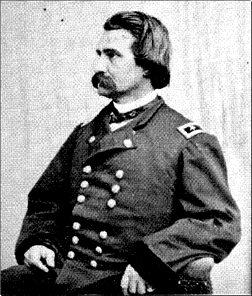
Filed under: History — Rick Moran @ 6:07 am


GENERAL JOHN A. LOGAN

Congressman John Logan was angry. His party, the Democrats, had just lost the election of 1860 to Abe Lincoln and the Republicans. But his opposition to the fire eaters of the South who were agitating for secession had incurred the wrath of men who just recently had called him a “son of the South.” In a speech on the floor of the House, Logan warned his Southern colleagues that if they persisted in their folly, the union would crush them. He returned to his district and gave a speech at Marion, Illinois that today is widely seen as helping keep that vital part of Illinois - “little Egypt” - loyal to the Union.

Resigning from Congress, he was one of a handful of Democratic lawmakers that fought on the Union side during the war. Most of these political officers were a disaster. Benjamin Butler, for instance, was a Massachusetts Democrat whose ineptitude as a soldier was surpassed only by his incompetence as an administrator. While overseeing the military occupation of New Orleans, Butler issued the infamous “General Order #28″ that stipulated that “any female shall, by word, gesture, or movement, insult or show contempt for any officer or soldier of the United States, she shall be regarded and held liable to be treated as a woman of the town plying her avocation.”

Other political generals were equally unfit for command and ended up costing thousands of lives because of their incompetent leadership. But not so John Logan.

Logan organized a regiment of volunteers and was named a Colonel. Immediately distinguishing himself on the field of battle, Logan made it his business to study the art of war. Attached to the Army of the Tennessee, General Grant recognized Logan’s leadership ability and promoted him to General. He played a key role in the victory at Raymond, Mississippi that cleared the way for Grant’s march to Vicksburg and eventual capture of that vital city.

When Grant moved North to take command of the Union armies, Sherman, who had nothing but disdain for political generals, took over the Army of the Tennessee. But after seeing Logan in action during the Battle of Atlanta, Sherman was impressed enough to give Logan command of the entire left wing of his army on its march to the sea. Again, Logan distinguished himself as he fought off whatever resistance the South could throw at Sherman as he devastated the countryside.

Popular with the men under his command, Logan was a rarity - a commander the men could trust. They sensed his concern for their welfare as Logan made it a habit of visiting the company mess to taste the food himself. If he found it inadequate, he’d dress down the company commander and order him to fix the situation. Usually it was something simple like changing cooks or cleaning the cooking pots once and a while. In addition, Logan made sure the men under his command were properly supplied with shoes, blankets, and other necessities that kept the men comfortable during winter months.

Logan’s concern for his men was evident after the war as well. Elected to Congress again in 1866, Logan took part in the first memorial day observance in Illinois. It’s thought that Logan became especially interested in the issue of a decoration day for the nation following a gesture by the women of Columbia, Mississippi who, during a remembrance for the dead, placed flowers on the graves of both Union and Southern soldiers. Logan had fought with Grant at the battle of Columbia and remembered well the hatred of civilians toward the Union Army. Horace Greeley wrote a famous editorial about the Columbian women and Francis Miles Finch wrote a beautiful poem for the Atlantic Monthly entitled “The Blue and the Grey.”

Logan’s popularity with the men paid off when he was named Commander in Chief of the Grand Army of the Republic (GAR). In 1868 he issued his famous general order that designated May 30th as Decoration Day “for the purpose of strewing with flowers or otherwise decorating the graves of comrades who died in defense of their country during the late rebellion, and whose bodies now lie in almost every city, village, and hamlet churchyard in the land.”

Because of Logan’s leadership, the GAR grew into the most influential voting bloc in the Republican party. For more than 30 years, no Republican could get the Presidential nomination without the support of the GAR. At it’s peak, more than 400,000 veterans of the civil war were members. Their presence during parades and remembrances of that war became a source of inspiration to an entire generation of American historians and writers.

Logan would go on and be elected Senator and even be nominated on the 1884 Democratic ticket for Vice President. He was a strong advocate of public education and served on the Committee for Military Affairs. When he died in 1886, he lay in state in the Rotunda of the Capitol. Thousands of tearful veterans filed past his coffin to pay their last respects to the man they nicknamed “Blackjack.”

Some historians have taken a less than charitable view of Logan’s motivations for initiating Decoration Day. They point out that Logan probably used the holiday to promote his own political career. His bid for the Senate in 1871 played up his role in boosting the holiday and he never failed to remind audiences of his service in that regard.

However, Logan also wrote a loving tribute to his men in a book that came out after his death entitled The Volunteer Soldier in America which was written partly in response to U.S. Grant’s autobiography that criticized the performance of volunteers during the war.

John Logan didn’t come up with the idea of Memorial Day. But his generous inclusion of Southern dead in his General Order authorizing Decoration Day was a magnanimous gesture that helped heal the wounds of that conflict and bring us together as a nation.

It might not be a bad idea this Memorial Day to take a page from our forefathers and recognize that those on the other side of the debate of the War in Iraq mourn our losses as well. For this one day, let us be united in recognition of the service these brave men performed and the fact that no matter what you believe, they have given that “last full measure of devotion” to a grateful nation.

5/29/2005

SUNDAY SLUMMIN’

Filed under: Blogging — Rick Moran @ 5:41 pm

We’re slouching toward Memorial Day here at the House and yardwork has occupied most of my weekend. Sue is a radical green - gardner that is. By radical, I mean she’s the Ward Churchill of cucumbers, the Nancy Pelosi of Tomatos, and the Barbara Boxer of radishes.

Here’s me yesterday:

ME: Can’t we just like, you know, buy the frickin’ food at the grocery store? What’s the point of all this work? My back hurts like hell, I’ve got blisters on my hands from the damn shovel, and I think I feel my heart palpitating.

SUE: Just think how delicious it will taste!

ME: I’m thinking of the hospital bill if I get a heart attack!

SUE: (Laughs) I love you!

What man can resist the cold, unemotional logic of a woman?

More quickies from blogland.

Maggies Farm is tractor blogging. Huh? Just read it and laugh at that group of very strange, but very nice people. They seem like the sort of folks you’d want to live next door to but wonder if they don’t carry out some kind of weird Wiccan rituals from time to time. In the middle of the night. Naked.

Basil comes clean about his fake sites. One seriously wonders about all that talent locked up inside, ready to explode into some gigantic creative atomic blast that bathes the Shadow Media in an unearthly glow…

But then you look at his site and see he has a picture of himself as a baby. Where’s Sigmund, Carl, and Alfred when you need them?

Wuzzadem: I’m Monty McCain, America’s favorite deal-maker, and it’s time to play Let’s Make a Deal, where everyone is a winner. Let’s go out into our studio audience and find our first lucky contestant.

Channeling Monty Hall is one thing…putting Robert “Sheets” Byrd with Barbara Boxer in the roll of contestants is nothing less than inspired genius.

The guys at Q & O are all over the non vote for the EU Constitution in France. And Llama Butchers has the Netscape market report on the disaster. Pretty graph showing the price going in the toilet the last few days.

God I hate the French! In this one instance though, I’m glad they have their heads so far up their tight little arses that they ruined one of the truly bad ideas in history - a united Europe. Individually, the Europeans are insufferable enough. Can you imagine a whole continent of obscenely self righteous, cynical, lazy, disdainful, anti-American dilettantes whose culture is decaying so fast that in 50 years it will be indistinguishable from the culture of the sheiks, imams, holy warriors, and mullahs of the middle east?

Makes my heart go pitter patter in anticipation.

Beth is doggy blogging. She’s also dog tired which might explain why she linked to Carnival of the Dogs twice in the same post. That’s right…she double linked Carnival of the Dogs. Another patient for Sigmund, Carl, and Alfred. (Did I link them already?)

I know it’s Sunday, but take a look at Mad Tech’s “WTF Friday Rant.”

I was disappointed that I was one of the only bloggers trying to write about the Lebanese elections held today. I say try because trying to make sense of that political muddle is a monumental task. Maybe it’s because there are no protest babes?

Not to worry. Publius Pundit knows what he’s talking about. And he’s got some great links. And he’s a got a picture of Lebanon’s entry for the Miss Universe pageant.

Who needs protest babes when you got eye candy like that?

Pat over at Brainsters puts Robert Kuttner over his knee and spanks him…hard:

You ever notice that economic populists all pine for the glory days of the Depression? So much so that they are constantly seeing just around the corner, like Paul Krugman, still holding out hope for his long-awaited double-dip? Is it because those were great times to be a working man in America? Obviously not. But they were great times to be an economic populist.

So much for blogging today. Maybe one post tomorrow as I wrestle with trying to plant flowers whose names I can’t pronounce and that I’m probably allergic to anyway.

DECISION ‘05: LEBANON

Filed under: WORLD POLITICS — Rick Moran @ 8:18 am

As the Lebanese people make their way to the polls today for the first round of parliamentary voting, the confusing muddle of regional and sectarian candidates has generated some ennui among the populace.

In some districts like Beirut, the opposition, led by Said Hariri (son of the late political icon) and the old Druze warlord Walid Jumblatt are united and virtually unopposed. In other districts, the opposition is fractured and contentious races involving other factions including Hizballah and the party led by former Prime Minister and political opportunist Michel Aoun expect to do well.

Here’s an excellent analysis on the strange bedfellows Lebanese politics has created in the last few weeks as both Hariri and Jumblatt seek to get the most out of the election:

The alliance between Saad Hariri and Hizb’allah’s Nasrallah was born out of a supposed deal struck between Nasrallah and the late Rafik Hariri just a week before his death. This deal was based on the notion that Hariri would not call on Hizb’allah to disarm personally, and Saad has affirmed this. Walid Jumblatt’s Progressive Socialist Party is also part of this alliance, and Nasrallah has urged his mainly Shiite followers to vote for Hariri’s lists in Beirut and Jumblatt’s lists in Aley-Baabda. In fact, many of the seats have gone uncontested and the opposition is likely to sweep them all. But Hizb’allah has also struck a sweet deal with another Shiite bloc, Amal, in order to retain total dominance of the South and likely Beqaa.

At bottom, is the electoral law written with the Syrian’s blessing and passed in 2001 that guarantees the various factions a certain number of seats. But the divisions in Lebanese politics go deeper than religion as this analysis points out:

The categories of “Muslim” and “Christian” are all but meaningless politically in Lebanon. The system is not based on the representation of “Muslims” and “Christians.” This is legally wrong, and assumes that “Muslims” are a monolithic, coherent political cluster, and the same goes for Christians. In reality, each one is divided into several sects, which are in turn divided into subcategories (families, regions, political inclination, etc.). Those are the divisions that count and are reflected in parliament and in the elections. The corollary to that are the alliances in the election and in parliament, which create what’s known as “real representation.” In part, this was the complaint of some in the Christian circles, that some “Christian” candidates on certain lists were really the choice of the dominant political figure or alliance in that particular district, as opposed to being the choice of the Christian voters (or certain Christian parties). In that sense, that particular Christian candidate will for the most part be allied in parliament with the non-Christian figure/list on which he ran. Of

These “lists” of candidates worked out in advance by political foes seek to bring some order to the chaos so that vote splitting between the many parties are kept to a minimun. To make up these lists, especially in areas where there’s fierce electoral competition, temporary electoral alliances are forged between parties that are likely to be at each other’s throats when parliament convenes.

Then, there’s the political wildcard represented by General Aoun whose last minute pullout from the Qornet Shehwan Gathering, the main Christian opposition group, has upset the applecart:

In Baabda-Aley, the Chouf, Metn and the North, Aoun will now challenge Jumblatt, Hariri and the scattered Christian parties. Even if these developments do not cause a complete upset (as no one truly expects they will), the unexpected shift has made the race too close to call.

Aoun had allied his FPM with Talal Arslan’s Lebanese Democratic Party, which will run alone against Jumblatt in the Chouf following the voluntary withdrawal of General Issam Abu Jamra to advance the chances of Arslan’s second-in-command, Marwan Abu Fadel, whereas Dory Chamoun and the Syrian Social National Party were excluded from this coalition.

Don’t worry. It gets even more confusing.

Aoun, who’s something of an anti-Syrian icon has made common cause with Talal Arslan’s pro-Syrian LDP. Arslan is a rival of Walid Jumblatt and expects to run well in the North. For Aoun, it was a case of having to align himself with someone and Arslan was about all that was left. Jumblatt has criticised Aoun for weakening the opposition at a crucial moment but in reality, the colorful former head of the Lebanese armed forces had little choice if he wanted to be a player in the new government.

And then there’s Hizballah. The US considers the “Party of God” to be a terrorist group. Indeed, the leader of the radicals, Secretary General Sayyed Hassan Nasrallah, recently bragged that his armed militia has 12,000 rockets aimed at Israel. And while UN Resolution 1599 urging the election called for disarming Hizballah, no prominent politician - including Hariri and Jumblatt - have done so. While tactically necessary, both men will be under pressure from the United States and the west after the elections to negotiate Hizballah’s disarming.

In a recent speech, Nasrallah seemed to lay out the conditions necessary for disarmament:

Hizbullah Secretary General Sayyed Hassan Nasrallah’s fiery Liberation Day comments Wednesday in Bint Jbeil come in this context. Nasrallah linked Hizbullah’s disarmament with achievement of a peace settlement in the region and asserted the party will fight to the death anyone who thinks about disarming the resistance by force.

He urged parties that established contacts with Israel in the past and relied on the U.S. not to do so again, and suggested they reach an understanding with their local partners instead, including Hizbullah.

Tying disarmament to a general middle east peace deal would seem to be bad news. Some observers however, thought they saw a little give in Nasrallah’s remarks:

Nasrallah gave Hizbullah’s weapons a regional function when he linked disarming to the settlement of the Israeli-Palestinian conflict and not to Israel’s withdrawal from the Shebaa Farms.

Nasrallah’s speech came at a time when some Western ambassadors are polling opinions of Lebanese officials and leaders regarding implementation of the clause in UN Resolution 1559 related to disarming Hizbullah.

In other words, Nasrallah may have left the door open for the militia’s integration into the Lebanese armed forces, a solution that’s been mentioned by all the major opposition candidates.

Three other rounds in the electoral process are scheduled. It remains to be seen whether these electoral alliances will lead to a stable, independent Lebanese government or if the sectarianism and factionalism of the past will lead to chaos.

With so much at stake and with the “Cedar Revolution” still fresh in their minds, there’s a good chance that the participants will put aside their many differences and reach an equitable solution - one that embraces Lebanon’s political diversity and religious differences.

5/28/2005

WHAT DO WE DO ABOUT LUIS POSADA CARRILES?

Filed under: War on Terror — Rick Moran @ 8:30 am

There isn’t much doubt that former anti-Castro Cuban exile Luis Posada Carriles is a terrorist. There also isn’t much doubt that Posada is privy to some of the dirtiest secrets of our intelligence community. Working with the CIA from the early 1960’s on, Posada has been a US intelligence asset until at least the late 1980’s when he apparently assisted Oliver North in running guns and supplies to the Contras in Nicaragua.

Posada’s most spectacular crime was blowing up a Cuban airliner in 1976 killing 73 people, including the teenage members of the Cuban National Fencing Team. Recently released documents from the FBI and elsewhere show that not only was Posada responsible for planning and executing the attack, but that the CIA had gotten wind of the plot and that an FBI agent in Caracas had met several times with one of the Venezuelan members of the conspiracy.

Did we know what Posada and his partner Orlando Bosch were up to and not warn the Cuban government of this imminent attack?

No wonder Castro is pissed.

After the attack on the airliner, Posada was arrested by Venezuelan security. Following two trials, both of which ended in his acquittal, Posada escaped custody in1985 by bribing his way out of Venezuela perhaps with American help. He immediately showed up in El Salvador where he went to work for Oliver North in the Contra supply operation. He apparently was also tangentially involved in organizing and training the Salvadoran “Death Squads” that wreaked havoc in that tiny country.

Mr. Carriles wasn’t finished. Posada admitted to a New York Times reporter, that he organized a wave of bombings in Cuba in 1997 that killed an Italian tourist and injured others. Then, in 2002 he was convicted in Panama of plotting to kill Castro. Outgoing Panamanian President Mireya Moscoso pardoned him. He has ties to the Cuban-American group CANF (Cuban-American National Foundation) members of which went on trial in the United States and were acquitted in 1999 of trying to kill Castro.

The 77 year old recently snuck into the United States and asked the government for asylum. When Fidel Castro and his stooge Venezuelan President Hugo Chavez got wind of this they were furious. Castro’s government organized “spontaneous” demonstrations against the US and blowhard Chavez went on Venezuelan TV and ranted for 4 hours about the US being hypocritical in fighting the war on terror.

He may have a point but 4 hours? I pity the Venezuelan people that they have to put up with this strutting, overblown peacock of a man who in a few short years has taken what was once one of the freest nations in the western hemisphere and turned it into a virtual prison.

Recently arrested on immigration charges, the Venezuelan government has asked that Posada be extradited so that he can stand trial a third time for blowing up the airliner. The initial request was rejected:

The Bush administration on Friday rejected Venezuela’s request for the arrest of Cuban exile Luis Posada Carriles so he can be returned to the South American country for trial.

Posada, a foe of Cuban President Fidel Castro, is wanted by Venezuelan authorities for his alleged role in the bombing of a Cuban passenger plane in 1976 that killed 73 people. The United States and Venezuela have had a strained relationship recently, with disagreements including the U.S. war in Iraq and Venezuela’s decision to buy Russian assault rifles.

Earlier this month, Venezuela asked the United States to arrest Posada as an initial step toward his eventual extradition there. Days after the request was received, U.S. authorities detained Posada on their own and charged him with illegal entry into the United States

The request was evidently denied on technical grounds. But this gambit won’t work forever. Sooner or later, the Bush Administration will have a decision to make. And that decision could have far reaching consequences for not only our standing in Latin America but also profoundly affect the War on Terror.

There’s no doubt this is a lose-lose situation for the American government. There quite simply can be no good outcome to their dilemma. If we hand the old terrorist over to Chavez, his secret police will go to work on him and probably extract some extraordinarily damaging information about his unholy deeds done on behalf of the American government during the last 40 years. The resulting firestorm would ignite protests from Mexico City to Havana and severely damage our already tarnished image in Latin America.

But if we grant Posada asylum or worse, send him to another country that doesn’t have an extradition treaty with Venezuela, we’ll either be guilty of harboring a terrorist or facilitating the escape of one. Either way, our credibility and ability to fight terrorism will take a huge hit. And if we send him to a third country that does have an extradition agreement with the Venezuelans, we’ll still be seen as hypocrites.

In this case, I think the Bush Administration is going to have to bite the bullet and hand Posada over to Chavez. Better the strutting peacock than the thug in Havana. Before honoring any extradition treaty with regards to Posada however, the Administration should get an assurance from Chavez that the Venezuelans will not hand him over to Castro. That would truly be a disastrous turn of events and must be prevented.

The Venezuelan judiciary is still semi-independent and would at least give Posada a fair trial - something that only a moonbat would think he’d get in Castro’s gulag.

It may be that the government won’t take this option and instead speed Posada on his way to a third country, possibly Panama. The Panamanians have already tried Posada but would probably turn him over to Venezuela themselves. In which case, we’ll only look like hypocrites - not very pleasant but the government may figure its a better alternative than having our dirty laundry hanging out all over Latin America.

Any alternative will do us no good in the short term in either our relations with Latin American countries or in the War on Terror. And while turning Posada over to Venezuela may seem like the worst option, I think in the long run it may do us some good. It will prove that we’re dead serious about terrorism. It will signal an openness that may eventually resonate with the Latin American people once the initial hub-bub dies down. And it may even have a salutatory effect in the middle east with our efforts at peace making and democracy building.

This is definitely a put-up or shut-up moment for the Bush Administration in its War on Terror. What course we choose will determine our credibility on the issue for years to come.

Cross Posted at Blogger New Network

DID WE JUST DODGE A TERRORISM BULLET?

Filed under: War on Terror — Rick Moran @ 6:08 am

The news of a bomb blast in eastern Indonesia that killed 19 people could mean that we thwarted an attack elsewhere; the U.S. embassy in Jakarta:

JAKARTA (Reuters) - Two bomb blasts ripped through a crowded market in a Christian town in eastern Indonesia on Saturday, killing 19 people in an attack likely to raise fears sectarian bloodshed could again break out in the region.

Police said the attacks occurred in the lakeside town of Tentena, on the eastern island of Sulawesi, part of an area where three years of Muslim-Christian clashes killed 2,000 people until a peace deal was agreed in late 2001.

Just yesterday, a security warning prompted the closing of our embassy in the Indonesian capitol and consulates elsewhere:

The US closed all of its diplomatic facilities in Indonesia today until further notice, citing an unspecified security threat.

The decision comes a week after Australia urged its citizens to avoid traveling to Indonesia because of a warning by police in Jakarta about possible suicide bombings, particularly at embassies, international schools, office buildings and shopping malls.

In an e-mailed statement, US officials said the American embassy in Jakarta would be closed along with the consulates in Surabaya, Medan and the island of Bali. Other American government offices would also be shuttered.

Could one of the terrorists original targets have been the embassy? While the violence in Indonesia is sectarian in nature as Christians battle Muslims, the radical islamists have targeted westerners in the past:

Attacks against Western targets and blamed on Jemaah Islamiah include blasts at Bali nightclubs in October 2002 that killed 202 people, mostly foreigners, and one last September outside the Australian embassy in Jakarta that killed 10.

When the history of the War on Terror is written a hundred years from now, historians will rely on information that today is highly classified. Only the terrorists and a select few in our intelligence community know for sure how many attacks have been thwarted. Last year, Representative Katherine Harris (R-FL) made headlines when she claimed that the US government had prevented over 100 terrorist attacks around the world:

On Monday, August 2, speaking at a rally for President Bush in Venice, Florida, Harris told the crowd that the administration had thwarted over 100 terrorist plots. She also claimed that “a plot existed to blow up the power grid in Carmel, Indiana,” the Associated Press reported.

The “Carmel” plot was denied by officials in that small, Indiana town. And to this day its not clear whether Harris was lying, exaggerating, or telling the truth. In the press frenzy that followed her remarks, she seemed genuinely sorry she had revealed something she shouldn’t have. Whether that “something” was information from a classified briefing or rumormongering by some government hack won’t be known for a long time.

These kind of dubious remarks have fueled the impression by some the terrorist threat is at best overblown or at worst, an nefarious plot by the Bush Administration to curtail civil liberties.

However, it seems probable that at least a dozen or more attacks have been thwarted in Europe:

Since 11 September 2001, at least 15 major terrorist attacks have been prevented in Europe, according to a Norwegian research institute.

In an interview with Radio Netherlands, a spokesman for the institute claims that all these attacks would have caused many casualties had they not been foiled.

And then there was the very real, very scary planned chemical attack in Jordan that was foiled at the last moment:

Officials close to the investigation told The Associated Press that several terror suspects arrested in Jordan last month have confessed the plots were hatched by Jordanian militant Abu-Musab al-Zarqawi (search), thought to be a close associate of Al Qaeda boss Usama bin Laden.

The officials, speaking on condition of anonymity, said the terrorist cell was planning to attack Jordan’s secret service — the General Intelligence Department — with a chemical bomb that would have killed as many as 20,000 people and caused large-scale destruction within a half-mile radius

So the war goes on. A silent, secret war with the highest possible stakes imaginable. It seems very possible that the sharing of intelligence by the Indonesian government with their American counterparts may have saved American lives today. The Bush Administration, as usual, doesn’t receive enough credit for this achievement in the War on Terror; intelligence swapping with dozens of countries around the world. But this may be the most important aspect in the ongoing battle with Islamic extremists.

And the hell of it is, we’ll never know of their successes. Only their failures.

Cross Posted at Blogger New Network

5/27/2005

WHERE BUSH WENT WRONG

Filed under: Politics — Rick Moran @ 1:20 pm

Alright, trolls. You’ve been bugging me for weeks to say something negative about President Bush and now you’re going to get your wish.

Somewhere in the archives is a post I did on blogger that will echo many of the same things I’m going to take the President to task for today. And scattered throughout other posts are various criticisms of the President’s profligate spending, his myopia on stem cell research, a general unhappiness with his catering to the fundamentalist wing of the Republican party, and a host of other minor annoyances that would prove to any fair person (liberals excluded) that I’ve got plenty to be upset about when it comes to the President’s policies.

Other center-right secularists like Bill Ardolino, Jeff Goldstein, John Cole, and Glenn Anderson have expressed similar dissatisfaction with the President. And while all of those worthies have said in the last month or so that they’re near the “tipping point” in their support for Bush, I’m not that close to joining them. Why?

I look at John Kerry, think of the alternative, and breathe a sigh of relief that it’s George Bush as President and not a man who would have entered office with a mandate to end the war.

That being said, George Bush has made a number of mistakes during his Presidency. Here, in my opinion, are just a few:

“WELL ARE WE AT WAR…OR AREN’T WE?”

That’s a question I asked during the first week this site was open. At that time, the terrorists were just beginning to step up their bombing campaign and the hell hounds in the media were baying at the President’s military strategy. My criticism, however, went back to early 2003 when it became clear that war with Iraq was a necessary adjunct to the war on terror.

My criticism had to do with the President’s entire approach to the coming conflict. I said at the time “it didn’t feel like we were going to war,” that the President didn’t step up to the plate and ask the American people to sacrifice anything, that indeed any sacrificing to be done would be borne by the armed forces and their families.

I realize now that the “cakewalk” theme was in vogue at the White House and the President didn’t think it necessary. But by May of 2004 when it became clear that the terrorists weren’t going away anytime soon, the President could have rallied the American people by abandoning much of his domestic agenda, slashing the budget, perhaps even (gasp! Here’s a novel idea)…) raising taxes to pay for the war.

It’s a good thing Bush didn’t listen to me. He would have been slaughtered in the November election.

That being said, I still feel the burden of this war is falling disproportionately on the military and their families. I think the President should have put everything else on the backburner in order to win this war. If that meant abandoning social security reform, so be it. What we have in Washington is too much “business as usual.” What we need is a sense of urgency. At the moment, we have North Korea and Iran on the horizon. Either one of those problems could lead to some kind of crisis that would involve the military. And with 125,000 of our best troops tied up in Iraq, this severely limits our options.

The President’s failure to rally the people and instead, depend on the 50% of us who couldn’t stomach the idea of Kerry’s wishy-washy internationalist approach to the conflict was the biggest mistake of his Presidency. He could have done better.

RUMMY HAS GOT TO GO

I admire the President’s sense of loyalty toward Secretary Rumsfeld but while he was throwing Colin Powell overboard he should have made it a clean sweep and dumped his defense secretary as well.

Now don’t get me wrong. I like Secretary Rumsfeld. He’s very smart. He’s got some capital ideas for altering our force structure to bring it in line with the realities of a post cold war world. And by and large, he was responsible for the war plan in Iraq that vanquished that army lickety-split. But he’s got to go. The reason? I’ll give you two words.

Abu Ghraib.

I’m with John Cole on this one. Someone has got to take ultimate responsibility for that fiasco as well as other abuse allegations that will soon come to light as the FBI, the Army, and other investigative bodies finish their probes into what appears to be isolated instances of torture and even death. I totally reject the moonbat argument that this torture was planned and carried out by the Administration, But that doesn’t lessen the responsibility of the civilian commander for these atrocities. There has also been a troubling lack of responsibility taken by commanders in the field, although ultimately this too would fall under the jurisdiction of the Secretary. He could have recommended the removal of any general officer under which these incidents of torture occurred. The fact that he didn’t shows a lack of understanding of how much real damage these incidents have done to use abroad.

This isn’t the way things used to be. Government officials used to take responsibility for screw-ups by resigning. The moonbats aren’t going to like this but you can trace this new attitude directly to President Bush’s predecessor.

Janet Reno may have been the most disastrous Attorney General in history. Not too many of her predecessors could have been charged with negligence that lead to the death of so many at Ruby Ridge and Waco. Either one of those disasters should have resulted in her immediate dismissal. As it is, the cover-ups involved in the incident at Waco (see the Academy Award nominee for Best Documentary Waco: Rules of Engagement) should have perhaps landed her in jail. Instead, Clinton kept her on despite the fact that her incompetence resulted in people being killed.

Reno wasn’t the only Clinton cabinet official who could have been sacked. Ron Brown, Henry Cisneros, the odd Justice Department official, the occasional White House staffer - any of these transgressors would have been fired in a minute by a Carter, a Reagan, or even one so loyal as a Bush #41. The fact that they weren’t set a precedent that’s being followed by the President hanging on to Rumsfeld.

YOU’VE GOT THE DAMN VETO…USE IT!

The Constitution grants the executive very few expressed powers. That’s why it’s been called both the strongest and weakest office in government. Strong Presidents are those who’ve taken the Congress by the scruff of the neck and wrung what they want out of them. They do this with the Presidential veto.

The very threat of a veto is usually enough for Congress to bend to a President’s will. In fact, Bush threatened to use the veto 40 times during his first term. And yet, he became the first President in 175 years not to use the veto during a term in office.

What gives? It’s not like he didn’t have the opportunity. Take any highway bill ever passed by Congress. Now there’s a likely candidate. How about agricultural subsidies? Ditto. If the President’s intent is not to undercut Congressional Republicans, he’s doing the opposite. He’s acting like the wife of an alcoholic who pours her husband into bed every night after finding him passed out on the front porch. He’s an enabler of profligate, wasteful, and unnecessary spending.

It would be quite another thing if the President was trying to reform entitlement programs. He’s not. Instead, the biggest entitlement program in a generation, his prescription drug bill, has saddled the nation’s taxpayers with a half a trillion dollar albatross that didn’t please anyone.

Now it appears that his first use of the most potent weapon in his arsenal will be to kill research into embryonic stem cells (see The Maryhunters comment in this post for an excellent explanation of this issue). While I admire his adherence to principles, the fact that this is the issue that has engaged his interest to the point where he feels it necessary to veto a bill desired by a majority of the Congress and the people is a little troubling.

WE NEED TO SEE MORE OF YOU

This appears to be changing a little in that the President’s has given two prime time press conferences in he last two months. Facing the press is, I’m sure, a distasteful task. But it’s also a duty. Kind of like having to eat your vegetables before the chocolate mousse. It’s something that has to be done but the rewards for doing it are satisfying.

A President’s give and take with the press shows the people he’s on top of the issues that are important to them. Who knows? Maybe regular press conferences will bring your approval ratings up a bit.

ADMIT YOU’RE WRONG ABOUT SOMETHING

I understand why this wasn’t possible during the campaign. What the press and the left wanted wasn’t so much an admission you did something wrong. They wanted you to admit you were wrong about Iraq. They wanted to wallow in your humiliation like pigs in mud. They are beyond reprehensible.

That being said, maybe if you admitted you were wrong about something else. Anything else. Like picking the wrong place settings for that dinner with Chirac. Or you underestimated the insurgency in Iraq. Anything. The way it stands now, it doesn’t look so much like you’re not giving your political foes ammunition to use against you as it appears to be arrogance.

Maybe you can take John Kennedy’s advice. Bobby Kennedy was worried about press reaction to his being named Attorney General. Kennedy joked that the way they’d announce it would be the President would wait until the middle of the night, go outside of the White House, and whisper “it’s Bobby” and then run back in.

Sounds like a plan.

There…I’ve given all my special trolls and DU moonbats who are regular visitors to the House exactly what they wanted. Now, anytime any of you loons accuse me of being myopic about Bush, all I have to do is link to this post and you’ll shut up faster than Michael Moore at an Overeaters Anonymous convention.

Now can I go back to being a partisan political hack?

NOW THAT’S MORE LIKE IT

Filed under: War on Terror — Rick Moran @ 6:09 am

The New York Times article on the Army’s investigation into the “mishandling” of the Koran proves that when the media tries to insert a little perspective, a story can actually be factually correct as well as free from overt bias.

WASHINGTON, May 26 - An American military inquiry has uncovered five instances in which guards or interrogators at the Guantánamo Bay detention facility in Cuba mishandled the Koran, but found “no credible evidence” to substantiate claims that it was ever flushed down a toilet, the chief of the investigation said on Thursday.

All but one of the five incidents appear to have taken place before January 2003. In three cases, the mishandling of the Koran appears to have been deliberate, and in two it was accidental or unintentional, the commander said, adding that four cases involved guards, and one an interrogator. Two service members have been punished for their conduct, one recently.

It’s all there, right up front with no spin and no editorializing. In the first two paragraphs we get the who, what, when, and where that’s usually missing from articles about military abuse stories. The fact that the perpetrators of the deliberate mishandling of the Koran have already been disciplined is also right up front where it should be,

And the article also handles the retraction of the Koran in the toilet scam by the inmate in question:

General Hood said his investigators asked the detainee whether he personally had seen any incidents of Koran abuse, “and he allowed as how he hadn’t, but he had heard guards - that guards at some other point in time had done this.”

The general said he could offer no explanation for any contradiction between the detainee’s statements to the Federal Bureau of Investigation in July 2002 and the interview conducted by his team on May 14.

Speculation by the reporter, Mr. Shanker, is kept to a minimum.

I wonder if the Times coverage of this issue could have been affected by the Newsweek story? Ya Think?

UPDATE

Michelle Malkin points to the same story in the Washington Post and what happens to the meaning of a story when context is lost:

In this morning’s coverage of Koran abuse allegations at Gitmo, the New York Times, Los Angeles Times, USA Today, Boston Globe, Reuters, and Associated Press all mention in their lead paragraph that the Pentagon found no credible evidence that a guard flushed the Koran down a toilet. The Washington Post, on the other hand, does not bother to mention the Koran-flushing incident until its fourth paragraph and does not note until the thirteenth paragraph that the detainee who made that allegation has retracted it.

Follow the link to Michelle’s site for the Post story and then read the Times story. This is a textbook example of how bias can color the perception of a story by the reader.

THE COUNCIL HAS SPOKEN

Filed under: WATCHER'S COUNCIL — Rick Moran @ 5:08 am

This week’s Watchers Vote featured so many good posts I had a hard time trying to decide who to vote for.

Dr. Sanity was channeling John Lennon in an uproarious spoof of “Imagine:”

Imagine there’s no Jihad
It’s easy if you try
No more suicide bombers
Who plan for you to die
Imagine every nation
with all their people free…

Imagine no Osama,
It isn’t hard to do,
And no Zarqawi
(He discovered he’s a Jew!)
Imagine all those mullahs,
buried under ground…

Heh.

The Glittering Eye continues to blog on intellectual property rights, this time what the WTO is doing about the problem:

In practice the situation is quite different with at least three competing groups: Europe and the United States (who have well-developed traditions of intellectual property law, bodies of law, and enforcement), a group of dissenters led by Brazil and India and including a number of South American and Asian countries who are pushing for recognition of national origin as a source of rights in the intellectual property law of biotechnology (who don’t have similar traditions, bodies, or enforcement, possibly motivated by memories of past exploitation), and the African countries who want no part of much of the bloody thing (probably with similar motivations). We’ll be hearing a lot more about this in the coming years

And I’m sure Dave will keep us updated.

Wallo World has a must read post about a new Mark Cuban venture that not only sounds like a fantastic idea, but could revolutionize the movie biz. Wouldn’t it be great if, on the same day a movie premiered in theaters, you could also watch it on TV or rent the DVD at your favorite video rental store?

The theory behind 2929 goes like this: Over the past few years, Mr. Cuban and Mr. Wagner have acquired or built HDNet Films, which funds smaller budget movies, Magnolia Pictures for distribution, Landmark Theaters for exhibiting, and HDNet and HDNet Movies for cable broadcast. Consumers with access to those cable networks will be able to see a film at home on the day it comes out. Or they can see it in the theater or, once details are worked out, simply buy the DVD. By closing the window between when a movie is released and when it becomes available on DVD - usually about four months - 2929 will save on marketing by not having to advertise twice.

Sue and I talked about this yesterday. We had just seen Revenge of the Sith and we both thought that even if it was on TV the same day, we’d definitely go to a theater and gladly plunk down the $6 to watch it there. But what about a light comedy like The Longest Yard? We both agreed having the option of watching it on pay per view would be fantastic. We both agreed that big-budget action movies like Sith would probably still be worth seeing in a theater. But having the other options would be a dream come true.

I think this would also change the way movies are made and marketed. After a while, it will be pretty clear which movies will do well in theaters and which will do better in the so-called aftermarket of TV and video. Producers and directors will tailor some films for the smaller screen while others will realize their full impact on the big screens in theaters. And as the article Bill links to indicates, marketing costs for movies would be reduced dramatically. Theater prices may actually stabilize or (God forbid!) go down.

All in all a great deal for the consumer.

Finishing second in the council category was Little Red Blog’s piece on Linda Foley’s outrageous remarks entitled “Neither First nor Last:”

As for the Little Red Blog’s view, it’s simple. Foley lives in an alternate reality. In her reality, saying the U.S. military targets journalist doesn’t mean that members of the service, the troops, target journalist. With 100 different ways to say that the U.S. military purposefully and willfully targets journalist, Foley manages to believe that the military isn’t the troops. In her reality their comes a point when a member of the armed forces, formerly known as a troop, becomes part and parcel of the “U.S. military” and is no longer worth supporting.

Spot on.

And the winning post was this gem from Gates of Vienna on some very strange and troubling goings on in Spain regarding the investigation into the 3/11 bombing of the train station:

We’re spiraling downward here in this stranger-than-fiction recount. Carmen Toro alledgedly supplied explosives for the bombings. And in Mr. Toro’s personal phonebook was the cellphone number for the chief of Tedax (the above mentioned Spanish bomb squad). When the investigating judge called the number, it turned out that a member of the bomb squad answered the phone. Creepy, no?

Creepy, yes. And begs the question asked eloquently by Dymphna:

Calling the MSM, calling the MSM. Hello? Anyone there?

In the non Council category, Citizen Smash revisits a massacre:

The building hasn’t been used in several years, so before we can move in we have a lot of cleaning and repairing to do. Everyone pitches in – soldiers and sailors, officers and enlisted work side-by-side to clean up over a decade’s worth of dust, grime, and general neglect. But despite all the activity, the hallways remain strangely quiet.

A yeoman is on her knees, scrubbing a particularly difficult stain in the stairwell. She decides to break the uncomfortable silence with a little bit of small talk. “Whoever worked in this building before sure was lazy,” she sighs. “Who would spill a whole pot of coffee on the stairs, and not clean it up?”

Everyone stops working, and stares at her.

“What?” she asks, looking around. “What did I say?”

“That’s not coffee,” one of her co-workers whispers.

“It’s not? What is it?”

“Blood.”

Read the entire thing. Very moving. Very powerful.

There is much more “bloggy goodness” (love that Glenn, sounds delicious!) at the Watcher’s website And if you wish to particpate in the weekly Watcher’s vote, go here for instructions.

A RESPONSE TO MR. COLE

Filed under: Blogging — Rick Moran @ 3:41 am

John Cole was kind enough to respond to my sometimes overheated diatribe accusing him of unfair criticism of Hugh Hewitt and other conservative bloggers. And while I won’t pick apart Mr. Cole’s defense on a line-by-line basis, I’d like to respond to one point he made regarding a treason accusation.

I want to make it clear that I had no intention of accusing John Cole of treason. The problem, as I see now, is poor paragraph construction. In other words, lousy writing.

And in his desire to do what he thinks is best for our military, it appears to me that Cole has unconsciously adopted some of the themes and talking points used by people who actually do hate the military, who lovingly dote on each and every casualty, who oppose the military’s efforts in recruiting and retention, and who by word, by thought, and by deed seek to have the United States military defeated on the field of battle.

We used to call this treason. In this day and age, these sentiments get you invited to the best cocktail parties, has the MSM hang on your every word, and procures the lickspittle a book contract. And these are the people espousing these sentiments who agree with Mr. Cole?

John Cole served this country for many years in the military. His love for the institution and for our country comes through loud and clear on many an article Mr. Cole has written about the war. He was, I believe, one of the first bloggers to take the Pentagon to task for the lack of armour on vehicles. If I in any way impugned his honor, I apologize.

That being said, I was trying to point out that while John may be animated by a spirit of patriotism, the themes and talking points he has used to bash conservativest are similar to those used by people who are driven by ideology, by hate and loathing of the President, and yes, by hatred of the United States of America, to attack our war effort and undermine the US armed forces in the process.

These people are dead serious. They are well funded, extremely well organized, have attractive, articulate spokespeople, and are determined to succeed. They attack recruiting efforts for the military on campus and even on city streets in front of recruting offices. They seek to destroy the morale of active duty military personnel by encouraging them to go absent without leave. They facilitate the escape of deserters.

The actions I’ve documented above are, by any rational definition, treasonous. We are in a war for our survival. To have private citizens deliberately trying to undermine the morale of the military in time of war cannot be excused. I’m sorry that my clumsy writing didn’t make absolutely clear that Mr. Cole’s motives are different from those who seek, for whatever reason, to undermine our war efforts in Iraq and Afghanistan.

One more note…Jay Rosen links to my article and says that I’m accusing Mr. Cole of “defecting” from the conservative side. Looking back through the piece, I see this:

After all, I look at his defection as temporary, a momentary fever brought about by a confluence of events that have disturbed many, including myself. And although it was never his intention, Mr. Cole’s attacks have resonated on the left side of the Shadow Media and given conservative critics plenty of unnecessary ammunition.

I think I make it pretty clear there that my half-jestful reference to “defection” was not a serious accusation. Chalk it up to more bad writing.

Besides, the liberals would never have you, John. You usually make too much sense.

5/26/2005

A KILLER IN THE SHADOWS

Filed under: History, Science — Rick Moran @ 2:16 pm

It must have seemed like all the furies had been unleashed to torment an already agonized world. The year 1918 saw not only the continuation of the senseless slaughter of World War I, but also the outbreak of an influenza pandemic that killed up to 40 million people worldwide. Scenes that would have been reminiscent of what happened during the Black Death in Europe during the middle ages were occuring daily as thousands of victims, many already weakened by the effects on diet as a result of the war, succumbed to the onslaught.

This is what was occuring in the United States:

The effect of the influenza epidemic was so severe that the average life span in the US was depressed by 10 years. The influenza virus had a profound virulence, with a mortality rate at 2.5% compared to the previous influenza epidemics, which were less than 0.1%. The death rate for 15 to 34-year-olds of influenza and pneumonia were 20 times higher in 1918 than in previous years (Taubenberger). People were struck with illness on the street and died rapid deaths. One anectode shared of 1918 was of four women playing bridge together late into the night. Overnight, three of the women died from influenza (Hoagg). Others told stories of people on their way to work suddenly developing the flu and dying within hours (Henig). One physician writes that patients with seemingly ordinary influenza would rapidly “develop the most viscous type of pneumonia that has ever been seen” and later when cyanosis appeared in the patients, “it is simply a struggle for air until they suffocate,” (Grist, 1979). Another physician recalls that the influenza patients “died struggling to clear their airways of a blood-tinged froth that sometimes gushed from their nose and mouth,” (Starr, 1976). The physicians of the time were helpless against this powerful agent of influenza.

Could this horrifying spectacle be repeated?

The answer is yes, it’s possible. The culprit this time is Avian or Bird Flu. According to the Centers for Disease control. the chances for a Bird Flu pandemic are small - but not impossible.

The H5N1 virus (Bird Flu) does not usually infect humans. In 1997, however, the first case of spread from a bird to a human was seen during an outbreak of bird flu in poultry in Hong Kong. The virus caused severe respiratory illness in 18 people, 6 of whom died. Since that time, there have been other cases of H5N1 infection among humans. Most recently, human cases of H5N1 infection have occurred in Thailand, Vietnam and Cambodia during large H5N1 outbreaks in poultry. The death rate for these reported cases has been about 50 percent. Most of these cases occurred from contact with infected poultry or contaminated surfaces; however, it is thought that a few cases of human-to-human spread of H5N1 have occurred.

So far, spread of H5N1 virus from person to person has been rare and spread has not continued beyond one person. However, because all influenza viruses have the ability to change, scientists are concerned that the H5N1 virus could one day be able to infect humans and spread easily from one person to another. Because these viruses do not commonly infect humans, there is little or no immune protection against them in the human population. If the H5N1 virus were able to infect people and spread easily from person to person, an “influenza pandemic” (worldwide outbreak of disease) could begin. No one can predict when a pandemic might occur. However, experts from around the world are watching the H5N1 situation in Asia very closely and are preparing for the possibility that the virus may begin to spread more easily and widely from person to person

The problem is that flu viruses have a nasty habit of mutating. The reason they mutate is as old as life on the planet; microbes do whatever gives them the upper hand in the fight for species survival. In Jared Diamond’s fascinating Pulitzer Prize winning book Guns, Germs, and Steel, the author lays out a natural history of infectious disease and how those diseases made the jump from animals to humans. Diseases like Measles (cattle), flu (pigs and ducks), Pertussis or whooping cough (pigs and dogs), and smallpox (cattle), made the successful leap in early farming societies because people lived in such close proximity to both the animals and their waste products. Microbes discovered (quite by accident) that humans were just as good a place to reproduce as animals.

Only recently has Bird Flu made the jump from birds to humans. Are we seeing the beginning of a new infectious disease? Here’s the CDC’s take:

Influenza viruses have eight separate gene segments. The segmented genome allows viruses from different species to mix and create a new influenza A virus if viruses from two different species infect the same person or animal. For example, if a pig were infected with a human influenza virus and an avian influenza virus at the same time, the viruses could reassort and produce a new virus that had most of the genes from the human virus, but a hemagglutinin and/or neuraminidase from the avian virus. The resulting new virus might then be able to infect humans and spread from person to person, but it would have surface proteins (hemagglutinin and/or neuraminidase) not previously seen in influenza viruses that infect humans.

This type of major change in the influenza A viruses is known as antigenic shift. Antigenic shift results when a new influenza A subtype to which most people have little or no immune protection infects humans. If this new virus causes illness in people and can be transmitted easily from person to person, an influenza pandemic can occur.

It also is possible that the process of reassortment could occur in a human. For example, a person could be infected with avian influenza and a human strain of influenza at the same time. These viruses could reassort to create a new virus that had a hemagglutinin from the avian virus and other genes from the human virus. Theoretically, influenza A viruses with a hemagglutinin against which humans have little or no immunity that have reassorted with a human influenza virus are more likely to result in sustained human-to-human transmission and pandemic influenza. Thus, careful evaluation of influenza viruses recovered from humans who are infected with avian influenza is very important to identify reassortment if it occurs.

This is what’s giving the folks at CDC nightmares. If Bird Flu were to mutate into a strain that could easily be spread by casual contact among humans, it could wreak havoc on the world’s population and the economy. Why the economy? Here’s a look into a possible future where a Bird Flu pandemic is already a reality in the United States. It’s from a mythical blogger: (Hat Tip: Instapundit)

The United States is battened down before the storm. The government has outlawed all gatherings in public places. In past pandemics that never worked. But epidemiologists say that if we do it early on, it might slow the spread. Modelling also suggests that closing schools and universities is especially important as teenagers and young adults are among the worst hit. We just need to stop them from hanging out elsewhere. Stay at home, is the message blaring from every TV screen.

On CNN it’s now round-the-clock coverage, with a red ‘Pandemic’ banner running across the bottom of the screen. “We’re in the twenty-first century, and they’re telling us about how to wash our hands properly, and practise ‘respiratory etiquette’,” exclaims Jonathan. “Why aren’t there drugs? And I can’t believe there’s no vaccine. This can’t be happening in America.”

Can you imagine the effects on the economy if the government banned public gatherings? Malls would have to shut down. Millions of people would lose their jobs. Tens of thousands of businesses would go under. And that’s just the malls. What about air travel? What about the hospitality, travel, and tourism industries?

The ripple effects would plunge the world into the deepest depression since the 1930’s. We’d be a decade recovering.

Just as a side note, this same scenario would play out if we came under a serious biological terrorist attack. And you might have been wondering what would be so serious about a biological as opposed to nuclear attack by terrorists?

I leave you with with a post from our mythical blogger from the future at the heighth of the pandemic here in the United States:

I watch the scenes of a society descending into chaos from the relative security of my mother’s isolated home. Red tail lights snake to the horizon as people pour out of the cities. Half the doctors haven’t turned up for work; many are either ill, or caring for loved ones.

Who should get the few mechanical respirators that can mean the difference between life and death? The youngest, or those with the best chances of pulling through? “Our leadership must be prepared to make calculated decisions that will force raw prioritization of life-saving resources,” explains a colonel on CNN.

Be afraid? Maybe not. But when Drudge has those stories on Bird Flu I’m going to read each and every one from now on.

« Older PostsNewer Posts »

Powered by WordPress