Right Wing Nut House

5/23/2005

UN BLUE HELMETS GET TOUGH…SORT OF

Filed under: WORLD POLITICS — Rick Moran @ 4:41 pm

The New York Times, one of the United Nations biggest cheerleaders, has an article today that reports on UN peacekeepers getting tough when carrying out their peacekeeping duties.

Given the problems and scandals in the Congo and Darfur with the Blue Helmets, does anyone else think that the timing of this article is just a little suspicious? Could the Times be doing the PR flacks at the UN a favor by pushing this flattering story of gallant UN peacekeepers battling against foes that want to break the peace?

No matter. Although not in the Times article, here are ways for UN Peacekeepers to get get tough with insurgents that continually try and upset the status quo.

1. Don’t say “please” when asking rebels to stop firing.

2. Move forces within 50 miles of insurgent activity. This will prove you mean business.

3. Relocate command headquarters from four star to three star hotel.

4. CHANGE THE COLORS OF UNIFORMS AND VEHICLES. ANYTHING BUT “ROBINS EGG” BLUE!

5. Remove all French and French trained troops from UN command. Replace with mannequins.

6. Put cardboard guns on turrets of APC’s. Better yet, put real guns on cardboard APC’s.

7. Put saltpeter in troops food and tell them to stay away from little boys and girls.

8. Take comfy chairs out of tanks.

9. Require commanders to take a course in how to be mean.

10. Require UN Security Council members who vote for peacekeepers to join them in the field. (The “Chickenhawk” argument)

At the very least, people may stop laughing at these guys if they follow my suggestions. Then again, maybe that’s the only thing they’ve go going for themselves.

Everyone likes clowns.

NoKo’S READY TO TEST?

Filed under: WORLD POLITICS — Rick Moran @ 6:12 am

It seems probable that, unless they can be dissuaded by China, the North Koreans will indeed go through with a nuclear weapons test. This is extremely troubling news for the United States. But for South Korea and Japan, the news borders on the catastrophic:

The North Koreans are basically hellbent on proving to the world that they need to be taken seriously. That’s dangerous,” said Rep. Curt Weldon (news, bio, voting record), R-Pa., vice chairman of the House Armed Services Committee.

“A North Korean test would embarrass China and might actually rally other nations to our position. But the result might push Kim Jong Il to take whatever steps he felt were necessary to rally his people into war,” Weldon said.

Weldon, who led a delegation to North Korea in January, said he met last Monday in New York with North Korea’s deputy U.N. ambassador, Han Song Ryol, and told him, “If you do a test, you’re going to set this process back years and years, and it’s going to lead to consequences neither of us want.”

Geography and military reality are two reason that US options would be limited in the event of a weapons test. The North Koreans have thousands of heavy artillery pieces trained on Seoul, the South Korean capital. Any military action taken by the United States to destroy the North’s nuclear capability would probably be met by a conventional military response that would devastate the capitol city which lies just 30 miles from the Korean DMZ. This would start a war the US can’t afford to fight. With our military engaged in both Afghanistan and Iraq, it’s doubtful we could send enough help to stem the onslaught from the North Korean’s 1.2 million man army.

In addition, a North Korean nuclear test would cause a radical shift in Japanese defense priorities and philosophy:

The potential downside of a test is enormous,” said Kurt Campbell, former assistant secretary of defense for Asia in the Clinton administration. “It would set off a chain reaction in the region with completely impossible-to-predict consequences.”

It could even lead South Korea and Japan to rethink their current policy against nuclear arsenals, Campbell said.

North Korea says it has removed fuel rods from a reactor at its main nuclear complex — a step toward extracting weapons-grade plutonium. U.S. officials say spy satellites spotted the digging of a tunnel and the construction of a reviewing stand in northeast North Korea, possibly suggesting an upcoming test.

During the cold war, it was an important American policy goal to keep Asia relatively nuclear free. While China exploded it’s first bomb in 1964, their nuclear arsenal was aimed mainly at Russia. And Japan, whose constitution forbids an extensive defense establishment, was one of the worlds best nuclear citizens in that they followed all treaties and conventions regarding nuclear power and were noted for the transparency of their program.

Recently however, Japan has taken the first tentative steps toward projecting its military power beyond its shores. Their deployment of a tiny contingent to Iraq as well as their military assistance during the recent tsunami are the first real deployments since the end of WWII. In addition, by some estimates, the Japanese extensive nuclear power program has produced enough separated uranium over the years to make 10,000 nuclear warheads.

That’s only the first step, of course. As far as we know the Japanese don’t yet have the capability to turn that enriched uranium into weapons grade material or even if they have a design or delivery systems for a bomb. But Japan is the most technologically advanced society on the planet and it would seem logical to assume that the time between making a decision to go nuclear and having a nuclear capability would probably be measured in months.

China’s reaction to a nuclear Japan would be extremely negative. The Chinese haven’t forgotten the Japanese invasion of Manchuria in 1933 and the resulting devastation wreaked by the Japanese military on much of the country. If Japan felt compelled to go nuclear as the result of an overtly nuclear North Korea, it could trigger a nuclear arms race in Asia.

So what’s holding the North Korean’s back? More than any potential action by the United States, the North may be worried about angering their best trading partner, China. In the last year, China has almost singlehandedly kept the North Korean people from massive starvation as their deliveries of foodstuffs and energy is keeping Kim Jong Il’s “worker’s paradise” from collapsing altogether:

The chairman of the Senate Foreign Relations Committee, Sen. Richard Lugar (news, bio, voting record), R-Ind., said he concluded from a recent meeting with Bush that the president expected other permanent members of the U.N. Security Council — including Russia and China — to join him in seeking U.N. penalties against North Korea if there were a test.

China has indicated it opposes such action as a means of leverage over North Korea.

But Lugar said Bush “feels the Chinese … would take a dim view of the test, to say the least, and would be prepared to go to the U.N. if that is required.”

Clearly the nuclear crisis on the Korean peninsula is about ready to come to a head. Unless the US can get the North Koreans back to the bargaining table where the six powers involved - the US, China, Russia, Japan, South Korea, and North Korea - can work to contain the crisis, the consequences flowing from a nuclear test by North Korea would change the face of politics and security in Asia forever.

Cross Posted at Blogger News Network

5/20/2005

CANADIAN TORIES: A DAY LATE AND A MOOSEHAIR SHORT

Filed under: WORLD POLITICS — Rick Moran @ 12:54 pm

If timing is everything in politics, somebody should give Canadian Tory Leader Stephen Harper a stopwatch.

Five weeks ago, the Tories were riding high as revelation after revelation from the Gomery inquiry into the Liberal Party’s electoral slush fund drove the approval numbers of Prime Minister Paul Martin’s ruling party lower than the attendance figures at an old Montreal Expos game. At that point, Harper was in the catbird seat as far as calling for a no-confidence vote in Martin’s increasingly shaky government.

But then Mr. Harper gambled. He decided to wait a while to see if even more damaging revelations would come out of the Gomery hearings. His theory was sound. Wait for the momentum caused by the ugly political scandal to build up to the point that the conservatives, who needed plenty of help in order to bring down the government, could rely on other minority parties to vote their way in any no confidence vote.

The gamble failed:

After his defeat on a vote designed to force a spring election, Conservative Leader Stephen Harper finds himself today with a chunk of his political capital spent, a temperamental image with the Canadian public, and some members of his party sniping at him for what they believe was the frittering away of the massive advantage given to him by the sponsorship scandal.

“He lost sight of the big picture,” one senior Tory said.

“You get so consumed by what’s going on in Parliament, sometimes you forget what it looks like from the outside.”

Harper didn’t help his cause when he got a sudden and severe case of foot in mouth disease:

The first questions about the Harper strategy began to surface after Prime Minister Paul Martin pledged in a speech to the nation to hold an election within 30 days of the report of Mr. Justice John Gomery. In his televised response, Mr. Harper kicked off what was to become a pattern of personal irritation, calling the Prime Minister a sad spectacle.

Later, he told the Commons that Mr. Martin’s career was going down the toilet, and, in perhaps the most controversial remark of all, accused the Prime Minister of waiting for two cancer-stricken MPs to get sicker so they could not make the budget vote.

MMMM…Harper is a conservative but he’d fit in right smartly with our Democratic party, I think.

So while Harper and the conservatives were skewering the liberals in Parliament and the media, the canny Martin was doing a little gambling himself - and with much better results. First, he locked up the New Democrats (NDP) with, what I would call (but Canadian readers have told me otherwise) a shameless budget bribe to increase spending by $9 billion.

Then, he took advantage of a political faux pas by Harper:

Then, in an effort to demonstrate that the Liberals had lost the moral authority to govern, Mr. Harper and his colleagues shut down the House of Commons, a move that one consultant said actually took the heat off the Liberals, who were being battered daily by testimony at the Gomery inquiry.

“Rule one in politics is that when your opponent is in the process of destroying himself, you don’t get in the way,” said Rick Anderson, who was an adviser to Preston Manning, former leader of the Reform Party. The rushed attempt to force an election interrupted what was a growing consensus that the Liberals needed to go.

This is the kind of advice our Republican Senate leaders should listen to. Instead, the Republicans are playing the Democrats game and what’s worse, on their playing field.

Finally, Harper experienced the biggest shocker of all; a high profile MP Belinda Stronach defected to the Liberal Party - in return for a Cabinet post:

Tories and other observers call the loss of former leadership foe Belinda Stronach to the Liberals the ultimate mistake. But Mr. Harper was also blamed for taking the heat off the Liberals by bringing controversy on himself.

Game, set, match, Martin.

The vote was close; 152 to 152, the tie being broken in favor of Martin by the Speaker. But a miss is as good as a mile. And Martin, who has promised elections next fall following the report by Judge Gomery on the scandal, has plenty of time to repair the party’s battered image.

Here’s the Captain on Harper’s future as leader of the conservatives:

Harper made some odd decisions in this fight, and all played against him. Telling people that this vote was an all-or-nothing one-shot deal was his biggest mistake. In light of the corruption already exposed in Ottawa, Harper should have instead made clear that he will not stop until the Liberals were kicked out. He made the decision to drop his challenge to the earlier motions which should have qualified as no-confidence votes for no return whatsoever, a decision which legitimized yesterday’s vote. Harper also failed to come to terms with Canadian ambivalence about his own political image; since he was in effect running for PM, he needed to make his case more publicly for that position. A slew of polls resulted in some contradictory numbers but showed a trend swinging back to the Liberals, driven mostly by a distrust of his leadership, and that needed immediate addressing.

Lastly, though, Harper may have been undone by his own basic honesty. During this entire episode, Harper made clear what he wanted to do and was aboveboard in his efforts to topple the Liberals. Harper clearly underestimated Martin and overestimated the man’s ethics. Harper appeared unprepared for the garage sale that Martin kicked off, buying the NDP with a budget package and Stronach with a second-tier ministerial position. Anyone who paid attention to the Gomery Inquiry should have known better, but even I was pretty amazed at how baldly Martin and his cohorts sold out Canada just to squeeze past the no-confidence vote.

Harper seems like a decent sort. Not flamboyant but certainly earnest and hardworking. As the Captain pointed out, he didn’t try to arrive at the no confidence vote using subterfuge or misdirection. He was straight and upfront about it.

Whether those are the qualities the Tory party wants in a leader as they go into elections this fall remains to be seen.

5/11/2005

CHINA NEEDS TO JOIN NUKE-ANON

Filed under: WORLD POLITICS — Rick Moran @ 11:42 am

Judging by this article in the New York Times, China would appear to be the world’s #1 nuclear enabler for Kim Jong Il and the North Koreans:

China on Tuesday ruled out applying economic or political sanctions to pressure North Korea to abandon its nuclear weapons program, appearing to undercut a crucial element of the Bush administration’s evolving North Korea strategy. The announcement comes just as American intelligence agencies are trying to determine whether North Korea is preparing for a nuclear test.

Echoing President Bush’s public comments, the Chinese said in a briefing on Tuesday that they still hoped that talks with North Korea would succeed in disarming the country, even though it has boycotted those talks for 11 months.

Liu Jianchao, China’s Foreign Ministry spokesman, said Tuesday that China rejected suggestions that it should reduce oil or food shipments to North Korea, calling them part of its normal trade with its neighbor that should be separate from the nuclear problem. “The normal trade flow should not be linked up with the nuclear issue,” he said. “We oppose trying to address the problem through strong-arm tactics.”

Given that the mad bomber Kim won’t respond to anything but “strong arm tactics” it appears certain that China will oppose any move the US and Europe make to bring Kim to account before the United Nations.

And evidently, it’s isn’t just North Korea that China wishes to enable:

Chinese delegation head Zhang Yan said China “favors resolving the Iranian nuclear issue within the framework of the IAEA,” the Vienna-based International Atomic Energy Agency, which verifies NPT safeguards.

Russian deputy foreign minister Sergei Kislyak sounded the same note when he said “current negotiations and consultations” should resolve the Iranian crisis.

China enunciated what is expected to be a key theme at the month-long NPT conference when Zhang said that “the relation between non-proliferation and the peaceful uses of nuclear energy should be put in correct perspective” so that respect is paid to “the rights of non-nuclear-weapons states to the peaceful uses of nuclear energy.”

Like the group Al-Anon that counsels the loved ones of alcoholics in how not to be an enabler for their spouses sickness, someone should take China aside and perform an intervention on behalf of the rest of us who aren’t quite as sanguine at the prospect of the mad mullahs or the nutty NoKo’s getting their mitts on weapons of mass destruction.

One might ask what possesses Beijing to act this way?

China could veto any United Nations resolution, and if it was unwilling to enforce sanctions along its border, any efforts to isolate North Korea would be likely to fail. The World Food Program, citing statistics from the Chinese government, said China’s food aid to North Korea soared in the beginning of this year. By the organization’s estimate, China sent 146,000 tons of food to North Korea in the first three months of this year, compared with 165,000 tons for all of 2004.

In addition, Chinese delivery of coal and oil to their starving, bankrupt neighbors are up 20% this year over last year.

Another reason for China’s reluctance to stop the Iranians and North Koreans may be their shadowy involvement in Pakistani nuclear scientist A.Q. Khan’s clandestine nuclear black market network:

Reacting to reports about the Khan nuclear network, the Chinese Foreign Ministry spokesperson urged Islamabad to undertake the investigations “properly” and bring them to a conclusion “quickly.” The Chinese preference for conducting investigations “properly” and ending them “quickly” reveals Beijing’s apprehensions over exposing the Chinese nuclear establishment’s long standing ties with Khan. His numerous visits to China’s nuclear installations over the last three decades and gains accrued to China’s weapons program from the Dutch centrifuge technology stolen by Khan in the mid-1970s are particularly sensitive issues for Beijing. A senior member of the Pakistan Muslim League (Quaid-e-Azam) told a Pakistani journalist in early February that “Chinese officials had expressed a desire for the proliferation inquiry to end quickly as they feared that Dr. Khan would publicly detail his network’s ‘China connection,’ thereby embarrassing a crucial ally that Pakistan considers a strategic counterweight to India.”

The Chinese enablers are playing with fire when it comes to allowing Kim to achieve his nuclear ambitions. Both South Korea and Japan are scared witless at the prospect of this lunatic having the bomb. Already Japan has made noises about increasing its defense capabilities, something unheard of in a country where the constitution is very restrictive of the defense establishment. China has voiced disapproval of this, as they remember what Japanese troops did in China 70 years ago and see any rearming by Japan as a direct threat to their security. But what is Japan to do? The madman has already test fired a missile over Japanese territory that landed in the Pacific Ocean. Besides looking into missile defense, Tokyo is seeking closer defense cooperation with the United States.

South Korea is a different matter as the US is not very popular there now and the yearning for reunification with the North grows steadily. President Roh Moo-hyun has his own political problems but has stated that the most desirable state of affairs would be a nuclear-free Korean peninsula. But any overt move by Kim to demonstrate his nuclear capability will inevitably draw the South Koreans closer to the United States.

If China makes good on its threat to block our sanctions effort in the United Nations against both North Korea and Iran, the US may have no alternative but to seek other means - including blockade or other military action - to get both Kim and the radioactive mullahs to give up their nuclear ambitions.

5/10/2005

THE DEVIL WENT DOWN TO GEORGIA

Filed under: WORLD POLITICS — Rick Moran @ 8:03 am


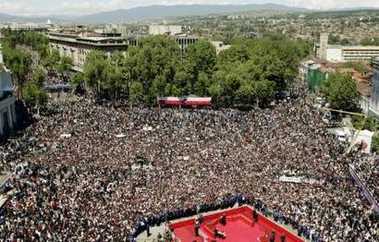
60,000 PEOPLE TURNED OUT TO HEAR THE PRESIDENT IN GEORGIA

This must be incredibly galling to the moonbats:

President Bush, before a cheering crowd of tens of thousands of people, said Tuesday that the former Soviet republic of Georgia is proving to the world that determined people can rise up and claim their freedom from oppressive rulers.

“Your courage is inspiring democratic reformers and sending a message that echoes across the world: Freedom will be the future of every nation and every people on Earth,” Bush said in speech from the Freedom Square that symbolizes the city’s democratic pursuits.

“You gathered here armed with nothing but roses and the power of your convictions and you claimed your liberty. And because you acted, Georgia is today both sovereign and free and a beacon of liberty for this region and the world.”

Why is it that the people in countries that until just a few short years ago were groaning under the yoke of communist dictatorships seem to be the only ones who truly understand what Bush is fighting for in Iraq and around the world?

Are people in France, Germany, Scandanavia and elsewhere in the increasingly apt term “old Europe” smarter than their cousins in eastern Europe? Are they more resistant to American propaganda? Are they nuts?

I think it’s pretty clear that the people in the newly freed republics of eastern and central Europe see a kindred soul when they look and listen to George Bush. What sounds like empty rhetoric when the President speaks of freedom to the cynical mountebanks and dilletantes of western Europe and our own home-grown moonbats, those words have extraordinary meaning and resonate deeply among peoples who only recently experienced only oppression and brutality.

Bush spoke to a massive crowd that filled the square — known as Lenin Square during Soviet rule — and spilled out into the roads that feed into the plaza. The buildings around the square were freshly painted for Bush’s visit, the first from a U.S. president, and hundreds of people dressed in red, white and blue stood in a human formation of the U.S. flag, with another group forming the red and white Georgian flag.

“When Georgians gathered here 16 years ago, this square had a different name,” Bush said. “Under Lenin’s steely gaze, thousands of Georgians prayed and sang and demanded their independence. The Soviet army crushed that day of protest, but they could not crush the spirit of the Georgian people.”

Georgian President Mikhail Saakashvili, who led the “Rose Revolution” in 2003 that overthrew a corrupt government, praised Bush as “a leader who has contributed as much to the cause of freedom as any man of our time. … We welcome a freedom fighter.”

Well and truly said.

It may be a large part of the Bush legacy that he be reviled as an American devil in the capitals of western Europe, a caricature of an American cowboy whose fast on the draw foreign policy and plain unvarnished speaking style grated on the ears of the sophisticates in the salons and drawing rooms of old, tired, elitist continental society.

But there will always be the Bush legacy in Georgia and other newly freed nations where he’ll be seen as freedom’s prophet, carrying the Good News of liberty and democracy to every corner of the earth.

Not a bad legacy at that.

Cross Posted at Blogger News Network

5/9/2005

BUSH: A SOLITARY VOICE FOR REMEMBRANCE

Filed under: History, WORLD POLITICS — Rick Moran @ 6:24 am

An orgy of remembrance took place all across Europe this last weekend as the continent’s increasingly passive and pacific countries celebrated the very war-like achievements of their grandfathers in tossing the regime of Adolph Hitler and all it stood for on the ash heap of history. Even France, where 2.5 million men of its armed forces never fired a shot in anger before their cowardly government surrendered thus leaving the British to face the Nazi onslaught alone, celebrated the end of World War II, confident in the knowledge that no one would bring up uncomfortable truths like their collaboration with Hitler or the myths surrounding the small minority of citizens who were actually involved in the resistance.

Where the French are concerned, some things are just better left unsaid lest Gallic huffiness spoil a good party.

Even George Bush was silent about the duplicitous French whose wartime actions as “ally” included armed resistance to the American landings in North Africa, handing tens of thousands of European Jews who had taken refuge in “unoccupied” France over to the tender mercies of the Nazi death merchants, and saddling the western world for a generation after the war with the prickly personality and insufferable haughtiness of Charles De Gaulle.

While the President may be faulted for his selective memory where the French are concerned, he should receive the thanks and admiration from all of us for being the only world leader to recall one of the immediate and proximate causes of the war; the Nazi-Soviet Pact signed a scant 2 days before the outbreak of Hitler’s unprovoked attack on Poland.

The fact that Bush spoke of this agreement in Latvia, one of the Baltic states that both Hitler and Stalin coveted is significant in that he connected the brutality of Hitler with the perfidy of Stalin and the Soviet Union in a way that’s rarely been done by an American President:

But in his speech, Mr. Bush indirectly acknowledged that the United States and Britain shared some blame for the annexation of the Baltics, noting that the 1945 Yalta agreement, in which Europe was carved up by Roosevelt, Churchill and Stalin, was in an “unjust tradition” of earlier treaties like the Munich and Molotov-Ribbentrop pacts.

“Once again, when powerful governments negotiated, the freedom of small nations was somehow expendable,” Mr. Bush said. “Yet this attempt to sacrifice freedom for the sake of stability left a continent divided and unstable. The captivity of millions in Central and Eastern Europe will be remembered as one of the greatest wrongs of history.”

And Bush recalled the spirit of defiance of the Baltic states following Stalin’s occupation for their own “protection” following the Nazi-Soviet Pact:

The Baltic states had no role in starting World War II. The battle came here because of a secret pact between dictators. And when the war came, many in this region showed their courage. After a puppet government ordered the Latvian fleet to return to port, sailors on eight freighters chose to remain at sea under the flag of free Latvia, assisting the United States Merchant Marine in carrying supplies across the Atlantic. A newspaper in the state of South Carolina described the Latvian crew this way: “They all have beards and dressed so differently… They are … exhausted, but full of fighting spirit.”

By the end of the war, six of the Latvian ships had been sunk, and more than half the sailors had been lost. Nearly all of the survivors settled in America, and became citizens we were proud to call our own. One American town renamed a street Ciltvaira — to honor a sunken ship that sailed under a free Latvian flag. My country has always been thankful for Latvia’s friendship, and Latvia will always have the friendship of America.

Curiously, this acknowledgment went unnoticed in the press who instead played up Bush’s “apology” for US inaction after Yalta to halt the spread of communism across eastern Europe.

The sad history of Batlic occupation is a direct result of Stalin’s greed and Hitler’s warped vision for Germany. Small German minorities in Lithuania, Latvia, and Estonia allowed Hitler to cast a covetous eye toward the prosperous little countries while Stalin, ever the expansionist, had similar designs to incorporate them into his growing empire. But Hitler had a strategic problem of the first magnitude. Before he could gobble up the Baltics, he had to make sure his rear was secure. That meant a final showdown with France and Britain, the only two military powers that could challenge him in the west.

The problem arose because Stalin was nominally committed to come to the aid of France if she went to war with Germany. And Hitler’s plan to invade and occupy Poland would most surely trigger a response from France, goaded on by Britain. So Hitler needed to somehow separate Stalin from the west. He was fully prepared to invade Poland regardless of anything Stalin did, but realized a two front war would be as disastrous for him as it had been for the Kaiser.

Hitler scheduled the invasion of Poland to begin on August 26, 1939. But less than 24 hours before the Nazi blitzkrieg began to roll, Hitler evidently got cold feet. He recalled some of his forward units who had already moved up to the German-Polish frontier and delayed the strike for 72 hours.

The reason was Stalin. The Soviet Union was, as usual, in horrible shape economically. And on the 25th, German Foreign Minister Johann Von Ribbentrop had begun negotiations that promised Stalin not only gigantic deliveries of raw materials like coal and copper, but also grain, fodder, and meat stuffs for his perpetually starving country. All Stalin had to do was sit on the sidelines while Hitler dealt with, in order, the Poles, the French, and the British.

Stalin, a shameless opportunist and as two American Presidents could attest, a canny and tough negotiator, realized he had Hitler over a barrel and went for the gold. How about settling all of our differences? Poland, the Baltics, and the mutual defense pact with France could all be on the table.

Thus, in one of the most cynical deals in modern history, Hitler and Stalin carved up eastern Europe between them. For the third time in 500 years, Russia and Germany partitioned Poland with Hitler getting the prize port of Danzig as well as the bulk of Polish industrial production. Stalin, whose forces invaded Poland on September 22 with the excuse of protecting ethnic Russians in “a country that no longer existed,” got western Poland’s vast agricultural holdings as well as what he thought was a 1000 mile buffer between himself and Hitler’s Wehrmacht.

In addition, Hitler recognized Stalin’s “sphere of influence” in the Baltics and Finland while Stalin promised to do nothing to to fulfill his mutual defense obligations with France. Both dictators got exactly what they wanted. And both should be held equally responsible for the carnage and slaughter that followed. The treaty of “Friendship and Non-Aggression” was signed on August 29. Hitler invaded Poland on September 1.

There are some who argue that the Nazi-Soviet Pact was Stalin’s response to the Munich Agreement signed 2 years earlier where Britain and France colluded in the partition of Czechoslovakia, leaving the Soviet dictator to believe that both western democracies wanted Stalin to be the one to bear the brunt of stopping Hitler. He was right of course. But that doesn’t lessen Stalin’s culpability one whit. The fact is there was no reason for Stalin to insist on the partition of Poland nor the occupation of the Baltic States by Soviet troops. The last was pure greed on Stalin’s part. And his country was to pay for his greed and shortsightedness with the loss of more than 20 million Russians.

There was no mention of all of this in Moscow yesterday while Putin basked in the reflected glow of dozens of world leaders watching Russian troops carrying the old Hammer and Sickle flag while modern jets screamed overhead as a reminder of more recent Soviet military achievements. Until Russia comes to terms with its part in starting World War II instead of celebrating its role in ending it, the legacy and true meaning of that conflict will never be understood and the wrong lessons will be drawn from it.

This may be what Putin is after. Russian revanchism would complicate matters immensely both for the United States and the recently freed Baltic states. As they turn to the west, the question uppermost in their minds must be will we once again become the pawns in the deadly games played by big powers?

Hopefully George Bush’s speech eased some of those concerns.

Cross Posted at Blogger News Network
5/1/2005

UNITED NATIONS COMMISSION ON BOVINE EXCREMENT

Filed under: WORLD POLITICS — Rick Moran @ 7:10 am

Zimbabwe’s dictator Robert Mugabe is probably enjoying this joke as much as anyone:

Zimbabwe, the human rights pariah accused of violence, intimidation and suppression of free speech against its people, has been re-elected to the United Nations Human Rights Commission for a three-year term over the strong protests of Australia, the US and Canada.

“How can we expect the Government of Zimbabwe to support international human rights standards at the Commission on Human Rights when it has blatantly disregarded the rights of its own people?” asked William Brencick, of the US.

Zimbabwe maintained repressive controls on political opposition and the media, and encouraged “a climate where the opposition fears for its safety”, Mr Brencick said.

President Mugabe, whose autocratic rule has been condemned around the world for its brutality, is nothing if not a wildly creative dictator. The elections last spring should be held up as an example to all would-be autocrats for the ingenious and innovative ways in which Mugabe and his thugs stole the contest:

“Thousands were turned away from the polling booths, there are serious, unexplained discrepancies between votes tallied and the official numbers later announced.

“Other abuse was rife. This included food aid being misused, ghost voters, a lack of equal access to the media, abuse of draconian security legislation and an election commission packed with Zanu-PF supporters,” he added.

He said even observers approved by Mr Mugabe had commented that at least 10% of voters were prevented from casting their vote, while independent observers put the figure closer to 30%.

Mugabe even went so far as to appear at a rally shortly after the polls closed congratulating himself on his “victory over imperialism.”

For all Mugabe’s shennanigans, the real comedy here is that the UN Human Rights Commission is slated by Kofi (”Talk to the hand. I’m not guilty”) Anan to be disbanded. The reason? Duh!

In a wide-ranging series of reforms unveiled earlier this year, Annan said he wanted to replace the rights commission with a permanent, smaller council composed of member states committed to tackle abuse throughout the world. “We have reached a point at which the commission’s declining credibility has cast a shadow on the reputation of the United Nations system as a whole,” Annan said earlier this month.

I’ll say this about the crook; he has a marvelously understated sense of irony and a keen eye for the absurd. After he’s finished at the UN - and if he’s not in jail somewhere - he may have a future as a stand-up comic or maybe a writer for “Comedy Central.”

Mark Noonan says “it’s like electing Al Capone Police Commissioner.” With past members like Cuba and Sudan, the Human Rights group may want to consider renaming itself the “UN Commission on Bovine Excrement.” That’s what they’ve been shoveling our way for years.

Cross-Posted at Blogger News Network

4/28/2005

THE TRUE NORTH STRONG AND FREE

Filed under: WORLD POLITICS — Rick Moran @ 6:27 am

I’ve always liked and admired our neighbors to the north. Leaving aside the muckety-mucks from eastern Ontario and just about anyone from Quebec, there are no more generous, gracious, and well mannered people on the planet. Taciturn and a little gruff at times (no more so than New Englanders), the same guy in the bait shop who unsmilingly sells you two dozen minnows would five minutes later give you the shirt off his back to keep you warm when, in your tenderfooted ignorance, you capsize your canoe into the most mind-numbingly frigid water imaginable.

In fact, that’s my only real beef with Canada; it’s too cold. As a kid, we took family vacations in the North Woods of Michigan so the occasional cold snap in July that necessitated the novelty of a roaring fire in the drafty old cottage’s fireplace was something I was used to. But Canada in July is different. Even when it’s warm - say around 80 degrees - there’s a whisper on the wind that speaks of coolness. It penetrates your skin all the way to your bones so that you’re never entirely comfortable without wearing a light jacket of some kind.

I think the windbreaker was invented in Canada.

In short, the Canadian people. like most people who live in democracies, are the salt of the earth. Also, like most people who live in democracies, they are in the aggregate much better humans than the people they’ve elected to represent them. It’s said that people who live in democratic societies get the kind of government they deserve. That just simply isn’t true. People don’t deserve to be lied to. They don’t deserve to be stolen from. And they don’t deserve to be treated as wayward children who need to have a bunch of bureaucratic nannies controlling every aspect of their lives. I would venture a guess that the saying about deserving a specific kind of government was invented by a liberal to explain why governments fail to live up to our modest expectations of honesty, integrity, and healthy libertarianism.

The truth of the matter is a little more prosaic; since governments are made up of imperfect human beings, we’re bound to be disappointed by them. The only thing that keeps us from going nuts is the realization we can try the whole miserable experiment again with another bunch of imperfect humans when elections roll around.

And this is what Canada will be facing in the next couple of months. It seems pretty clear that the Conservative Party is about ready to call for a no confidence vote in Parliament that, if successful, would bring about elections in late May or June:

Conservative Leader Stephen Harper said Wednesday he has made up his mind and will ask his caucus on Monday to vote in favor of a non-confidence motion against the minority Liberal government at the earliest opportunity.

“This is not the way that parliament should ever work,” Harper said in a speech in Amherstberg, Ontario. “It’s the most disgraceful thing I’ve seen in all my years on Parliament Hill.

“This not how Parliament should work and as soon as we get back I will be asking our caucus to put this government out of its misery at the earliest possible opportunity.”

Harper is referring, of course, to the Adscam scandal whose revelations have rocked not only Prime Minister Paul Martin’s Liberal Party government, but also threatened a unified Canada. Ed Morrisey explains:

One of the bitter ironies of the Canadian Adscam scandal involves the status of Quebec. Originally, the government launched the Sponsorship Program as a public-relations effort to convince Quebeckers that they are a vital part of the Canadian federation, hoping to combat the separatists that had gained enough political power to force a referendum on independence — which lost, but only narrowly, a few years ago. After seeing $250 million of Canadian tax money disappear into the pockets of Liberal Party activists and the party coffers, however, the momentum away from separatism has been reversed. Now 54% of Quebec favors separation from Canada in some form.

Harper is also referring to one of the more cynical and shameless moves I’ve ever seen a politician make; Martin’s desperation deal with the ultra-liberal NDP party on the government’s budget that incorporates many of the leftists’ legislative priorities into the budget process. It’s a shameless move on the part of both Martin and NDP leader Jack Layton because Martin has sold out his own party’s legislative agenda for the sole purpose of garnering NDP votes in any no confidence motion in Parliament. And Layton has made a deal with a corrupt government to boost his party’s electoral prospects with Canadian moonbats by giving them things near and dear to their hearts:

Layton said new areas of spending would include investments in education and training, an acceleration of the gas tax transfer to the provinces, a “significant investment” in building more affordable housing and an increase in foreign aid.

All this is new spending not included in Finance Minister Ralph Goodale’s budget.

Another sign of desperation has Martin and his ministers criss-crossing Canada in what the Canadian press has cynically dubbed “The Sorry as Hell” tour:

Critics are fuming over the Liberal government’s tax-funded cross-country travels they’re dubbing the “Sorry as Hell Tour.” Prime Minister Paul Martin, cabinet ministers and Grit MPs have been fanning out across the country, doling out goodies on a national image-boosting exercise.

Calling it a “deja vu” of last year’s “Mad as Hell Tour,” John Williamson, federal director of the Canadian Taxpayers Federation, insisted the Liberals should be footing the bill for partisan events.

Good luck with that, Mr. Williamson. Trying to shame a politician into doing the right thing is a futile exercise - especially when it comes to their political survival.

Even though the Conservatives hold a lead over Martin’s sticky fingered Liberals, it remains to be seen whether or not the Tories can win an absolute majority in Parliament that would give them the levers of government. At 99 seats, the Conservatives would have to win 54 additional seats in an election to unseat Martin. Theoretically, they could win less than that and try to create a coalition with the Bloc Quebec party who currently hold 54 seats themselves but the price for those votes may be too high. In which case, there would be a real scramble for power with some good old fashioned back room dealing that would make the survivor of such a scenario the proprietor of a pretty shaky government.

Alas, the Canadian people deserve better.

Cross-Posted at Blogger News Network

UPDATE

Angry in the Great White North has an excellent but disturbing post on something that Captain Ed touched on; the break up of the Canadian nation:

Federal money goes in large quantities to Quebec in order to entice them to stay in Confederation, to keep that single leg upright and continue to prop up the country. It’s no wonder that many want to secede. For them, it is a mixture of a desire to make their own future unfettered by concerns in other parts of the country, other parts that have given up on their original role in keeping Canada together. It is also a realization that the effort spent by the Rest of Canada on keeping Quebec would probably better be spent on their own problems and on their own future.

The Rest of Canada is coming to that realization now. Anecdotal evidence suggests that more and more people in the Rest of Canada would just skip a referendum altogether and just send Quebec on its way. With all three legs gone, the system would collapse completely. But this might not be a bad thing in the end. Any engineer will tell you that a system that is wildly unstable is dangerous. It is also expensive, requiring constant work and input of energy to remain in a quasi-stable state. If it allowed to collapsed, the components will seek the low-energy state. From there a new system can be created, hopefully in a new configuration that is highly stable.

Read the whole thing.

4/22/2005

FRANCE TO TAIWAN: SUBMIT OR PERISH

Filed under: WORLD POLITICS — Rick Moran @ 7:30 am

In what has to be one of the most astonishing betrayals of this young century, France has given a green light to mainland China to invade and conquer the tiny island nation of Taiwan:

During a state visit to China, French Premier Raffarin threw support behind a law allowing China to attack Taiwan and continued to push for a lift of the EU arms embargo.

At the outset of a three-day visit to China, French Prime Minister Jean-Pierre Raffarin said he supported Beijing’s “anti-secession” law on Taiwan, and vowed to keep pushing for an end to an EU arms embargo that could open the door for Paris to sell weapons to the Asian giant.

Raffarin also signed or finalized major business deals with Beijing valued at around $3.2 billion (2.4 billion euros).

(Hat Tip: Little Green Footballs)

The so-called “anti secession law” passed by China last month was widely considered by analysts to be an indication that the Chicoms were finally ready to get serious about solving their “Taiwain problem.”

This scenario is eerily reminiscent of the shameful betrayal of Czechoslovakia by England and France in 1938. Under another weasely Prime Minister, Edouard Daladier, the French helped Adolph Hitler solve his “Czech problem” by allowing the Nazi brute to occupy the Sudetenland in direct violation of solemn agreements signed with the Czechoslovakian state to guarantee its territorial integrity. At a conference in Munich attended by England, France, Germany, and Italy, Nazi Foreign Minister Johann Ribbentropp mercilessly browbeat, cajoled, and threatened both England and France if they didn’t allow the immedate occupation of Czech territory. (A representative of the Czech government was not allowed to attend the conference. He was forced to wait in another room as the fate of his tiny nation was decided by others.)

Captured documents after the war show the true duplicity of the French who were more concerned with mollifying any domestic critics than in living up to its obligations under its mutual defense pact with the Czechs. The resulting occupation by Hitler of the entire country of Czechoslovakia proved strategically disasterous for France as it took the tough, well-trained Czech army off the board and weakened the western alliance against Hitler when war broke out a year later.

And now, once again, the French are cynically giving the go-ahead for a very large nation to invade a much smaller one.

The reasons for this indefensible action by the Chirac government are twofold; money and more money:

At the same time, he vowed that his government would continue to push for the lifting of what he called the “anachronistic” and “discriminatory” arms embargo against China. The embargo contradicts the current “strategic partnership” between the EU and China, he added.

During his visit to Beijing on Thursday, China Eastern Airlines and Shenzhen Airlines signed a deal with the European consortium Airbus to buy a total of 10 A319/A320 planes. And China Southern completed an agreement on its purchase of five A380 super jumbos.

The deals were signed between the carriers and the European consortium’s vice-president, Philippe Delmas, who is in China accompanying Raffarin on his visit

Clearly the French are eager to resume selling arms to whoever ponies up the francs. And given the large stake the Chirac government has in the European consortium that runs the airplane manufacturer Airbus, it’s not surprising that the French want to get in on the exploding Chinese air travel market.

If the French get their way, when the United States rushes to the defense of Taiwan following a Chicom invasion, we may be fighting against a host of French weapons systems including sophisticated Mirage jet fighters and technologically advanced Exocet anti-ship missiles.

Once again, the French have proven that in their quest to find a “counterweight” to American military power, they’re willing to sacrifice just about anything - including another country - to achieve their strategic goals.

Cross Posted at Blogger News Network
UPDATE:

I see where Wizbang also resurrects the ghost of World War II, referring to another French lickspittle Marshall Petain, who led the collaborationist government during the war.

Daimnation! calls France “The most amoral democracy on earth” and believes they’re cozying up to China partly out of “pure spite.”

This is one of those “grown up countries” Kofi Anan was talking about when the Oil for Food scandal first broke.

And Blogs for Bush weighs in:

So, France is in favor of arming one of the most tyrannical regimes on Earth, and has no problem if China decides that it has to invade Taiwan to prevent the “secession” of an island outside of Chinese rule for 56 years…ok, liberals, tell us again about how we shouldn’t make the French mad because they have a greater wisdom in the world than our cowboy President…

Why is it that France brings out the best rhetoric on the conservative side of the blogosphere?

4/21/2005

THE MAKING OF THE PONTIFF 2005

Filed under: WORLD POLITICS — Rick Moran @ 5:52 am

One may think that politics and religion are two mutually exclusive activities or that religious people are somehow above the grubby, mundane maneuverings usually associated with the very earthly practice of the political arts.

At least when it comes to the College of Cardinals, nothing could be further from the truth.

The fact is, the College is made up the same kinds of people we find in leadership positions in western politics, albeit men with a great deal more humility (in most cases) and good deal less pomposity. But the fact is the heirarchy of the church has been engaged in this kind of political maneuvering for more than 1600 years, since the at least the First Council of Nicaea. In short, the Catholic church has a long (sometimes dishonorable) history of its heirarchy maneuvering for power.

It was a dirtier proposition when being in the Church heirarchy meant wealth, secular power, and status worthy of some Kings. Until the rise of secular democracies, Catholic prelates enjoyed privileges and advantages that surpassed all but the richest citizens and competition for “the red hat” was fierce. At that time, church politics was much more of a contact sport with candidates using tactics that would have made Boss Tweed or Mayor Daly proud.

That’s not the case today. The Church has accepted its diminished secular role and now seeks more of a pastoral function for its Bishops. This changed status hasn’t dimmed the fires of ambition that burns in many cardinals who seek to wear the white robes and sit in the chair of St. Peter. In the modern world where the media is the message, the jostling for power is carried out knowing that the glare of television will bring the decision making process - no matter how secret - into the light of day.

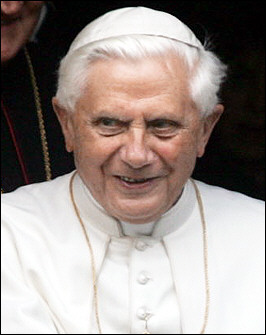
The recent conclave that elected Pope Benedict XVI is a fascinating example of the politics of perception. According to this article in the International Herald Tribune, the elevation of Cardinal Ratzinger was a result of both the future Pope’s careful lobbying as well as the conclave bowing to the inevitable:

Joseph Ratzinger of Germany became Pope Benedict XVI in rapid fashion, rushing to election by a scant four votes over less than 24 hours in conclave. How it happened began to emerge Wednesday once the cardinals who chose him left the secret gathering and were no longer bound by a gag order imposed by Ratzinger the week before it started

Ratzinger was widely believed to be a leading vote-getter going in, but was thought by some Vatican analysts and prelates to have only a modest chance of election. His age, 78, and reputation for divisiveness were blamed. Most thought he would swing his votes to a fellow conservative.

But the cardinals defied those expectations.

In picking Ratzinger, they were clearly drawn to his defense of traditional Roman Catholic doctrine in the face of what he called the “dictatorship of relativism,” or shifting winds of belief in a secular society, during the Mass that opened the conclave on Monday.

His choice also indicated that they believed shoring up the fundamentals of the faith was a main priority, despite extensive discussion about the needs of the church in Latin America and elsewhere outside Europe.

But it was also his dignified celebration of John Paul’s funeral Mass on April 8; his guiding hand in the cardinals’ daily meetings during the interregnum, or period between popes; and the preconclave Mass that helped to convince the cardinals. Ratzinger fulfilled those roles by virtue of his position as dean of the college.

Spending more than 20 years at the top of the Vatican heirarchy, the new Pope was in an excellent position to orchestrate the series of events that led to his election. In addition, prior to the death of John Paul II, it seems pretty clear that then Cardinal Ratzinger had been busy lining up conservative supporters both in the Vatican and elsewhere:

Most agreed that Ratzinger entered the conclave as the man with the most support - perhaps 30 to 50 votes out of the necessary two-thirds, or 77. During the first vote Monday night, it must have become clear that his position was strong enough to be a viable candidacy. Two ballots on Tuesday morning sealed the deal, and he was elected on the fourth.

Going into the conclave, he had active help in mustering votes from powerful cardinals of the Roman Curia in charge of major departments, including Darío Castrillón Hoyos, Alfonso López Trujillo and Julián Herranz, a member of Opus Dei. Giovanni Battista Re, Crescenzio Sepe and Angelo Sodano were also mentioned as Ratzinger backers, perhaps in the second round.

The tipping point came, Politi wrote, when two crucial Italians - Camillo Ruini, John Paul’s longtime vicar of Rome, and Angelo Scola, the patriarch of Venice who had often been mentioned as a candidate - threw their support to Cardinal Ratzinger. Scola had worked in Ratzinger’s congregation.

The prospect of a drawn-out battle most likely scared off the opposition, and their leader, Carlo Maria Martini, sent his votes to Ratzinger.

Were there any other candidates? As I speculated here the Italian contingent of Cardinals did indeed coalesce around one candidate, Cardinal Martini, but it must have become apparent by the weekend that history would pass him by:

Cardinal Martini may have had an inkling of what was ahead. On the weekend before the conclave, a priest who had seen him said he appeared to be distressed.

As in secular politics, there are winners and losers.

Pope Benedict’s political skills will be put to the test early and often as he seeks to unite a divided church. Many more moderate and liberal elements will question his call to resist the “dictatorship of relativism” because of his strict formulation of canon law. Others will seek to wrest more control from the centralized power structure of the Vatican and attempt to act with more independence. And then there are already questions about the 77 year old Pontiff’s health which could lead to a mindset among some that if they can delay implementing church directives long enough, a new Pope could be elected more to their liking.

These are indeed political calculations. And the men who make them, although guided as they believe by the holy spirit, nevertheless do not operate in a vacuum. The real world decisions they make have consequences both for the Church and for the almost billion adherents to the Catholic faith who look to their bishops for leadership and guidance in an ever more secular and changing world.

UPDATE

Jay Tea at Wizbang has some excellent thoughts on the inevitability of Benedict’s elevation:

1) Ratzinger was, for about twenty years, the closest advisor, assistant, and confidante of Pope John Paul II, to the point of some calling him John Paul’s “alter ego.”

2) John Paul II had personally elevated to Cardinal nearly every single man who was voting for his successor.

3) Even before the Conclave, nearly every observer had him pegged as the likely winner, and I don’t recall any other Cardinal even being named as a possible rival.

He also has a look at the chances that the new pope will initiate drastic changes (not likely!).

« Older PostsNewer Posts »

Powered by WordPress