Right Wing Nut House

4/20/2005

RUSSIAN REVANCHISM

Filed under: WORLD POLITICS — Rick Moran @ 5:43 pm

How soon they forget.

Forgotten are the tens of thousands of ordinary citizens taken away never to be heard from again. Forgotten are the millions - no one will ever know how many - of peasants who perished in one of the 20th century’s most dastardly deeds; the deliberate starvation of the Kulaks:

But in November of 1928 the Central Committee decided to implement forced collectivization. It was called a move against “rural capitalism”. Grain requisitioning intensified and peasants were forced to join collective farms. Anyone opposing collectivization was labeled a kulak. The policy of “liquidation of kulaks as a class,” formulated by Stalin at the end of 1929, meant executions, and deportation to concentration camps. The policy targeted the most productive elements of Russian agriculture.

Contrary to official propaganda, peasants resisted collectivization and preferred to consume or destroy everything they had before joining. Food production dropped drastically; at least 4 million died in the resulting famine (mostly in Ukraine). But Stalin succeeded; in 1936 about 90% of Soviet agriculture was collectivized. Productivity, however, was very low. The existence of famine was denied and those who talked about it were treated as counterrevolutionary elements.

Forgotten are the numerous purges of the party, the military, the arts, and all segments of society in which more millions died either as a result of execution or their being sent to the infamous gulags. Alexander Solzhenitsyn who lived the nightmare reality of a political prisoner in Joseph Stalin’s Russia had a gruesome reason for the gulag’s existence:

“Violence can only be concealed by a lie, and the lie can only be maintained by violence. Any man who has once proclaimed violence as his method is inevitably forced to take the lie as his principle.”

Now it appears that some in Russia seek to rehabilitate Stalin’s image by erecting statues in his honor. By doing so, they will dishonor the millions who fought his tyranny and paid the ultimate price for their courage:

To the dismay of many, proposals to erect new monuments to the tyrant for what apologists see as his “outstanding” war leadership have won support from figures close to President Vladimir Putin’s Kremlin.

A shiny effigy of the Communist dictator in a prominent position might even put uppity foreign powers in their place, said one senior politician.

“They never miss a chance in the West to rewrite history and diminish our country’s role in the victory over fascism, so that’s even more reason not to forget Stalin now,” said Lyubov Slizka, a parliamentary vice-speaker

The only history being rewritten in the West has consisted of writing Stalin’s part in starting World War II in the first place out of those same history books. It’s a story best told by William L. Schirer in his masterpiece “Rise and Fall of the Third Reich.”

Stalin was to say later that by dealing with Hitler, he bought the western allies time to rearm. This is the same excuse Chamberlain gave for his shameful surrender at Munich, since debunked many times over. Stalin’s real reason for the Nazi-Soviet Pact was his agreement with Hitler to basically divide Europe between them. In the secret protocols of the treaty found after the war, the Russians agreed to give Hitler a free hand in the west while Stalin gobbled up Finland and the Baltic states. As a bonus, the two dictators would partition Poland (for the third time in 400 years) with Hitler getting the eastern portion where most of the people lived. Stalin got what he thought was a 1000 mile buffer between himself and Hitler which turned out to be an illusion.

What made this deal especially odious was that Stalin had been assuring both France and Great Britain that he would support them if they felt it necessary to go to war over a German invasion of Poland. Stalin gave a private assurance along these lines to the British Ambassador to Russia on August 26, 1939.

The Nazi-Soviet Pact was signed on August 30. Hitler invaded Poland on September 1.

To erect a statue to a man whose actions cynically led to the deaths of 20 million of his own countrymen is madness. But that seems to be what’s affecting Russia these days as she marches steadily toward an authoritarian government:

Officials in Moscow have insisted that no statues of the dictator will appear in the Russian capital. But his name resurfaced last year when a Kremlin memorial plaque to “Volgograd” was replaced with one to “Stalingrad”.

That city was renamed Volgograd in 1961. Since then, veterans’ associations and the Communist Party have lobbied to have the name change revoked, citing the importance of its victory over Hitler’s armies in 1943.

But, while preferring to stay above the debate, Mr Putin has spoken against the move, saying: “I’m sure that it would give rise to suspicions that we are returning to Stalinist times.”

Putin wants to continue his stealthy assault on freedom without the political baggage of Stalin hanging around his neck. When the time comes, he may try to rehabilitate “Uncle Joe” himself as a way of stoking the fires of nationalism. Such a move would no doubt open old wounds:

The resurgence of Stalin, no matter what the context, threatens to open fresh rifts in a society still traumatised by the horrors of his rule, critics argue.

“Imagine the reaction to Hitler monuments in Germany - that’s how we regard this,” said Boris Belenkin of Memorial, a human rights group originally founded to remember Stalin’s victims. “This individual has no moral or historical right to any monuments.”

There’s no doubt that for many Russians, the image of Stalin would bring back some sense of the glory years, when the Soviet military was feared throughout Europe - so much so that the United States abandoned 150 years of isolation to permanently station troops on the continent to counter Soviet expansion.

The question is, what other memories would that image bring back? And will the Russians finally come to terms with their part in starting the largest, most destructive conflict in human history?

It would seem not to be the case if the Russian people, egged on by unscrupulous politicians, wish to rehabilitate the image of one of the great mass murderers in human history.
BUSH WEIGHS IN ON LEBANON’S FUTURE

Filed under: WORLD POLITICS — Rick Moran @ 5:29 am

In an interview with the Lebanese Broadcasting Corporation, President Bush criticized Hizbullah and went so far as to offer American “assistance” if they refused to disarm:

BEIRUT: U.S. President George W. Bush lashed out at Hizbullah on Tuesday, calling the Lebanese resistance group a “dangerous organization.” Speaking in an interview with the Lebanese Broadcasting Corporation, Bush said: “There is a reason why we’ve put Hizbullah on a terrorist list. They’ve killed Americans in the past. We will continue to work with the international community to keep them on that list and we will continue to pressure this group.”

He added: “You can’t have a free country if a group of people are like an armed militia.”

He stressed: “Hizbullah is trying to destabilize the Israeli-Palestinian peace process. It is a dangerous organization.”

Bush added that if Lebanon failed to implement the clause in UN Resolution 1559 calling for the disarmament of all militia, and if Hizbullah refused to disarm, the U.S. would be willing to offer its assistance in doing so.

The President also had a message for Bashir Assad of Syria, who still has 1500 troops and the remnants of his intelligence service embedded in Lebanon:

He said: “The United States can join with the rest of the world, like we’ve done, and say to Syria ‘Get out - not only get out with your military forces, but get out with your intelligence services, too. Get completely out of Lebanon, so Lebanon can be free and the people can be free.’”

The U.S. president was confident Syrians “know what we expect. They have to stop their support of the Baathists in Iraq, stop inciting violence in Iraq and stop the arms smuggling into Iraq.”

In a thinly veiled threat, Bush said that if Syria doesn’t implement these demands: “We are just beginning. Diplomacy is the first course of action and if not … I’m sure diplomacy will work

Meanwhile, new Prime Minister Najib Mikati is trying to form a government, taking opposition demands into account for the first time:

Mikati’s Cabinet is made up of mostly new faces, at least eight of which are close to the pro-Syrian regime, with others close to - but not direct members of - the opposition.

Speaking after a closed-door meeting with Lebanon’s two pro-Syrian leaders, President Emile Lahoud and Speaker Nabih Berri, Mikati said: “Some people may have reservations about this Cabinet.”

He added: “But I assure you that all the members of this Cabinet will not be candidates in the elections. The government will hold parliamentary elections as fast as possible and, God willing, within the constitutional period,” which ends May 31.

Most opposition groups have given cautious support to the new government, choosing to try and end the political crisis that has gripped the country since the assassination of former Prime Minister Rafiq Hariri and the subsequent street demonstrations that demanded the ouster of Syrian troops and Syrian influence from the country:

Aley MP Akram Shehayeb, an ally of opposition leader Walid Jumblatt, said the opposition will give Mikati a vote of confidence if his ministerial statement, due to be released early next week, comprises the opposition’s longstanding demands.

He listed the demands as “the dismissal of security officials and of the public prosecutor, that the elections be held on time and that the Lebanese government be extremely positive in dealing with the international probe into Premier Hariri’s murder,” and added: “Many people in this Cabinet are extremely respectable. But others are at the service of the intelligence agencies.”

And that’s the huge problem facing Lebanon; the fact that many of its experienced leaders have demonstrated dual loyalties to both Assad’s Syria and their native country. Not only its leaders, but groups like Hizbullah have been at the beck and call of Syria’s intelligence services since the occupation began.

In a conciliatory editorial, the Daily Star is asking the Lebanese people to reach out to the Syrian people and build bridges of understanding between the two countries:

The Syrian people did not choose the operatives who served in Lebanon; they were not consulted about sending these agents, nor do they participate in the decision-making of their government. They are as subject to the abuse of power by unaccountable security agencies as we were.

We must begin building bridges with the Syrian people, not just in the name of fairness or of good relations, but in the name of the truth that we are seeking. It is incumbent upon the Lebanese people and government to begin absolving the Syrian people from the blame that their security apparatus well deserves.

Any bridges built will apparently have to deal with the fact that Hizbullah is now a force to be reckoned with politically as well as militarily. Refusing to disarm while the electoral process is underway, the terrorist group has allied itself with another pro-Syrian faction, the Free Patriotic Movement (FPM):

Representatives from Hizbullah and the Free Patriotic Movement said on Tuesday Lebanon’s best option out of the country’s worst political crisis since the end of the civil war is through rational dialog leading to parliamentary elections.

Ghaleb Abu Zeinab and Ziad Abs, representing respectively Hizbullah and the Free Patriotic Movement insisted during a panel discussion at the American University of Beirut that adopting an electoral law based on larger districts with proportional representation “will lead to the second and prosperous rebirth of the country.”

According to Abs, both the FPM and the resistance are liberation organizations with political agendas.

He added: “The difference is in the choice each has made or will make in the future on whether to remain a liberation movement or become a political party willing to transform Lebanon into a habitable country.”

And the former head of the FPM (and former Prime Minister) Michel Aoun has said he will run for President if he’s nominated.

Speaking from his headquarters in exile in France, the former General in Chief of the Lebanese Armed Forces, said “I do not run away from confrontation, and if I am nominated to be president I will not refuse, but that does not mean that I will nominate myself for presidency.”

This is typical doublespeak from someone who most observers of Lebanese politics feel is one of the slipperiest fish in that country’s political ocean. At various times he’s been pro-Syrian, anti-Syrian, pro-Christian, anti-Christian, and both an ally and enemy of current President Emil Lahoud. He’s accepted support from Saddam Hussein as well as the Saudis. In short, he’s a shameless opportunist. It’s unlikely though that even his own FPM party will nominate him for the Presidency, which is nominally reserved for someone from the faction representing Christians.

What all this adds up to is that although there have been huge demonstrations in favor of an opposition that seeks to eradicate all vestiges of Syrian influence, it’s apparent that whatever government emerges from the elections next month will have an enormous task in trying to unite all of the disparate elements of Lebanese society into a strong enough coalition so as to resist the machinations of President Assad and his murderous agents who still wield influence to this day.

Cross Posted at Blogger News Network

4/19/2005

“HABEMUS PAPUM”

Filed under: General, WORLD POLITICS — Rick Moran @ 12:23 pm

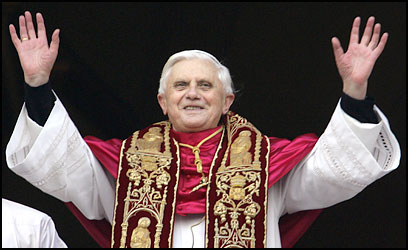
We have a Pope!

In a short conclave, the College of Cardinals has elected a new Pope! The new leader of a billion Roman Catholics around the world is Cardinal Joseph Ratzinger who has chosen the name Benedict XVI for his papacy.

For only the third time in a hundred years, the conclave took 3 days to choose the new Pontiff.

Ratzinger may have sealed his election with an impassioned homily at The Mass for the Election of the Roman Pontiff that touched on several themes that are close to the heart of the conservatives, including the very traditional view of the Savior’s suffering that some more liberal theologians would like to de-emphasize in Catholic teachings:

The mercy of Christ is not a cheap grace; it does not presume a trivialization of evil. Christ carries in his body and on his soul all the weight of evil, and all its destructive force. He burns and transforms evil through suffering, in the fire of his suffering love. The day of vindication and the year of favor meet in the paschal mystery, in Christ died and risen. This is the vindication of God: he himself, in the person of the Son, suffers for us. The more we are touched by the mercy of the Lord, the more we draw closer in solidarity with his suffering - and become willing to bear in our flesh “what is lacking in the afflictions of Christ” (Col 1, 24).

Ratzinger has proved very popular all over the world to the point where he has his own “fan club.” He served as Prefect for the Doctrine of the Faith, one of the more powerful positions in the church. His nickname of “the enforcer” among some more liberal publications indicates his unwavering support for traditional church doctrine.

He’s also been known for his charm and personality:

Personally charming, quick-witted and fluent in four languages, the Cardinal is a convincing orator. Jesuit Father Thomas Reese calls him “a delightful dialog partner”, but adds that most of the Cardinal’s fellow clergy would be too worried about the prospect of excommunication to enjoy talking to him.

Ratzinger at age 78 is one of the older Popes elected in recent memory. This reflects a feeling that perhaps John Paul II served too long (27 years) and that some of the younger candidates like Cardinal Maradiaga of Honduras (age 62) or Schoenborn of Austria (59) need a little more seasoning before their turn comes.

The election of Benedict XVI comes as a huge disappointment to the America Church. They were looking for someone more open to change on issues like birth control (not abortion), married clergy, and some matters of independence from Rome. They won’t get any help on those issues from this Pope.

Perhaps this Pope will surprise us in some respects. But as a creature of the Vatican, so to speak, it’s doubtful whether he could have gotten elected unless he gave some assurances to the curiae that things wouldn’t change very much.

4/4/2005

CHINA SERIOUS ABOUT SOLVING ITS TAIWAN “PROBLEM”

Filed under: WORLD POLITICS — Rick Moran @ 5:31 pm

A little more than two weeks ago, I wrote a post about China’s stepped-up preparations for war with Taiwan. This was immediately after the puppet legislature, the National People’s Congress, had passed an “Anti-Secession Law” that was aimed directly at Taiwan’s aspirations to remain independent of the mainland:

“If possibilities for a peaceful reunification should be completely exhausted, the state shall employ nonpeaceful means and other necessary measures to protect China’s sovereignty and territorial integrity,” Wang Zhaoguo, deputy chairman of the congress’ Standing Committee, told the nearly 3,000 members gathered in the Great Hall of the People.

Now we hear that Chinese tactics may include a so-called “Out-of-the-Blue” (OOTB) attack on the tiny island where Chinese troops already on “maneuvers” would suddenly turn and pounce on their unsuspecting neighbor.

The exact details are kept secret, but the plan involves using over 600 ballistic missiles, and several hundred warplanes, which China has stationed within range of Taiwan. Within an hour, the missiles could hit Taiwanese anti-aircraft missile launchers, radars, airbases, ships in harbor and army barracks and combat vehicles. Launch the attack in the pre-dawn hours, and you catch most of the troops in their barracks, and the ships, warplanes and tanks lined up and vulnerable. Amphibious troops would already be on their ships, for an amphibious exercises, escorted by numerous warships. As the amphibious fleet headed for Taiwan, hundreds of Chinese warplanes would return to hit whatever targets had been missed.

The tactic was part of the Soviet Union’s military planning for years; something NATO didn’t find out until the defection of Yuri Nosenko, a high ranking KGB Officer:

They prepared for it by holding large scale training exercises twice a year, near the border with West Germany. The Russian troops were all ready to practice, or go to war. An OOTB attack could be ordered by having the troops to cross the border and attack NATO forces, who would have insufficient warning to deal with the sudden offensive. NATO finally caught on to this plan, and put the troops on alert during the Russian field exercises. The OOTB was most noticeably used, and successfully at that, when the Russian trained Egyptian army surprised the Israelis and recaptured the Suez canal in 1973.

While Taiwan is doing its best to prepare for this kind of attack - dispersing units and parts of their fleet to keep them from being destroyed in the missile barrage - the real headache for the tiny island’s military planners is how to coordinate a defense with the United States.

Current American doctrine does not specifically call for US military assistance to Taiwan if she’s attacked by China. However, it’s believed that every President since Richard Nixon announced the “One China” policy (which recognizes Beijing’s claim that Taiwan is a runaway province) has privately assured Taiwanese leaders of American support if China attempts reunification by force.

To that end, we could have at least two and perhaps three Carrier Battle Groups near the straits of Taiwan in a matter of 10 days to 2 weeks. The thought being that any crisis involving the two nations would occur over an extended period of time. The three carrier groups would be able to deploy about 300 of the best high performance, all weather fighters and fighter bombers in the world; the F-14 Tomcats and F-18 Hornets. With several Aegis-class Missile Cruisers capable of not only protecting the carriers but also launching several dozen cruise missiles of their own, it was thought that this force would be able to overwhelm any Chinese attempt at conquering the island nation.

That thinking may be out the window now as China’s military could be steeling itself for battle. There’s no doubt that China’s ability to project it’s military power has improved in the last decade. The big question is would China risk it? Would it risk at the very least, certain sanctions from the west? And even if they caught the US flatfooted, would that stop us from coming to Taiwan’s assistance?

No doubt China has thought of the consequences of any invasion of Taiwan. And that’s what makes this current posturing so worrisome. They may be prepared to be isolated diplomatically for a short time until the world and the Europeans especially become inured to the idea of forced reunification.

Do they want a war with the United States? If they believe they can get away without becoming involved in a large scale conflict with the United States, they may go for it. From their point of view, if they can conquer Taiwan before we’re fully engaged they know we’ll have a decision to make: do we start a conflict that could drag the world into a war over the independence of tiny Taiwan? Do we attack China which could invite some kind of nuclear exchange?

The Chinese are an enormously patient people. You can pretty much count on them waiting until all their “stones” are set. Then and only then will they play Go…and the world will hold its breath waiting for the outcome.

4/3/2005

WHO WILL WEAR THE “SHOES OF THE FISHERMAN?”

Filed under: WORLD POLITICS — Rick Moran @ 8:03 am

Handicapping the upcoming vote for the next pope is fraught with uncertainty. Not only is the College of Cardinals a more secretive group than the CIA, NSA, and FBI put together, but since John Paul II has been in declining health for years, it appears that several leading candidates have had the opportunity to line up support among their colleagues by staffing their own bureaucratic enclaves with Cardinals who could vote for them when the time came.

My personal belief is that the next pope will not come from the pastoral wing of the college. This would seem to leave out several candidates who would make excellent Popes but have had the political misfortune of serving as Archbishop of a diocese while the bureaucrats in the Vatican were free to maneuver for power by appointing allies to key positions in one of the many secretariats.

This is a very old game played best by the Italians. And since 35% of the College is made up Italian Cardinals, chances are pretty good that the papacy will revert to form and once again the Chair of St. Peter will be occupied by an Italian Cardinal.

The big question is will the Italians be able to agree on a single candidate? As a voting bloc, they potentially hold enormous power. But unless they can coalesce around one aspirant, the chances are that a dark horse will emerge.

Here are the rules by which the College will elect a new pope as amended by John Paul II himself in 1996:

1. The voting usually begins about 3 weeks after the pontiff has been laid to rest

2. Votes are held twice in the morning and once in the afternoon

3. If no cardinal has been elected by two-thirds majority after a certain number of ballots (30), the cardinals may agree by absolute majority (half + 1) to elect the Pope by an absolute majority instead of a two-thirds majority

4. Rather than stay in uncomfortable, makeshift quarters in the Papal Palace, the Cardinals will stay in the Domus Sanctae Marthae, hotel-style accommodation in Vatican City

5. The only remaining method of electing the Pope is by scrutiny, ie, silent ballot — the methods of election by acclamation and by committee have been excluded (but were rarely used)

6. The older cardinals are still unable to enter the conclave, but they are invited to take an active role in the preparatory meetings

7. The rules on secrecy are tougher .

Something to watch for: If no candidate has been elected after the first 3 or 4 days, the chances are very good the next pope will be another non-Italian. But the Italians have been pointing toward this election for 26 years. In some ways, they see the papacy has their own private preserve. In my opinion, they’ve already settled on a candidate and will back him unless or until the College makes it known that they wish to go in another direction.

Here’s a rundown of some of the top candidates:

THE ITALIANS

Cardinal Angelo Sodano

Age: 77

Position: Secretary of State

On the plus side: He’s the right age as apparently the College may not wish to elect a pope that will serve longer than a decade or so. And he’s very powerful, occupying the second highest office in the Vatican. And he’s a conservative which almost all the Cardinals are given that 80 of the 120 were appointed by John Paul II.

Minuses: Could be too visible. Plus some of the non-Italians have been upset with his administration. His critics have called him a dry bureaucrat with little sense of humor.

Dionigi Tettamanzi

Age: 71

Position: Archbishop of Milan

On the Plus side: Although from the pastoral wing of the College, he’s held several bureaucratic posts in the Vatican. He’s also supported by the very conservative Opus Dei movement that advocates a “strict constructionist” approach to church dogma.

Minuses: He’s been away from the Vatican for years. He may be too conservative. He may be too young in that the College may be looking for a caretaker pope until one of the very young (early to mid 50’s) Cardinals get a little more seasoning.

Giovanni Battista Re

Age: 72

Position: Prefect for the Congregation of Bishops

On the Plus side: Conservative. Close ally of Pope John Paul II. He’s the dark horse among the Italians but has occupied a very powerful position for nearly 10 years. He may have the support of the curate due to his being able to appoint so many allies to positions of influence.

Minuses: Not been a priest in the pastoral sense in that he’s never run a diocese. And for as many friends as he’s made, he has just as many opponents passed over. Also, may be too conservative.

THE NON-ITALIANS:

Francis Arinze (Nigerian)

Age: 72

Position: Pontifical Council for Inter-religious Dialog

On the Plus side: If the College wishes to put a third world face on the papacy, Cardinal Arinze is the front-runner. He has been extremely visible as someone who has tried to reach out to Muslims. In this age of Terror, that could be very significant. He’s also extremely well liked personally. And the fact that he’s black could have political advantages despite his conservatism.

Minuses: Many feel the African church, which has grown from 15 million in 1960 to over 120 million today, is too young for a pope. Also, the fact that he’s black may in fact work against him because of racial prejudice in the US and Latin America. And finally, the African church has grown so much because it has incorporated some of the native animist themes into its ceremonies which does not sit well with many more conservative Cardinals.

Oscar Andres Rodriguez Maradiaga (Honduras)

Age: 62

Position: Archbishop of Tegucigalpa

On the Plus Side: The second largest voting bloc of Cardinals is from Latin America. He has chaired the Latin American Council of Bishops so would be in a position of knowing most of the Latin American electors. A strong spokesman for the poor (he’s been an outspoken advocate for debt forgiveness in the third world), he supports decentralization of church authority which has been a bone of contention for years between John Paul II and the bishops.

Minuses: Too young. Has been outspoken against the media for its coverage of the pedophile scandals. And many Latin American bishops have been tainted with the charge of supporting “liberation theology” which supported Marxist principles to redistribute wealth in the desperately poor countries of Latin America. In short, it’s probably not his turn.

Christoph Schoenborn (Austrian)

Age: 59

Position: Archbishop of Vienna

On the plus side: An intellectual with a first class mind, Schoenborn is the leading non-Italian European candidate. Given the decline of the Church in Europe, this may be a direction the College would wish to go. He’s a conservative who helped write the latest version of the universal catechism. If the college is looking for a genuine thinker, Schoenborn would probably be elected.

Minuses: Too young. May be too closely identified with the pedophile scandals as he had to deal with one involving his predecessor in his own Archdiocese. The fact that the Austrian church is the most divided in Europe between liberals and conservatives could rule him out because of the polarization factor.

Other very dark horses include Cardinal Ratzinger, a German, who has taken strong, conservative stands on matters of faith and Cardinal Claudio Hummes a Brazilian who’s made the transition from advocate of liberation theology to born again conservative. Both men have support but would appear to be too polarizing to gain anything but an absolute majority of Cardinals. if the vote goes more than 2 weeks, one of these dark horses or even a greater unknown could step in “stand in St. Peter’s place.”

Cross-Posted at Blogger News Network

4/2/2005

“THE ANGELS WELCOME YOU”

Filed under: WORLD POLITICS — Rick Moran @ 6:21 pm

The Pope is dead.

John Paul II died at 9:27 pm Rome time, succumbing at last to inevitable. “Remember thou art but mortal,” they tell him immediately after his election.

Used to be that Popes held political power greater than any king or potentate. They could command Princes to give them armies to punish or conquer. They planned. The plotted. A single word from a pope could cause a recalcitrant prince to be excommunicated; a fate worse than death for someone who lived in the middle ages.

But with the rise of the nation-state, the popes influence waned. Eventually, all they had left was their moral authority over the more than a billion Catholics all over the world.

We’ll hear much about this pope’s long pontificate. We’ll hear how stubborn he was, how anti-women he was, how resistant to modernity he was. But we won’t hear a word spoken against the man. A true mystic, he believed in the miracles and wonders of life. In a way, he was a throwback, a relic from a time when people obeyed what the pope had to say because they believed him to be infallible.

John Paul II may not have been infallible. But when he spoke, people listened. And even in this day and age, a word from him made princes tremble. So much so, that the Soviet Union tried to murder him, so much a threat to their control they believed him to be.

President Bush called him a “hero for the ages.” Well put. We’ll be living in his gigantic shadow for the rest of my years and probably longer.

3/15/2005

THE HORIZON DARKENS

Filed under: WORLD POLITICS — Rick Moran @ 7:48 pm

According to this fellow, we’ll be at war with China in a few years:

The proposed anti-secession law, read out for the first time before the ceremonial National People’s Congress, does not specify what actions might invite a Chinese attack.

“If possibilities for a peaceful reunification should be completely exhausted, the state shall employ nonpeaceful means and other necessary measures to protect China’s sovereignty and territorial integrity,” Wang Zhaoguo, deputy chairman of the congress’ Standing Committee, told the nearly 3,000 members gathered in the Great Hall of the People.

Beijing claims Taiwan, which split from China since 1949, as part of its territory. The communist mainland repeatedly has threatened to invade if Taiwan tries to make its independence permanent, and the new law does not impose any new conditions or make new threats. But it lays out for the first time legal requirements for military action.

(HT: Instapundit)

China has very quietly and without much notice made itself into an economic powerhouse. It will continue to grow as long as the communist party keeps its mitts off the economy, something that by no means is certain to happen. The reason is simple.

In order for China to keep growing, it’s going to need to reform. And the young technocrats running the communist party in China today are as fearful of political reform as the octogenarians who slaughtered thousands of innocents in Tienamien Square in 1989. Communism by its nature brooks no opposition. How can it when it sets itself up as the only authentic voice of the people? If it loses that it loses its legitimacy. Hence, the Chinese are soon to reach a crossroads where one path will necessarily lead to more freedom and the other leads to a crackdown.

Something like 800 million people are not enjoying the benefits of Chinese economic growth. That’s a pretty big cauldron to be bubbling below the surface. There has to be an outlet and the Chinese are betting on nationalistic fervor.

The author of this post, Mr. Dunn, believes that the 2008 Olympics to be held in Beijing may offer a perfect cover for Chinese aggression against Taiwan while whipping up nationalistic feeling at the same time:

The only question is when China will go. I think it will be on the eve of the 2008 Peking summer Olympics. China will have the security issue to cover mobilization and movement of military units. And everybody will assume China is using the attention as a coming out party to highlight their advances and their place in the sun. I think swallowing China under the nose of US and Japanese protection will be even better to demonstrate their power. Why else go on a crash building program for naval units?

Inside Taiwan, the move for independence may be gaining momentum. Like the American colonies of 200 years ago, Taipei is beginning to recognize that they’ve developed a culture and way of life separate and distinct from their cousins across the Straits. Any move by Beijing to annex the tiny island would meet fierce resistance. And that, of course, is where the United States comes in.

Our “one China” policy has allowed the US to walk a tightrope between satisfying our obligations to protect Taipei while not riling Beijing and forcing their hand over the indpendence issue. While we oppose independence for Taiwan, American policy is to sell the tiny country defensive weapons while at the same time giving it assurances that a Chinese military move to reunite with the mainland would be met with force. For more than 30 years, this policy worked well as Beijing was to weak to stand up to the US militarily. But now China has embarked on a crash naval building program that would seem to have one purpose: To give them the capability for amphibious landings necessary to conquer the little island nation.

Would such an invasion trigger a war? Most certainly yes. Not only our treaty obligations would require it but a successful Chinese takeover of Taiwan would massively impact the strategic situation in the entire far east. There’s no telling what an aggressive China would mean for Japan and our relations with Korea and other nations in Asia would be drastically affected. A Chinese takeover of Taiwan then must be prevented; even at the risk of war with another nuclear power.

Mr. Dunn has some suggestions:

The best way to avoid this (nuclear exchange with China) is to make Taiwan strong enough to hold the line while US and Japanese forces rush to repel a Chinese invasion. If China knows this, they may hold off in the hope that the future will change the strategic situation in their favor.

The second best way to avoid the escalation problem is to win quickly, if the Chinese delude themselves into thinking the US and/or Japan will not defend Taiwan and that the Taiwanese cannot resist. Cripple the first wave; crush the paratroopers and infantry that come across the beach; interdict the follow-up waves with naval and air power; and hit the ports of embarkation. Do all this and make sure Taiwan can throw the Chinese back into the sea so the war ends quickly

Taiwan is in trouble. If China is really seeking to resolve it’s problem with Taipei, it may prove to be the most dangerous move since Kruschev sent missiles to Cuba in 1963.

UPDATE:

Glen Anderson has updated his post with this:

Many readers are skeptical of Dunn’s analysis, but reader Jim Satterfield isn’t:

Think on this possible scenario. The Chinese consider it a very minor possibility that we would do anything to defend Taiwan. But just to cover their bases they won’t move until we represent a small enough portion of their foreign trade to where they think they can take the hit by appealing to nationalism. First they will launch a massive distraction by nationalizing every American company in China and simultaneously flooding the world currency markets with their dollar reserves while stopping the acquisition of dollars. The resultant economic crash in the U.S. will pretty much guarantee that there won’t be any military action taken except if America was to be attacked directly. Tyrants full of themselves and desirous of retaking what they view as their wayward territory won’t necessarily stop long enough to think through the long term economic repercussions even to themselves.

I believe this scenario much less likely than a Chinese reaction to a move towards independence by Taipei. Picking up the pieces after a war with the US would be easier if China didn’t burn their bridges as they would with nationalization of American businesses and initiating economic armageddon by dumping their dollars.

A Sino-American war would represent a failure of their policy. Their goal is to achieve unity with Taipei without resorting to force of arms. But, their naval buildup may signal that they’re ready to challenge US-Japanese hegemony in the far east. Having the capability to invade will also change the strategic balance.

Any way you look at it, we’re in for a some rough times with China over the next decade.

« Older Posts

Powered by WordPress